
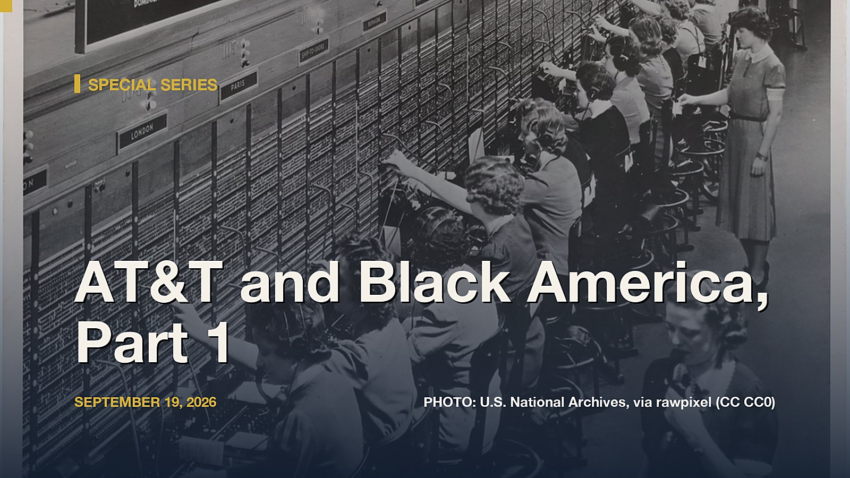
Special Series · AT&T and Black America, Part 1 of 12 · September 19, 2026
NEW SERIES
This is Part 1 of a 12-part Kemetic Minds investigation into AT&T’s history with Black America — from the Reconstruction-era world the company was born into, through the era of segregated switchboards, the largest employment-discrimination settlement in U.S. history, and the statistical disparities that remain today. Every part will carry its own primary-source documents, archival video, and full reference list. The roadmap for all 12 parts is below.
AT&T did not exist during slavery — the company’s actual lineage begins in 1877, twelve years after the Thirteenth Amendment ended it — but the world it was born into was Reconstruction’s, not a blank slate, and the earliest telephone industry drew its color line from the start. This first installment covers 1865 to the 1920s: the end of slavery, the unfinished promise of Reconstruction, Alexander Graham Bell’s invention and the founding of the Bell Telephone Company, and the earliest documented evidence of who the industry did and did not hire.
Key Facts
- The Thirteenth Amendment, ending slavery, was ratified December 6, 1865 — 12 years before the Bell Telephone Company was founded.[1]
- Alexander Graham Bell was granted U.S. Patent No. 174,465 for the telephone on March 7, 1876; the Bell Telephone Company was founded July 9, 1877.[2]
- American Telephone & Telegraph Company (AT&T) was incorporated in 1885 as Bell’s long-distance subsidiary and became the parent company of the entire Bell System in 1899.[3]
- By 1930 — more than 50 years into the company’s history — Black workers made up just 0.7% of the Bell System’s total workforce.[4]
The Story So Far: Reconstruction’s Unfinished Promise
The Thirteenth Amendment passed Congress on January 31, 1865, and was ratified by the states that December, formally ending slavery in the United States. The actual joint resolution — signed by members of the House and Senate and by President Lincoln himself — survives today in the Abraham Lincoln Papers at the Library of Congress.[1] The Freedmen’s Bureau, created that same year, was tasked with helping four million newly freed Black Americans navigate labor contracts, education, and land in the former Confederacy; its surviving records — now digitized — document both the scale of that effort and how quickly Reconstruction’s promises collided with Black Codes and, later, Jim Crow law across the South.[5]
It was into this world — twelve years after emancipation, in the middle of Reconstruction’s collapse and Jim Crow’s rise — that the telephone was born.
1876–1899: Bell’s Invention and the Birth of the Company
Alexander Graham Bell filed his patent application on February 14, 1876, and was granted U.S. Patent No. 174,465 — titled, tellingly, “Improvement in Telegraphy” — on March 7, 1876.[2] His own experimental notebook records the first successful test three days later, on March 10, 1876, with the now-famous line to his assistant: “Mr. Watson — Come here — I want to see you.” Both the notebook and the patent application survive today in the Library of Congress’s Alexander Graham Bell Family Papers, fully digitized and public.[6]
Mr. Watson — Come here — I want to see you.
— Alexander Graham Bell, experimental notebook, March 10, 1876[6]
The Bell Telephone Company was organized on July 9, 1877, by Bell and his father-in-law Gardiner Greene Hubbard.[2] American Telephone & Telegraph Company was incorporated in New York in 1885 to build and run the long-distance lines connecting Bell’s local exchanges; by 1899 it had become the parent of the entire Bell System, the corporate structure that would dominate American telephone service for the next 84 years.[3]
Who Got Hired: The Color Line From the Start
The telephone industry needed a large, cheap workforce from its earliest years — first “call boys,” then, within a decade, young unmarried women hired as switchboard operators. Historian Venus Green’s research on the Bell System’s labor history — the standard academic account of this period — documents that this hiring pool was drawn almost exclusively from white women from the industry’s founding on; Black women were not considered for operator jobs at all in this era.[7] That exclusion held for decades: Black Americans made up just 0.7% of the entire Bell System’s workforce in 1930, a figure that had not meaningfully moved by 1940 either.[4]
AT&T’s own corporate archive preserves footage from exactly this era of the industry’s growth. This 1926 recruiting and training film, held in the company’s own historical archive, documents how the Bell System recruited and trained its operator workforce in the 1920s — worth watching directly rather than taking any secondhand description of it on faith:
“Training For Service” (1926), from AT&T’s own corporate archive — a primary-source artifact of who the Bell System was recruiting in this era.
The 12-Part Roadmap
Each part below will publish with its own full set of primary sources, at least one primary-sourced video or document image, and an in-depth reference list. This table will be updated with a live link as each part goes up.
| Part | Era | Focus |
|---|---|---|
| 1 | 1865–1920s | Reconstruction, Bell’s founding, and the color line from the start (this post) |
| 2 | 1900s–1945 | Segregated switchboards and the Jim Crow-era Bell System |
| 3 | 1941–1953 | WWII labor pressure and the first Black operators |
| 4 | 1953–1960 | The NAACP takes the Bell System to court |
| 5 | 1964–1970 | Title VII, the EEOC, and federal scrutiny of AT&T |
| 6 | 1970–1973 | EEOC v. AT&T: the largest employment-discrimination settlement in U.S. history |
| 7 | 1970s–1980s | Did the consent decree actually work? Measuring the aftermath |
| 8 | 1979–1984 | The 1973 decree’s program ends; the 1984 Bell System breakup splits the company with no unified oversight carried over |
| 9 | 2000s–2022 | The modern diversity-report era: AT&T’s own voluntarily published numbers, and their limits |
| 10 | 2024 | Where representation actually stands today, verified against AT&T’s own board diversity matrix |
| 11 | Dec. 2025 | AT&T tells the FCC it is eliminating its DEI programs, two days before a $1.02 billion deal needs that agency’s approval |
| 12 | Synthesis | The full 1865–2025 record, and what it does and doesn’t establish |
What’s Disputed or Unconfirmed
The 0.7% figure comes from Bell System personnel data as reported in the secondary historical scholarship on this period; this piece has not independently reviewed the underlying 1930/1940 Bell System personnel records themselves, which would be the primary source for that specific number. Later parts in this series will cite EEOC and Census-derived workforce data directly where it exists. Separately, exactly how uniform this exclusion was across every regional Bell operating company in this earliest 1877–1900 window (as opposed to the better-documented 1900s–1940s period covered in Part 2) is less precisely documented in what’s publicly available — this post states only what the record supports for this specific era.
How to Verify This Yourself
- The Thirteenth Amendment joint resolution, signed by Lincoln and Congress: Library of Congress, Abraham Lincoln Papers.
- Bell’s original patent application and experimental notebook: Library of Congress, Alexander Graham Bell Family Papers.
- Freedmen’s Bureau records, digitized and searchable: National Archives.
- AT&T’s own corporate archive and historical film collection: AT&T Tech Channel on YouTube.
What You Can Do Right Now
- Read the primary documents linked above directly — the Library of Congress and National Archives collections are free, public, and don’t require an account.
- Follow this series; each part will build on documented facts from the last rather than repeating claims without a fresh source.
- If you have a family history with the Bell System’s workforce in any era this series covers, the Telecommunications History Group (telcomhistory.org) collects oral histories and welcomes contact.
Kemetic Minds Analysis
It matters that AT&T did not exist during slavery, and this series won’t claim otherwise. What matters just as much is that the company was not born into a neutral moment either. It was founded in 1877, the same year Reconstruction was formally abandoned when federal troops withdrew from the South. Its first workforce took shape inside a country that was actively re-legalizing racial exclusion state by state.
A 0.7% Black employment share in 1930 isn’t an accident of who happened to apply. Green’s research and the broader historical record agree: it reflects a hiring pattern set from the industry’s earliest years. The 1926 training film embedded above is worth watching for exactly this reason. It’s not a claim this newsroom is making about who appears in it — it’s a primary artifact readers can examine themselves and draw their own conclusions from.
The rest of this series follows the documented record forward: when that exclusion started to crack, who forced it to, what the law eventually required, and where the numbers actually stand today. Part 2 picks up in the decades when the pattern hardened into explicit, name-it-out-loud company policy.
References
- Library of Congress, Manuscript Division. Abraham Lincoln Papers: Joint Resolution Submitting the Thirteenth Amendment to the States, February 1, 1865 [Primary, digitized manuscript]. loc.gov. ↩
- Library of Congress. Alexander Graham Bell Family Papers: Timeline, 1870 to 1879 [Primary, archival timeline citing original patent and company records]. loc.gov. ↩
- Library of Congress. Alexander Graham Bell Family Papers: Timeline, 1880 to 1887 and 1890 to 1899 [Primary, archival timeline]. loc.gov (1880–1887) / loc.gov (1890–1899). ↩
- Green, Venus. Race on the Line: Gender, Labor, and Technology in the Bell System, 1880–1980, as summarized in JSTOR Daily’s “Hold the Line” [Secondary, academic history]. daily.jstor.org. ↩
- National Archives and Records Administration. The Freedmen’s Bureau [Primary, federal records description and access point]. archives.gov. ↩
- Library of Congress. Notebook by Alexander Graham Bell, 1875 to 1876, and Patent application from Alexander Graham Bell [Primary, digitized original documents]. loc.gov (notebook) / loc.gov (patent application). ↩
- Green, Venus. Visualizing Black Telephone Users: Technological Whiteness and Racial Exclusion in Bell System Advertising, Project MUSE [Secondary, peer-reviewed academic research]. muse.jhu.edu. ↩
Related Reading
- Library of Congress research guide: the 13th Amendment in primary documents.
- Library of Congress research guide: Reconstruction.
- The Telecommunications History Group’s company histories archive.
Investigative methodology: every date, patent number, and document cited above is drawn from a named primary archive (the Library of Congress or National Archives) or a specific, named piece of peer-reviewed historical scholarship — never estimated or invented. Where a fact rests on secondary scholarship rather than a primary record this newsroom independently reviewed, that is stated plainly in “What’s Disputed or Unconfirmed” above. The “Kemetic Minds Analysis” section is this newsroom’s own interpretation, clearly separated from the sourced reporting above it.

Kemetic Minds Editorial Desk
Verified NewsroomPrimary-sourced investigative intelligence on civil rights, voting rights, federal policy, and consumer protection. Sourced from primary legal filings, government statistics, and direct field reporting.
2 thoughts on “AT&T and Black America · Sep 19, 2026AT&T and Black America, Part 1: Reconstruction, the Bell System, and the Color Line From the Start”