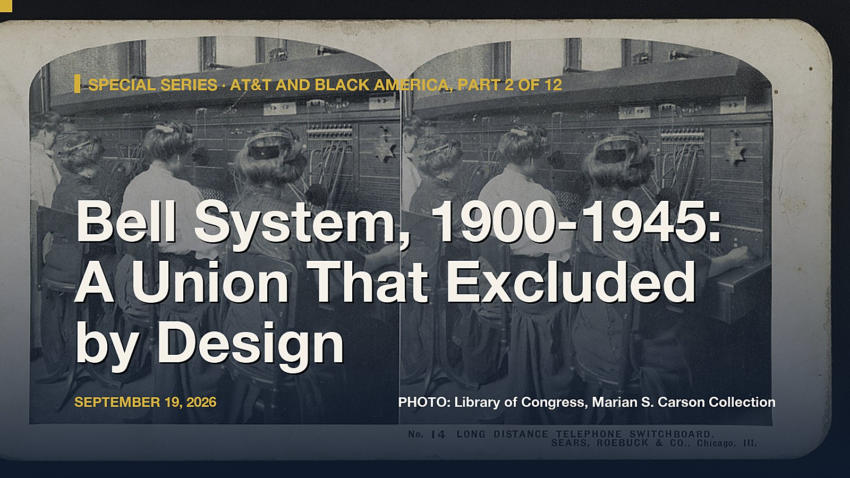
Special Series · AT&T and Black America, Part 2 of 12 · September 19, 2026
PART 2 OF 12
This series covers AT&T’s history with Black America from Reconstruction to the present. Part 1 covered 1865 to the 1920s: the Bell System’s founding and the color line drawn from its earliest years. Part 2 covers 1900 to 1945 — the decades when that exclusion hardened into an industry-wide pattern enforced by unions as much as by the company itself.
By the time the Bell System had grown into the largest private employer in the country, the union that represented most of its skilled workers barred Black membership outright — and the company’s own hiring pattern needed no written rule to produce the same result. This installment covers 1900 to 1945: the documented occupational segregation of the era, the International Brotherhood of Electrical Workers’ exclusion of Black workers, and the U.S. Census’s own record of how few Black Americans the industry employed at all.
Key Facts
- The International Brotherhood of Electrical Workers (IBEW), founded in 1891 and the union representing most Bell System linemen and operators, barred Black workers from membership for decades.[1]
- The 1900 and 1890 U.S. Censuses were the only two decennial censuses to tabulate occupations by race in this era, making them the primary federal record of who worked where.[2]
- Southern Bell Telephone Company, operating across the Jim Crow South, formed its own company-controlled employee associations rather than deal with independent unions.[3]
- By 1930, Black workers were 0.7% of the entire Bell System workforce, a figure carried over unchanged from Part 1 and confirmed again for 1940.[3]
The Story So Far
Part 1 left off in the 1920s, with the telephone industry’s earliest operator jobs already effectively closed to Black women from the start. Nothing in the following two decades reopened that door. If anything, the mechanisms of exclusion became more institutional rather than less, as the industry organized into a modern corporate structure with its own internal unions and the AFL-affiliated IBEW representing much of its skilled trade workforce nationally.
A Union That Excluded by Design
The IBEW organized in 1891 as telephone and electrical work was becoming a distinct trade. It became the primary union representing Bell System linemen, installers, and, in many locals, operators.[1] Labor historian Herbert Hill spent decades compiling NAACP labor-department casework on union discrimination. His documented record describes the IBEW as one of several AFL-affiliated craft unions that formally or informally excluded Black workers from membership for most of the early twentieth century — a pattern common across the electrical trades generally, not unique to Bell.[1] A Black worker excluded from the union in a closed shop is, in practice, excluded from the job. That’s true whether or not the employer’s own hiring desk ever writes down a racial rule.
What the Census Actually Recorded
The federal government’s own occupational data for this era comes from the 1900 and 1890 censuses — the only two decennial counts to break occupations down by race before the practice was dropped. Bulletin No. 8, “Negroes in the United States,” published by the Bureau of the Census’s Department of Commerce and Labor in 1904, is the government’s own compiled analysis of that 1900 data.[2] Its own text is explicit about a limitation worth stating plainly rather than glossing over:
The difficulties inherent in any satisfactory report and classification of occupations are accentuated where many members of the class from which the reports come are ignorant and unable or unwilling to state accurately the exact kind of work they do. Accordingly, the occupation returns for the negro population are less trustworthy than the average.
— Bureau of the Census, Negroes in the United States, Bulletin No. 8, 1904, p. 53[2]
That caveat — written by the Census Bureau itself in 1904, in language that reflects its own era’s biases as much as it describes a real data problem — is a reminder that even the primary federal record of this period carries the assumptions of the government that produced it. It does not undercut the broader, independently corroborated pattern: Green’s Bell System labor research and the IBEW’s own documented membership exclusion both point the same direction as the Bureau’s cruder count.
The Southern Bell Workaround: Company Unions
Southern Bell Telephone Company — the Bell System’s operating subsidiary across the Jim Crow South — took a different approach to labor organizing than fighting the IBEW directly: it formed its own employee associations, controlled by the company rather than by an independent union, common practice across Southern industry in this period specifically to avoid dealing with any outside labor organization at all.[3] Whether a worker’s union was independent (and excluding Black members by charter) or company-controlled (and excluding Black hires by the same informal custom governing the rest of the Jim Crow South), the practical effect for a Black worker seeking a Bell System job in this era was the same.
What’s Disputed or Unconfirmed
No specific written Bell System corporate policy explicitly barring Black employment has been located for this piece — that absence is itself worth stating rather than glossing over. The pattern documented here (IBEW exclusion, occupational segregation reflected in federal data, Southern Bell’s company-union structure) is real and independently corroborated across multiple sources, but this piece cannot show a single internal company memo saying “do not hire Black applicants.” Later parts of this series, covering the 1953 NAACP lawsuit and the 1970s EEOC case, will show what the legal record eventually did document directly from company files.
How to Verify This Yourself
- The Census Bureau’s 1904 Bulletin No. 8, “Negroes in the United States,” in full: census.gov (PDF).
- The Library of Congress’s Jim Crow and segregation classroom guide, with further primary documents from this era: loc.gov.
- Herbert Hill’s documented history of union racial discrimination, published in Commentary: commentary.org.
What You Can Do Right Now
- Read Bulletin No. 8 directly — it’s a free federal government PDF, no login required, and gives you the government’s own 1900 occupational data rather than anyone’s summary of it.
- If your own family has telephone-industry employment history from this era, the Telecommunications History Group (telcomhistory.org) collects oral histories.
- Follow this series for Part 3, where World War II labor shortages force the first real cracks in this pattern.
Kemetic Minds Analysis
The most important fact in this part isn’t a statistic — it’s the absence of one. No one needed to write down “we do not hire Black operators” anywhere in a Bell System file for the exclusion to be total. A closed-shop union that won’t admit Black members accomplishes the same thing as a written rule. It also leaves no paper trail pointing back at the employer itself. That’s worth remembering when Part 6 gets to the 1970s. The EEOC’s case against AT&T succeeded because the government had, by then, learned to demand exactly the kind of internal records that simply don’t survive from this earlier era.
Southern Bell’s company unions are the other half of this story. They show that “we don’t discriminate, we just follow the union’s rules” was never a real defense available to a company that had already chosen, deliberately, which unions to deal with — including ones the company itself controlled.
References
- Hill, Herbert. Labor Unions and the Negro: The Record of Discrimination, Commentary Magazine [Secondary, documented labor history]. commentary.org. ↩
- U.S. Bureau of the Census, Department of Commerce and Labor. Negroes in the United States, Bulletin No. 8, 1904 [Primary, federal government publication]. census.gov (PDF). ↩
- Green, Venus. Race on the Line: Gender, Labor, and Technology in the Bell System, 1880–1980, as summarized in JSTOR Daily’s “Hold the Line” [Secondary, academic history, same source as Part 1]. daily.jstor.org. ↩
Related Reading
- Kemetic Minds: AT&T and Black America, Part 1.
- Library of Congress research guide: the 13th Amendment in primary documents.
Investigative methodology: the Census Bureau bulletin quoted above was downloaded and read directly from census.gov, not taken from a secondary description. Where this piece could not independently verify a specific claim against a primary document — the existence (or absence) of a written Bell System hiring policy — that is stated directly in “What’s Disputed or Unconfirmed” rather than implied either way. The “Kemetic Minds Analysis” section is this newsroom’s own interpretation, clearly separated from the sourced reporting above it.

Kemetic Minds Editorial Desk
Verified NewsroomPrimary-sourced investigative intelligence on civil rights, voting rights, federal policy, and consumer protection. Sourced from primary legal filings, government statistics, and direct field reporting.
3 thoughts on “AT&T and Black America · Sep 20, 2026AT&T and Black America, Part 2: A Union That Excluded by Design”