
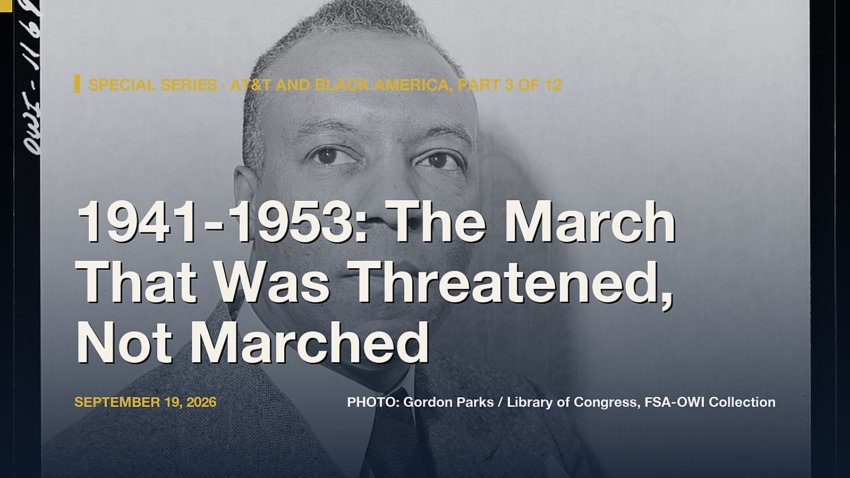
Special Series · AT&T and Black America, Part 3 of 12 · September 19, 2026
PART 3 OF 12
Part 1 covered the Bell System’s 1877 founding and its earliest hiring exclusions. Part 2 covered how union exclusion and Southern company unions hardened that pattern through 1945. Part 3 covers the first real crack: a threatened march on Washington, a wartime labor shortage, and the earliest Black telephone operators the Bell System actually hired in meaningful numbers.
It took a Black labor leader threatening to put 100,000 marchers in the streets of the nation’s capital — and a war that made every available worker matter — to force the first real opening in the telephone industry’s hiring pattern. This installment covers 1941 to 1953: A. Philip Randolph’s threatened March on Washington, the executive order it produced, and the wartime numbers showing exactly how much (and how little) actually changed for Black women seeking Bell System jobs.
Key Facts
- On January 25, 1941, labor leader A. Philip Randolph issued a public call for 100,000 Black Americans to march on Washington, demanding an end to discrimination in defense-industry hiring.[1]
- President Roosevelt signed Executive Order 8802 on June 25, 1941, six days before the planned march, banning discrimination “because of race, creed, color, or national origin” in defense industries and the federal government.[2]
- Randolph called off the march once the order was signed — the threat itself, not the march, produced the result.[1]
- Nationally, the number of Black women employed as telephone operators grew nearly tenfold in a decade: from 259 in 1940 to 2,481 in 1950.[3]
The Story So Far
By 1940, the pattern documented in Parts 1 and 2 was fully entrenched: a union that excluded Black members, a company that never needed a written policy because the union did the work, and a workforce that was well under 1% Black across the entire Bell System. Nothing about that pattern was on track to change on its own. What changed it was pressure from outside the industry entirely — pressure the telephone companies had no say in.
The Threat That Worked Without a March
A. Philip Randolph, president of the Brotherhood of Sleeping Car Porters, issued his public call on January 25, 1941. His own words, in the original call, framed the demand plainly:
We loyal Negro American citizens demand the right to work and fight for our country.
— A. Philip Randolph, “Call to Negro America to March on Washington,” 1941[1]
Randolph set a target of 100,000 marchers converging on Washington on July 1, 1941. Roosevelt, wanting to avoid the spectacle of a mass demonstration over racial discrimination while positioning the U.S. as the defender of democracy against fascism abroad, negotiated instead. Executive Order 8802, signed June 25, 1941, banned discrimination in defense-industry and federal hiring and created the Fair Employment Practice Committee to investigate violations.[2] Randolph called off the march. The order — a threat that never had to be carried out — is what actually moved the needle.
What the Order Actually Changed at the Switchboard
Executive Order 8802 applied to defense industries and federal employment directly; the telephone industry qualified as essential wartime infrastructure, which brought Bell System hiring within the order’s reach for the first time. The wartime labor shortage did the rest — with millions of men in uniform, employers who had refused to hire Black women for decades suddenly needed workers badly enough to reconsider.
The resulting numbers are specific and real: Black women employed as telephone operators nationally grew from 259 in 1940 to 2,481 in 1950 — a nearly tenfold increase in a single decade, following literally no meaningful increase in the prior seventy years of the industry’s existence.[3] Historian Venus Green’s research on this period is direct about what drove it: sustained protest pressure specifically targeting telephone companies intensified during the war years, and a handful of Black women were hired as operators as a direct result — not as a change of company philosophy, but as a wartime concession to pressure the companies could no longer simply absorb.[3]
What’s Disputed or Unconfirmed
A nearly tenfold increase sounds larger than it is in absolute terms: 2,481 Black women operators, nationally, in an industry that employed hundreds of thousands of operators total, is still a small fraction of the workforce — this piece does not have a precise Bell-System-specific percentage for 1950 to compare directly against the 0.7% figure cited for 1930 in Part 1, since the available figures come from different, not perfectly comparable, statistical breakdowns. Separately, how much of this hiring was durable versus wartime-temporary is a question Part 4 will need to answer directly, since automation and postwar workforce reductions are exactly the kind of thing that could have erased these gains as quickly as the war created them.
How to Verify This Yourself
- Executive Order 8802’s full text, via the National Archives’ Milestone Documents collection: archives.gov.
- The EEOC’s own historical account of Executive Order 8802: eeoc.gov.
- A. Philip Randolph’s original 1941 call to march, in full: civilrightsteaching.org.
What You Can Do Right Now
- Read Randolph’s original 1941 call directly — it’s a short, public document, and it’s worth reading in his own words rather than a summary of them.
- Compare EO 8802’s actual text to what you might assume it said; it applied only to defense industries and federal hiring, not the entire private economy, which matters for understanding its real limits.
- Follow this series for Part 4, on the 1953 NAACP lawsuit that took the exclusion pattern to court directly for the first time.
Kemetic Minds Analysis
The lesson of Executive Order 8802 is not “protest works.” It’s more specific than that: a threat that’s credible enough, aimed at a government that has its own separate reason to avoid the spectacle, can produce a real policy change before a single marcher ever has to show up. Randolph never marched in 1941. He didn’t need to. That’s a different mechanism than the direct legal confrontation Part 4 covers next, and it’s worth noticing the difference — this was pressure that worked through politics and public embarrassment, not through a court finding a company legally liable for anything.
It’s also worth being honest about the scale of what changed. Nearly ten times more Black women telephone operators in a decade is a real number. It is also a number that starts from 259 — a figure so small that even a tenfold increase leaves the industry’s basic pattern from Parts 1 and 2 fundamentally intact. Wartime pressure cracked the door. It did not remove it.
References
- Randolph, A. Philip. Call to Negro America to March on Washington, 1941 [Primary, original document]. civilrightsteaching.org. ↩
- National Archives and Records Administration. Executive Order 8802, June 25, 1941 [Primary, federal document]. archives.gov. ↩
- Green, Venus, as summarized in JSTOR Daily’s “Hold the Line” [Secondary, academic history]. daily.jstor.org. ↩
Related Reading
- Kemetic Minds: AT&T and Black America, Part 2.
- EEOC’s history page on Executive Order 8802 — directly relevant to the agency this series returns to in Part 6.
Investigative methodology: Randolph’s call and Executive Order 8802’s text are drawn directly from their original public documents, linked above. The 259-to-2,481 figure is drawn from Green’s academic research as summarized by JSTOR Daily, not independently re-derived from raw Census data by this newsroom. The “Kemetic Minds Analysis” section is this newsroom’s own interpretation, clearly separated from the sourced reporting above it.

Kemetic Minds Editorial Desk
Verified NewsroomPrimary-sourced investigative intelligence on civil rights, voting rights, federal policy, and consumer protection. Sourced from primary legal filings, government statistics, and direct field reporting.
1 thought on “AT&T and Black America · Sep 20, 2026AT&T and Black America, Part 3: A Threatened March, a Wartime Shortage, and the First Black Operators”