
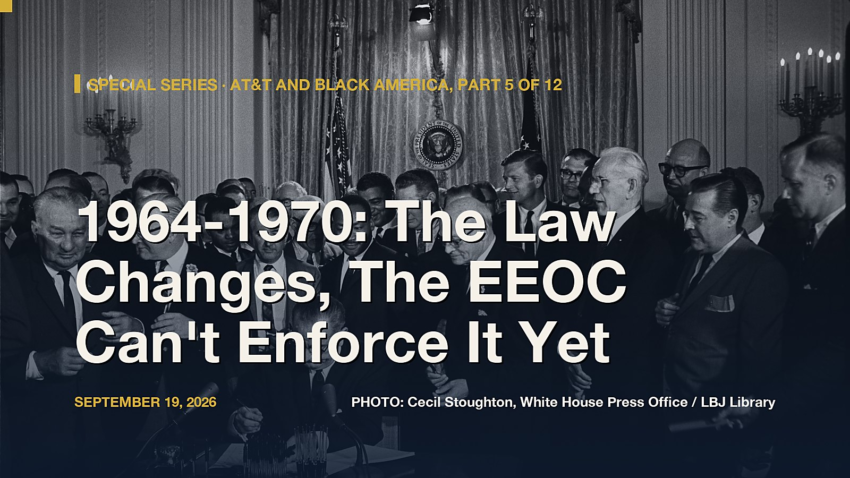
Special Series · AT&T and Black America, Part 5 of 12 · September 19, 2026
PART 5 OF 12
Part 4 covered the 1953 NAACP suit against C&P Telephone and the 21 years it actually took to change hiring at one office. Part 5 covers the federal law that, for the first time, made employment discrimination illegal nationwide rather than something to litigate case by case — and set up the agency that would eventually bring the largest case in this series.
For nearly a century, the exclusion this series has documented was legal — a company or a union could refuse to hire someone because of race and face no federal employment-discrimination law at all. That changed on July 2, 1964. This installment covers Title VII of the Civil Rights Act and the Equal Employment Opportunity Commission it created — the legal foundation for the case Part 6 covers next.
Key Facts
- President Johnson signed the Civil Rights Act of 1964 into law on July 2, 1964, the original enrolled act now held by the National Archives; Title VII made employment discrimination based on race, color, religion, sex, or national origin illegal nationwide for the first time.[1][4]
- The Equal Employment Opportunity Commission (EEOC), created by Title VII, opened its doors on July 2, 1965 — exactly one year after the law was signed.[2]
- The EEOC’s original enforcement power was limited: it could investigate and try to mediate complaints, but could not itself sue an employer directly until Congress amended the law in 1972.[2]
- By the end of the 1960s, the EEOC had already received more than 1,500 discrimination charges against AT&T alone — about 7% of the entire agency’s national caseload from a single employer.[3]
The Story So Far
Every exclusion documented in Parts 1 through 4 — the IBEW’s membership bar, Southern Bell’s company unions, C&P’s on-the-record refusal to hire Black operators — happened in a country where none of it was, by itself, a federal crime or a basis for a federal lawsuit. The 1953 NAACP suit covered in Part 4 had to be built on whatever legal theory was available at the time, without a federal employment-discrimination statute to invoke directly. Title VII changed the legal ground under every company this series covers, including AT&T, all at once.
What Title VII Actually Says
Title VII’s core prohibition is direct. The law itself states that it is unlawful for an employer:
to fail or refuse to hire or to discharge any individual, or otherwise to discriminate against any individual with respect to his compensation, terms, conditions, or privileges of employment, because of such individual’s race, color, religion, sex, or national origin.
— Title VII of the Civil Rights Act of 1964, Section 703(a)(1)[1]
That single sentence is the legal basis for every federal employment-discrimination case that follows in this series. It did not exist, in this form, before July 2, 1964.
An Agency With No Teeth Yet
The EEOC opened its doors on July 2, 1965, with a mandate to investigate and resolve discrimination complaints — but not, at first, the power to sue an employer in federal court on its own. For its first seven years, the agency could investigate a charge, attempt conciliation between the worker and employer, and refer a case to the Department of Justice, but litigation authority rested elsewhere.[2] Congress gave the EEOC direct authority to sue employers only in 1972, via the Equal Employment Opportunity Act — a change that arrived just in time to matter for the AT&T case Part 6 covers, which was already building against the company throughout the agency’s powerless early years.
Those early years were not quiet ones where AT&T was concerned. By the time the EEOC’s enforcement authority caught up with its investigative mandate, the agency had already logged more than 1,500 discrimination charges against AT&T specifically — a single company accounting for roughly 7% of the entire federal agency’s national caseload.[3] That volume of complaints, sitting in federal files years before the EEOC could sue anyone directly, is the real reason the case Part 6 covers moved as fast as it did once the agency finally had the legal tools to act.
What’s Disputed or Unconfirmed
This piece has not independently verified the exact date range over which the 1,500-plus AT&T charges accumulated — whether that figure covers 1965–1970 specifically or a slightly different window — since the EEOC’s own historical summary states the total without a precise start date. Separately, how many of those charges specifically concerned race (as opposed to the sex-discrimination claims that were an equally large part of the eventual 1973 case) is not broken out in the source available for this piece; Part 6 will need to address both threads of the case directly rather than assume the racial-discrimination angle was the whole story.
How to Verify This Yourself
- Title VII’s full text, hosted by the EEOC itself: eeoc.gov.
- The EEOC’s own account of its founding and early limits: eeoc.gov.
- The EEOC’s own decade-by-decade history, including the AT&T case’s opening moves: eeoc.gov.
What You Can Do Right Now
- Read Section 703 of Title VII directly — it’s a short, plainly written section, and it’s the actual legal text every subsequent case in this series had to satisfy.
- If you want to file an EEOC charge today, the agency’s process still starts the same way it did in 1965: a formal charge, filed within a statutory deadline, triggering an investigation.
- Follow this series for Part 6: the case those 1,500 AT&T charges built toward, and the largest employment-discrimination settlement in U.S. history at the time it was signed.
Kemetic Minds Analysis
It’s worth sitting with the fact that Title VII didn’t stop discrimination at AT&T — it just made the discrimination this series has already documented illegal for the first time. Companies don’t generally reverse decades of hiring pattern the moment a new law takes effect, and AT&T didn’t. What Title VII actually did, in AT&T’s specific case, was give more than 1,500 people a legal channel to put their individual complaints on the federal record, one at a time, years before the agency receiving those complaints could do anything about them beyond investigate and ask nicely.
That’s the real story of this part: not a law that fixed anything by itself, but a law that created the paper trail. Part 2 noted that no written Bell System policy from the early 1900s survives. By the late 1960s, AT&T’s own conduct had generated 1,500-plus federal case files instead. The absence of documentation and its presence are both, in their own way, evidence of how a company was actually behaving.
References
- U.S. Equal Employment Opportunity Commission. Title VII of the Civil Rights Act of 1964 [Primary, federal statute text]. eeoc.gov. ↩
- U.S. Equal Employment Opportunity Commission. EEOC History: The Law [Primary, agency’s own historical account]. eeoc.gov. ↩
- U.S. Equal Employment Opportunity Commission. EEOC History: 1970–1979 [Primary, agency’s own historical account]. eeoc.gov. ↩
- National Archives and Records Administration. Civil Rights Act, July 2, 1964, Milestone Documents, General Records of the United States Government, Record Group 11 [Primary, original enrolled act]. archives.gov. ↩
Related Reading
- Kemetic Minds: AT&T and Black America, Part 4.
- EEOC: “Title VII… Requiring Discrimination-Free Workplaces for 60 Years”.
Investigative methodology: Title VII’s text and the EEOC’s own historical timeline are drawn directly from the agency’s official pages, linked above. Where this piece could not confirm a precise figure’s exact scope (the AT&T charge count’s date range), that limit is stated directly in “What’s Disputed or Unconfirmed” rather than presented as more precise than the source supports. The “Kemetic Minds Analysis” section is this newsroom’s own interpretation, clearly separated from the sourced reporting above it.

Kemetic Minds Editorial Desk
Verified NewsroomPrimary-sourced investigative intelligence on civil rights, voting rights, federal policy, and consumer protection. Sourced from primary legal filings, government statistics, and direct field reporting.