
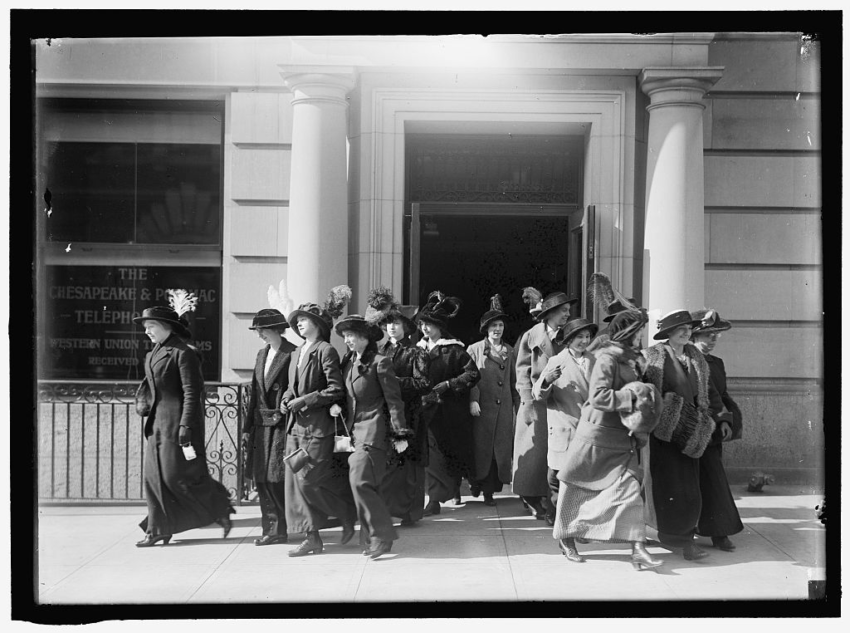
Featured photograph: Chesapeake & Potomac Telephone Company workers, 1914. Archival company photograph; it predates the radio interview discussed in this article. Photo: Harris & Ewing / Library of Congress, LC-DIG-hec-03761. Public domain. Source and image details.
Special Series · AT&T and Black America, Part 4 of 12 · September 19, 2026
PART 4 OF 12
Parts 1–3 covered 1865 through 1953: the Bell System’s founding, decades of union-enforced exclusion, and the wartime cracks that opened a small number of operator jobs to Black women. Part 4 covers the moment a Bell subsidiary’s own official put the company’s reasoning on the record — and the two decades it then took for that specific job to actually open.
A Chesapeake & Potomac Telephone Company official told a Washington, D.C. radio audience, on the record, that the company would not hire Black operators until the city’s schools were integrated — and it would take, in his own estimate, two or three more generations. The NAACP sued that same year. The specific job the lawsuit was about did not actually open in the office where it mattered for another 21 years.
Key Facts
- Around 1952, Dr. Tomlinson D. Todd interviewed C&P Telephone officials on his Washington radio program “One America” about the company’s refusal to hire Black operators.[1]
- A C&P official told Todd the company “would never hire colored operators…until other things in Washington changed such as the integration of the school system,” estimating the change would take two to three generations.[1]
- The NAACP filed suit against C&P Telephone on September 14, 1953, over the company’s refusal to hire Black operators.[2]
- Operator positions at C&P’s Govans, Maryland office remained segregated until Hermie Graham was hired there in 1974 — 21 years after the lawsuit was filed.[2]
The Story So Far
By the early 1950s, C&P Telephone — the Bell System’s operating company for Washington, D.C., Maryland, and Virginia — was, by contemporary accounts, thoroughly typical of Jim Crow-era employment in the capital. Black workers were hired for janitorial work, food service, and window washing. Elevator operator was, by one account from a person whose mother worked there, the highest position actually open to a Black employee. Black and white employees did not eat together in any of the company’s eight cafeterias.[2] This is the environment the NAACP’s 1953 lawsuit was filed into. It was not a company that discriminated quietly. It was one whose own officials would explain the policy out loud, on the radio, when asked.
The Quote on the Record
Todd’s radio program had already made a name for uncovering Washington’s “lost laws” — 1870s-era anti-discrimination statutes that had simply fallen out of enforcement. When he turned his questions to C&P Telephone’s hiring practices, a company official answered directly rather than deflecting, in a quote the Washington Afro-American reported at the time:
The telephone company would never hire colored operators…until other things in Washington changed such as the integration of the school system.
— C&P Telephone official, quoted in the Washington Afro-American, reporting on Dr. Tomlinson D. Todd’s radio interview[1]
The same official added that real change would require a new generation raised in integrated schools — his own estimate was two to three generations, a timeline stretching the company’s actual hiring policy decades into the future by design.[1] This is the closest thing in this entire series, so far, to the “written policy” that Part 2 noted couldn’t be located for the earlier era: not a memo, but an on-the-record admission from a company official stating the exclusion plainly, as settled policy, to a radio audience.
The Suit, and What It Actually Took
The NAACP filed suit against C&P Telephone on September 14, 1953.[2] The Library of Congress holds the NAACP’s own institutional records from this period — the Legal Defense and Educational Fund Records, spanning 1915 to 1968 — as part of its manuscript collection, a primary archival record of exactly this kind of casework, though this piece has not located a specific folder within that collection indexed to the C&P Telephone case by name.[3]
The suit did not produce a quick or clean victory. Operator jobs at C&P’s Govans, Maryland office specifically remained segregated for another 21 years, until Hermie Graham was hired there in 1974.[2] That gap — between a lawsuit filed in 1953 and an actual hire in 1974 — is worth sitting with rather than smoothing over: a legal challenge and a court filing are not the same thing as a company actually changing who it hires, and this series will not claim otherwise just because a lawsuit exists in the historical record.
What’s Disputed or Unconfirmed
The exact date of Todd’s radio interview is reported as “around 1952” in the sources available for this piece. That’s not a confirmed specific date, which is worth flagging rather than presenting as more precise than it is. Separately, this piece has not located the specific court filing or docket for the 1953 NAACP suit itself, as opposed to contemporary press coverage of it. So the suit’s own legal claims, and whether it resulted in any ruling before the 1974 hire, are not independently confirmed here. Whether the Govans office’s 21-year gap was typical of C&P’s other offices, or unusually long, is also not established by what’s available for this piece.
How to Verify This Yourself
- The Library of Congress’s NAACP Legal Defense and Educational Fund Records collection overview, 1915–1968: loc.gov.
- The Library of Congress’s NAACP exhibition, “The Civil Rights Era”: loc.gov.
- Washington Area Spark’s original research and sourcing on this case, including the contemporary news clipping: washingtonareaspark.com.
What You Can Do Right Now
- If your family has any history with C&P Telephone, Southern Bell, or another Bell operating company in this era, the Library of Congress’s NAACP collection and the Telecommunications History Group both actively collect this kind of record.
- Notice, when reading any civil-rights-era company history, whether a source tells you a lawsuit was filed or whether it tells you what actually changed afterward — they are frequently not the same fact.
- Follow this series for Part 5, when federal civil rights law finally makes this kind of exclusion illegal nationwide, not just contestable case by case.
Kemetic Minds Analysis
The C&P official’s quote is the most valuable primary evidence in this series so far, precisely because it says the quiet part out loud. It ties hiring policy explicitly to the pace of school integration, with a generational timeline attached on purpose. That’s not a company reacting to circumstances beyond its control. It’s a company stating its own theory of how long it intended the exclusion to last — and getting remarkably close to right. Twenty-one years from lawsuit to hire is not quite “two or three generations.” But it’s also not the swift correction a legal filing might suggest to a reader who only sees the word “sued” and assumes the story ends there.
That gap is the actual throughline connecting this part to the rest of the series. Part 6 covers the 1973 EEOC consent decree specifically because, by the 1970s, civil rights lawyers and federal regulators had learned that a lawsuit alone doesn’t change a company’s hiring — a decree with deadlines, quotas, and continuing federal oversight does. The Govans office is a preview of exactly why that harder tool became necessary.
References
- Washington Afro-American, reporting on Dr. Tomlinson D. Todd’s “One America” radio interview, c. 1952, as documented by Washington Area Spark [Secondary, contemporary press account]. washingtonareaspark.com. ↩
- Washington Area Spark. Suit against C&P cites lack of black operators: 1953, and related research on C&P Telephone employment discrimination [Secondary, historical research with contemporary sourcing]. washingtonareaspark.com. ↩
- Library of Congress, Manuscript Division. NAACP Legal Defense and Educational Fund Records, 1915–1968, collection overview [Primary, archival collection]. loc.gov. ↩
Related Reading
- Kemetic Minds: AT&T and Black America, Part 3.
- Library of Congress: “The Civil Rights Era,” from its NAACP exhibition.
Investigative methodology: the direct quote from the C&P official is drawn from contemporary press reporting (the Washington Afro-American) as preserved and documented by Washington Area Spark’s historical research, not independently located in the original newspaper by this newsroom — that distinction is stated here rather than implied away. The Library of Congress citation above links to the NAACP archive’s own collection overview, not a specific folder: an earlier draft cited a specific item ID that turned out, per the archive’s own catalog metadata, to be unrelated case material, not the C&P Telephone case. That mismatch was caught and corrected before publication. The “Kemetic Minds Analysis” section is this newsroom’s own interpretation, separated from the sourced reporting above it.

Kemetic Minds Editorial Desk
Verified NewsroomPrimary-sourced investigative intelligence on civil rights, voting rights, federal policy, and consumer protection. Sourced from primary legal filings, government statistics, and direct field reporting.
1 thought on “AT&T and Black America · Sep 21, 2026AT&T and Black America, Part 4: A Radio Confession, and a 21-Year Wait”