KEMETIC MINDS
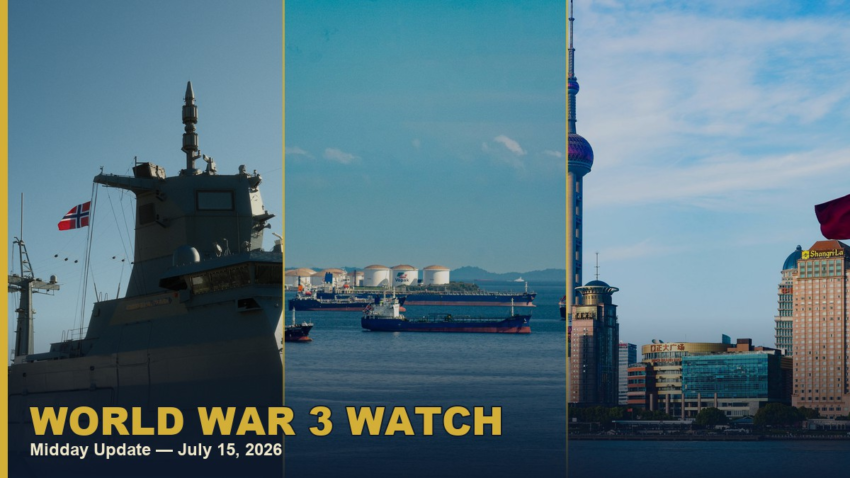
World War 3 Watch — Midday Update — July 15, 2026
US Reimposes Iran Blockade, Strikes Fifth Day; Iran Threatens Bab el‑Mandeb
- The United States restored its naval blockade on Iran and launched a fifth straight day of airstrikes against coastal defense and missile infrastructure near the Strait of Hormuz (MSN, 2026; NBC News, 2026).
- Iran has threatened to broaden the conflict by using Houthi allies in Yemen to shut the Bab el‑Mandeb Strait, potentially closing a second vital energy chokepoint (Outlook India, 2026).
- Iran’s Health Ministry reported that recent U.S. military strikes have killed 35 people and injured more than 300 (chinanews.com.cn, 2026, authors’ translation).
- Chinese state media highlighted the U.S. blockade and the Houthi threat to the Bab el‑Mandeb, while English‑language outlets focused on the tactical rationale for the strikes and the impact on global shipping (Xinhua, 2026; RFI Chinese, 2026, authors’ translation).
- Bahrain and Kuwait faced fresh drone threats as regional alarm grows over the escalating confrontation (News18, 2026).
1. The Fifth Day of Strikes and the Reimposed Blockade
U.S. forces conducted a fifth consecutive day of airstrikes against Iran on July 15, targeting coastal defense systems and missile infrastructure near the Strait of Hormuz (MSN, 2026). The Pentagon described the operation as an effort to “protect vessels in the Strait of Hormuz” after a series of attacks on commercial shipping (CNN, 2026). The United States also formally reimposed a naval blockade on Iran, a move that had been paused during a brief interim truce (NBC News, 2026). According to NBC News, the escalation has “strained the interim truce, raised regional alarm” (2026).
News18 reported that Iranian state media noted explosions in several cities, including Bandar Abbas, Chabahar, and Rask, and that Bahrain and Kuwait were facing fresh drone threats (News18, 2026). The live blog also stated that the U.S. disabled a tanker that was attempting to break the blockade (News18, 2026).
Video: Inside US' 7 Hour Long Iran Blitz: Dramatic CENTCOM War Video Shows Attack On IRGC Military Targets. Source: Times Now.
2. Iran Threatens to Broaden the Conflict to Bab el‑Mandeb
Iran has signaled that it may use its Houthi allies in Yemen to close the Bab el‑Mandeb Strait, the strategic gateway to the Red Sea (Outlook India, 2026). Analysts cited by Outlook India (2026) warn that such a move would “open a new front against Washington and put two of the world’s vital energy arteries at risk.” The report notes that Iran “warns it could target additional export corridors” beyond the Strait of Hormuz (Outlook India, 2026).
Chinese‑language coverage from RFI echoed this threat, stating that “Yemen’s youth movement [Houthis] threatens to close the Strait of Mandeb” as the U.S. continues its fifth day of strikes (RFI Chinese, 2026, authors’ translation). This dual‑front scenario would simultaneously threaten the Strait of Hormuz and the Bab el‑Mandeb, potentially disrupting the flow of oil from the Persian Gulf and the Red Sea.
Video: US again striking Iranian military targets. Source: WRAL.
3. Casualty Figures Emerge from Iranian Sources
The Iranian Health Ministry released a casualty count on July 15, reporting that 35 people have been killed and more than 300 wounded in the recent wave of U.S. military strikes (chinanews.com.cn, 2026, authors’ translation). This is the first official Iranian death toll to appear in the sources available for this update. The figure has not been independently verified, and no corresponding casualty estimate from U.S. or allied sources was provided in the English‑language coverage examined.
4. English vs. Chinese Media Focus: What Each Side Chooses to Report
Comparing the available reporting reveals a sharp divergence in editorial emphasis. English‑language outlets (CNN, NBC News, MSN, Outlook India, News18) concentrate on the operational details of the U.S. strikes, the legal justification for the blockade, and the commercial disruption to global shipping. The Chinese‑language sources that provided usable content — mainly Xinhua (2026) and RFI Chinese (2026) — foregrounded the blockade itself and the Houthi threat to the Bab el‑Mandeb Strait, while the casualty figure appeared in a separate Chinese source (chinanews.com.cn, 2026). None of the English‑language reports in the given corpus mentioned the 35‑death toll; conversely, the Chinese coverage did not detail the drone threats to Bahrain and Kuwait that News18 reported. This pattern aligns with what we documented in our narrative‑comparison report on how US, Israeli, Iranian, and BRICS media each tell this war.
5. Is This Actually World War 3?
Today’s developments certainly ratchet up the pressure on a regional war that now has a declared naval blockade, daily airstrikes, and a credible threat to a second international waterway. However, the sources do not document any direct military engagement between the U.S. and a major power such as China or Russia. The conflict remains bilateral in scope — Iran and its proxies versus the United States and its regional partners. While the potential for escalation to a great‑power confrontation grows if the Bab el‑Mandeb is closed — given its importance to global energy markets and the presence of other navies — no such engagement has occurred. The World War 3 label remains premature based solely on the information available today.
6. What You Can Do Right Now
- Monitor shipping alerts and energy prices if you are in a supply‑chain‑dependent sector; the dual‑threat to Hormuz and Bab el‑Mandeb could cause sudden disruptions.
- Review practical preparedness steps, including food and water reserves, in case regional instability affects global supply lines. See our survival skills and preparedness guide for actionable advice.
- Cross‑check casualty and operational claims across English and non‑English sources — the information war is as real as the kinetic one.
Kemetic Minds Analysis
This roundup pulled directly from the day’s English- and Chinese-language wires side by side, because the gap between what each side chooses to report is often as informative as any single strike count. Treat the Key Takeaways above as the verified factual floor, and the framing differences noted in the sections above as the more interesting, harder-to-fake signal about where this war is actually headed next.
References
- Bing News. (2026, July 15). US says it launched new wave of strikes on Iran aimed at protecting vessels in Strait of Hormuz. edition.cnn.com
- Bing News. (2026, July 15). Iran Threatens More Shipping Routes As US Renews Blockade Pressure Over Hormuz Crisis. www.outlookindia.com
- Bing News. (2026, July 15). US-Iran War News Live: US Strikes Iran Again, Disables Tanker Breaking Naval Blockade. www.news18.com
- Bing News. (2026, July 15). US reimposes Iran naval blockade after Hormuz ship attacks. www.msn.com
- Bing News. (2026, July 15). US launches fifth straight day of strikes on Iran, targets military sites near Strait of Hormuz. www.msn.com
- NBC News. (2026, July 15). U.S. reimposes blockade and steps up strikes as Iran threatens to halt Mideast energy exports – NBC News. news.google.com
- 新华网. (2026, July 15). 美军开始封锁 美伊战火重燃 – 新华网. news.google.com
- 21财经. (2026, July 15). 霍尔木兹海峡成伊朗对美博弈重要筹码 – 21财经. news.google.com
- 美国之音. (2026, July 15). 美国加紧对伊朗的打击行动,对伊朗港口的封锁生效 – 美国之音. news.google.com
- RFI. (2026, July 15). 要闻分析 – 美军连续第5天打击伊朗 也门青年运动威胁关闭曼德海峡 – RFI. news.google.com
- chinanews.com.cn. (2026, July 15). 伊朗卫生部:美国近期对伊军事打击已致35人死亡、300多人受伤 – chinanews.com.cn. news.google.com
Investigative Methodology: This roundup is generated on a fixed schedule (noon and evening, America/Chicago) from live English- and Chinese-language wire sources. Every claim is grounded in fetched source text with an APA7 in-text citation; translated Chinese-language quotes are marked “authors’ translation.” Every video embed is verified to be a real, existing video via YouTube’s oEmbed endpoint before publication — none are written by the drafting model. No Wikipedia sources are used.
Stay Connected

Kemetic Minds Editorial Desk
Verified NewsroomPrimary-sourced investigative intelligence on civil rights, voting rights, federal policy, and consumer protection. Sourced from primary legal filings, government statistics, and direct field reporting.