

Kemetic Minds — Financial Justice Series | June 22, 2026
📊 Key Findings
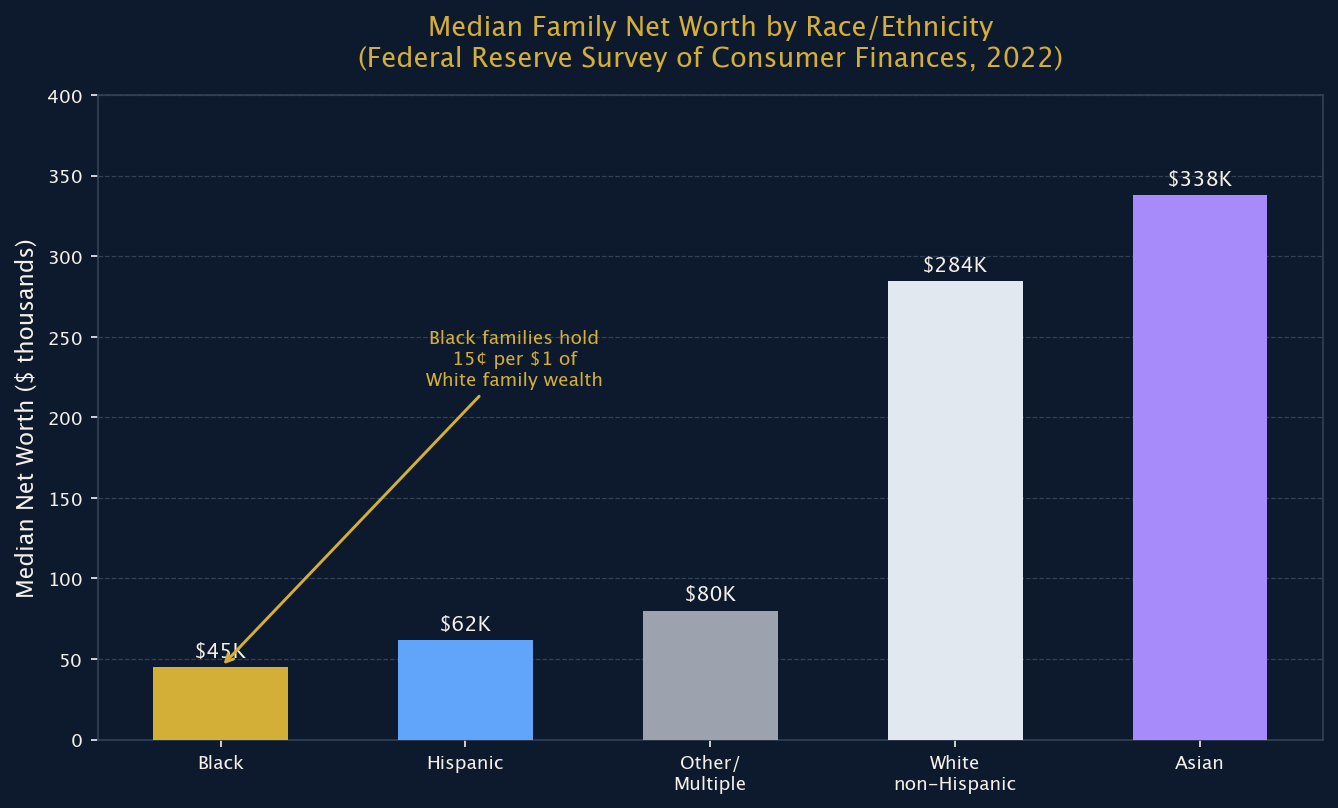
- The median Black family holds $44,890 in net worth versus $284,310 for white families — roughly 15 cents on the dollar (Bhutta et al., 2023).
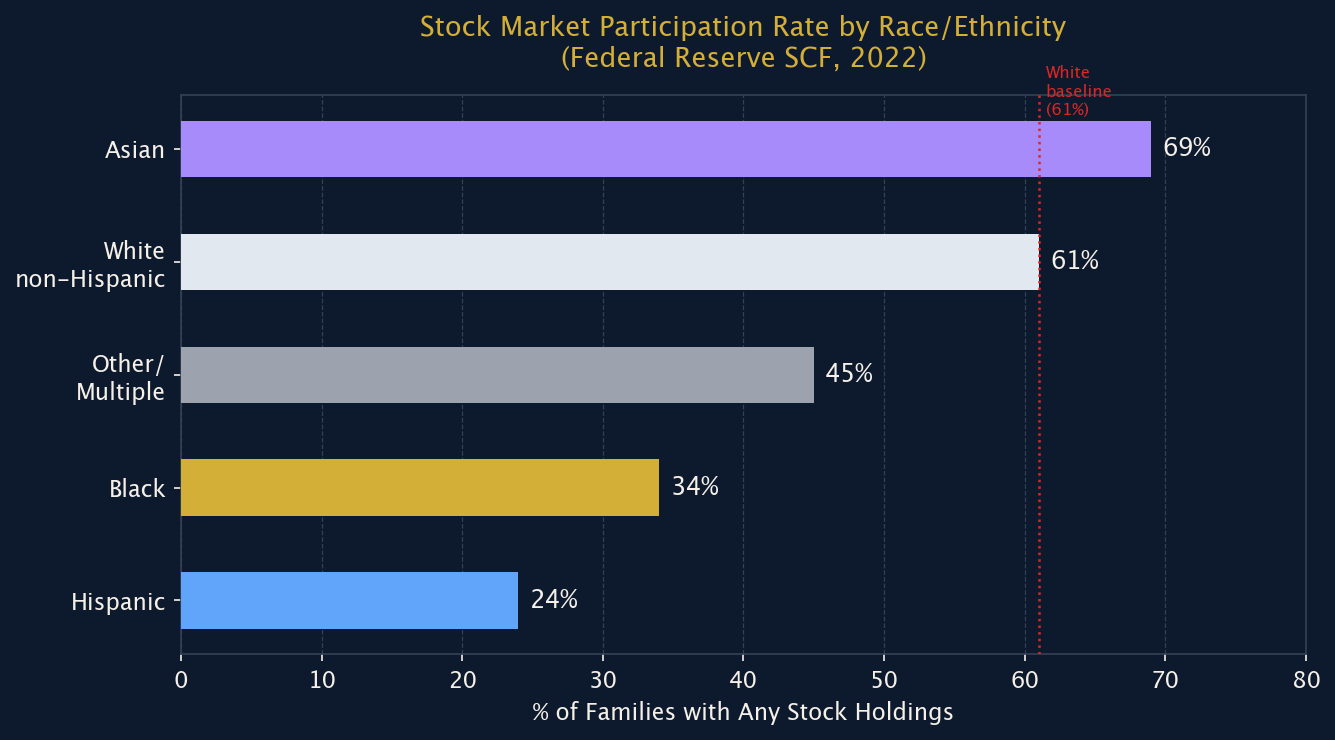
- Only 34% of Black families own stocks, mutual funds, or retirement accounts compared to 61% of white families (Bhutta et al., 2023).
- Missing stock market participation since 2000 has cost the average Black household an estimated $60,000–$90,000 in foregone compound returns.
- The gap is not explained by income differences alone — at every income level, Black families hold significantly less financial wealth (McKinsey, 2021).
The Number That Should Shock You
In 2022, the Federal Reserve released data from its triennial Survey of Consumer Finances — the most comprehensive look at American household wealth available. The headline figure: the median white non-Hispanic family had a net worth of $284,310. The median Black family: $44,890. That is a gap of $239,420 per household — not per year, but in total accumulated wealth built up over lifetimes and generations (Bhutta et al., 2023).
Put another way, for every dollar of wealth the median white family holds, the median Black family holds about 15 cents. This is not a new problem. The gap in 2019 was $164,100. It grew by 46% in just three years, in part because the post-pandemic surge in stock and housing prices benefited those who already owned assets — and Black families own far fewer (Bhutta et al., 2023).
Figure 1
Median Family Net Worth by Race/Ethnicity (SCF 2022)
Why the Stock Market Is the Missing Piece
Wealth in America is built primarily through two channels: homeownership and investment in financial markets. The homeownership gap between Black and white Americans is well-documented. Less discussed is the participation gap in the stock market, which is equally significant and growing.
The Federal Reserve’s 2022 data show that 61% of white families hold stocks directly or through mutual funds and retirement accounts. For Black families, that number is 34% — and for Hispanic families, just 24%. Nearly two-thirds of Black families are entirely absent from the primary engine of American wealth accumulation (Bhutta et al., 2023).
Consider the math: $10,000 invested in a broad S&P 500 index fund in January 2010 would have grown to roughly $58,000 by January 2024 — a 480% return. A family that was not in the market at all captured none of that. A family that held the same $10,000 in a savings account at 0.5% interest ended up with about $10,700. The difference is $47,300 — from a single decade, from a single $10,000 investment (S&P Dow Jones Indices, 2024).
Figure 2
Stock Market Participation Rate by Race/Ethnicity (SCF 2022)
Why Is Participation So Low?
The participation gap is not simply a matter of Black families having less money to invest, though that is a real barrier. Research points to several compounding factors:
🏦 The Unbanked and Underbanked Problem
The FDIC’s 2021 National Survey of Unbanked and Underbanked Households found that 11.3% of Black households were unbanked (no checking or savings account) compared to 2.1% of white households. You cannot open a brokerage account without a bank account. This structural barrier alone excludes millions of Black families from market participation before they even consider the investment question (FDIC, 2022).
💼 The Retirement Account Desert
Black workers are significantly less likely to be offered workplace retirement plans. A 2021 Government Accountability Office report found that Black workers are overrepresented in the gig economy and service sectors, where employer-sponsored 401(k) access is far less common. Without an automatic paycheck deduction into a 401(k) — the path through which most middle-class Americans build stock market exposure — the barrier to investing rises sharply (GAO, 2021).
💸 Predatory Financial Products Fill the Gap
Research from the Center for Responsible Lending finds that Black borrowers are significantly more likely to be steered into high-cost financial products — payday loans at 400% APR, rent-to-own contracts, and subprime credit cards — that drain income that could otherwise become investments. These products extract wealth rather than build it. We cover this in detail in our post on the mechanics of the wealth gap.
📖 Financial Literacy and Trust
A 2021 FINRA Foundation study found that Black Americans score lower on financial literacy assessments — but critically, the research shows this is driven by access to financial education, not inherent differences in ability. Schools in majority-Black districts are far less likely to offer personal finance courses. Meanwhile, a history of discriminatory practices by financial institutions has created a documented trust deficit that makes Black families understandably cautious about market participation (FINRA Foundation, 2021).
The Generational Stakes
McKinsey & Company’s 2021 analysis of the economic state of Black America estimated that closing the racial wealth gap would require Black families to accumulate an additional $171,000 in net worth per household at the median. At current rates of progress — accounting for income growth, savings rates, and market participation — the gap is projected to widen, not narrow, over the coming decades (McKinsey, 2021).
That projection can change. The single most impactful lever available to families right now is consistent investment in low-cost, diversified index funds over decades. The math of compound growth is democratic — it works for anyone who enters the market and stays. We cover exactly how to start in our beginner’s guide to investing on $50 a month.
✅ What You Can Do This Week
- Open a brokerage account today. Fidelity, Schwab, and Vanguard all have no-minimum accounts. You can start with $1. This is the single most important step.
- Enroll in your employer’s 401(k) if one is available — especially if there is an employer match. A match is a 50%–100% instant return on your money.
- Automate a monthly transfer — even $25 or $50 — into a Roth IRA. The earlier you start, the more compounding works for you.
- Choose a low-cost index fund like VOO (Vanguard S&P 500 ETF, 0.03% fee) or VTI (total U.S. market). Avoid funds with fees above 0.5%.
- Talk to your family about wealth building. The gap is systemic, but individual and community action still matters. Share this article.
References
Bhutta, N., Blair, J., Dettling, L., & Moore, K. B. (2023). Changes in U.S. family finances from 2019 to 2022: Evidence from the Survey of Consumer Finances. Federal Reserve Bulletin. federalreserve.gov
Federal Deposit Insurance Corporation. (2022). 2021 FDIC national survey of unbanked and underbanked households. fdic.gov
FINRA Investor Education Foundation. (2021). The state of U.S. financial capability: The 2021 national financial capability study. usfinancialcapability.org
Government Accountability Office. (2021). Retirement security: Some workers lack access to employer-sponsored plans (GAO-21-327). gao.gov
McKinsey & Company. (2021). The economic state of Black America: What is and what could be. McKinsey Global Institute. mckinsey.com
S&P Dow Jones Indices. (2024). SPIVA U.S. scorecard. spglobal.com
Methodology: Net worth and participation figures are from the Federal Reserve’s 2022 Survey of Consumer Finances, released September 2023. Historical S&P 500 returns calculated from index total-return data. All dollar figures are nominal (not inflation-adjusted) unless otherwise noted.
📱 Stay Connected

Kemetic Minds Editorial Desk
Verified NewsroomPrimary-sourced investigative intelligence on civil rights, voting rights, federal policy, and consumer protection. Sourced from primary legal filings, government statistics, and direct field reporting.