
KEMETIC MINDS
Civil Rights & Investigations | August 1, 2026
In October 2022, Rasheem Carter told his mother and Mississippi police, twice, that white men in trucks were chasing him. Weeks later his dismembered remains turned up in a Smith County wood lot, and the state medical examiner said a cause of death “could not be reasonably determined.” In July 2026, Nolan Wells — the only Black member of his friend group on a Fourth of July boat trip — was found dead off Mississippi’s coast, and as of late July his family was still waiting on a grand jury referral. Four years apart, the pattern looks the same: local authorities slow to act, an ambiguous official finding, and a family forced to hire its own civil rights attorney to get answers. What’s changed in between is the federal safety net Mississippi has needed before — and it’s being dismantled on purpose.
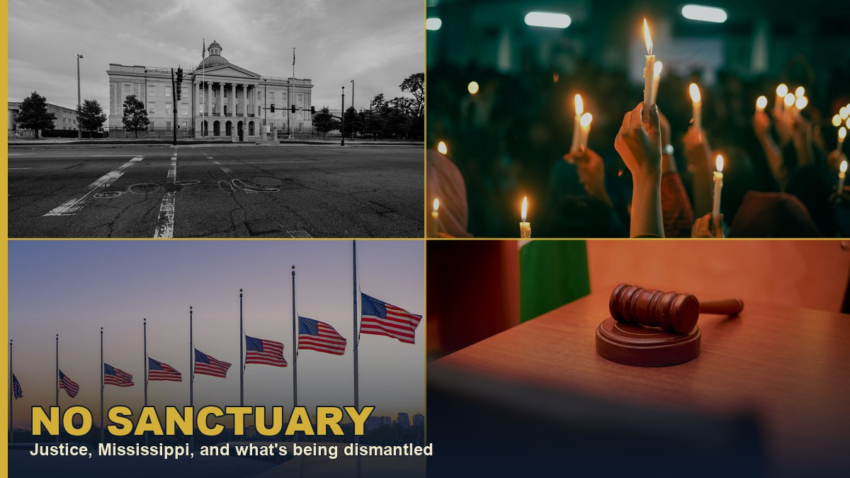
Photo by Dominik Gryzbon via Pexels · Photo by Nahmad Hassan via Pexels · Photo by David Dibert via Pexels · Photo by Boko Shots via Pexels
Two Cases, Four Years Apart
Rasheem Carter, 25. In early October 2022, Carter called his mother, Tiffany Carter, and said white men in three trucks were chasing him near Laurel, Mississippi. She told him to go to police. He did — twice. “He asked for help, but they did not help him,” she said[1]. Carter went missing October 2; on November 2, his remains — his skull and spinal cord recovered as two separate finds — were located in a wooded area near Taylorsville, in neighboring Smith County. The State Medical Examiner’s Office said a cause of death “could not be reasonably determined.” Local authorities said they had no evidence of foul play[2]. Attorney Ben Crump, who took the family’s case, called it a case that could have been prevented had the justice system not been an obstacle itself — describing it plainly as a “Mississippi lynching” and demanding a Department of Justice investigation[1][3].
Nolan Wells, 18. A football player at Ocean Springs High School and Southwest Mississippi Community College, Wells boated out to Horn Island with friends on July 4, 2026, to celebrate the holiday. He was the only Black member of the group. He was the only one who didn’t come back[4]. His mother, Christine Wonsley, reported him missing that night; his body was recovered two days later. She had her first meeting with the Jackson County DA’s office in late July — more than three weeks after his death — described by both sides as “respectful.” The DA’s office said it would present the case to a grand jury only once the sheriff’s department’s investigation is complete, with no timeline given[5]. Civil rights leaders, including Rev. Al Sharpton, spoke at his funeral calling for justice[6]. The family retained Ben Crump on July 7. By late July, the case had drawn cease-and-desist letters, a combined $125,000 reward from Tyler Perry, Sharpton, and NFL veteran Terrell Owens, and signs of an impending defamation lawsuit — but no arrest[7].
The pattern that repeats:
- A Black man or teenager dies under circumstances his own family flags as suspicious.
- Local police or investigators are slow to act, or the family says they were turned away when they first asked for help.
- The official finding is ambiguous or incomplete rather than a clear determination.
- The family has to hire a national civil rights attorney to get the case taken seriously at all.
- Federal involvement is requested, but never clearly confirmed.
The Federal Backstop Mississippi Has Needed Before
This isn’t a new problem, and Mississippi’s history is precisely why a federal backstop exists at all. The Community Relations Service (CRS) — the Justice Department’s mediation arm, sometimes called its “Peacemakers” — was created by the 1964 Civil Rights Act, the same year Klan-affiliated Neshoba County conspirators murdered civil rights workers James Chaney, Andrew Goodman, and Michael Schwerner near Philadelphia, Mississippi. The state’s own justice system wouldn’t convict anyone of murder in that case for 41 years. CRS exists because Washington concluded Mississippi couldn’t always be trusted to police itself on exactly this kind of case.
There’s a more recent example of federal civil rights machinery actually working, at least partially: in 2023, Rankin County sheriff’s deputies and a Richland police officer who called themselves the “Goon Squad” tortured two Black men during a late-night raid. The Justice Department opened a pattern-or-practice investigation into the whole department later that year; six officers went to federal prison; the county reached a civil settlement with the victims in May 2025; and as of an October 2025 report, the broader federal pattern-or-practice probe was still open[8][9]. That’s what it looks like when the federal layer functions as designed.
What’s Being Dismantled Right Now
Project 2025, the Heritage Foundation’s governing blueprint, calls explicitly for stripping DOJ’s Civil Rights Division of its independent authority to prosecute civil rights cases and folding that power into the Criminal Division instead — removing the standalone enforcement arm built for exactly the kind of case described above[10]. It also anticipated eliminating hate-crime grant funding and gutting CRS itself[11].
That blueprint is no longer theoretical. Since her April 2025 confirmation, Assistant Attorney General Harmeet Dhillon has restructured DOJ’s Civil Rights Division, shifting its focus away from traditional discrimination enforcement; the division has cancelled the post-George Floyd Minneapolis and post-Breonna Taylor Louisville police consent decrees, and closed Biden-era pattern-or-practice findings against six more departments, including Louisiana State Police and the Memphis, Phoenix, and Trenton police forces[12]. Dozens of civil rights cases have been dismissed division-wide, and hundreds of career Civil Rights Division attorneys have resigned.
CRS itself — the office literally created in response to Mississippi’s 1964 crisis — has had its staff cut from roughly 50 to fewer than 20, with every regional office set to close and no funding included in the FY2026 budget. In October 2025, a federal judge allowed the near-elimination to proceed over an NAACP legal challenge[13].
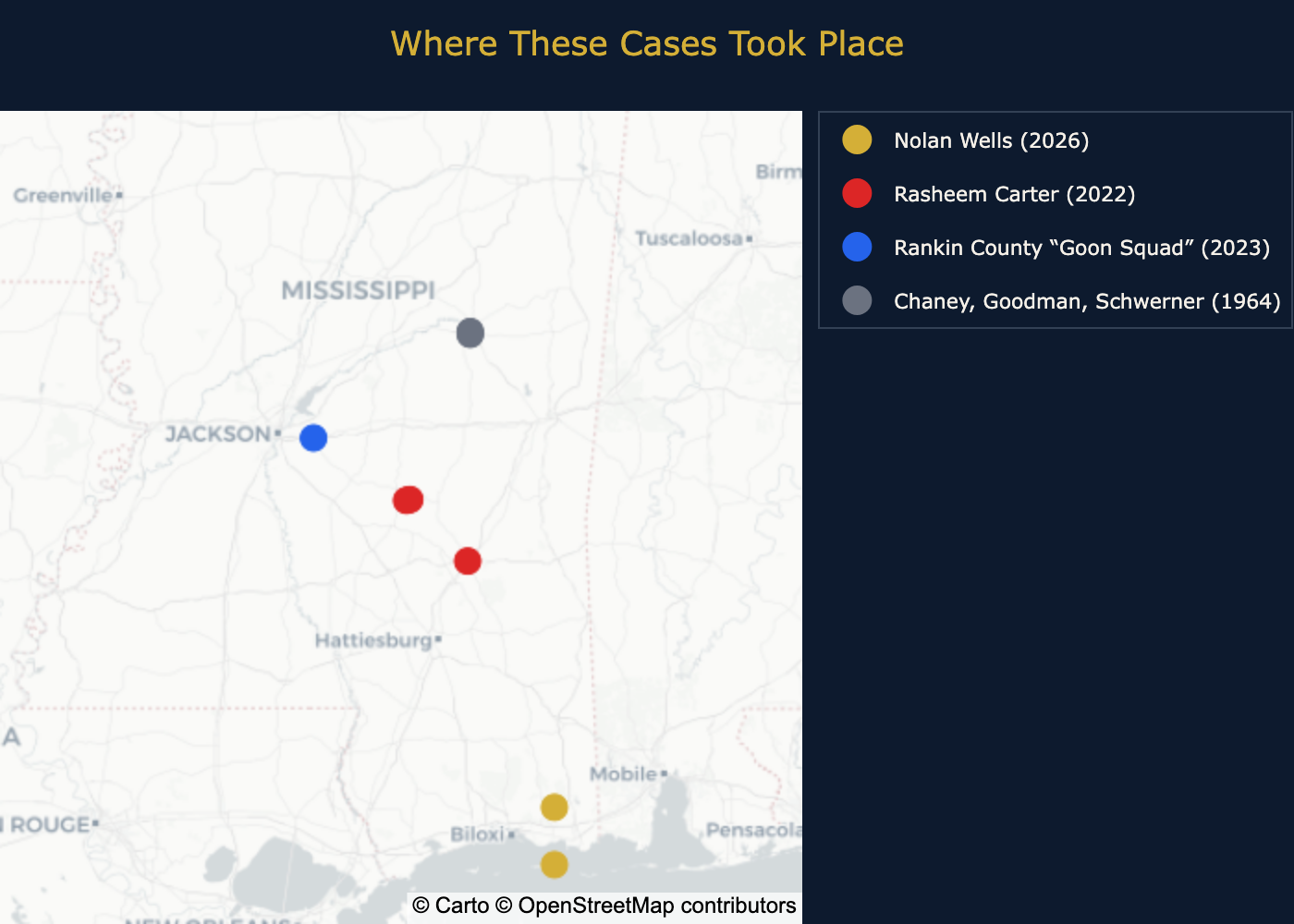
Figure 1
Where These Cases Took Place
What this piece is not claiming.
Carter’s case happened in 2022, three years before the current DOJ restructuring began — the federal rollback did not cause his death or the ambiguous finding in it, and no investigation has drawn that line. Both the Rankin County pattern-or-practice probe and the underlying question of whether DOJ will engage with the Wells case remain open and unresolved as of publication; it is possible either could still move forward. The claim here is narrower and about capacity: the specific federal tools Mississippi families have used before — CRS mediation, pattern-or-practice investigations, an independently empowered Civil Rights Division — are measurably smaller now than they were two years ago, at the same moment a case with the same shape as Carter’s is unfolding again.
Kemetic Minds Analysis
“No sanctuary” isn’t a metaphor here — it’s a description of what happens when the specific institutions built to catch cases like Rasheem Carter’s aren’t there to catch the next one. Mississippi didn’t develop federal civil rights oversight because Washington distrusted the state in the abstract; it developed it because in 1964, and again in 2022, and arguably again in 2026, local systems moved slowly or not at all on cases involving Black victims and armed white suspects. The Rankin County probe shows the machinery still works when it’s allowed to run. The question this moment actually raises isn’t whether Carter’s or Wells’ case would have gone differently under a fully staffed Civil Rights Division — nobody can know that. It’s whether the next case like theirs will have anywhere to go if the answer from local authorities is, once again, no foul play.
References
- Tensley, B. (2023, March 16). Rasheem Carter’s Death Shows the Fault Lines of Jim Crow Still Run Through Mississippi. Capital B News. capitalbnews.org ↩a ↩b
- ABC News. (2023, October). A year after Black man disappeared under mysterious circumstances, questions remain. abcnews.com ↩
- NPR. (2023, March 14). Family of Rasheem Carter, whose body was found in Mississippi, urges DOJ probe. npr.org ↩
- NPR. (2026, July 8). What we know about Nolan Wells, the student-athlete found dead off the coast of Mississippi. npr.org ↩
- ABC News. (2026, July). Nolan Wells’ family has “respectful” meeting with DA. abcnews.com ↩
- NPR. (2026, July 20). At Mississippi funeral, civil rights leaders call for justice for Nolan Wells, 18. npr.org ↩
- NOLA.com. (2026, July). What’s new in Nolan Wells case? Cease and desists, big cash reward, defamation claims, more. nola.com ↩
- Mississippi Today. (2025, October 20). DOJ investigation into Rankin County sheriff continues. mississippitoday.org ↩
- Magnolia Tribune. (2025, May 2). Rankin County settles with victims of ‘Goon Squad.’ magnoliatribune.com ↩
- Thurgood Marshall Institute at LDF. (2024). What Project 2025 Means for Black Communities: Criminal Legal System. tminstituteldf.org ↩
- The Leadership Conference on Civil and Human Rights. (2024). Project 2025: What’s At Stake for Fighting Hate. civilrights.org ↩
- Washington Examiner. (2026). Harmeet Dhillon upends DOJ Civil Rights Division in shift toward curbing antisemitism and DEI. washingtonexaminer.com ↩
- JURIST. (2025, October). US federal judge allows Trump administration to continue with near-elimination of Community Relations Service. jurist.org ↩
Methodology: Facts about Rasheem Carter’s case are sourced to Capital B News, NPR, and ABC News reporting from 2023. Facts about Nolan Wells’ case are sourced to NPR, ABC News, and NOLA.com reporting current through late July 2026; his case remains under active investigation and no charges have been filed as of publication. Facts about DOJ Civil Rights Division policy changes are sourced to the Thurgood Marshall Institute at LDF, the Leadership Conference on Civil and Human Rights, the Washington Examiner, JURIST, Mississippi Today, and Magnolia Tribune. This piece does not claim the 2025-2026 federal rollback caused either death — Carter’s case predates it by three years — only that the federal mechanisms historically available to Mississippi families in cases like these are measurably smaller now than they were even two years ago. No facts were sourced from Wikipedia.
📱 Stay Connected

Kemetic Minds Editorial Desk
Verified NewsroomPrimary-sourced investigative intelligence on civil rights, voting rights, federal policy, and consumer protection. Sourced from primary legal filings, government statistics, and direct field reporting.