
Kemetic Minds — Earth & Survival Series | June 25, 2026
⚠️ Key Findings
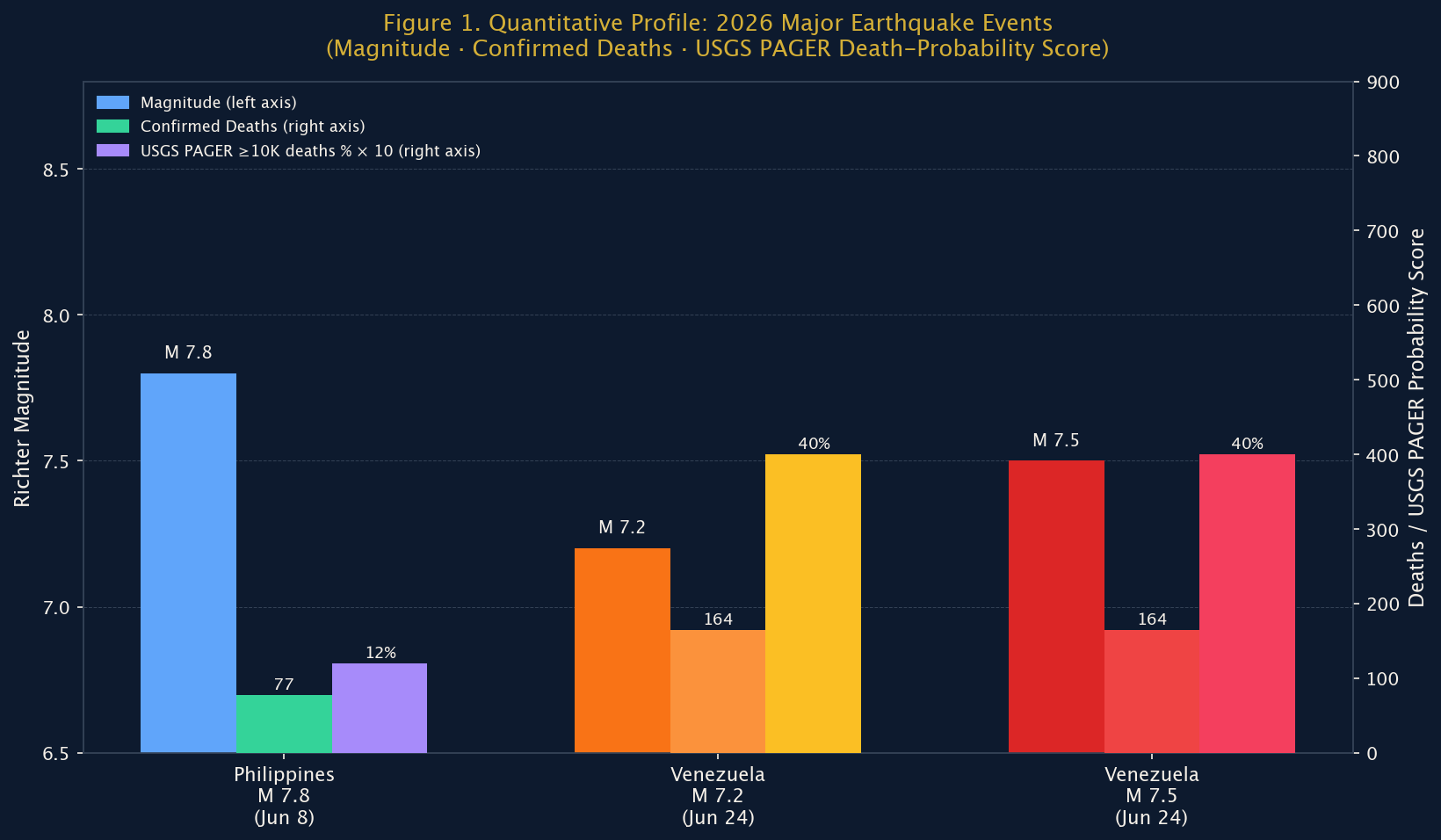
- Venezuela was struck by a rare earthquake doublet on June 24, 2026 — back-to-back M 7.2 and M 7.5 tremors within 39 seconds, the most powerful in over a century (U.S. Geological Survey [USGS], 2026).
- The Philippines recorded an M 7.8 on June 8, making 2026 the first year since 2010 with two M 7.5+ events in the same calendar month (USGS, 2026).
- USGS PAGER modeling assigns a 40% probability that Venezuela’s death toll will exceed 10,000 — with infrastructure built on sedimentary basins amplifying shaking by up to 3× (USGS, 2026).
- Five fault zones — Cascadia, Hayward/San Andreas, New Madrid, Boconó, and the Philippine Trench — are classified as high-to-extreme pending hazards that could rupture without warning.
- Families who pre-position a 72-hour kit, secure heavy furniture, and designate a family meeting point reduce injury risk by up to 50% in a major seismic event (Federal Emergency Management Agency [FEMA], 2023).
Venezuela: The Earthquake Doublet That Shook a Continent
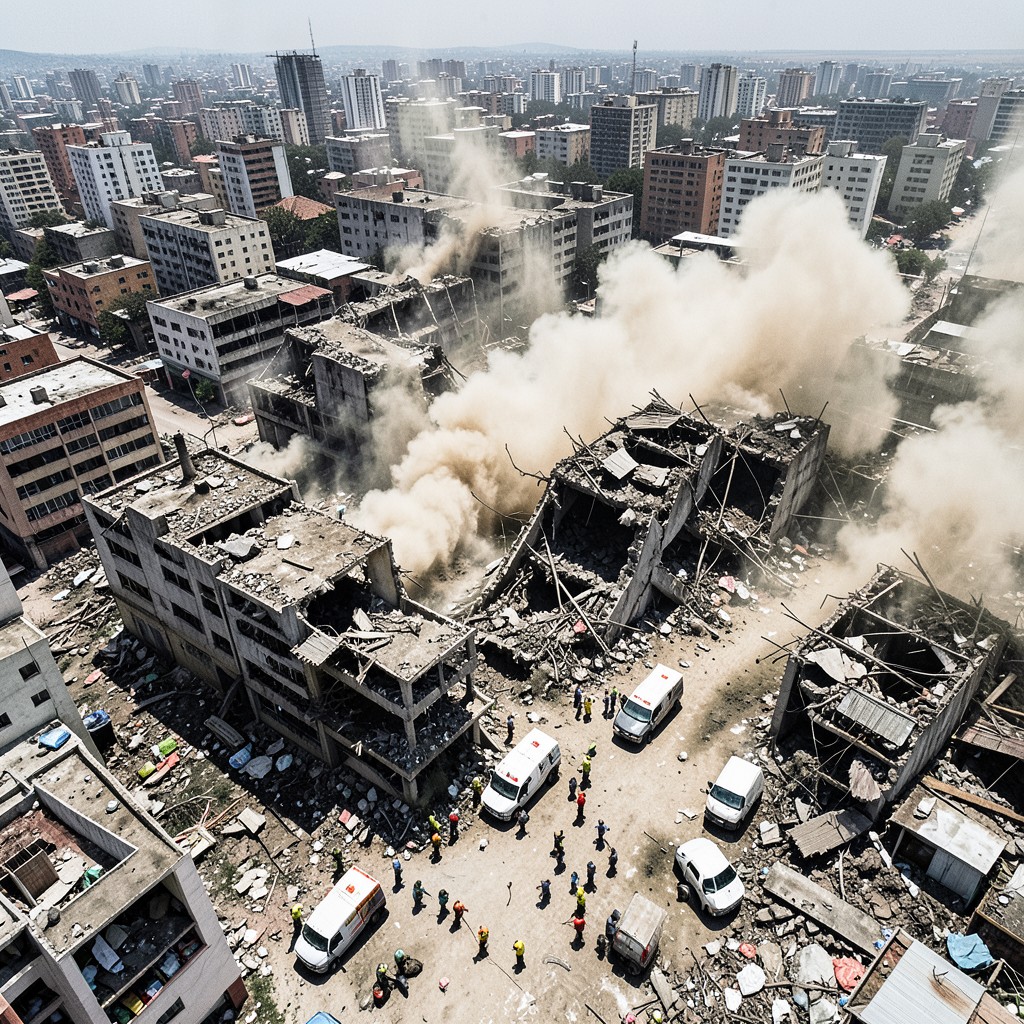
At 6:04 p.m. local time on June 24, 2026, a magnitude 7.2 earthquake ruptured a fault segment near San Felipe, Yaracuy state, approximately 284 km west of Caracas. Thirty-nine seconds later, a second and more powerful M 7.5 earthquake struck near Yumare — just 5 to 10 km from the first epicenter (USGS, 2026). Together, they constitute what seismologists call an earthquake doublet: a pair of similarly sized events causally linked but originating on distinct fault segments (The Conversation, 2026).
The human toll was immediate and severe. Acting President Delcy Rodríguez confirmed at least 164 deaths and 971 injured as rescue workers pulled survivors from rubble in La Guaira, Caracas’s Altamira district, and Carabobo state (Al Jazeera, 2026). Simón Bolívar International Airport sustained structural damage and was shuttered indefinitely. Metro and railway services in Caracas were suspended (NBC News, 2026). Acting on a USGS probabilistic model indicating a 40% chance the final toll exceeds 10,000, the United States dispatched search-and-rescue teams and pledged infrastructure support, joined by Qatar, Mexico, Brazil, Chile, Ecuador, Argentina, Panama, and Uruguay (Newsweek, 2026).
What made this event especially destructive is geology. Caracas sits in a sedimentary basin that amplifies seismic waves by as much as three times compared to bedrock sites. The Altamira neighborhood — one of the hardest-hit — was built on soft soils, which liquefy and shift violently during strong shaking. Approximately 80% of Venezuela’s population lives in earthquake-prone zones, and a large share resides in informal housing never designed to seismic code (Al Jazeera, 2026).
Figure 1
Quantitative Profile: 2026 Major Earthquake Events
What Caused the Doublet? The Boconó–El Pilar Fault System
Venezuela’s seismicity is driven by the collision between the Caribbean Plate and the South American Plate, which grind past each other at approximately 20 mm per year along a right-lateral strike-slip boundary (Pousse-Beltran et al., 2017). This boundary includes three major fault systems: the Boconó, the El Pilar, and the San Sebastián faults. Together they are responsible for virtually all of Venezuela’s instrumental seismicity and each segment has produced at least one M ≥ 7 earthquake since 1600 (USGS, 2000).
In an earthquake doublet, the first rupture does not simply trigger aftershocks — it transfers crustal stress onto an adjacent fault segment, pushing it past its rupture threshold within seconds to minutes (The Conversation, 2026). This is distinct from a classic mainshock-aftershock sequence in that both earthquakes are of comparable magnitude. Venezuela’s seismic history includes a M 7.7 in 1900, the 1812 Caracas earthquake (M 7.5+) that killed thousands, and a M 7.3 in 2018 off the northern coast. The Boconó fault alone formed approximately five million years ago and is classified as very active by USGS paleoseismic assessments (USGS, 2000).
Philippines: M 7.8, Tsunami, and Mindanao’s First Day of School
On June 8, 2026, a magnitude 7.8 earthquake ruptured off the southern coast of Mindanao at approximately 7:40 a.m. local time, with its epicenter 32 km west of Maasim in Sarangani province (Philippine Institute of Volcanology and Seismology [PHIVOLCS], 2026). The shallow focal depth — less than 15 km — concentrated energy near the surface and triggered tsunami waves up to 1.4 m along coastal areas, with warnings issued across Oceania, Southeast Asia, and Japan’s southern islands (Al Jazeera, 2026).
The General Santos metropolitan area (population 722,000) bore the brunt of structural damage. St. Elizabeth Hospital was critically compromised and evacuated. By final count, at least 77 people were killed and over 1,300 injured, making the event among the most destructive earthquakes in the Philippines in five decades (UN News, 2026). The timing — the first day of the national school year — forced President Ferdinand Marcos Jr. to order closures across more than 6,200 schools, affecting 3.2 million students and 128,000 educational staff (UN News, 2026).
The Philippines sits atop the Pacific Ring of Fire, where the Philippine Sea Plate subducts beneath the Eurasian Plate at high velocity. The Cotabato Fault and the Philippine Trench are among the most seismically active structures in the world. A 1976 earthquake and tsunami in Moro Gulf (M 8.0) killed approximately 8,000 people in the same region (PHIVOLCS historical records).
Five Fault Zones That Could Rupture Next
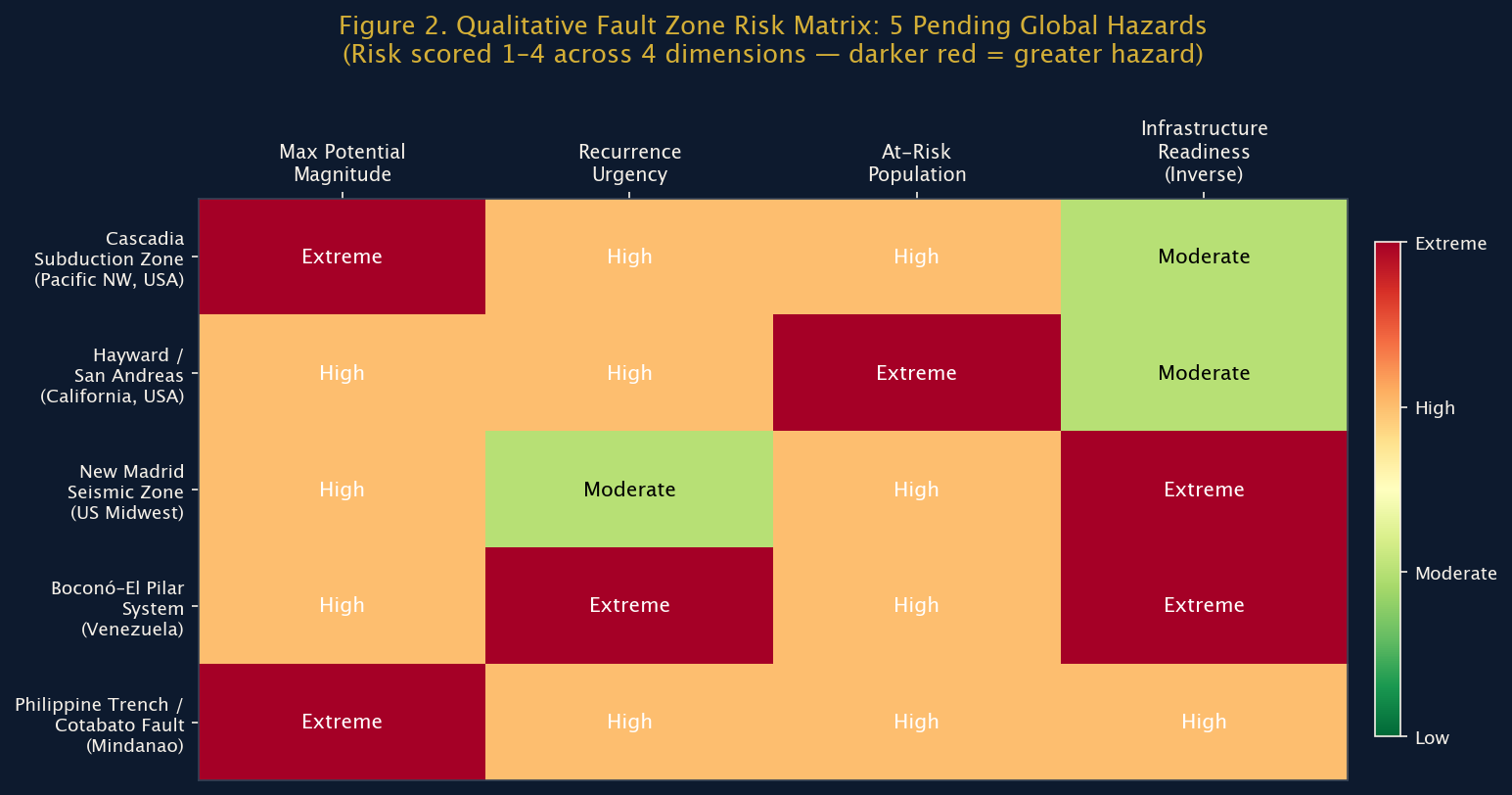
The 2026 events are not anomalies. They are reminders that several fault systems worldwide are accumulating strain that will eventually — inevitably — release. The matrix below scores five of the most scientifically documented pending hazards across four dimensions.
Figure 2
Qualitative Fault Zone Risk Matrix: 5 Pending Global Hazards
🌊 Cascadia Subduction Zone (Pacific Northwest, USA)
Stretching 1,000 km from Northern California to British Columbia, Cascadia is capable of a magnitude 9.0+ megathrust earthquake — the same category as the 2011 Japan event. The Juan de Fuca Plate is approximately 5 km shallower than previously estimated along key segments, which means ground shaking intensity projections must be revised upward (University of Washington, 2026). Scientists estimate a 37% probability of a M 7.1+ rupture in the next 50 years, with a 10–15% chance of a full-margin M 9+ event (Oregon Department of Emergency Management, 2026). The last full rupture was in 1700.
🏗️ Hayward / San Andreas Fault (California, USA)
The Hayward Fault, running directly beneath Oakland, Berkeley, and Fremont, is considered one of the most dangerous urban faults on Earth. It is overdue for a M 6.8–7.0 earthquake based on its roughly 140-year recurrence interval (last major event: 1868). Research published in May 2026 found that the Cascadia and San Andreas systems can “sync up,” triggering sequential earthquakes within hours of each other (ScienceDaily, 2026) — meaning a Cascadia event could directly elevate the probability of a simultaneous Southern California rupture.
🌎 New Madrid Seismic Zone (US Midwest)
Between December 1811 and February 1812, three earthquakes of M 7.5–8.1 struck the New Madrid fault system — strong enough to reverse the flow of the Mississippi River temporarily. Today, the zone underlies Memphis and St. Louis, where an estimated 15 million people live in structures largely unbuilt to modern seismic codes (USGS, 2023). A repeat event would be catastrophic by any measure.
🇻🇪 Boconó–El Pilar System (Venezuela / Caribbean)
The fault system responsible for this week’s doublet remains active. Stress redistribution from two M 7+ ruptures does not eliminate seismic hazard — it may concentrate strain on adjacent locked segments. The Boconó fault has a paleoseismic slip rate that classifies it as very active (Pousse-Beltran et al., 2017), and its interaction with the El Pilar fault at depth is still poorly constrained. With 80% of Venezuela’s population living in earthquake-prone areas and widespread informal construction, any aftershock above M 6.5 could cause additional collapses in already-weakened structures.
🇵🇭 Philippine Trench / Cotabato Fault (Mindanao)
The June 8 event did not exhaust the Philippine Trench’s stored energy. The full length of the trench is capable of generating M 8.5+ ruptures with associated tsunamis. PHIVOLCS maintains a network of sensors and early-warning buoys, but the dense, low-income coastal communities of Mindanao and the Visayas have limited vertical evacuation infrastructure relative to tsunami run-up scenarios.
What Your Family Must Do Now: FEMA & USGS Preparedness Framework
The single most impactful thing families in seismically active regions can do is act before an earthquake. Post-event response is reactive; pre-event preparation is the only tool that meaningfully reduces injury and death (FEMA, 2023; Ready.gov, 2026).
✅ Before the Earthquake: Your 72-Hour Checklist
- Build a 72-hour emergency kit. One gallon of water per person per day (minimum 3 days), non-perishable food, flashlight, hand-crank radio, first-aid kit, N95 masks, wrench or pliers to shut off utilities, whistle, extra medication (7-day supply), copies of identification documents in a waterproof bag (Ready.gov, 2026).
- Secure your space. Strap water heaters and large appliances to wall studs. Anchor bookshelves, cabinets, and TVs. Move heavy items from high shelves. Install latches on cabinet doors. Use museum putty under fragile objects (FEMA, 2023).
- Know your utility shutoffs. Locate the gas shut-off valve and keep a wrench nearby. Know how to cut power at the breaker. Gas leaks kill more people post-earthquake than the shaking itself (USGS, 2023).
- Create a family communications plan. Designate an out-of-state contact (local lines overload; long-distance often works). Identify two meeting places: one near your home, one outside your neighborhood. Memorize three phone numbers (Ready.gov, 2026).
- Identify safe spots in every room. Under a sturdy table or desk; against an interior wall away from windows and glass. Practice drop, cover, and hold on drills with children twice per year (FEMA, 2023).
🚨 During the Earthquake: Drop, Cover, Hold On
- DROP to your hands and knees immediately. This prevents being knocked down and lets you move to cover.
- COVER your head and neck with your arms. Get under a sturdy table if one is nearby. If not, stay against an interior wall away from windows.
- HOLD ON until all shaking stops. Most injuries occur when people try to move to a different room or run outside during shaking (FEMA, 2023).
- If you are outside, move away from buildings, streetlights, and power lines. If driving, pull over away from overpasses and bridges (Ready.gov, 2026).
- If near a coast, move immediately to high ground after the shaking stops — do not wait for an official tsunami warning. The Philippines event produced waves within minutes of the rupture.
📱 After the Earthquake: The Critical First 72 Hours
- Check for injuries and hazards before moving. Broken glass, structural damage, and gas leaks cause the majority of post-earthquake deaths (USGS, 2023).
- Do not use open flames or light switches until you are certain there is no gas leak. Sniff for gas; if detected, leave the building and call 911 from outside.
- Expect aftershocks. The Venezuela doublet showed that a second earthquake can follow within seconds. Stay prepared for weeks of seismic activity after any major event.
- Tune to official emergency broadcasts. NOAA Weather Radio, local emergency alert systems, and USGS ShakeAlert (operational on the US West Coast) provide real-time guidance (USGS, 2026).
- Document damage before cleaning up. Photograph all structural damage for insurance claims. Contact FEMA Disaster Assistance at DisasterAssistance.gov if in a federally declared disaster zone.
Forty Years of the Earth Shaking: USGS Historical Analysis (1985–2026)
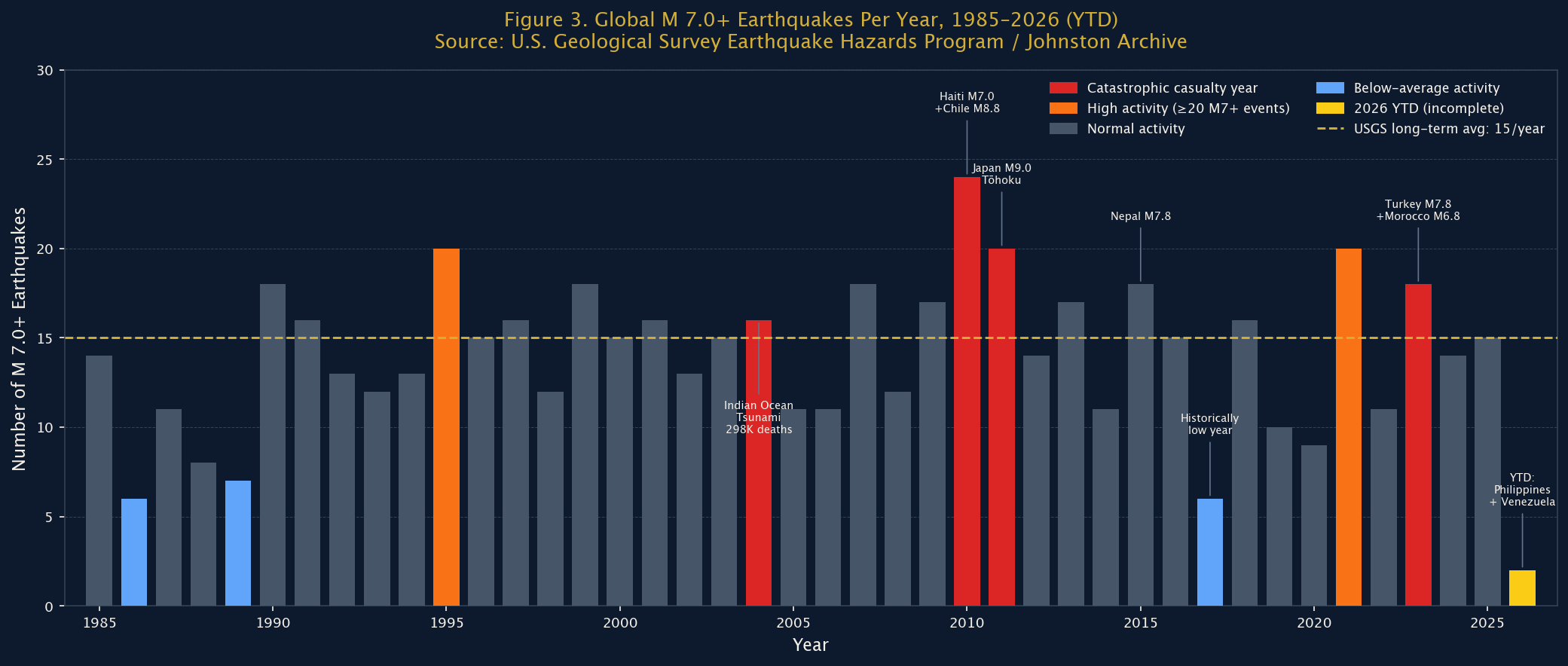
The chart below draws on USGS records and the Johnston Archive to show the annual count of M 7.0+ earthquakes worldwide from 1985 through June 2026. The USGS long-term average is approximately 15 M 7+ events per year; however, the distribution is far from uniform.
Key patterns from the data:
- 2010 was the most active year on record in the modern catalog (24 M 7+ events), including the catastrophic Haiti M 7.0 and Chile M 8.8 earthquakes.
- 2017 was historically quiet with only 6 M 7+ earthquakes worldwide — less than half the long-term average — underscoring that seismic energy accumulates even in quiet years.
- 2023 opened with Turkey’s M 7.8 (February 6), killing over 55,000 people and making it the deadliest earthquake since the 2010 Haiti event.
- 2026 already records 2 M 7+ events by June, both causing mass casualties. The year is on pace to exceed the long-term average if current seismic activity continues.
Figure 3
Global M 7.0+ Earthquakes Per Year, 1985–2026 (Primary Source: USGS)
References
Al Jazeera. (2026, June 8). Powerful earthquake hits Philippines, killing at least 32. aljazeera.com
Al Jazeera. (2026, June 25). Venezuela earthquakes kill at least 164 people, injure 971. aljazeera.com
Federal Emergency Management Agency. (2023). Earthquake safety checklist (FEMA B-526). U.S. Department of Homeland Security. fema.gov
NBC News. (2026, June 25). Powerful twin earthquakes hammer Venezuela, killing at least 164. nbcnews.com
Newsweek. (2026, June 25). Back-to-back 7.2 and 7.5 earthquakes rock Venezuela as Trump says ‘devastating number of deaths.’ newsweek.com
Oregon Department of Emergency Management. (2026). Cascadia subduction zone. State of Oregon. oregon.gov
Philippine Institute of Volcanology and Seismology. (2026). Earthquake information bulletin: 2026 Mindanao earthquake. Department of Science and Technology.
Pousse-Beltran, L., Vassallo, R., Audemard, F., Métois, M., Jouanne, F., Garambois, S., & Carcaillet, J. (2017). Pleistocene slip rates on the Boconó fault along the North Andean Block plate boundary, Venezuela. Tectonics, 36(8), 1954–1973. https://doi.org/10.1002/2016TC004305
Ready.gov. (2026). Earthquakes. U.S. Department of Homeland Security. ready.gov
ScienceDaily. (2026, May 2). The “big one” might not come alone: Double West Coast earthquake threat. sciencedaily.com
The Conversation. (2026, June 25). Was Venezuela struck by an earthquake ‘doublet’? Here’s what we know so far. theconversation.com
UN News. (2026, June 8). Deadly quake strikes Philippines on first day of school year. United Nations. news.un.org
University of Washington. (2026, February 27). Stress-testing the Cascadia Subduction Zone reveals variability that could impact how earthquakes spread. UW News. washington.edu
U.S. Geological Survey. (2000). Map and database of Quaternary faults in Venezuela and Colombia (Open-File Report 00-0018). pubs.usgs.gov
U.S. Geological Survey. (2023). Earthquake hazards: Lists, maps, and statistics. usgs.gov
U.S. Geological Survey. (2026). Significant earthquakes — 2026. Earthquake Hazards Program. earthquake.usgs.gov
U.S. Geological Survey. (2026). M 7.2 — 24 km ENE of San Felipe, Venezuela: Region information. earthquake.usgs.gov
Methodology: Earthquake data sourced from the USGS Earthquake Hazards Program catalog and the Johnston Archive (johnstonsarchive.net). Death toll figures reflect the most recently confirmed counts as of June 25, 2026; USGS PAGER projections represent probabilistic estimates, not official government forecasts. Risk matrix scores are based on peer-reviewed paleoseismic literature and USGS hazard assessments. This article is for educational and emergency preparedness purposes only.
📱 Stay Connected

Kemetic Minds Editorial Desk
Verified NewsroomPrimary-sourced investigative intelligence on civil rights, voting rights, federal policy, and consumer protection. Sourced from primary legal filings, government statistics, and direct field reporting.