
KEMETIC MINDS
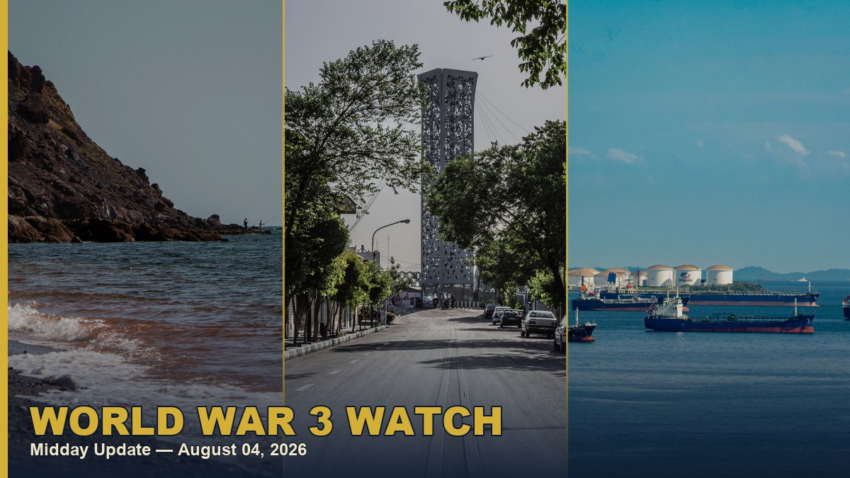
World War 3 Watch — Midday Update — August 04, 2026
- US Treasury Secretary Scott Bessent predicted a Strait of Hormuz deal could come “today or tomorrow,” sending oil prices sliding as traders priced in a reopening of the waterway that carries roughly a fifth of the world’s oil supply (Al Jazeera, 2026; Cryptobriefing, 2026).
- Iran rejects the premise: Foreign Ministry spokesman Esmaeil Baqaei said Tehran has no plans to send or receive negotiating delegations, even as Trump claims he called off “the biggest attack since WWII” for talks (The Washington Post, 2026; VOA Chinese, 2026, authors’ translation).
- Iran and Oman are reportedly near a lane-separation agreement for Hormuz, but Washington and Tehran are publicly fighting over who may charge ships “service fees” (Xinhua, 2026, authors’ translation).
- The US Army has consumed “almost all” of its ATACMS and PrSM precision missiles in 23 weeks of war, raising fresh concerns about deterrence against Russia and China (RFI Chinese, 2026, authors’ translation; Al Jazeera, 2026).
- CENTCOM is quietly soliciting “creative, unconventional” ideas from analysts — a sign US pressure options are narrowing (Xinhuanet App, 2026, authors’ translation).
Video: Trump Says Iran Talks Last Chance | Balance of Power: Early Edition 8/3/2026. Source: Bloomberg Podcasts.
1. Deal ‘Today or Tomorrow’? Bessent’s Timeline vs Tehran’s Denial
Treasury Secretary Scott Bessent told CNBC on Monday that the US and Iran might “hammer out a deal” over the Strait of Hormuz “today or tomorrow” (Cryptobriefing, 2026).
The deal would include “freedom of movement” for commercial vessels, per Al Jazeera’s live coverage — which also logged another vessel hit in the strait on the same day (Al Jazeera, 2026).
Oil prices “promptly fell off a cliff” as traders priced in a possible reopening of the chokepoint, which has been severely disrupted since July 2026 (Cryptobriefing, 2026).
Qatar’s Foreign Ministry says mediators are still working closely to facilitate negotiations and exchange proposals between the two sides (Al Jazeera, 2026).
Tehran, however, is not on the same page.
Baqaei said Iran had no plans to send or receive any negotiating delegations, undercutting Trump’s Sunday claim that talks would start Monday afternoon (The Washington Post, 2026).
VOA’s Chinese-language service carried the same Air Force One quote: “We are talking to them in the form of negotiations. Negotiations will begin tomorrow (Monday) afternoon — let’s wait and see” (VOA Chinese, 2026, authors’ translation).
On the water, UKMTO recorded a Sunday explosion off the Oman coast — with the crew reported safe — and a July 31 strike on a gas tanker by an unknown projectile, noting commercial traffic through the strait remains reduced (VOA Chinese, 2026, authors’ translation).
Video: US-Iran War LIVE | World War 3 About To Start | Trump's Biggest Announcement | Trump Latest Live. Source: Times Now.
2. Trump’s ‘Last Chance’ Pattern: 23 Weeks of Whiplash
Today’s war is in its 23rd week, and Al Jazeera catalogs the pattern: Trump escalates, shakes the markets, then backs down at the 11th hour (Al Jazeera, 2026).
On April 7, he warned that unless the strait reopened, “a whole civilisation will die tonight, never to be brought back again.”
Tehran didn’t blink, and with two hours left on the deadline Trump replaced the threat with a two-week ceasefire brokered by Islamabad (Al Jazeera, 2026).
Monday brought the same loop: Trump said negotiations were close and gave “duplicitous” Iran “one last chance” to make a deal or face catastrophic strikes (Al Jazeera, 2026).
Sky News headlines the identical message: Tehran has a “last chance” to sign a “good” deal (Sky News, 2026).
Yet MSN reports Trump is still “reportedly considering renewed heavy attacks over this weekend” (MSN, 2026).
Chinese state media adds the July version: Trump said he was “seriously considering” resuming large-scale operations, possibly against Iran’s Gaoshan underground nuclear facility, before cancelling on August 1 (Xinhuanet App, 2026, authors’ translation).
Trump said he agreed to postpone the strikes at the request of Saudi Arabia, the UAE, Qatar, and Iran itself (VOA Chinese, 2026, authors’ translation).
On Truth Social, Trump claimed the strait is “fully controlled by the US Navy” and that the blockade will continue “unless a deal is reached or Iran completely surrenders” (China.com.cn, 2026, authors’ translation).
The July escalation ran both directions: Washington accused Iran on July 7 of violating the truce — the day Iran struck three transiting ships — and the US retaliated with strikes and a renewed port blockade (VOA Chinese, 2026, authors’ translation).
One informed source says Trump has even weighed restriking the Iranian nuclear sites hit last year by the US and Israel as a symbolic “fireworks show” to end the war (Xinhuanet App, 2026, authors’ translation).
Video: 'This is the last chance': Trump warns Iran to sign a peace deal or strikes will resume. Source: The Hill.
3. The Iran-Oman Lane Scheme and the Fee Fight
While Washington talks about “last chances,” Beijing’s Xinhua reports the actual negotiating mechanics: Iran and Oman are close to a lane-separation deal for Hormuz.
Under the reported blueprint, inbound Persian Gulf ships would use a lane near the Iranian coast controlled by Tehran, while outbound ships use a lane closer to Oman (Xinhua, 2026, authors’ translation).
Multiple Iranian officials said ships would pay “service fees,” with revenue split between Iran and Oman — a plan Washington flatly rejects (Xinhua, 2026, authors’ translation).
A US official familiar with the talks called the Iranian descriptions “inaccurate,” saying a “temporary” lane needs no Iranian approval and would carry no fees (Xinhua, 2026, authors’ translation).
Trump was blunter at the White House on August 3: “If [fees] are to be charged, we will be the ones to charge them” (Xinhua, 2026, authors’ translation).
Tehran’s Supreme Leader military adviser, Mohsen Rezaei, answered in kind: Iran will never allow a non-Iranian route, and any US warship on an “illegal” lane will be targeted (China.com.cn, 2026, authors’ translation).
Iranian officials add a hard condition: even an Iran-Oman deal will not reopen the strait unless the US lifts its port blockade and honors the June 18 14-point memorandum of understanding (Xinhua, 2026, authors’ translation).
Iran’s foreign minister, Seyed Abbas Araqchi, says the negotiations with Oman on joint management of the strait are in their “final stage” (Xinhua, 2026, authors’ translation).
4. What Chinese-Language Coverage Adds (and Omits)
The two language camps are covering the same war and telling different stories.
English-language outlets emphasize the Washington whiplash: Bessent’s timeline, oil slides, and Tehran’s denials (Cryptobriefing, 2026; The Washington Post, 2026).
Chinese-language coverage carries the war’s institutional memory: the February 28 US-Israel strikes that killed Iran’s then-Supreme Leader, the April 8 Pakistan-brokered pause, and the June 18 14-point MOU (VOA Chinese, 2026, authors’ translation).
Only the Chinese-language set reports the Ukraine dimension: Ukraine’s July 25 attack on an Iranian commercial ship in the Caspian, which killed one crew member and wounded another, and Iran’s claim it prepared strikes on three Ukrainian sites before cancelling after an apology (China.com.cn, 2026, authors’ translation).
And only the Chinese set carries Rezaei’s red line verbatim alongside Trump’s own Truth Social post claiming total US Navy control of the strait (China.com.cn, 2026, authors’ translation).
English coverage frames Tehran’s position as simple denial; the Chinese sources show Tehran actively negotiating a lane scheme with Oman while refusing to call it a “deal” with Washington.
Our narrative-comparison report on how US, Israeli, Iranian, and BRICS media each tell this war traces exactly this divergence — and today’s feeds confirm it is widening, not closing.
5. Missile Stocks Near the Bone: Depletion and Deterrence
Reuters, via RFI Chinese, reports the US Army has used “almost all” of its ATACMS and PrSM precision missiles in the five-month conflict (RFI Chinese, 2026, authors’ translation).
Each round costs over $1 million, and two of three sources said the depletion is raising concerns about US deterrence against Russia and China (RFI Chinese, 2026, authors’ translation).
CSIS estimates roughly 65% of Patriot interceptors were consumed between February and July, THAAD stocks are down at least 38%, and the US has burned through slightly less than half of its worldwide Tomahawk supply (RFI Chinese, 2026, authors’ translation).
One consequence: a renewed mass strike on Iran may have to lean on riskier manned bomber missions rather than stand-off precision munitions (RFI Chinese, 2026, authors’ translation).
Pentagon spokesman Sean Parnell insists the US military has “everything needed” to execute at the president’s chosen time and place (RFI Chinese, 2026, authors’ translation).
But CENTCOM is also emailing analysts for “creative, unconventional” ways to pressure Iran — a step CNN notes is unusual for the military and signals dwindling coercive options (Xinhuanet App, 2026, authors’ translation).
US intelligence assessments reportedly conclude airstrikes alone are unlikely to force Iran to change its negotiating stance, and Joint Chiefs Chairman Dan Caine conceded the same in congressional testimony (Xinhuanet App, 2026, authors’ translation).
Is This Actually World War 3?
Not yet — but today’s sources show why the label keeps getting floated.
This is a real, 23-week US-Israel-Iran war with daily maritime attacks, closed oil lanes, and missile stockpiles draining (Al Jazeera, 2026; RFI Chinese, 2026, authors’ translation).
What keeps it short of “World War 3” is geography: Russia and China appear in today’s sources only as deterrence concerns, not as combatants (RFI Chinese, 2026, authors’ translation).
The most dangerous line in today’s feeds is Rezaei’s promise to target US warships on non-Iranian lanes — a direct naval-confrontation scenario layered on top of the airstrike war (China.com.cn, 2026, authors’ translation).
Watch the gap between Bessent’s “today or tomorrow” and Baqaei’s “no talks”: the wider it gets, the closer the weekend’s “renewed heavy attacks” come (MSN, 2026; The Washington Post, 2026).
What You Can Do Right Now
- Do not trade or travel on headline claims alone. US and Iranian officials are publishing directly contradictory statements about whether talks exist — cross-check both sides before making oil-sensitive or logistics decisions (The Washington Post, 2026; VOA Chinese, 2026, authors’ translation).
- If you live in a port, fuel-sensitive, or logistics-heavy area, expect continued price volatility: Bessent’s single prediction moved oil markets within hours (Cryptobriefing, 2026).
- Build household resilience now while diplomats still claim a deal is near. Our survival skills and preparedness guide covers the practical basics for war-time and supply-chain disruptions.
Kemetic Minds Analysis
This roundup pulled directly from the day’s English- and Chinese-language wires side by side, because the gap between what each side chooses to report is often as informative as any single strike count. Treat the Key Takeaways above as the verified factual floor, and the framing differences noted in the sections above as the more interesting, harder-to-fake signal about where this war is actually headed next.
References
- MSN. (2026, August 4). Trump To Hold Off New Strikes On Iran, Says "For Future Benefit Of World". msn.com
- Al Jazeera. (2026, August 4). Iran war live: US says deal to open Hormuz possible ‘today or tomorrow’. aljazeera.com
- Al Jazeera. (2026, August 4). ‘One last chance’: The times Trump threatened Iran, said deal imminent. aljazeera.com
- Sky News. (2026, August 4). Iran war latest: Trump says Tehran has 'last chance' to sign 'good' deal. news.sky.com
- The Washington Post. (2026, August 4). Iran rejects Trump’s claim that talks will restart, adding to weekend of whiplash. washingtonpost.com
- Cryptobriefing. (2026, August 4). Scott Bessent predicts US-Iran deal on Strait of Hormuz by Tuesday, oil prices slide. cryptobriefing.com
- 美国之音. (2026, August 3). 美国和伊朗再次寻求外交途径,努力重开霍尔木兹海峡 [The US and Iran are once again seeking a diplomatic path to reopen the Strait of Hormuz]. voachinese.com
- 新华网. (2026, August 4). 美媒称伊朗与阿曼接近达成霍尔木兹海峡航行协议 [US media reports Iran and Oman are nearing an agreement on Hormuz Strait navigation]. news.cn
- 中国网新闻中心. (2026, August 3). 伊朗高级官员:不允许美在霍尔木兹海峡开辟非伊朗航线 [Iranian senior official: The US is not allowed to open non-Iranian shipping lanes in the Strait of Hormuz]. news.china.com.cn
- RFI. (2026, August 4). 在与伊朗战争中 美陆军已使用“几乎所有”ATACMS等精准地对地导弹 [The US Army has used "nearly all" of its ATACMS precision-guided missiles in the war with Iran]. rfi.fr
- app.xinhuanet.com. (2026, August 4). 伊朗战事如何继续?美军开始内部“求支招” [How will the conflict in Iran continue, US military internally seeks advice]. app.xinhuanet.com
Investigative Methodology: This roundup is generated on a fixed schedule (noon and evening, America/Chicago) from live English- and Chinese-language wire sources. Every claim is grounded in fetched source text with an APA7 in-text citation; translated Chinese-language quotes are marked “authors’ translation.” Every video embed is verified to be a real, existing video via YouTube’s oEmbed endpoint before publication — none are written by the drafting model. No Wikipedia sources are used.
Stay Connected

Kemetic Minds Editorial Desk
Verified NewsroomPrimary-sourced investigative intelligence on civil rights, voting rights, federal policy, and consumer protection. Sourced from primary legal filings, government statistics, and direct field reporting.