
Special Report, Part 7 of 7 — Synthesis & The Horizon. Published Saturday, Nov. 14, 2026. Every quotation and statistic below is checked against a saved copy of its source.
Executive summary
- The organization’s 2025 service year report lists a peak of 9,205,326 publishers in 241 lands, 119,652 congregations and Memorial attendance of 20,635,015. These are its own counts of people who report preaching, not a census of believers. [1][2]
- Growth has slowed. Peak publishers were 5,199,895 in 1995, 6,613,829 in 2005, 8,220,105 in 2015 and 9,205,326 in 2025: by our calculation, increases of about a quarter in each of the first two decades and about an eighth in the third. Memorial attendance, 19,862,783 in 2015, barely moved over the last decade. [3][4][5][1]
- Between 2017 and 2025, by our calculation from the two country tables, publishers in Africa rose by more than a quarter while Europe was essentially flat and North America rose by about one-fortieth. Mozambique went from 59,990 to 109,531; the United States from 1,232,293 to 1,256,919. [6][2]
- The split is not simply South against West. Mexico, the third-largest country total after the United States and Brazil, rose from 871,207 to 887,844 while its congregations and Memorial attendance fell. [6][2]
- Since November 2023 rank-and-file publishers no longer report hours, only whether they took part, so the activity behind a “publisher” changed during the period compared. [7]
- Outside data are thin. Pew’s surveys put Witnesses at 1% or less of U.S. adults, with the lowest retention of any group in its 2014 table; Canada’s 2021 census counted 137,255 people identifying as Witnesses. [8][9][10]
What the numbers count
This closing part sets the organization’s own figures against each other and against the few outside measures that exist. Parts 1 to 6 dealt with history, doctrine, structure and legal scrutiny. Here the question is narrower: what do the published counts show about where the movement is growing and where it is not, and how far can those counts be trusted as a measure of membership?
The answer starts with the definition. The organization counts activity, not affiliation.
Primary source excerpt. “We count as Jehovah’s Witnesses only those who are actively preaching the good news of God’s Kingdom each month.” (How Many of Jehovah’s Witnesses Are There Worldwide?, jw.org FAQ, accessed November 2026) [11]
The same page says congregation reports are tabulated, sent to the branch office and then to world headquarters, and that the peak for each land is added together to produce the worldwide figure. [11] The 2025 report repeats the definition in a footnote.
Primary source excerpt. “A publisher refers to one who actively publishes, or preaches, the good news of God’s Kingdom.” (2025 Grand Totals, 2025 Service Year Report of Jehovah’s Witnesses Worldwide, note a) [1]
People who attend but do not preach are not counted. The FAQ says their number “can be roughly determined by the difference between the attendance at this meeting and the number of Witnesses”, meaning the annual Memorial of Christ’s death. [11] Every figure below from the service reports is therefore self-reported activity data, compiled by the organization and not audited by anyone outside it.
A change in what is reported
What a publisher reports changed during the period this part compares. The Associated Press reported in November 2023 that “For the first time since 1920, leaders of the Jehovah’s Witnesses have removed the hours-reporting requirement for rank-and-file adherents.” [7] Publishers now report only whether they took part in the ministry and conducted Bible studies; pioneers still record hours. Governing Body member Samuel Herd told the October 2023 annual meeting that “Our ministry involves much more than counting time.” [7]
The hours themselves have left the published totals. The 2015 summary reported 1,933,473,727 hours spent in the field ministry. [12] The 2025 grand totals list no hours figure. [1] In the AP report, a headquarters spokesman said hours had peaked above 2 billion before the pandemic and rose from 1.4 billion in 2021 to 1.5 billion hours in 2022. [7] Whether the change in reporting affected the number of people counted as publishers is not addressed in any source we hold.
Fifty years of totals
The series of grand totals is the longest consistent record. All figures are the organization’s.
| Service year | Lands | Peak publishers | Congregations | Memorial attendance |
|---|---|---|---|---|
| 1986 | 208 | 3,229,022 | 52,177 | 8,160,597 |
| 1995 | 232 | 5,199,895 | 78,620 | 13,147,201 |
| 2005 | 235 | 6,613,829 | 98,269 | 16,383,333 |
| 2015 | 240 | 8,220,105 | 118,016 | 19,862,783 |
| 2017 | 240 | 8,457,107 | 120,053 | 20,175,477 |
| 2025 | 241 | 9,205,326 | 119,652 | 20,635,015 |
Sources: [13][3][4][5][6][1]. The 1986 figures are from the January 1987 Our Kingdom Ministry report on that service year; the others are from the yearbooks and service year reports.
By our calculation, peak publishers grew by about three-fifths between 1986 and 1995, by just over a quarter from 1995 to 2005, by about a quarter from 2005 to 2015 and by about an eighth from 2015 to 2025. Memorial attendance grew by about a quarter and then a fifth in the first two of those decades, then by less than one-twentieth from 2015 to 2025. Congregations followed the same curve, and the 2025 total of 119,652 is lower than the 120,053 reported for 2017. [6][1]
The organization still reports growth each year: the 2025 report gives a “Percentage of Increase Over 2024” of 2.5 and 304,643 baptized, against 284,212 baptized in 2017. [1][6] What the longer series shows is that the pace of the 1980s and 1990s has not returned.
Where the growth is, 2017-2025
The 2017 and 2025 country tables list the same measures for nearly every land, which allows a direct comparison eight years apart. [6][2] We grouped the named lands by United Nations region and summed them. Each table also has an unnamed group (“33 Other Lands” in 2017, “35 Other Lands” in 2025) with peaks of 218,096 and 225,159, which we left out because the lands are not identified. [6][2] Russia, whose Supreme Court dissolved the Witnesses’ national organization in April 2017 (Part 6), does not appear by name in either table.
| Region (named lands) | Change in peak publishers, 2017-2025 | Change in congregations | Publishers per baptism, 2025 | Bible studies per 100 publishers, 2025 |
|---|---|---|---|---|
| Africa | up by more than a quarter | up by about a sixth | about 15 | about 187 |
| Asia | up by about one-seventh | up by about one-eighteenth | about 37 | about 66 |
| Latin America and Caribbean | up by less than one-twentieth | down slightly | about 35 | about 67 |
| North America | up by about one-fortieth | down by more than an eighth | about 54 | about 35 |
| Europe | essentially unchanged | down by about a tenth | about 63 | about 28 |
All values are our calculations from the two country tables [6][2]. North America here is the United States, Canada, Bermuda, Greenland and St. Pierre and Miquelon.
Africa’s share of publishers in named lands rose, by our calculation, from about one in five to nearly one in four. Europe and North America together fell from about 34 to under 32 of every 100. Latin America and the Caribbean remains the largest regional bloc, with just over a third.
The fastest growth is in southern and central Africa; the Philippines is included for comparison. These rows are copied from the tables.
| Country | 2017 peak | 2025 peak | 2017 congregations | 2025 congregations | 2025 baptized |
|---|---|---|---|---|---|
| Congo, Dem. Republic of | 216,696 | 306,303 | 3,763 | 4,810 | 23,170 |
| Zambia | 191,311 | 284,792 | 3,126 | 3,908 | 20,634 |
| Angola | 143,322 | 189,454 | 1,913 | 2,614 | 12,200 |
| Malawi | 93,412 | 127,154 | 1,540 | 2,058 | 8,439 |
| Mozambique | 59,990 | 109,531 | 1,254 | 2,072 | 10,368 |
| Philippines | 210,914 | 273,412 | 3,383 | 3,832 | 11,098 |
Sources: [6][2]. Zambia’s table entry gives a ratio of one publisher to 84 inhabitants in 2025, against one to 274 for the United States. [2] Mozambique’s peak rose, by our calculation, by more than four-fifths in eight years.
Growth in the count is not the same as growth relative to population. Nigeria’s peak rose from 381,398 to 421,375, but the table’s ratio of inhabitants per publisher worsened from 500 to 589, because the population figure in the same rows rose from 190,886,000 to 237,528,000. [6][2] Angola’s ratio also worsened, from 187 to 211. [6][2]
The West, and the case of Latin America
In the United States the peak rose from 1,232,293 in 2017 to 1,256,919 in 2025. Over the same years congregations fell from 13,578 to 11,803, Memorial attendance from 2,459,741 to 2,377,763 and the number baptized in the year from 27,674 to 23,848. [6][2] The inhabitants-per-publisher ratio moved from 263 to 274. [6][2]
| Country | 2017 peak | 2025 peak | 2017 congregations | 2025 congregations | 2017 Memorial | 2025 Memorial |
|---|---|---|---|---|---|---|
| United States | 1,232,293 | 1,256,919 | 13,578 | 11,803 | 2,459,741 | 2,377,763 |
| Mexico | 871,207 | 887,844 | 13,331 | 12,215 | 2,257,346 | 2,129,826 |
| Brazil | 858,799 | 938,337 | 12,135 | 12,669 | 1,822,259 | 1,793,667 |
| Italy | 251,192 | 252,521 | 2,955 | 2,696 | 431,035 | 405,476 |
| Japan | 213,473 | 214,118 | 3,047 | 2,835 | 291,158 | 287,497 |
| Germany | 165,470 | 176,478 | 2,118 | 1,954 | 267,296 | 270,177 |
| Britain | 137,468 | 144,116 | 1,626 | 1,565 | 222,201 | 223,423 |
| Poland | 118,036 | 113,987 | 1,294 | 1,263 | 185,246 | 175,523 |
Sources: [6][2]. Ukraine, not shown, fell from 140,300 to 99,155; the tables give no reason. [6][2]
Three patterns stand out. Western Europe is not uniformly in decline: Germany, Britain, France and Spain all reported more publishers in 2025 than in 2017, while Italy and Japan were flat and Poland fell. [6][2] Congregation counts fell in the United States, Japan and every European country in the table, including those where publishers rose; the reports do not say whether this reflects mergers, building policy or shrinking groups. And Latin America, often grouped with the Global South, looks more like the West than like Africa: Mexico’s peak rose by about one-fiftieth while its congregations, baptisms and Memorial attendance all fell, and Brazil’s Memorial attendance was lower in 2025 than in 2017. [6][2]
What outside data show
Independent measures exist for only a few countries, and they measure something different: self-identification.
Primary source excerpt. “Government census bureaus often determine their figures by asking people which religious group they identify themselves with.” (How Many of Jehovah’s Witnesses Are There Worldwide?, jw.org FAQ) [11]
The organization adds that it counts “only those who preach to others and who report that activity, not those who merely identify themselves as Witnesses.” [11] The gap between the two measures is visible in Canada. Statistics Canada’s 2021 census table counted 137,255 people in private households identifying as Jehovah’s Witnesses. [10] The organization reported a Canadian peak of 115,580 publishers in 2017 and 125,116 in 2025. [6][2] The census counts everyone reported as a Witness, children included, whether or not they preach; the publisher count, by the FAQ’s definition, takes in only people who report preaching, baptized or not. [11] The two are not the same population, and neither is wrong on its own terms.
Brazil’s 2022 census results on religion were released in broad groups, “sem identificação de subgrupos ou de denominações específicas” (without identifying subgroups or specific denominations), so they give no Witness count. [14]
In the United States the census does not ask about religion, and the best outside source is the Pew Research Center’s Religious Landscape Study. Its 2025 report says those who identify as Witnesses were at 1% or fewer of U.S. adults in all three landscape studies (2007, 2014 and 2023-24). [8] The 2014 study, which included interviews with 245 Jehovah’s Witnesses, found an unusual pattern of turnover. [9]
Primary source excerpt. “Most people who currently identify as Jehovah’s Witnesses (65%) also were raised outside that tradition.” (Pew Research Center, America’s Changing Religious Landscape, chapter 2, May 12, 2015) [15]
The other side of that pattern is retention. In Pew’s 2014 table of childhood religion, of every 100 adults raised as Witnesses, 34 still identified as Witnesses, 35 had become religiously unaffiliated and 66 in all no longer identified with the faith. That was the lowest retention of the 12 groups in the table. [9] The same report found that roughly two-thirds of U.S. Witnesses are women and that 48% report household incomes under $30,000. [9] A 2016 Pew analysis described the group as one of the most racially diverse in America: 36% white, 32% Hispanic, 27% Black and 6% another race or mixed race. [16]
Pew’s figures are survey estimates for one country, from a sample of a few hundred Witnesses. Taken together they describe a U.S. membership with high turnover: most current members are converts, and most people raised in the faith no longer identify with it. They cannot be compared directly with the publisher count.
The horizon: indicators, not forecasts
No source we hold projects future membership, and this report does not invent one. The service reports do publish measures that indicate where new publishers may come from, and they point in one direction.
By our calculation from the 2025 table, Africa reported roughly one baptism for every 15 publishers, against about one for every 54 in North America and one for every 63 in Europe. Africa reported nearly two Bible studies per publisher; Europe fewer than three for every ten publishers. Memorial attendance in Africa was about three times the publisher count, against less than twice in Europe and North America. [2] The Democratic Republic of Congo alone reported 1,411,774 at the Memorial and 788,698 Bible studies, against 306,303 publishers. [2]
Those are the organization’s own leading indicators, and they are highest where publishers have grown fastest. Two cautions apply. The reporting change of November 2023 means the meaning of “publisher” and “Bible study” changed during the period; and Nigeria and Angola show that rapid growth in a count can still lag population growth. [7][6][2]
What the record does and does not show
- Established by the organization’s own reports: worldwide peak publishers rose from 3,229,022 in 1986 to 9,205,326 in 2025, with each decade’s increase smaller than the last; congregations were fewer in 2025 than in 2017; Memorial attendance barely grew from 2015 to 2025. [13][6][1]
- Established by our calculation from those reports: between 2017 and 2025 the growth in named lands was concentrated in Africa and parts of Asia, while Europe was essentially flat and North America and Latin America grew slowly with falling congregation counts. [6][2]
- Established by outside data: Pew finds Witnesses at 1% or fewer of U.S. adults, with most current members converts and the lowest retention of childhood members in its 2014 table; Canada’s 2021 census counted 137,255 self-identified Witnesses. [8][9][15][10]
- Not established: independent counts for most countries, including the fastest-growing ones; whether the 2023 reporting change affected the totals; why congregations are falling where publishers are not; and anything about the 35 unnamed “Other Lands”.
- Disputed or uncertain: what the figures mean. The organization presents them as evidence of growth; Pew’s U.S. data show high turnover. Both can be true, because the two sources count different things.
Image provenance
Every image in this report was checked against its source page for public-domain status. The basis is stated for each.
| Image (source page) | Creator, date | Public-domain basis |
|---|---|---|
| The Earth seen from Apollo 17 ("The Blue Marble") | NASA, Apollo 17 crew (Harrison Schmitt or Ron Evans), 7 December 1972 | Public domain: photograph taken by NASA astronauts as part of their official duties (US federal government work); the Wikimedia Commons file page licence reads Public domain |
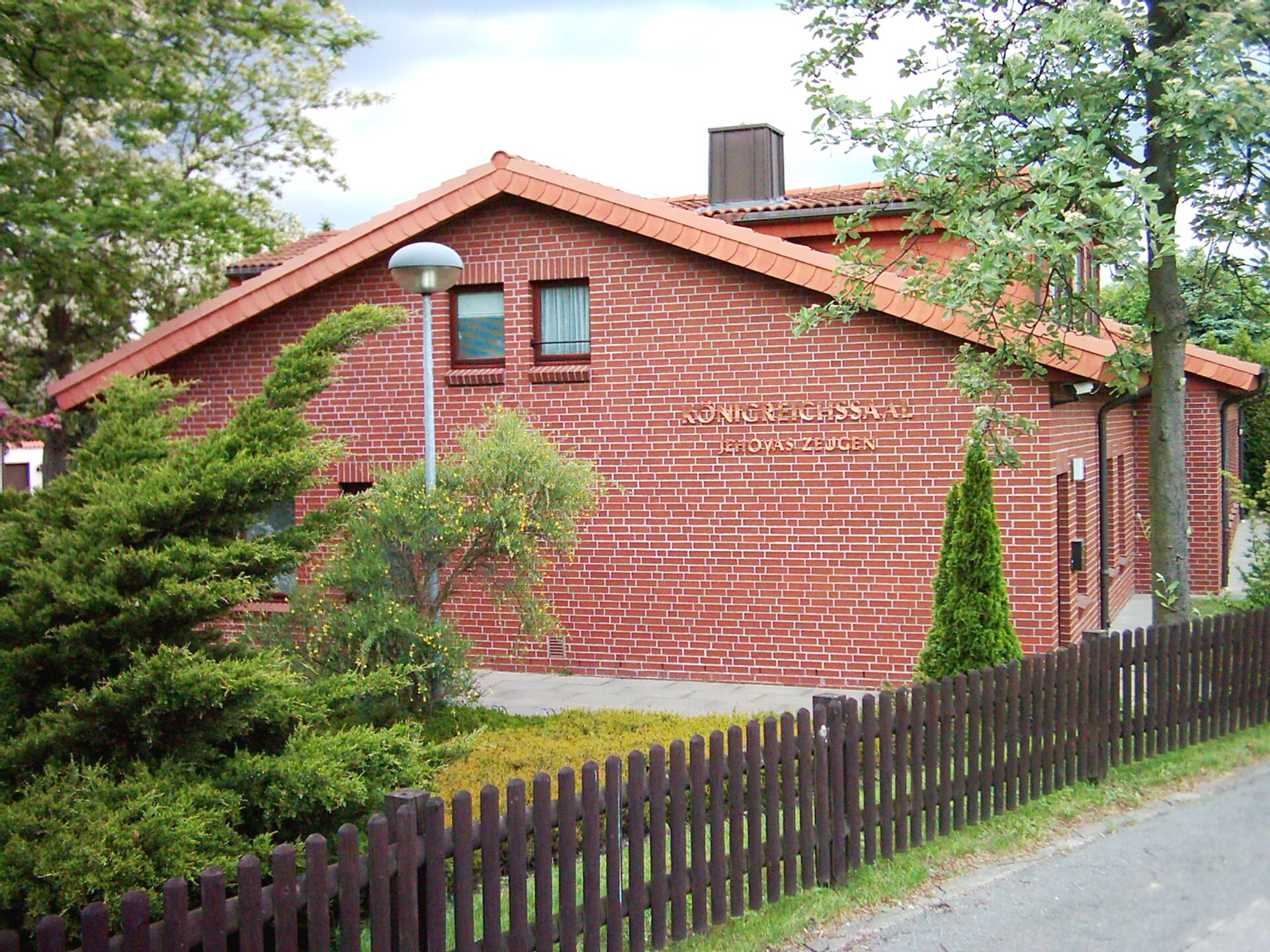
| Kingdom Hall of Jehovah's Witnesses, Heimfeld, Hamburg, Germany | GeorgHH (Wikimedia Commons user), May 2007 | Public domain: released into the public domain by the photographer; the Wikimedia Commons file page licence reads Public domain |
- Part 1: Roots & Reconstruction (Sunday, Nov. 8, noon Central)
- Part 2: Separate Tables (Monday, Nov. 9, noon Central)
- Part 3: The Original Watchtower & Esoteric Symbolism (Tuesday, Nov. 10, noon Central)
- Part 4: Mid-Century Transformation (Wednesday, Nov. 11, noon Central)
- Part 5: Global Expansion & Information Architecture (Thursday, Nov. 12, noon Central)
- Part 6: Contemporary Pressures & Institutional Scrutiny (Friday, Nov. 13, noon Central)
- Part 7: Synthesis & The Horizon (Saturday, Nov. 14, noon Central) — you are here
References
- Jehovah's Witnesses (jw.org). “2025 Grand Totals,” 2025 Service Year Report of Jehovah's Witnesses Worldwide (organization's own report). ↩
- Jehovah's Witnesses (jw.org). “2025 Country and Territory Reports,” 2025 Service Year Report of Jehovah's Witnesses Worldwide (organization's own report). ↩
- Watch Tower Bible and Tract Society. “Worldwide Report: 1995 Grand Totals,” 1996 Yearbook of Jehovah's Witnesses (1996). ↩
- Watch Tower Bible and Tract Society. “Worldwide Report: 2005 Grand Totals,” 2006 Yearbook of Jehovah's Witnesses (2006). ↩
- Watch Tower Bible and Tract Society. “2015 Grand Totals,” 2016 Yearbook of Jehovah's Witnesses (2016). ↩
- Watch Tower Bible and Tract Society. “Country and Territory Reports,” 2017 Service Year Report of Jehovah's Witnesses Worldwide (syr17 pp. 3-5). ↩
- Associated Press, via NBC News. “Timekeepers no more, rank-and-file Jehovah's Witnesses say goodbye to tracking proselytizing hours” (November 2023; secondary). ↩
- Pew Research Center. “Decline of Christianity in the U.S. Has Slowed, May Have Leveled Off: Findings from the 2023-24 Religious Landscape Study” (February 26, 2025). ↩
- Pew Research Center. “America's Changing Religious Landscape” (full report, May 12, 2015). ↩
- Statistics Canada. “Religion by gender and age: Canada, provinces and territories, Table 98-10-0353-01” (2021 Census, 25% sample data; released June 21, 2023). ↩
- Jehovah's Witnesses (jw.org). “How Many of Jehovah's Witnesses Are There Worldwide?” (FAQ page, accessed November 2026). ↩
- Watch Tower Bible and Tract Society. “Worldwide Preaching and Teaching,” 2016 Yearbook of Jehovah's Witnesses (2016). ↩
- Watch Tower Bible and Tract Society. “Worldwide Service Report—A Cause for Rejoicing,” Our Kingdom Ministry (January 1987, pp. 1-2; report on the 1986 service year). ↩
- Instituto Brasileiro de Geografia e Estatística (IBGE). “Censo Demográfico 2022, Religiões: Resultados preliminares da amostra” (presentation; date not shown on the saved text). ↩
- Pew Research Center. “Chapter 2: Religious Switching and Intermarriage,” America's Changing Religious Landscape (May 12, 2015). ↩
- Pew Research Center (Michael Lipka). “A closer look at Jehovah's Witnesses living in the U.S.” (April 26, 2016). ↩

Kemetic Minds Editorial Desk
Verified NewsroomPrimary-sourced investigative intelligence on civil rights, voting rights, federal policy, and consumer protection. Sourced from primary legal filings, government statistics, and direct field reporting.