Special Report, Part 2 of 7 — Separate Tables. Published Monday, Nov. 9, 2026. Every quotation and statistic below is checked against a saved copy of its source.
Executive summary
- In 1901 and 1907 Zion’s Watch Tower treated “colored” readers as a distinct category: about 200 such names on its lists, a call for speakers to report nearby “colored churches,” and lodging requests marked “if colored” [1][2][3].
- A January 15, 1950 Watchtower report described two 1949 assemblies for “colored brethren,” in Jacksonville and New Orleans, and said of the second that Witnesses were “forced by the law of the southland to practice segregation.” In 1948 Awake! had attacked a Southern church body for calling segregation God’s will [4][5].
- The Supreme Court reversed convictions of Witnesses from Georgia (1938), Mississippi (1943) and Alabama (1946). None of the opinions concerns segregation [6][7][8].
- A 2011 Watchtower life story says that in parts of the United States Black and white Witnesses “had to have separate congregations, circuits, and districts” and that integration came “gradually.” It is memoir and gives no dates [9].
- In 1958 and 1961 Awake! rejected racial-superiority theories while telling Christians not to join demonstrations or social-reform movements [10][11].
- No independent newspaper account was retrieved, and no dated document located shows seating rules or the year any Southern congregation integrated.
Scope and how the sources are labeled
Part 1 covered Charles Taze Russell’s origins and the post-Reconstruction settlement. This part starts in 1901 and runs to 1961, with one 2011 retrospective. Its subject is narrow: what the Bible Students and, later, Jehovah’s Witnesses wrote about race, what they reported doing, and what courts and outside observers recorded.
The organization’s own magazines are primary evidence of what it taught and reported about itself, not independent proof that events happened as described. Court opinions are primary. A 2021 UCLA master’s thesis and a chapter reporting 1968-69 fieldwork are secondary, and the thesis repeats claims from works not fetched here [12][13].
One category is missing. Searches of the Library of Congress’s Chronicling America newspapers were run, but the Library’s servers throttled the requests and no page text could be retrieved. No independent contemporary newspaper report is cited below.
1901-1907: a “colored” category in the Watch Tower
On October 15, 1901, Zion’s Watch Tower printed a letter from a Georgia reader and added an editor’s note. The note said about 200 “colored persons on the Watch Tower lists” gave good evidence of being among the “pure in heart” [1]. It also answered a complaint that the magazine “disdained brethren of color” because tract volunteers had been told to work at white Protestant churches.
Primary source excerpt. “Some have thought that we in some measure disdained brethren of color, because we stipulated that the […] distribution should be done at white Protestant churches. But not so: we meant no disparagement of Catholics, nor of blacks; but arranged thus merely because their average standards of intelligence, etc., do not seem to warrant the necessary outlay.” (Zion’s Watch Tower, October 15, 1901, editor’s note signed “Editor,” pp. 335-336) [1]
The note gives a reason, the “average standards of intelligence” of the groups named. It addresses one tract-distribution rule and says nothing about how Black readers were treated inside Bible Student meetings.
By June 1, 1907 the magazine was asking congregations to direct speakers toward Black churches. A short item, “Laboring Amongst the Colored People,” proposed that congregations with “a surplus of talent” put it to use “to the help of the colored brethren,” and it asked would-be speakers to state “the number of colored churches in your vicinity” [2].
Primary source excerpt. “In nearly every city of our land there are colored people whose parents were brought from Africa as slaves, and who in the Lord’s providence are now free and able to speak and read the English language. Many of them give evidence of deep religious sentiment and fervency of spirit. Why is not the Truth for these?” (Zion’s Watch Tower, June 1, 1907, “Laboring Amongst the Colored People,” p. 165) [2]
Two later 1907 items show race recorded in the mechanics of gatherings. For a convention at Niagara, readers wanting help with lodging were to state “sex (and if colored).” The item does not say why [3].
Primary source excerpt. “Write of this to the WATCH TOWER, Allegheny, on separate letter sheet, indicating sex (and if colored), stating the number of your party, and which two would occupy same double bed.” (Zion’s Watch Tower, August 15, 1907, “Secure Your Lodgings,” p. 244) [3]
The November 1, 1907 report on a convention at Norfolk, Virginia, said about 700 people assembled to hear a discourse on baptism in “the largest Baptist Church in Norfolk,” and that 53 were immersed [14]. It then added a sentence about two Black attendees.
Primary source excerpt. “Two colored brethren purposed being baptised the next day in the river, because Southern usage forbade the use of the Church fount, but they were not permitted to do so.” (Zion’s Watch Tower, November 1, 1907, report of the Norfolk convention, p. 325) [14]
The report does not say who refused the river baptism or why. It does show “Southern usage” shaping who used the church’s baptismal font.
1919-1930s: a magazine against lynching, and a “Colored Branch” known only second-hand
At the 1919 Cedar Point convention, Rutherford announced “a new magazine under the name and title THE GOLDEN AGE,” according to the organization’s own history of the period [15]. On May 26, 1920 that magazine ran “Facts About the American Negro.” It stated that in the thirty years from 1889 to 1918, lynching mobs killed 3,224 people in the United States, 2,522 of them Negroes and 702 white [16]. It also stated that in 1919 there were 78 blacks and 6 whites lynched.
The article’s tone was mixed. It described lynchings at length, and called Negroes “peaceful and law-abiding.” It also generalized about a race: “As a race they are happy, gentle, affectionate and humorous; and most of them are honest and industrious.” It said the South’s social attitude toward the Negro was one of aloofness but “not more so than in the North” [16]. Its remedy was eschatological.
Primary source excerpt. “The remedy for the injustices the Negro has suffered, and still suffers, is the same remedy that the Lord has reserved for the downtrodden of every race and clime. It is the coming of Messiah’s kingdom of wisdom, justice, love and power […]” (The Golden Age, May 26, 1920, “Facts About the American Negro,” p. 553) [16]
A UCLA master’s thesis by Markus Hicks reports a separate administrative structure in these years. Quoting “The 1931 I.B.S.A. Year Book,” p. 73, Hicks says that in 1919 the Society opened a “Colored Branch,” headed until 1934 by T. E. Banks of Cincinnati, and, citing the Year Book, describes it as “not for the purpose of segregation.” Hicks adds that in 1929 there were 304 public meetings held across the United States exclusively for Blacks, with attendance of 13,315 [12].
These are second-hand. The Year Books were not available for this report. For the 1929 figures Hicks cites the 1927 Year Book and a 2009 work by Pinn, and a 1927 volume cannot report 1929, so the origin of the figures is unclear. Treat the Colored Branch and its figures as unverified until the Year Books are checked.
1938-1946: Southern courts and Southern mobs
Three Southern Witness cases reached the Supreme Court in these years.
| Case | State and date decided | What the Witness was charged with | Outcome | Race in the opinion |
|---|---|---|---|---|
| Lovell v. City of Griffin, 303 U.S. 444 | Georgia, March 28, 1938 | Distributing religious tracts without a permit from the city manager | Judgment reversed | Not mentioned [6] |
| Taylor v. Mississippi, 319 U.S. 583 | Mississippi, June 14, 1943 | Teaching and distributing literature said to encourage disloyalty and refusal to salute the flag | Judgments reversed | Statute’s wording includes “racial distrust”; the charges concerned the flag and government [7] |
| Marsh v. Alabama, 326 U.S. 501 | Alabama, January 7, 1946 | Distributing religious literature in the company-owned town of Chickasaw | Conviction reversed | Not mentioned [8] |
In Taylor the Court wrote that the statute made it a crime to communicate “views and opinions respecting governmental policies,” and that “criminal sanctions cannot be imposed for such communication” [7]. In Marsh it held that a company town could not bar a Witness from distributing literature on its sidewalks [8]. The docket shows how Witnesses were policed. It does not show how Black and white Witnesses sat.
One document records racial violence against a Black Witness in this period. In January 1941 the American Civil Liberties Union published “The Persecution of Jehovah’s Witnesses,” a pamphlet quoting affidavits and other reports. It quotes one dated October 30, 1940, in which the affiant described the treatment of a Black Witness near Jasper, Texas [17].
Primary source excerpt. “While he was in Jasper he performed a baptismal service for some of the colored people, he himself being a colored man and one of Jehovah’s Witnesses.” (American Civil Liberties Union, The Persecution of Jehovah’s Witnesses, January 1941, pp. 9-10, quoting an affidavit dated October 30, 1940) [17]
According to the affiant, a mob seized him, beat him and ordered him out of Jasper, and the incident was one of “numerous acts of mob violence” in Jasper and Newton counties over three or four months [17]. These are an affiant’s allegations, collected by an advocacy group. The saved text records no court finding about them.
1948-1950: what Awake! said of others, and what the Watchtower reported of itself
The November 22, 1948 Awake! opened with “Democracy Backslides on the Racial Front.” It condemned segregation in schools, hospitals, the armed forces and transportation, and it criticized churches, quoting a May 13, 1948 Religious News Service dispatch in which the Southern Methodist General Conference called total race segregation “the will of God.” Awake! answered with Acts 17:26 and Genesis 11:1-9 [5]. The article’s first sentence set the tone: “Democracy in America is not as democratic as it boasts.” It named Christ’s “Theocratic Government” as the only answer to racial hatred. The saved text of the article does not mention the Witnesses’ own meetings or congregations.
The Witnesses’ own arrangements appear in the Watchtower of January 15, 1950, in a report on the 1949 U.S. district assemblies. It described Jacksonville, Florida, as “the first of two district assemblies for colored brethren,” with 1,163 present for the public lecture [4]. It then said “colored brethren in New Orleans, Louisiana, were holding theirs,” where 1,553 people were accommodated for the Sunday talk [4].
Primary source excerpt. “The witnesses present appreciated the fact that, even though forced by the law of the southland to practice segregation, Jehovah’s hand was in no wise shortened […] there will be no segregation of Christian brethren necessary.” (The Watchtower, January 15, 1950, “United States District Assemblies of 1949,” pp. 28-31) [4]
In a second passage about Jacksonville the report added:
Primary source excerpt. “While the assembly was for colored persons, there was no color line as far as the witnesses were concerned.” (Same article, The Watchtower, January 15, 1950, pp. 28-31) [4]
Principle and practice sit in the same report. In the New Orleans passage it attributed the separation to Southern law, and it predicted that at the 1950 New York convention “there will be no segregation of Christian brethren necessary.” It totaled fourteen assemblies at 49,641 on Saturday and 85,441 on Sunday, with 1,644 baptized [4]. It does not say whether mixed assemblies were tried or whether the law applied to religious gatherings.
The 1950s: separate congregations, circuits and districts, from memoir
The fullest account of congregational structure comes from the Watchtower’s own December 15, 2011 issue, in a life story by James A. Thompson, born in 1928 in the South [9].
Primary source excerpt. “At that time in parts of the United States, white and black Jehovah’s Witnesses had to have separate congregations, circuits, and districts. […] In 1954, some Witnesses took offense when no black speakers were on the program at a number of district assemblies.” (The Watchtower, December 15, 2011, “Making Adjustments Has Been Rewarding”) [9]
Thompson says his father was “company servant” of the Black congregation in Chattanooga in 1937, with another man leading the white one. In the summer of 1953 he was assigned, he writes, to serve “black circuits in the South” as a district overseer. He writes that after he was assigned as a speaker the following summer, “more black brothers in the South were on the programs,” and that “in time” congregations “gradually began to integrate,” which required reassigning publishers and adjusting territories, and that “Some, both blacks and whites, did not favor the new arrangement” [9]. He gives no year for integration.
Thompson also recounts refusing, in high school, to join an NAACP membership drive, explaining that “God is impartial” [9]. The account is retrospective and published by the organization.
The scholarship is thin. Hicks cites the scholar Werner Cohn as writing in the mid-1950s that “the Witnesses practice a very rigid racial segregation,” says segregation was practiced “as early as 1914” and ended as an institutional practice in the late 1960s. His sources are Cohn (1956) and a 1974 work by Cooper and Lee, neither fetched here [12]. The author of a 1968-69 study of a Black Witness congregation in North Philadelphia wrote that one historical study covered the Witnesses from 1942 to the 1960s, by Timothy White (1968), and that a 1962 book by the theologian George McKinney “gives only a superficial theological analysis without any consideration of Negro membership” [13].
Neutrality and the civil rights movement
The stated posture toward the movement followed from the doctrine of political neutrality. A November 22, 1958 Awake! article on race conflict in the United States said the Bible gave no support to racial hierarchy, then told Christians what their task was.
Primary source excerpt. “There is no basis in fact or Scripture to the theory of race superiority. […] So the work of Christians today is not to become embroiled in the world’s problems of social reform, but rather to announce to all men of good will that incoming New World of God’s creation.” (Awake!, November 22, 1958, pp. 19-20) [10]
The August 22, 1961 Awake! carried a longer treatment of “passive resistance.” It described Black students sitting at segregated lunch counters beginning February 1, 1960, questioned how effective such methods were and answered the question whether a Christian should take part.
Primary source excerpt. “The policy that Jesus followed was that of strict separateness from the political affairs of the world. […] When a Christian is arrested or made to suffer, it should be for keeping integrity to God, not for civil disobedience in a protest demonstration.” (Awake!, August 22, 1961, p. 12) [11]
Together these issues show a consistent public line: segregation and racial-superiority doctrines were condemned as unscriptural, and Witnesses were told to stay out of reform movements and demonstrations. What that meant for the structure of Southern congregations is what the saved documents leave open.
Stated policy and recorded practice, in date order
| Date | Document | Stated | Recorded practice | Kind of source |
|---|---|---|---|---|
| 1901-1907 | Zion’s Watch Tower | Denied disdain for “brethren of color” | Tract volunteers sent to white Protestant churches; lodging requests marked “if colored”; “Southern usage” barred two Black baptisms from a church font | Organization, primary [1][3][14] |
| May 26, 1920 | The Golden Age | Condemned lynching; remedy was God’s kingdom | Racial generalizations alongside condemnation | Organization, primary [16] |
| 1919-1934 | “Colored Branch” | Said not to be for segregation | Separate branch; meetings “exclusively for Blacks” | Thesis quoting a Year Book, secondary [12] |
| Nov. 22, 1948 | Awake! | Segregation is unscriptural | Not addressed | Organization, primary [5] |
| Jan. 15, 1950 | The Watchtower | “No color line”; segregation “forced by the law” | Separate assemblies for “colored brethren” at Jacksonville and New Orleans | Organization, primary [4] |
| 1953-1954 | Thompson memoir (2011) | Impartiality | Separate congregations, circuits and districts; no Black speakers on some 1954 programs | Organization, retrospective memoir [9] |
| 1958 and 1961 | Awake! | Do not join reform or demonstrations | Not addressed | Organization, primary [10][11] |
What the record does and does not show
- Established by dated documents: the Watch Tower used “colored” as a distinct category for readers, lodging and outreach in 1901 and 1907; it recorded Southern custom shaping a 1907 baptism; and its January 15, 1950 report acknowledged separate district assemblies for “colored brethren” in Jacksonville and New Orleans, attributing them to Southern law [1][3][14][4].
- Established by court opinions: the Supreme Court reversed Southern convictions of Witnesses in 1938, 1943 and 1946, on grounds that do not involve segregation [6][7][8].
- Not established: the year any specific Southern congregation integrated, whether separate Kingdom Halls were required by law, local custom or headquarters instruction, and how people were seated at mixed gatherings. The sources describe separate assemblies and congregations, not seating rules. A keyword search of the organization’s history chapter on 1919-1941 and its 1975 Yearbook chapter on the United States found no passage describing racial arrangements in congregations [18][15].
- Disputed or unverified: Cohn’s mid-1950s characterization, the 1914 start date, the late-1960s end date and the Colored Branch details all come through one master’s thesis citing works not fetched here [12].
- Thin by nature: the documented experience of Black Witnesses in these decades rests on one 1940 affidavit gathered by the ACLU, one organization-published memoir and one 1968-69 ethnography, not on contemporary records from the congregations themselves [17][9][13].
Image provenance
Every image in this report was checked against its source page for public-domain status. The basis is stated for each.
| Image (source page) | Creator, date | Public-domain basis |
|---|---|---|
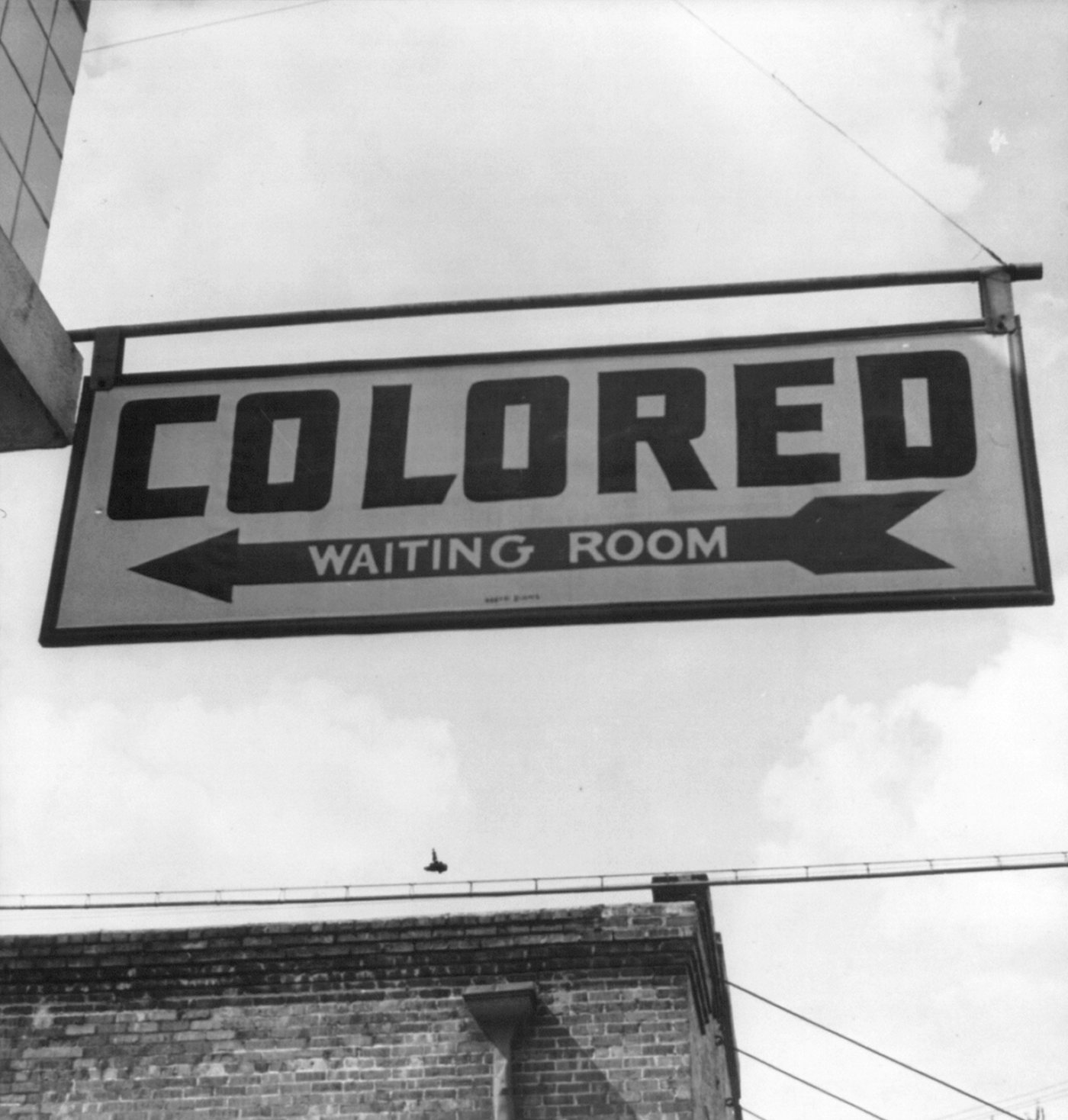
| "Colored Waiting Room" sign, Greyhound bus station, Rome, Georgia | Esther Bubley (Office of War Information photographer), September 1943 | Public domain: photograph by a US government (Office of War Information) photographer, Library of Congress digital ID cph.3b22541; Wikimedia Commons file page carries the PD-US-no notice tag and describes it as public domain. |
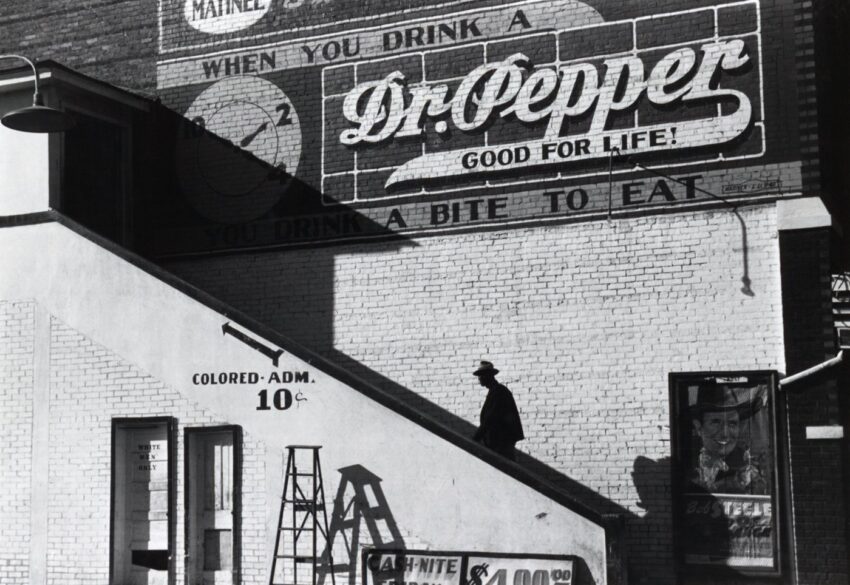
| Man going in the "colored entrance" of the Crescent Theatre, Belzoni, Mississippi, on a Saturday afternoon | Marion Post Wolcott (Farm Security Administration photographer), October 1939 | Public domain: Farm Security Administration photograph by a US government employee, Library of Congress digital ID ppmsca.12888; Wikimedia Commons file page carries the PD-USGov-FSA tag and describes it as public domain. |
- Part 1: Roots & Reconstruction (Sunday, Nov. 8, noon Central)
- Part 2: Separate Tables (Monday, Nov. 9, noon Central) — you are here
- Part 3: The Original Watchtower & Esoteric Symbolism (Tuesday, Nov. 10, noon Central)
- Part 4: Mid-Century Transformation (Wednesday, Nov. 11, noon Central)
- Part 5: Global Expansion & Information Architecture (Thursday, Nov. 12, noon Central)
- Part 6: Contemporary Pressures & Institutional Scrutiny (Friday, Nov. 13, noon Central)
- Part 7: Synthesis & The Horizon (Saturday, Nov. 14, noon Central)
References
- Watch Tower Bible and Tract Society. “Zion's Watch Tower, vol. XXII, issue of October 15, 1901 (editor's note after a reader's letter)” (October 15, 1901). ↩
- Watch Tower Bible and Tract Society. “Laboring Amongst the Colored People,” Zion's Watch Tower (June 1, 1907, p. 165). ↩
- Watch Tower Bible and Tract Society. “Secure Your Lodgings,” Zion's Watch Tower (August 15, 1907, p. 244). ↩
- Watch Tower Bible and Tract Society. “United States District Assemblies of 1949,” The Watchtower (January 15, 1950, pp. 28-31). ↩
- Watch Tower Bible and Tract Society. “Democracy Backslides on the Racial Front,” Awake! (November 22, 1948). ↩
- Supreme Court of the United States. “Lovell v. City of Griffin, Ga., 303 U.S. 444” (March 28, 1938). ↩
- Supreme Court of the United States. “Taylor v. Mississippi, 319 U.S. 583” (June 14, 1943). ↩
- Supreme Court of the United States. “Marsh v. Alabama, 326 U.S. 501” (January 7, 1946). ↩
- Watch Tower Bible and Tract Society. “Making Adjustments Has Been Rewarding,” The Watchtower (December 15, 2011). ↩
- Watch Tower Bible and Tract Society. “Awake!, issue of November 22, 1958 (article on race riots in the United States, pp. 16-20)” (November 22, 1958). ↩
- Watch Tower Bible and Tract Society. “Awake!, issue of August 22, 1961 (article on passive resistance, pp. 8-12)” (August 22, 1961). ↩
- Markus Hicks, University of California, Los Angeles. “Psychological Warfare: Jehovah's Witnesses and The African American Experience” (M.A. thesis, 2021). ↩
- De Gruyter (book chapter). “'Publish' or Perish: Negro Jehovah's Witness Adaptation in the Ghetto” (publication date not shown on the fetched page; reports 1968-69 fieldwork). ↩
- Watch Tower Bible and Tract Society. “Zion's Watch Tower, issue of November 1, 1907 (Norfolk convention report, p. 325)” (November 1, 1907). ↩
- Watch Tower Bible and Tract Society. “Advertise the King and the Kingdom! (1919-1941),” in Jehovah's Witnesses—Proclaimers of God's Kingdom (online edition, publication year not shown on the fetched page). ↩
- The Golden Age (Brooklyn, N.Y.). “Facts About the American Negro” (May 26, 1920, pp. 547-553). ↩
- American Civil Liberties Union. “The Persecution of Jehovah's Witnesses” (January 1941). ↩
- Watch Tower Bible and Tract Society. “1975 Yearbook of Jehovah's Witnesses, Part 2: United States of America” (1975). ↩

Kemetic Minds Editorial Desk
Verified NewsroomPrimary-sourced investigative intelligence on civil rights, voting rights, federal policy, and consumer protection. Sourced from primary legal filings, government statistics, and direct field reporting.