
Kemetic Minds Special Report — June 10, 2026
EXECUTIVE SUMMARY
The federal government has issued an El Niño Watch: there is an 82% chance El Niño conditions emerge by July 2026 and a 96% chance they persist through next winter, with forecasters unable to rule out a “super” event on the scale of 1997–98 or 2015–16 (NOAA Climate Prediction Center [CPC], 2026). This is arriving on top of the warmest decade ever measured and record ocean heat (NASA GISTEMP Team, 2026; NOAA National Centers for Environmental Information [NCEI], 2026; World Meteorological Organization [WMO], 2026). This report reviews the data, weighs the realistic worst cases against the scientific literature, and lays out a concrete family preparedness plan — because the households that plan ahead are consistently the ones that recover.
1. What the Earth System Is Telling Us
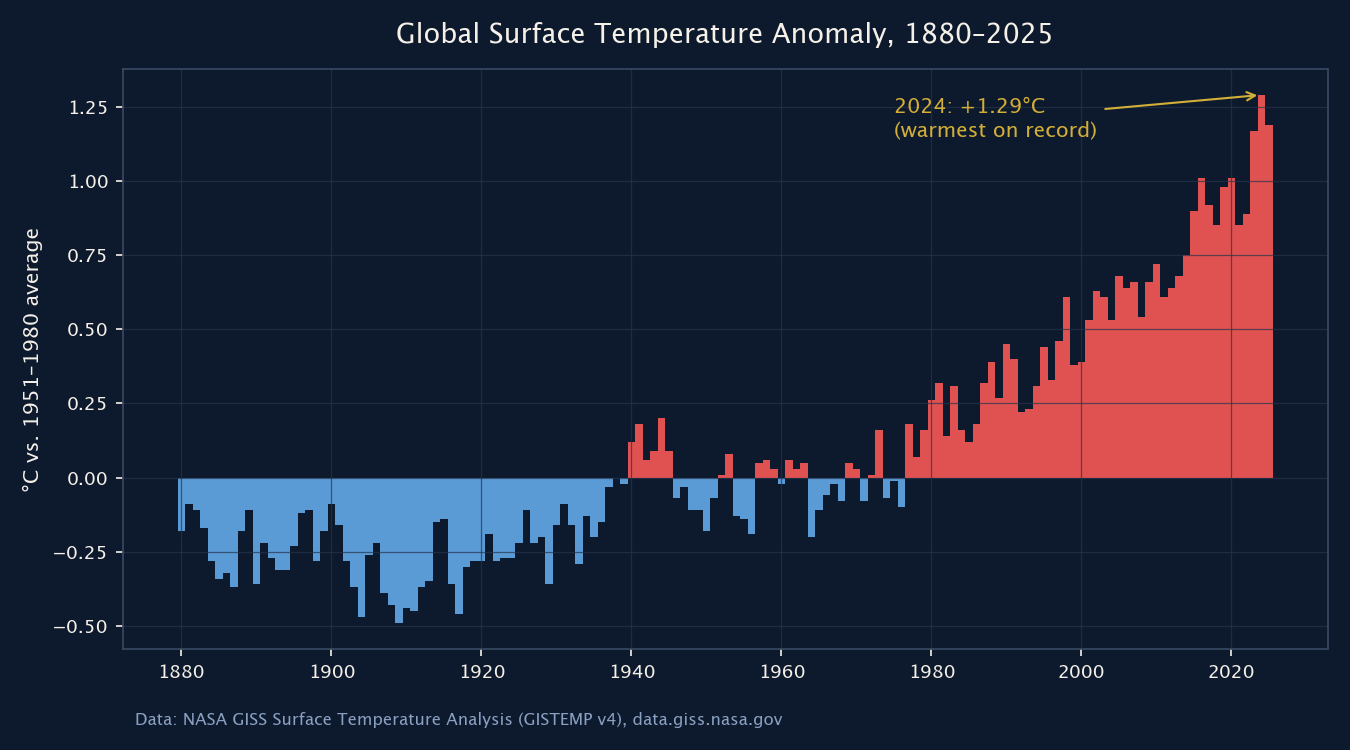
The numbers from the world’s primary monitoring agencies are unambiguous. NASA’s surface temperature analysis shows 2024 was the warmest year in the 146-year instrumental record at +1.29 °C above the 1951–1980 baseline, with 2025 the second warmest in its dataset (NASA GISTEMP Team, 2026). The World Meteorological Organization, drawing on eight independent datasets, reports that 2025 ran about 1.44 ± 0.13 °C above pre-industrial levels, that 2023–2025 were the three warmest years ever measured, and that 2015–2025 now stand as the warmest eleven years on record (WMO, 2026).
Figure 1
Global Surface Temperature Anomaly, 1880–2025
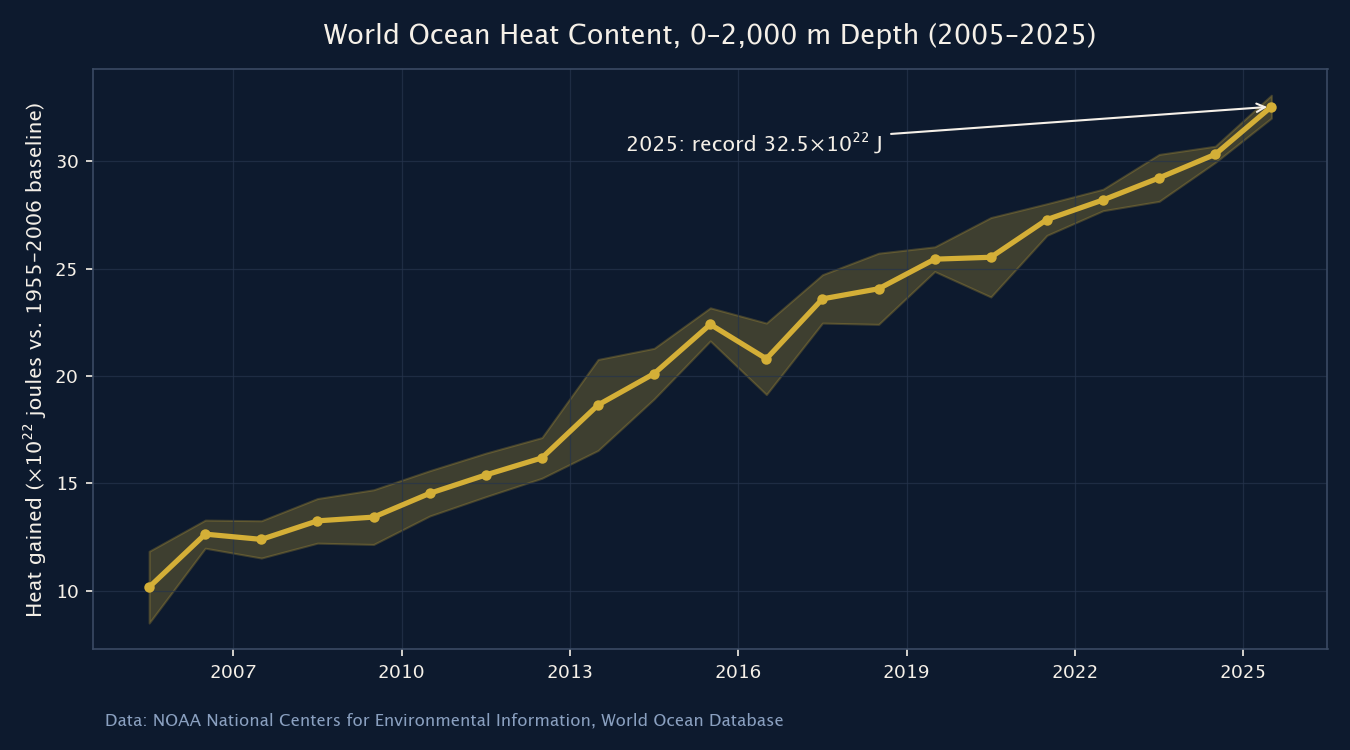
The clearest single indicator of a heating planet is not the air — it is the ocean, which absorbs roughly 90% of the excess heat trapped by greenhouse gases. In 2025 the heat content of the upper 2,000 meters of the world ocean set another record, continuing an essentially unbroken twenty-year climb (NOAA NCEI, 2026). A warmer ocean is the fuel tank for what comes next: it loads the dice for stronger El Niño impacts, heavier rainfall events, marine heat waves, and coral die-offs.
Figure 3
World Ocean Heat Content, 0–2,000 m, 2005–2025
2. The 2026–27 Super El Niño Watch
On May 14, 2026, NOAA’s Climate Prediction Center placed the country under an official El Niño Watch. The agency’s diagnostic discussion gives El Niño an 82% chance of emerging during May–July 2026 and a 96% chance of being in place through the December 2026–February 2027 winter (CPC, 2026). Critically, the CPC’s strength outlook spreads its probabilities almost evenly across moderate, strong, and very strong outcomes — no single category exceeds about 37% — which means forecasters cannot rule out a top-tier event (CPC, 2026).
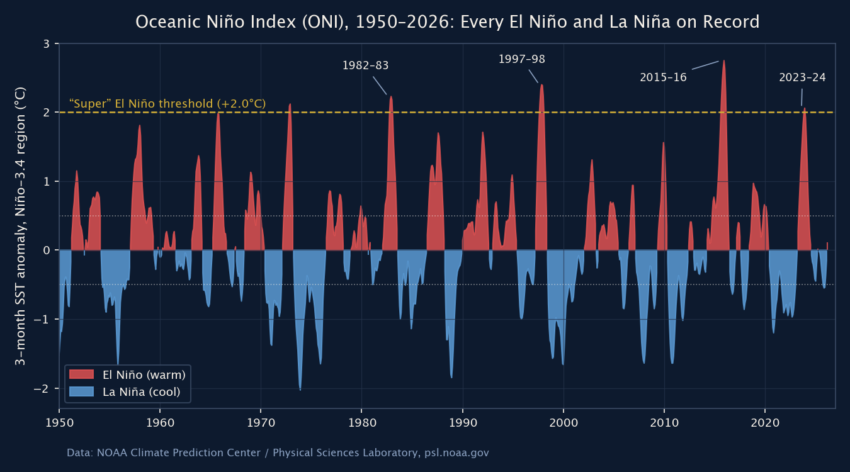
The historical record explains why that matters. In the 76-year Oceanic Niño Index record, only four events have reached or passed the +2.0 °C threshold commonly called a “super” El Niño: 1982–83 (peak about +2.2), 1997–98 (about +2.4), 2015–16 (about +2.6), and 2023–24 (about +2.0) (NOAA Physical Sciences Laboratory, 2026). Each reorganized weather across the planet — drought and fire in Southeast Asia and southern Africa, catastrophic flooding in Peru and East Africa, mass coral bleaching, and disease outbreaks in their wake.
For our readers across Texas and the Gulf South, El Niño winters historically tilt wetter and cooler, raising flash-flood risk through the cool season. There is one piece of better news: NOAA’s May outlook calls for a below-normal 2026 Atlantic hurricane season — a 55% chance of below-normal activity, with 8–14 named storms — precisely because El Niño’s wind shear tends to suppress Atlantic storms (NOAA, 2026). Forecasters add the standard caution that it only takes one landfalling storm to make it a bad year for your family.
3. Could This Cascade Into Global Catastrophe?
Let us be precise, because this is where coverage usually goes wrong in one of two directions — dismissal or doom.
What is likely if a strong El Niño develops: a new global temperature record in 2026 or 2027 (the WMO already gives an 80% chance that at least one year between 2025 and 2029 beats 2024); regional crop failures and food-price spikes in rice, wheat, and palm oil; cholera and dengue surges in flood zones, as happened after 1997–98; another global coral bleaching event; and billions of dollars in weather losses concentrated, as always, in communities with the least cushion (WMO, 2026).
What the scientific literature says about worst cases: a body of peer-reviewed work argues that genuinely catastrophic outcomes are understudied rather than impossible. Kemp et al. (2022), writing in the Proceedings of the National Academy of Sciences, call worst-case warming scenarios “dangerously underexplored” and argue for treating them the way we treat pandemic and nuclear risk. Armstrong McKay et al. (2022), in Science, identify multiple climate “tipping elements” — the Greenland and West Antarctic ice sheets, tropical coral systems, and abrupt permafrost thaw among them — that could be triggered within the warming range we have already entered. And Ditlevsen and Ditlevsen (2023) published statistical evidence that the Atlantic overturning circulation, which regulates climate on both sides of the Atlantic, could collapse this century — a finding that remains actively debated, with other oceanographers arguing the timeline is far less certain.
The honest bottom line: no scientific agency forecasts that this El Niño will produce a global catastrophe. What the data do show is a planet running hotter than at any point in recorded history, entering a phase of its strongest natural climate cycle, with credible researchers warning that the tail risks deserve more respect than they get. You do not need to believe in apocalypse to conclude that the rational household response is the same one the science supports: be prepared for longer disruptions, more often.
4. Family Preparedness: The Case for Acting Now
Preparedness is not paranoia — it is generational self-defense, and for Black families the stakes are documented. Sociologists Junia Howell and James Elliott, studying fourteen years of federal data, found that natural disasters actively widen racial wealth gaps: in hard-hit counties, white households on average gained wealth after disasters while Black households lost tens of thousands of dollars, in part because recovery aid flows along lines of property and credit (Howell & Elliott, 2019). The families that weather disruption are the ones with a plan, supplies, documents, and insurance in place before the sirens. We covered the on-the-ground reality in our report on the storms battering the Southern states and the survival gameplan that goes with them.
The federal standard, from the Department of Homeland Security’s Ready.gov emergency kit guidance (2026) and FEMA, comes down to this:
🧰 THE KEMETIC MINDS FAMILY PREPAREDNESS CHECKLIST
- Water: one gallon per person per day — at least 3 days for evacuation, aim for 2 weeks at home.
- Food: 2 weeks of shelf-stable food your family actually eats; manual can opener.
- Power & light: flashlights, batteries, battery banks for phones, battery or hand-crank NOAA Weather Radio.
- Medicine: minimum one week of prescriptions; first-aid kit; copies of prescriptions.
- Documents: IDs, deeds, insurance policies, and medical records — physical copies in a waterproof pouch plus encrypted digital copies.
- Cash: small bills; ATMs and card readers fail when the grid does.
- Communication plan: an out-of-state contact every family member can text, plus two meeting points (near home, outside the neighborhood).
- Alerts: enable Wireless Emergency Alerts on every phone; know your county’s outdoor-warning and evacuation routes.
- Insurance: review now — standard homeowners and renters policies do not cover flooding, and National Flood Insurance Program policies typically carry a 30-day waiting period. An El Niño winter is exactly when the Gulf South floods.
- Community: check on elders; coordinate with neighbors, church, and family group chats. Mutual aid is the oldest preparedness technology we have.
What Happens Next
The Climate Prediction Center updates its ENSO outlook on the second Thursday of every month, and NOAA will refresh its hurricane outlook in early August. We will track each update, and if this event strengthens toward the super-El Niño tier, we will publish follow-up guidance for the regions our readers call home. Build the kit this month — not the week the forecast turns.
References
Armstrong McKay, D. I., Staal, A., Abrams, J. F., Winkelmann, R., Sakschewski, B., Loriani, S., Fetzer, I., Cornell, S. E., Rockström, J., & Lenton, T. M. (2022). Exceeding 1.5°C global warming could trigger multiple climate tipping points. Science, 377(6611), eabn7950.
Ditlevsen, P., & Ditlevsen, S. (2023). Warning of a forthcoming collapse of the Atlantic meridional overturning circulation. Nature Communications, 14, Article 4254.
Howell, J., & Elliott, J. R. (2019). Damages done: The longitudinal impacts of natural hazards on wealth inequality in the United States. Social Problems, 66(3), 448–467.
Kemp, L., Xu, C., Depledge, J., Ebi, K. L., Gibbins, G., Kohler, T. A., Rockström, J., Scheffer, M., Schellnhuber, H. J., Steffen, W., & Lenton, T. M. (2022). Climate Endgame: Exploring catastrophic climate change scenarios. Proceedings of the National Academy of Sciences, 119(34), e2108146119.
NASA GISTEMP Team. (2026). GISS Surface Temperature Analysis (GISTEMP), version 4. NASA Goddard Institute for Space Studies.
NOAA. (2026, May). NOAA predicts below-normal 2026 Atlantic hurricane season. National Oceanic and Atmospheric Administration.
NOAA Climate Prediction Center. (2026, May 14). El Niño/Southern Oscillation (ENSO) diagnostic discussion. National Weather Service.
NOAA National Centers for Environmental Information. (2026). Global ocean heat and salt content. NOAA NCEI.
NOAA Physical Sciences Laboratory. (2026). Oceanic Niño Index (ONI) data. NOAA PSL.
U.S. Department of Homeland Security. (2026). Build a kit. Ready.gov.
World Meteorological Organization. (2026). State of the global climate 2025. WMO.

Kemetic Minds Editorial Desk
Verified NewsroomPrimary-sourced investigative intelligence on civil rights, voting rights, federal policy, and consumer protection. Sourced from primary legal filings, government statistics, and direct field reporting.