
KEMETIC MINDS
Weather & Survival Report — May 25, 2026
A year-long run of deadly tornado outbreaks across the South and Midwest — including an EF-3 that tore a mile-wide path through St. Louis — reflects a broader trend: billion-dollar U.S. weather disasters now strike roughly every 16 days, down from every 82 days in the 1980s. Below is a recap of the latest outbreak and a 5-step preparedness plan that could save your life.
🔥 STORM RECAP — THE SOUTH UNDER SIEGE
Southern States Hammered: A Year of Deadly Tornadoes, Violent Hail, and Rising Casualties
The South has taken a brutal beating. From a mass-casualty tornado outbreak in the spring of 2025 to
a rapid-fire series of violent twisters across the lower Mississippi Valley in 2026, the pattern is
impossible to ignore: extreme weather is arriving faster, hitting harder, and striking with less warning
than previous generations ever experienced. Here is what happened.
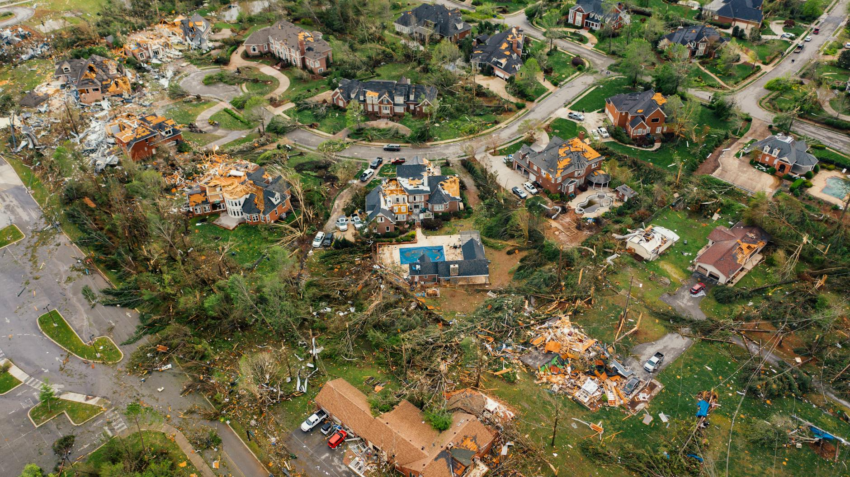
🌪️ Storm 1 — May 16–17, 2025: Multi-State Outbreak, 28 Dead
One of the deadliest single outbreak sequences in recent memory tore through 15 states
from the Heartland to the East Coast over two days. Kentucky bore the heaviest toll with
19 fatalities, primarily concentrated in Laurel County, where entire neighborhoods
were described by officials as simply “blown away.” Missouri lost 7 people, mostly in
St. Louis, where an EF-3 tornado with 140 mph winds and a path up to one mile wide
ripped through densely populated areas. Two more died in Virginia (ABC News, 2025).
- At least 26 tornadoes confirmed across the outbreak sequence
- EF-3 in St. Louis: 140 mph winds, 1-mile-wide damage path, 38 injured
- 462,000+ customers lost power across multiple states
- Governor Andy Beshear called it one of the worst disasters “in terms of loss of life and damage” during his tenure
🌪️ Storm 2 — April 23–28, 2026: EF-4 Strikes Oklahoma, 99 Tornadoes Confirmed
A six-day outbreak sequence produced 99 confirmed tornadoes across Oklahoma, Texas,
Missouri, Kansas, and surrounding states. The most violent tornado — an EF-4 near
Enid, Oklahoma on April 23 — produced winds of 180 mph and caused extreme
structural damage across multiple homes. An EF-3 in Mineral Wells, Texas on April 28 destroyed
or damaged 132 buildings and injured five people. Softball-sized hail in
Springfield, Missouri alone was estimated to cause tens of millions of dollars in damage
(Wikipedia / NWS, 2026).
- 99 tornadoes total: 1 EF-4, 1 EF-3, 5 EF-2, 45 EF-1, 36 EF-0
- 3 deaths, 16 injuries across the full sequence
- A Particularly Dangerous Situation (PDS) Tornado Watch was issued for multiple states
- Widespread power outages affected thousands of customers
🌪️ Storm 3 — May 6–7, 2026: Nocturnal EF-3 Ravages Southern Mississippi
A particularly dangerous overnight outbreak struck southern Mississippi, where an extremely
long-tracked EF-3 tornado carved a path through Wilkinson, Franklin,
Lincoln, and Lawrence counties. The storm struck while most residents were asleep, limiting
evacuation time. Nearly 500 homes were damaged or made inaccessible; 815 structures
were damaged in Franklin and Lincoln counties alone. Approximately 20,000 customers lost
power. The heaviest concentration of casualties occurred at the Wash Trailer Park in
Bogue Chitto, where 12 people were injured.
- Rain-wrapped, nocturnal tornado — nearly invisible and striking while people slept
- 500+ homes damaged or inaccessible; 815 structures damaged in two counties alone
- 20,000 power outages reported
- Highlights the deadly danger of tornadoes that arrive without visual warning at night
📊 The Data Doesn’t Lie: Extreme Weather Is Accelerating
The storms above are not flukes. They fit a decades-long and accelerating trend
documented by the National Oceanic and Atmospheric Administration (NOAA) and maintained by
Climate Central
since NOAA’s NCEI program was restructured in May 2025. The Billion-Dollar Weather and Climate
Disasters dataset — the most authoritative long-term record of U.S. catastrophic weather —
tells a stark story across more than four decades.
1980–2024. Data: NOAA National Centers for Environmental Information (NCEI) & Climate Central
(steward since May 2025). CPI-adjusted. The frequency of catastrophic weather events has increased
7-fold from the 1980s to the early 2020s.
| Decade | Total Events | Avg Events/Year | Avg Annual Cost | Days Between Disasters |
|---|---|---|---|---|
| 1980s | 28 | 2.8 | $12.8B | 82 days |
| 1990s | 52 | 5.2 | $27.0B | — |
| 2000s | 59 | 5.9 | $51.0B | — |
| 2010s | 119 | 11.9 | $80.2B | — |
| 2020–2024 | ~100 | ~20 | $149B | 16 days |
Source: NOAA National Centers for Environmental Information & Climate Central, CPI-adjusted to 2024 dollars.
Decade totals and averages from
NOAA Climate.gov
and Climate Central.
The numbers are jarring: in the 1980s, a billion-dollar disaster struck roughly once every 82 days.
By the early 2020s, that interval had collapsed to once every 16 days — and in 2025,
to once every 10 days (Climate Central, 2025). Annual costs quadrupled from an average of
$22.6 billion in the 1980s to $99.5 billion in the 2010s, and surged again to $149 billion
annually during 2020–2024 — a 50% increase over the previous decade.
🛡️ Your 5-Step Survival Gameplan for Extreme Weather
You don’t need an elaborate bunker. You need a simple, practiced plan your whole
household can execute when a tornado warning drops at 2 a.m. or a flash flood cuts off your exit.
Here is what actually works — condensed and actionable.
Step 1 — Know Your Alerts Before the Storm
- Download a NOAA weather app (Weather.gov, Weather Channel, or Apple/Google Weather) and enable severe weather push notifications for your county right now — not during the storm.
- Understand the difference: a Watch means conditions are favorable; a Warning means a tornado has been spotted or radar-confirmed. A Warning means move immediately.
- If you live in tornado alley or the South, invest $30 in a NOAA weather radio with battery backup. It wakes you up. Your phone on silent does not.
Step 2 — Identify Your Safe Room Now
- Safest: underground basement, storm cellar, or FEMA-rated safe room. Second safest: interior room on the lowest floor, away from windows — a bathroom or closet with load-bearing walls.
- Walk your household through it tonight. Everyone — including kids — should know the route in the dark.
- If you live in a mobile home or manufactured housing: leave for a sturdy building immediately when a Warning is issued. Mobile homes offer almost no protection from even a weak tornado.
Step 3 — Build a 72-Hour Go-Bag
- Water: 1 gallon per person per day for 3 days. Add water purification tablets as backup.
- Food: Non-perishable items (canned goods, protein bars, peanut butter). No cooking required.
- Power: Portable battery bank fully charged, plus a hand-crank or solar charger.
- Documents: Copies of ID, insurance cards, medications list in a waterproof bag or sealed zip-lock.
- First aid kit: Include any prescription medications (2-week supply if possible), plus a whistle and flashlight with extra batteries.
- FEMA’s ready.gov/kit is the free, authoritative checklist. Bookmark it.
Step 4 — Make a Household Communication Plan
- Designate an out-of-state contact everyone can reach. Local lines get jammed during disasters; long-distance calls often go through.
- Agree on a meeting point outside your neighborhood in case you can’t return home.
- Teach kids your phone number and the out-of-state contact’s number by memory — don’t rely on them having a charged phone.
- Text before you call during emergencies — texts use less network bandwidth and are more likely to deliver.
Step 5 — After the Storm: Don’t Rush In
- Wait for the all-clear from local authorities before exiting your shelter. Secondary tornadoes within the same system are common.
- Assume downed power lines are live. Stay at least 30 feet away from any downed wire and report it to the utility company.
- Do not use gas-powered generators, grills, or camp stoves indoors — carbon monoxide kills more people after storms than the storms themselves.
- Document all damage with photos before you move anything. You will need this for insurance claims.
- Check on elderly neighbors and those without transportation — the community recovery is as important as the individual one.
📌 Bottom Line
Preparedness is not paranoia — it is the one variable entirely within your control when a storm
doesn’t care about your plans. The data shows extreme weather is not slowing down. The community
that survives it is the one that already walked through the plan before the sirens went off.
Do it this week. Not next month.
🧠 The Bigger Picture
The three storm events above are not random bad luck. They are the visible edge of a systemic shift
in weather patterns driven by a warming atmosphere holding more energy and moisture. The peer-reviewed
science behind the NOAA billion-dollar disaster database — now maintained by
Climate Central
— documents this not as projection but as observed, measured fact: from 1980 to 2024, the U.S.
sustained 403 billion-dollar weather disasters claiming nearly 17,000 lives and costing over
$2.9 trillion (Climate Central, 2025; NOAA NCEI, 2024).
The particular vulnerability of the South and Midwest deserves emphasis. Tornado Alley has functionally
expanded eastward into what researchers now call the “Dixie Alley” — covering Mississippi,
Alabama, Tennessee, and the surrounding region. Tornadoes in this corridor are more likely to be
nocturnal, rain-wrapped, and moving through high-population rural areas with lower rates of access
to basements or storm shelters than the classic Great Plains footprint (NOAA Storm Prediction Center, 2026).
The May 6–7 Mississippi outbreak — striking overnight, invisible in the rain, tearing through
trailer parks while families slept — is not an edge case. It is the new template.
Preparation is not a guarantee. But it is a multiplier. Communities where residents have shelter
plans, go-bags, and working weather alerts consistently record lower per-capita injury and death
rates even in equivalent-strength tornado events. That is the lever we control.
References
- Climate Central. (2025). U.S. Billion-Dollar Disasters: 1980–2024.
climatecentral.org
(Peer-reviewed dataset, formerly NOAA NCEI) - NOAA Climate.gov. (2020). 2010–2019: A landmark decade of U.S. billion-dollar weather and climate disasters.
climate.gov - NOAA National Centers for Environmental Information (NCEI). (2024). U.S. Billion-Dollar Weather and Climate Disasters, 1980–present.
ncei.noaa.gov - Wikipedia / NWS. (2026). Tornado outbreak sequence of April 23–28, 2026.
Wikipedia - iWeatherNet / NWS. (2026). 2026 Southern Mississippi tornado outbreak (May 6–7, 2026).
Tornadoes Wiki - ABC News / CBS News. (2025). At least 28 dead as tornadoes, storms batter states from the Heartland to the East Coast.
ABC News - FEMA / Ready.gov. (2025). Build a Kit.
ready.gov - NOAA Storm Prediction Center. (2026). Day 1 Convective Outlook, May 25, 2026.
spc.noaa.gov
Methodology: Storm data sourced from NOAA National Weather Service confirmed reports,
Wikipedia/Tornadoes Wiki (citing NWS), ABC News, and CBS News. Climate trend data sourced from NOAA
NCEI Billion-Dollar Disasters dataset (now stewarded by Climate Central) and NOAA Climate.gov peer-reviewed
analysis. All cost figures CPI-adjusted to 2024 dollars. Preparedness guidance follows FEMA/Ready.gov
standards.
📱 Stay Connected
Related Interactive Tracker
U.S. Power Outage Tracker (Live 50-State Grid Status)
Monitor county-by-county power grid status and severe weather utility restorations.

Kemetic Minds Editorial Desk
Verified NewsroomPrimary-sourced investigative intelligence on civil rights, voting rights, federal policy, and consumer protection. Sourced from primary legal filings, government statistics, and direct field reporting.