
KEMETIC MINDS
Analysis — July 16, 2026
Note: This piece uses a clinical psychology concept — trauma bonding — as an interpretive lens on history and survey data. It is an analogy, not a diagnosis. No individual or group is being clinically assessed. Read the counter-arguments section before drawing conclusions.
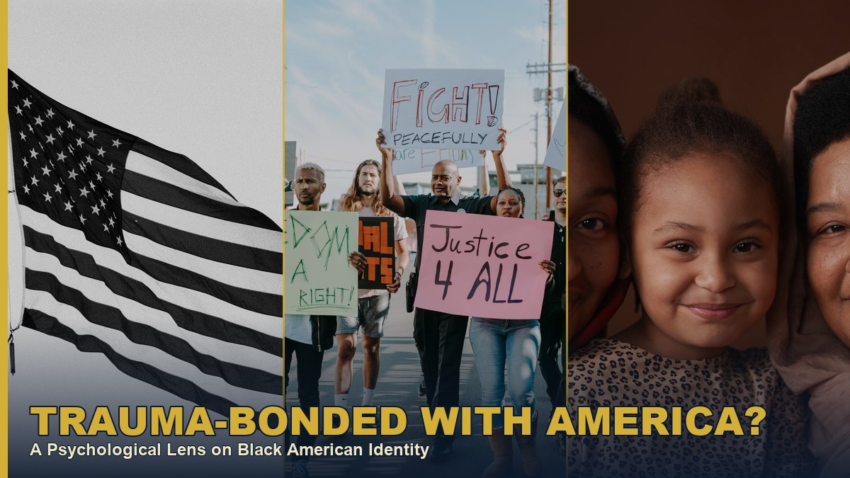
Clinicians warn the term “trauma bond” is being misapplied to everyday hardship — but the data behind this piece raises a genuine question: with only 20% of Black Americans saying they’re extremely proud to be American and just 19% saying the American Dream holds true for them, is the relationship between Black America and the country itself showing signs of one? Here’s what the clinical definition actually requires, and what the 2026 polling shows.
1. What a Trauma Bond Actually Is, Clinically
Before applying any psychological concept to a group of 40+ million people, it’s worth being precise about what the concept actually means in a clinical setting, because “trauma bond” has become one of the most overused phrases in pop psychology. Psychology Today’s clinical reference defines it as an emotional attachment that forms specifically inside an abusive relationship — “the connection the victim feels toward the perpetrator” — built on “cycles of negative reinforcement interspersed with occasional bursts of positive reinforcement” (Ma, 2026). The mechanism is intermittent reinforcement: unpredictable rewards are, counterintuitively, more powerful at cementing attachment than either consistent punishment or consistent kindness would be on their own.
Two structural features distinguish a clinical trauma bond from an unhappy relationship: an uneven power dynamic, and a foundation that includes real harm — “threats of harm, manipulation, control, shaming, gaslighting, and sabotage, mixed with intermittent moments of calm and displays of affection” (Ma, 2026). The term was popularized by psychologist Patrick Carnes to describe exactly this pattern inside abusive intimate relationships, and it has since been extended by clinicians to family systems, workplaces, cults, and — more controversially — to the relationship between citizens and the state itself. Clinical psychologist Leigh W. Jerome argued in Psychology Today that when “citizens form trauma bonds with abusive or narcissistic political leaders, these environments have been characterized as intrinsically toxic, cult-like, and harmful to followers” — a framework she applies to authoritarian politics broadly, not to any one racial or ethnic group (Jerome, 2025).
That last point matters for what follows. Jerome’s article establishes that clinicians already treat citizen-state trauma bonding as a coherent, discussable idea — this piece borrows that structure and asks a narrower question: does the specific, centuries-long relationship between Black Americans and the United States exhibit the pattern the clinical literature describes? The honest answer requires taking the analogy seriously without mistaking a nation of individuals for a single psychiatric patient.
2. The Historical Pattern: Cycles of Harm and Partial Repair
Applied loosely as a lens, the trauma-bond framework maps onto a recognizable historical rhythm. Two and a half centuries of chattel slavery were followed by the brief expansion of citizenship and voting rights during Reconstruction, which was then rolled back by nearly a century of Jim Crow segregation, convict leasing, and racial terror. The Civil Rights Act and Voting Rights Act of the 1960s delivered another expansion, followed by decades of contested enforcement, mass incarceration, and ongoing disparities in policing, lending, and housing. Each cycle contains the same two ingredients the clinical definition requires: documented harm, and a period of genuine, if partial and unevenly distributed, improvement — what the psychological literature calls intermittent reinforcement.
W.E.B. Du Bois gave this dynamic its most enduring name in 1903: “double consciousness,” the experience of “always looking at one’s self through the eyes of others,” of feeling “two souls, two thoughts, two unreconciled strivings” — American and Black at once (Pittman, 2023). Du Bois was not describing an abuse dynamic in clinical terms; he was describing an identity condition produced by exclusion from full citizenship while still being asked to claim it. That distinction is worth holding onto: the trauma-bond lens and the double-consciousness lens describe overlapping territory from different disciplines, one clinical and one sociological, and neither was designed as a diagnosis of a people. Our earlier piece on what the Fourth of July has historically meant to formerly enslaved Americans traces this same tension through Frederick Douglass’s 1852 speech asking what the holiday means to someone still excluded from its promise.
None of this requires treating history as a single unbroken abuse cycle. Legal emancipation, the end of legal segregation, and the election of Black officials at every level of government are not manipulative gestures inside a closed system — they are the product of sustained organizing, litigation, and political coalition-building by Black Americans themselves, often over the objection of the state. A trauma-bond lens that erases that agency isn’t more accurate; it’s just a different kind of flattening.
3. What the 2025-2026 Data Actually Shows
Set the history aside for a moment and look only at how Black Americans currently describe their relationship to the country, in their own survey responses. Gallup’s June 2025 measurement found that just 24% of Black Americans are satisfied with how Black people are treated in the United States, compared with 45% of white Americans and 37% of Hispanic Americans — and that Black satisfaction has fallen roughly 20 points since 2001, when majorities of Black respondents were satisfied (Gallup, 2026b). In Gallup’s separate 2026 national-pride tracking poll, only 20% of “people of color” said they were “extremely proud” to be American, down 10 points from 30% the year before, against 33% of all U.S. adults (Gallup, 2026a).
The AP-NORC America 250 poll, fielded in April 2026 amid heightened national tension, asked a more pointed question: does the American Dream hold true for you? Only 19% of Black adults said yes, currently true, compared with 40% of white adults; 30% of Black adults said the American Dream has never been true for people like them, compared with 12% of white adults (AP-NORC, 2026). That is close to a mirror-image gap — white and Black Americans are reporting close to opposite lived experiences of the same national promise.
At the same time, in-group identification and mutual obligation among Black Americans remain strong and largely unchanged over time: 75% of Black adults say being Black is extremely or very important to their self-concept, and among those who feel that way most strongly, 65% describe other Black Americans as “brothers or sisters” (Cox et al., 2026). Read alongside the dissatisfaction numbers, the picture isn’t simply “attachment despite harm” in the trauma-bond sense — it looks more like two separate and only loosely connected relationships: a durable, largely positive bond to Black community and identity, and a much more conditional, increasingly strained relationship to the state and its institutions. That distinction is the same one explored in our piece on why more Americans are leaving the country than arriving, and how Freedmen and Freedwomen are opting out, and in the growing Black expatriate movement we’ve tracked through 2026.
4. The Case Against the Framing
The strongest objection to this entire exercise is clinical, not political: “trauma bond” is a term of art describing a specific interpersonal pattern between an identifiable victim and an identifiable abuser, and licensed clinicians are increasingly frustrated at watching it get stretched to cover almost any difficult relationship. Clinical psychologist Carla Manly told Salon that casual, social-media-driven overuse of the term “dilutes the meaning and significance of serious mental health concerns,” and that people routinely misapply language meant for victims of repeated abuse to ordinary conflicts with coworkers or exes (Karlis, 2023). A nation-state is not a single perpetrator with intent, and 40+ million Black Americans are not one patient with one psychology; applying a two-person clinical framework to a multigenerational, geographically and economically diverse population risks exactly the kind of dilution Manly is warning about.
There’s a second objection, more historical than clinical: trauma-bond language centers the abuser’s behavior as the explanation for why the victim stays, which can obscure the fact that Black Americans have never been purely passive parties choosing between leaving and staying. The Reconstruction amendments, the Civil Rights Act, and the Voting Rights Act weren’t concessions an abuser handed down during a calm phase of the cycle — they were extracted through litigation, boycotts, marches, and political organizing that Black Americans led. A framework built around victimhood and passive attachment can undersell exactly the agency that produced most of the country’s actual civil rights progress.
A third, more sympathetic reading treats the trauma-bond lens not as a diagnosis of a people but as a description of a structural bind: leaving is expensive, disruptive to family and community networks, and not equally available to everyone, while staying means continuing to absorb documented disparities in wealth, health, policing, and political representation. Under that reading, the framework isn’t explaining irrational attachment — it’s naming a rational cost-benefit calculation made under real constraints, which is a very different thing from a psychological bond to an abuser.
5. So: Trauma Bond, or Something Else?
Held up against the clinical criteria — an identifiable power imbalance, a pattern of real harm, and intermittent reinforcement that produces attachment despite that harm — the historical rhythm of Black American life in the United States does exhibit real structural parallels to what clinicians describe. The data confirms that the “reinforcement” side of that cycle looks thinner every year: satisfaction with treatment near historic lows, pride in the country falling faster among people of color than among the population overall, and a stark racial gap in whether the American Dream itself is even believed to be real (Gallup, 2026a, 2026b; AP-NORC, 2026).
What the data does not support is the passive half of the analogy. The in-group data shows a Black American identity that is strong, self-defined, and largely independent of how the state treats it — not a bond forged by dependency on an abuser, but a source of resilience that has consistently outlasted, and often driven, the periods of “positive reinforcement” the trauma-bond model credits to the country itself. Whatever this relationship is, it is not simple, and it is not static. What keeps some people choosing to stay and organize for change, rather than exit, is its own question — one we take up directly in a companion piece the following day.

Kemetic Minds Analysis
Psychological language travels easily and explains poorly when it’s stretched past its clinical boundaries, and we want to be direct about that risk here: “trauma bond” is a two-person clinical term, and no group of 40+ million people functions as a single psychiatric case study. What the data does support is narrower and, we think, more useful — a documented, worsening gap between how attached Black Americans are to their own community and identity (strong, stable, self-defined) and how satisfied they are with their treatment by the country itself (declining, on nearly every available measure through 2026). Whether you call that gap a trauma bond, a rational cost-benefit calculation under real constraints, or simply the latest chapter of Du Bois’s double consciousness, the honest takeaway is the same: attachment and grievance are not contradictory in this relationship, they are the relationship. We’re not resolving that tension in this piece, and we don’t think it resolves the same way for everyone — which is exactly why we’re following it tomorrow with the other half of the conversation: why a lot of Black Americans, knowing all of the above, choose to stay and fight anyway.
References
- AP-NORC Center for Public Affairs Research. (2026, June). AP-NORC America 250 poll. apnorc.org
- Cox, K., Edwards, K., Im, C., & Mukherjee, S. (2026, February 25). For many Black Americans, family extends beyond birth and legal ties. Pew Research Center. pewresearch.org
- Gallup. (2026a). American pride falls to 25-year record low. news.gallup.com
- Gallup. (2026b). How Americans perceive treatment of racial, ethnic groups. news.gallup.com
- Jerome, L. W. (2025, June 27). The trauma-bonded citizen. Psychology Today. psychologytoday.com
- Karlis, N. (2023, June 14). You’re misusing the term “trauma bonded.” Salon. salon.com
- Ma, L. (Reviewer). (2026, May 19). Trauma bonding. Psychology Today. psychologytoday.com
- Pittman, J. P. (2023). Double consciousness. In E. N. Zalta & U. Nodelman (Eds.), The Stanford Encyclopedia of Philosophy (Spring 2023 ed.). plato.stanford.edu
Investigative Methodology: Every statistic and quote in this analysis is sourced to a named publication or dataset with a direct link, and every source was independently fetched and checked against the original page before inclusion. No Wikipedia sources and no unverified social-media claims were used. Citations follow APA 7th edition format. This piece applies a clinical concept as an analytical lens on group-level survey data and historical scholarship; it is not a clinical assessment of any individual or group.
Stay Connected

Kemetic Minds Editorial Desk
Verified NewsroomPrimary-sourced investigative intelligence on civil rights, voting rights, federal policy, and consumer protection. Sourced from primary legal filings, government statistics, and direct field reporting.