
KEMETIC MINDS
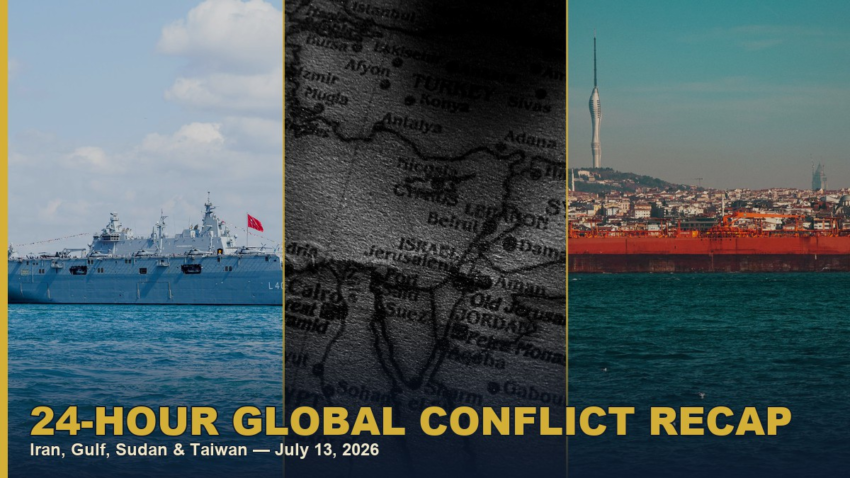
24-Hour Global Conflict Recap — July 13, 2026
In the past 24 hours the U.S. reinstated a full naval blockade of Iranian ports, new explosions hit near the Strait of Hormuz, the Houthis threatened Saudi infrastructure, and a Sudanese court sentenced a militia commander to death over Darfur killings. Below is the full rundown of each flashpoint, tracked in real time on our Global Conflict Tracker.
1. The Blockade: What Changed Overnight
Our July 12 report covered Iran firing coordinated strikes at six Gulf nations in a single morning. In the 24 hours since, the US carried out another wave of strikes on Iranian air-defense systems, coastal radar sites, and missile and drone capabilities, using fighter aircraft, naval vessels, and — for the first time in this conflict — one-way attack sea drones. Iran’s IRGC retaliated within hours, hitting a radar site in Bahrain, a vessel-detection system in Oman, and a US Army missile base in Kuwait (Al Jazeera, 2026a).
The US Navy-led Joint Maritime Information Centre then announced the reinstated blockade will take effect at 20:00 GMT on July 14, covering the entire southern coast of Iran including ports and oil terminals. Neutral transit through the Strait of Hormuz and humanitarian shipments are still permitted pending inspections, but JMIC warned that vessels helping others circumvent the blockade will be treated as “working with or for Iran” and subject to boarding (Al Jazeera, 2026b).
2. Bandar Abbas and Araghchi’s “Guardian Forever” Line
Iran’s state news agency IRNA reported new explosions in eastern Bandar Abbas late Monday, with air defenses activated and the cause still unconfirmed. It follows a round of US strikes a day earlier that targeted Bandar Abbas, Qeshm Island, and Hajjiabad in Hormozgan province, including a submarine and ship maintenance facility at Iran’s Bandar Abbas Naval Base (Al Jazeera, 2026b).
The explosions came hours after Iranian Foreign Minister Abbas Araghchi said Iran “has always been the guardian of the Strait and will remain so forever,” responding to President Trump’s announcement that the US would levy a charge on vessels transiting Hormuz. Araghchi added on social media that a 20% cut “is of course too much. We will be fair” (Al Jazeera, 2026b).
3. The Houthis Widen the Fight
Yemen’s Saudi-backed, internationally recognized government struck the Houthi-controlled airport in Sanaa, saying the strike was meant to prevent an Iranian aircraft from landing. The Houthis responded by claiming a strike on Saudi Arabia’s Abha International Airport with “a number of ballistic missiles and drones” and warning airlines against flying through Saudi airspace. A Houthi political-bureau official separately said the group would target Saudi “vital infrastructure” in retaliation (Al Jazeera, 2026b).
Iran’s foreign ministry condemned the Sanaa strike as a “clear violation of international law and the United Nations Charter,” a reminder that the Houthi-Saudi track and the direct US-Iran track are now moving in parallel rather than in isolation (Al Jazeera, 2026b).
4. Gaza and Lebanon: The War’s Other Fronts Keep Bleeding
Away from the Gulf headlines, Israeli forces bombed a group of Palestinians near Gaza City, critically wounding several, and an Israeli drone attack wounded more Palestinians near az-Zawayda in central Gaza, according to Wafa news agency (Al Jazeera, 2026b).
In Lebanon, Prime Minister Nawaf Salam and President Joseph Aoun discussed the latest round of Lebanese-American-Israeli negotiations, with the withdrawal of Israeli forces still the central sticking point. Lebanon’s health ministry says Israeli attacks since March 2 have killed at least 4,324 people and wounded 12,221 (Al Jazeera, 2026b).
“Israel does not control the strait. Traffic is flowing.”
US Central Command, on the Strait of Hormuz dispute — via Kemetic Minds, July 12 report — Read the full report →
5. Sudan’s Death Sentence, Taiwan’s Buildup
A Sudanese anti-terrorism court in Port Sudan sentenced RSF commander Mohamed Hamdan “Hemedti” Dagalo and 15 other defendants to death over killings in West Darfur — a symbolic ruling given Hemedti remains at large, but one that adds to the mounting documentation of RSF atrocities our tracker has followed since the UN’s genocide finding in el-Fasher (Middle East Eye, 2026).
In the Indo-Pacific, analysts continue reading China’s recent moves — joint air patrols with Russia, coast guard activity east of Taiwan, and last week’s rare submarine-launched ballistic missile test into the open Pacific — as reflecting a broader push for regional military dominance rather than isolated exercises (Channel News Asia, 2026).
6. Track It Live
This recap covers roughly the last 24 hours across all four fronts we’re following. For the full, continuously updating, timestamped feed — sourced exclusively from outlets headquartered outside the United States — see our Global Conflict Tracker, which refreshes hourly as verified developments occur.
Treat single-source casualty figures and “closed strait” claims from any party as provisional until independently confirmed — a discipline that has mattered in every report we’ve published on this conflict so far.
Kemetic Minds Analysis
The throughline of the last 24 hours is that this conflict is no longer escalating on one axis at a time. A naval blockade, a live exchange of fire near the Strait of Hormuz, a second front opening between the Houthis and Saudi Arabia, and unrelated but simultaneous developments in Gaza, Lebanon, Sudan, and the Taiwan Strait are all moving in the same 24-hour window. None of that guarantees a wider war — the blockade still permits humanitarian shipments and neutral transit pending inspection, and Iran’s own statements are aimed at extracting compensation for strait passage rather than closing it outright. But it does mean the number of independent flashpoints that could misfire into something larger is growing, not shrinking. The single clearest thing to watch next is whether the blockade actually takes effect as announced on July 14, and how Iran responds in the hours after enforcement begins.
References
- Al Jazeera. (2026a, July 13). US and Iran trade strikes as ceasefire comes under growing strain. aljazeera.com
- Al Jazeera. (2026b, July 13). Iran war live: US naval blockade of Iran to begin on Tuesday. Live updates, tracked on kemeticmind.com
- Middle East Eye. (2026, July 13). Sudan court sentences RSF commander to death over West Darfur killings. middleeasteye.net
- Channel News Asia. (2026, July 13). ‘Extraordinary confluence’: What China’s latest military moves reveal about its broader strategy. channelnewsasia.com
Investigative Methodology: Sourced from Al Jazeera’s live conflict coverage, Middle East Eye, and Channel News Asia — all outlets headquartered outside the United States. No Wikipedia sources and no unverified social-media claims were used. Citations follow APA 7th edition format.
Stay Connected

Kemetic Minds Editorial Desk
Verified NewsroomPrimary-sourced investigative intelligence on civil rights, voting rights, federal policy, and consumer protection. Sourced from primary legal filings, government statistics, and direct field reporting.