KEMETIC MINDS
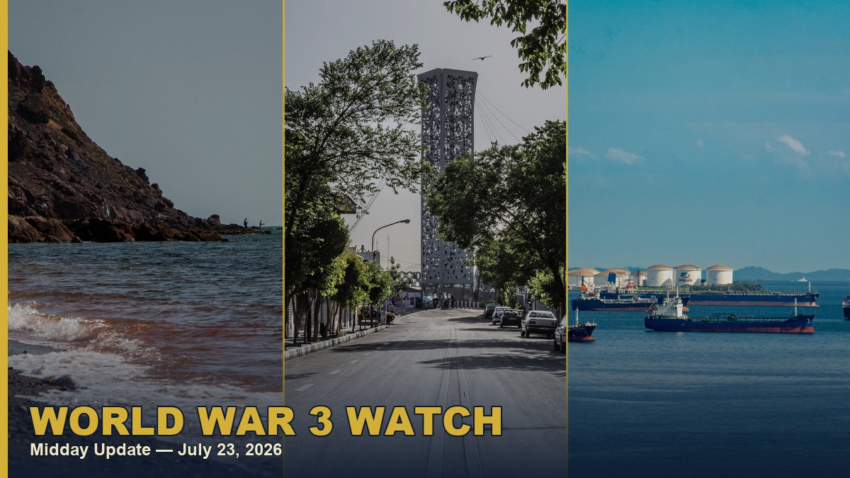
World War 3 Watch — Midday Update — July 23, 2026
- Houthis strike Saudi oil tankers in the Red Sea; the US conducts its 12th consecutive night of strikes on Iran (Yahoo, 2026; Al Monitor, 2026).
- Oil surges past $100 a barrel for the first time since late May; the UN chief warns the region is “teetering on the edge of the unimaginable” (Al Monitor, 2026).
- China begins two days of live-fire drills in the Taiwan Strait near Fujian province while Beijing’s Commerce Ministry blocks US sanctions on five Chinese firms linked to Iranian oil (Reuters via MSN, 2026; 财联社, 2026, authors’ translation).
- Trump warns of “major military punishment” for both the Houthis and Iran if Red Sea attacks continue, as US Secretary of State Rubio says Iran will “pay a heavy price” (Yahoo, 2026; 美国之音, 2026, authors’ translation).
Video: US-Iran War LIVE: Iran’s ‘Monster Missiles’ Hit Qatar, Kuwait, Jordan; IRGC Claims Syria Strike Too. Source: WION.
1. Houthi Red Sea Attacks & the Strait of Hormuz Crisis
Yemen’s Iranian-backed Houthi movement escalated the maritime front of the Iran war on Wednesday evening, attacking two Saudi oil tankers in the Red Sea. Houthi military spokesman Yahya Sarea said the group struck the Saudi-flagged tankers Encelia and Layla with missiles and drones, claiming the vessels had “violated” the Houthi blockade of Saudi ports (Yahoo, 2026). The Saudi Press Agency confirmed that the Encelia was hit while sailing in the Red Sea, resulting in a fire at the bow of the vessel; all crew members were reported safe (Yahoo, 2026).
In a parallel development, Iran’s Islamic Revolutionary Guard Corps (IRGC) said a tanker caught fire following an explosion on a mined route in the Strait of Hormuz, a vital waterway that is now effectively closed (Yahoo, 2026). President Donald Trump warned the Houthis on Thursday that any further attacks on Saudi vessels would trigger “major military punishment” against both the Houthis and Iran (Yahoo, 2026). US Secretary of State Marco Rubio, speaking on the sidelines of a Southeast Asian summit in Manila, said the Houthis had been “suckered” into attacking Red Sea shipping by Iran (Al Monitor, 2026).
Chinese-language coverage from 华尔街见闻 adds an important detail absent from most English reports: Trump posted on his Truth Social platform that a civilian nuclear cooperation agreement between the US Energy Department and Saudi Arabia will be approved — but only if Riyadh joins the Abraham Accords and normalizes relations with Israel (华尔街见闻, 2026, authors’ translation). This linkage, also reported by NBC News (2026), ties the maritime crisis directly to the broader diplomatic realignment Washington is demanding in the region.
For a deeper look at how US, Israeli, Iranian, and BRICS media each frame these events, see our narrative-comparison report.
Video: US launches attacks to ‘punish’ Iran after troops killed. Source: TRT World.
2. US Military Escalation: 12th Night of Strikes and Regional Fallout
The US military completed its 12th consecutive night of strikes on Iranian military assets early Thursday. US Central Command (CENTCOM) said the overnight round targeted Iranian naval capabilities, missile and drone storage facilities, coastal surveillance sites, and air defense assets, further degrading “Iran’s ability to attack civilian mariners and commercial shipping” (美国之音, 2026, authors’ translation). The same Chinese-language report notes that the US has resumed a naval blockade of Iranian ports and oil terminals since the ceasefire collapsed, diverting nine commercial vessels and disabling one to prevent进出 Iranian ports (美国之音, 2026, authors’ translation).
Iran’s military responded in kind. Army spokesperson Mohammad Akraminia said, “The armed forces’ retaliatory attacks will continue as long as the US attacks on the country’s infrastructure and coastal areas continue” (Al Monitor, 2026; 华尔街见闻, 2026, authors’ translation). Iranian state media reported that two people were killed in the latest US strikes (Yahoo, 2026).
The conflict is spilling across multiple borders. Jordan and Kuwait both reported intercepting Iranian missiles and drones. 华尔街见闻 (2026, authors’ translation) reports that the Iraq-Kuwait border crossing of阿卜杜利 (Abdali) was hit by Iranian missile strikes on Wednesday, while Iranian media reported that a US missile strike on the伊朗 border crossing at 沙拉姆切赫 (Shalamcheh) killed two people. Bahrain said its air defenses intercepted and destroyed multiple Iranian aerial attacks launched on Wednesday (美国之音, 2026, authors’ translation).
The IRGC also warned the UK that any base used to attack Iran is a “legitimate target,” following reports that US long-range B-1 bombers flown out of a British airbase were used in the overnight strikes (Yahoo, 2026). There has been no comment from London. 华尔街见闻 (2026, authors’ translation) adds that US特种作战部队 (special operations forces) have been deployed from bases inside the US to the Middle East over the past week, with multiple fighter squadrons assembled and bombers on heightened alert. The report states that 18 US service members have been killed and at least 482 wounded in military operations against Iran.
Video: Live: Latest on Middle East conflict as Iran’s retaliates against US-Israel strikes. Source: CGTN.
3. China-Taiwan Flashpoint: Live-Fire Drills in the Strait
Even as the Iran-Hormuz war dominates headlines, the parallel China-Taiwan flashpoint remains active. China’s Maritime Safety Administration issued a navigation warning that live-fire drills would be conducted in parts of the Taiwan Strait near the coast of Fujian province on July 23 and 24, from 06:00 to 18:00 local time each day (手机网易网, 2026, authors’ translation; Reuters via MSN, 2026). The warning, posted by漳州海事局 (Zhangzhou Maritime Safety Administration), specifies that entry into the affected zone is prohibited during drill hours.
The English-language coverage from Reuters (via MSN, 2026) is brief, noting only that the drills began Thursday and come a day after other regional developments. The Chinese-language source (手机网易网, 2026) provides the exact coordinates and timing but no additional political commentary — a contrast with earlier PLA drills around Taiwan that were accompanied by explicit statements from Beijing about opposing “separatism.” The timing of these drills, simultaneous with the peak of US-Iran hostilities, keeps the Taiwan Strait as an active secondary front in the broader great-power tension.
4. Economic Shockwaves: Oil at $100 and Washington’s Energy War on Iran
The price of Brent crude surged past $100 a barrel on Thursday, the highest level since the end of May, as the Houthi attacks and the effective closure of the Strait of Hormuz tightened global supply fears (Yahoo, 2026; Al Monitor, 2026). European Central Bank President Christine Lagarde warned that “the energy shock could intensify further” and push up inflation, feeding speculation about a September eurozone interest rate hike (Al Monitor, 2026). German Defence Minister Boris Pistorius warned of “dire consequences” for oil-importing economies and said “nothing — absolutely nothing — suggests that a ceasefire, let alone peace, could be reached” (Al Monitor, 2026).
The economic war extends beyond the battlefield. In Chinese-language coverage, US Treasury Secretary Scott Bessent claimed in a Fox Business interview that China’s purchases of Iranian oil have dropped by approximately 40% due to US sanctions on Chinese “teapot” refineries (手机网易网, 2026, authors’ translation). The Chinese commentary dismisses this as political spin, arguing that the reduction is driven by China’s ample strategic petroleum reserves and normal market adjustments, and noting that China is building alternative payment channels through CIPS and bilateral settlement systems (手机网易网, 2026, authors’ translation).
Beijing is fighting back legally. On May 2, 2026 — with the ban republished on July 23 — China’s Ministry of Commerce issued a blocking order under the Blocking Foreign Laws and Measures with Improper Extraterritorial Application rules, prohibiting Chinese entities from recognizing, enforcing, or complying with US sanctions against five Chinese petrochemical firms: 恒力石化(大连)炼化有限公司, 山东寿光鲁清石化有限公司, 山东金诚石化集团有限公司, 河北鑫海化工集团有限公司, and 山东胜星化工有限公司 (财联社, 2026, authors’ translation). This is a direct legal countermeasure to Washington’s “long-arm jurisdiction” over Iran oil trade.
5. The Nuclear Dimension: ‘Mount Gao’ and the Saudi-Israel Deal
Beneath the surface of the daily strikes and tanker attacks, a nuclear subplot is intensifying. 华尔街见闻 (2026, authors’ translation) reports that the US has notified Israel of plans to escalate strikes in the coming days, including the potential use of heavy bombers for the first time since the US-Israeli campaign against Iran began this year. The target: Iran’s地下核设施 (underground nuclear facility) at 镐山 (Mount Gao), near the Natanz nuclear site in Isfahan province. Israel’s intelligence community believes Iran moved thousands of uranium enrichment centrifuges to tunnels beneath Mount Gao in the autumn of 2025 (华尔街见闻, 2026, authors’ translation).
Iran’s Foreign Ministry spokesperson巴加埃 (Bagaei) dismissed the focus on Mount Gao, saying the site has “no nuclear activity” and that “America’s obsessive attention to Mount Gao is nothing but a fabricated excuse for aggression, destruction, and vandalism” (华尔街见闻, 2026, authors’ translation).
Meanwhile, the nuclear deal between the US and Saudi Arabia that Trump conditionally endorsed — requiring Riyadh to normalize with Israel — explicitly excludes uranium enrichment and is limited to civilian nuclear energy (华尔街见闻, 2026, authors’ translation; NBC News, 2026). This puts Washington in the position of demanding non-proliferation from Saudi Arabia while simultaneously threatening to bomb Iranian nuclear facilities — a duality that each side’s media covers very differently.
Is This Actually World War 3?
Based solely on today’s sources, the answer remains: not yet — but the architecture of a multi-front great-power conflict is becoming more visible by the hour. The US and Iran are in a direct, daily kinetic exchange across the Gulf and into Iraq, Kuwait, Jordan, and Bahrain.
The Houthis have opened a Red Sea front against Saudi shipping. China has activated a Taiwan Strait military exercise simultaneous with the peak of US-Iran fighting. And Beijing has formally legislated a countermeasure to US sanctions on Iran-linked firms — an explicit legal-economic confrontation.
What prevents this from being “World War 3” in the classic sense is the absence of direct combat between nuclear-armed great powers (US vs. China or Russia).
But the parallel theaters — Hormuz and the Taiwan Strait — are now live simultaneously, and the economic spillover ($100 oil, energy shock warnings from the ECB and Germany) is global. The UN Secretary-General’s warning that the situation is “teetering on the edge of the unimaginable” is the most sober assessment in today’s sources. This is not yet a world war, but it is a world in the throes of a rapidly expanding regional war with global-systemic implications.
What You Can Do Right Now
- Revisit your household preparedness: With oil past $100 and European leaders warning of an escalating “energy shock,” supply chain disruptions and price increases are likely to accelerate. Review our survival skills and preparedness guide for practical steps on food, water, and energy resilience.
- Track the maritime exclusion zones: If you or your organization has supply chain exposure in the Red Sea, Gulf, or Taiwan Strait, check official navigation warnings daily. The Strait of Hormuz is effectively closed, and the Taiwan Strait has active live-fire zones through at least July 24.
- Watch for currency and payment-system shifts: China’s formal blocking order against US sanctions and its promotion of CIPS-based trade settlement are early indicators of a fracturing global financial system — monitor how your bank and investments handle sanctions-related disruptions.
Kemetic Minds Analysis
This roundup pulled directly from the day’s English- and Chinese-language wires side by side, because the gap between what each side chooses to report is often as informative as any single strike count. Treat the Key Takeaways above as the verified factual floor, and the framing differences noted in the sections above as the more interesting, harder-to-fake signal about where this war is actually headed next.
References
- Yahoo. (2026, July 23). Yemen’s Houthis attack Saudi tanker as US launches more Iran strikes. yahoo.com
- MSN. (2026, July 23). US hits Iran as Houthis claim strikes on Saudi tankers. msn.com
- Al Monitor. (2026, July 23). US vows to punish Iran after Houthis strike tankers. al-monitor.com
- Fox News. (2026, July 23). US completes latest round of strikes on Iran as oil prices continue rising over Mideast instability. foxnews.com
- NBC News. (2026, July 23). Trump administration live updates: Iran-backed militants’ Red Sea attacks could open new trade chokepoint. nbcnews.com
- fire drills in Taiwan Strait. (2026, July 23). China begins two days of live. msn.com
- 美国之音. (2026, July 23). 卢比奥国务卿称伊朗将为袭击船只付出“沉重代价”,美军连续第12次发动袭击 [US Secretary of State Rubio warns Iran will pay a “heavy price” for attacking ships as US military launches 12th consecutive strike]. voachinese.com
- 华尔街见闻. (2026, July 23). 伊拉克与科威特边境口岸遭伊朗打击,特朗普:若再袭沙特船只,美国将施以“重大军事惩罚” [Iraq-Kuwait border crossing hit by Iran, Trump: US will impose “major military penalty” if Saudi ships are attacked again]. wallstreetcn.com
- 手机网易网. (2026, July 23). 航行警告:台湾海峡军事演习 [Navigation Warning: Military Exercises in the Taiwan Strait]. 163.com
- 财联社. (2026, July 23). 商务部发布禁令,阻断美国对5家中国企业实施涉伊朗石油制裁措施 [China’s Ministry of Commerce issues ban to counter US sanctions on 5 Chinese firms over Iran oil dealings]. cls.cn
- 手机网易网. (2026, July 23). 美财长又挑拨:中国采购伊朗石油骤降40%,德黑兰被逼入绝境 [US Treasury Secretary Accuses China of Sharply Reducing Iranian Oil Purchases by 40%, Forcing Tehran into a Desperate Situation]. 163.com
Investigative Methodology: This roundup is generated on a fixed schedule (noon and evening, America/Chicago) from live English- and Chinese-language wire sources. Every claim is grounded in fetched source text with an APA7 in-text citation; translated Chinese-language quotes are marked “authors’ translation.” Every video embed is verified to be a real, existing video via YouTube’s oEmbed endpoint before publication — none are written by the drafting model. No Wikipedia sources are used.
Stay Connected

Kemetic Minds Editorial Desk
Verified NewsroomPrimary-sourced investigative intelligence on civil rights, voting rights, federal policy, and consumer protection. Sourced from primary legal filings, government statistics, and direct field reporting.