World News · World War 3 Watch · September 26, 2026, 9:22 AM CDT
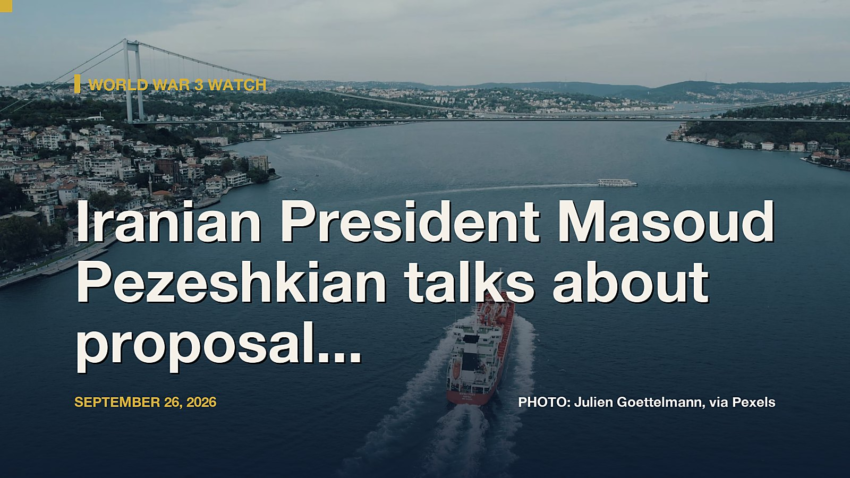
Iranian President Masoud Pezeshkian said there was an "atmosphere of distrust" between Iran and the U.S. when asked whether he would have been willing to meet with President Trump in New York this week, an idea raised by the U.S. leader.[1]
Pezeshkian, during an interview with "Face the Nation with Margaret Brennan" Friday, suggested that he would need to know "what exactly we want to reach an understanding on," after running through a list of the times the U.S. has attacked Iran while the countries were in the midst of negotiations.[1]
Video: Associated Press, September 27, 2026 — “Trump rejects Iran's proposal to reopen the Strait of Hormuz”. Matched to this story by shared names and terms in its title; watch the original for full context.
What happened
But he also said Iran would "abide by whatever we commit to" if the U.S. accepts the latest Iranian proposal to reopen the Strait of Hormuz.[1]
Related developments
Trump rejects Iran's conditional ceasefire proposal, WSJ reports, as Saudi coalition intercepts projectiles
President Donald Trump has rejected Iran's conditional proposal for reopening the Strait of Hormuz, telling aides he expects to resume bombing the country after November's mid-term elections, The Wall Street Journal reported Saturday, quoting unnamed U.S. officials. Meanwhile, Yemen's Saudi-led coalition forces said they intercepted projectiles fired by Iran-backed Houthi rebels.[2]
Iranian Foreign Minister Abbas Araghchi on Friday proposed reopening the strategically vital strait and resuming nuclear talks with the U.S. within seven days if the Trump administration accepts its conditions.[2]
Trump ‘rejects’ Iran’s seven-day ceasefire proposal. What’s next?
Analyst says Trump may opt to resume attacks on Iran after November midterm elections. United States President Donald Trump has reportedly ruled out an Iranian proposal to reopen the Strait of Hormuz within a week, according to unnamed US officials cited by The Wall Street Journal.[3]
Trump’s rejection comes just hours after Iran put forward a new roadmap to opening the strait, through which one-fifth of global oil and natural gas is shipped during peacetime – and days after the US president threatened to “annihilate” Iran from the floor of the UN General Assembly.[3]
FM Outlines Iran’s Position on US Aggression, Nuclear Program, Hormuz
September, 26, 2026 – 14:50 – Politics news TEHRAN (Tasnim) – Foreign Minister Abbas Araqchi outlined Iran’s positions on US aggression, the country’s peaceful nuclear program and the situation in the Strait of Hormuz, stressing that Tehran remains committed to international law and diplomacy but will not accept coercion or threats.[4]
Speaking to reporters at a stakeout outside the United Nations Security Council, Araqchi said Iran remains firmly committed to international law, the UN Charter and diplomacy, pointing to the negotiations that led to the 2015 nuclear deal, its implementation and Iran’s continued diplomatic efforts over the past two years.[4]
He said that even as Iran faced aggressive actions by the US and the Israeli regime, Washington chose “aggression, threats, assassination, economic warfare and blatant disregard for international law and the UN Charter.”[4]
'Complete demolition': Trump outlines 4-hour attack plan if Iran deal isn't reached by 8 p.m. ET Tuesday
He said every power plant and bridge in Iran would be destroyed by midnight. President Donald Trump on Monday held firm to his threat to launch massive attacks on critical Iranian infrastructure if Tehran doesn't make a peace deal that he said needs to include reopening the Strait of Hormuz.[5]
"The entire country can be taken out in one night, and that night might be tomorrow night," Trump said as he held a news conference in the White House briefing room.[5]
Key Facts
- Iranian President Masoud Pezeshkian talks about proposal to reopen Strait of Hormuz, says Iran would allow nuclear inspectors (via cbsnews.com).[1]
- Trump rejects Iran’s conditional ceasefire proposal, WSJ reports, as Saudi coalition intercepts projectiles (via cnbc.com).[2]
- Trump ‘rejects’ Iran’s seven-day ceasefire proposal. What’s next? (via Al Jazeera).[3]
Context & Key Entities.
Places mentioned: Araghchi, Araqchi, Brennan, China, Hormuz, Iran, Iraq, Islamabad, Israel, Lamerd.
Organizations mentioned: ABC News, ABC News – Breaking News, Al Jazeera, Araqchi, CBS News, CNBC, Coalition to Support Legitimacy, Congress, Georgetown University, Houthi.
What Observers & Citizens Can Monitor Right Now
- Energy Market Volatility: Monitor global crude benchmarks and regional distribution lines for sudden supply chain interruptions.
- Civil Defense Advisories: Keep household emergency preparedness resources, battery backups, and local contingency plans up to date.
- Maritime Shipping Notices: Follow international maritime security advisories regarding Strait of Hormuz and Red Sea transit corridors.
- Verify Official Disclosures: Check direct statements from defense ministries and maritime security agencies rather than unverified social media claims.
Infrastructure & Outage Resources
⚡ Related Interactive Tracker
U.S. Power Outage Tracker (Live)
Real-time county-by-county power grid monitoring across all 50 states.
References
- cbsnews.com. Iranian President Masoud Pezeshkian talks about proposal to reopen Strait of Hormuz, says Iran would allow nuclear inspectors. ↩
- cnbc.com. Trump rejects Iran’s conditional ceasefire proposal, WSJ reports, as Saudi coalition intercepts projectiles. ↩
- Al Jazeera. Trump ‘rejects’ Iran’s seven-day ceasefire proposal. What’s next?. ↩
- tasnimnews.ir. FM Outlines Iran’s Position on US Aggression, Nuclear Program, Hormuz. ↩
- abcnews.com. ‘Complete demolition’: Trump outlines 4-hour attack plan if Iran deal isn’t reached by 8 p.m. ET Tuesday. ↩
Investigative methodology: this update was produced by scripts/ww3_monitor.py, a keyword-and-entity
heuristic (see scripts/significance.py) — not a language model. It quotes and links each source verbatim
and does not add analysis or interpretation.

Kemetic Minds Editorial Desk
Verified NewsroomPrimary-sourced investigative intelligence on civil rights, voting rights, federal policy, and consumer protection. Sourced from primary legal filings, government statistics, and direct field reporting.