World News · World War 3 Watch · September 22, 2026, 7:22 PM CDT · Revised Update
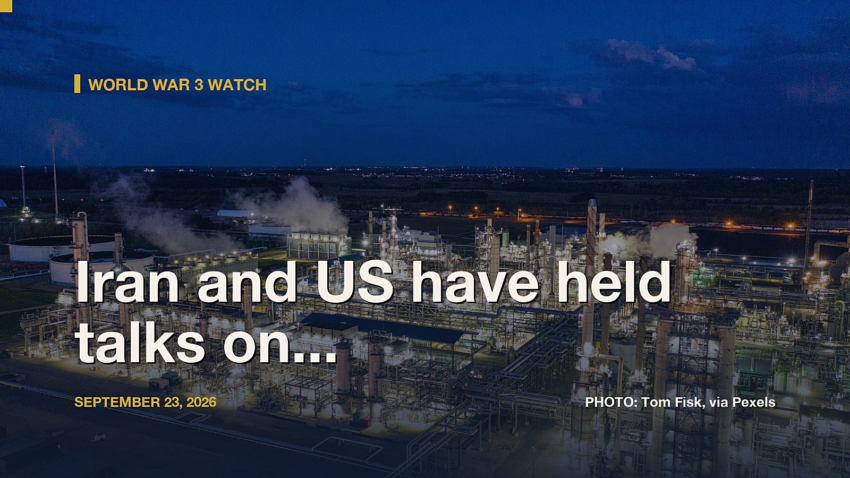
Iranian officials held three hours of talks with US special envoy Steve Witkoff on the sidelines of the UN General Assembly on Tuesday — the first such contact since June. Hours earlier, from the General Assembly podium, President Trump asked world leaders whether he should annihilate the Islamic Republic. Both happened the same day, and reading either one alone gives a false picture of where this stands.[1][2]
- The meeting was mediated by Qatari diplomats and involved Iranian Foreign Minister Abbas Araghchi.
- It was the first such contact since Vice President JD Vance met an Iranian delegation in Switzerland in June.
- Iran signalled it could reopen the Strait of Hormuz within a week — a softening of the seven preconditions it had previously set.
- Iranian media close to the IRGC denied any new position had been adopted, indicating a split in Tehran.
- US aviation sanctions took effect the same week, cancelling Iranian flights to Baghdad and Muscat.
The Story So Far
Our September 22 evening update covered the approach to this week: delegations traveling to New York, both governments trading threats, and diplomats testing whether the General Assembly could produce contact rather than escalation. This update reports that the contact happened.
What it did not produce is an agreement, and the clearest way to read Tuesday is as two tracks running at once — a negotiating track through Qatari mediators, and a rhetorical track from the podium that got considerably worse.
1. What Actually Took Place
Trump disclosed the meeting on Tuesday and said another would follow. Witkoff said he felt very good about it. Iranian officials confirmed the session involved Araghchi and was mediated by Qatari diplomats.[1]
The timeline matters: this was the first such contact since Vance met an Iranian delegation in Switzerland in June to agree a memorandum of understanding. Three months of no direct contact is the baseline against which “a three-hour meeting” should be read.[1]
Trump’s own account was warmer than his envoy’s.[3]
“They had a very good meeting, a very productive meeting,”
President Donald Trump, to reporters at the UN.[3]
Trump said US envoys Witkoff and Jared Kushner took part, and that another meeting was scheduled “in the very near future.” The White House referred Al Jazeera to the president’s comments when asked where the second round would take place — which is to say no venue has been announced.[3]
2. The Other Track: What Trump Said From the Podium
Earlier the same day, in his address to the General Assembly, Trump described the choice before him in terms that are worth quoting exactly rather than summarizing, because summaries have been softening them.[3]
“Will a deal be made with Iran that lets them rebuild and create a far greater country than it ever was before? … Or do I annihilate the Islamic Republic and do it quickly?”
President Trump, addressing the UN General Assembly.[3]
The Guardian records the same passage and Trump’s framing of it as a decision he expected to resolve after the US midterm elections. Most of the Iranian delegation left the hall during the speech, after Trump described Iran as the bully of the Middle East and the number one terror organisation on Earth.[1]
The IRGC issued a statement saying there was no contradiction between negotiating and waging war at the same time — a position echoed by Iran’s chief negotiator, Mohammad Ghalibaf, in remarks delivered online to the Iranian parliament. Both sides, in other words, are explicitly treating talks and pressure as compatible.[1]
3. Iran’s Position Softened — and Tehran Argued About It in Public
This is the substantive development, and it is the part most easily lost. A senior Iranian official indicated Iran was prepared to reopen the Strait of Hormuz within a week if the US took reciprocal steps to ease military and economic pressure.[1]
That is a retreat from where Tehran had been. The Guardian states the prior position plainly: Iran had set seven onerous preconditions for lifting its blockade of the strait, including an end to the US war “on all fronts” and a commitment to end all aggressive actions against Iran, including sanctions.[1]
Reuters, which broke the seven-day offer, adds two details the other accounts omit. The proposal was delivered to the United States through mediators on September 16 — six days before the talks — and the Iranian delegation in New York was described as holding full authority to revive diplomacy. The senior official also set out what Tehran wants first.[5]
“The US needs to announce that it wants to resolve the issue diplomatically, make that official, and then agree on a timeline for how the process will move forward”
A senior Iranian official, to Reuters.[5]
The same official told Reuters that President Masoud Pezeshkian, who left Tehran for New York on Tuesday morning, would not meet Trump at UN headquarters — which is why the Qatari-mediated channel was the only one available.[5]
| Element | Previous position | Position signalled Tuesday |
|---|---|---|
| Preconditions | Seven, described as onerous | Some relaxed[1] |
| Hormuz reopening | Conditional on the full set | Within seven days, on reciprocal US steps[1] |
| Channel | No direct contact since June | Qatari-mediated session with Araghchi[1] |
| Internal agreement | — | Disputed: IRGC-aligned media denied any new position[1] |
The official claimed the position had been approved by Iran’s supreme leader and the supreme national security council. Some Iranian media close to the IRGC denied any new position had been adopted. The Guardian reads this as a visible tussle in Tehran between hardliners and figures around President Masoud Pezeshkian over whether talks are worth anything — made harder to resolve by the low profile of the supreme leader, normally the arbiter in such disputes.[1]
4. The Pressure That Did Not Pause for the Talks
US aviation sanctions took effect as the talks proceeded. Majid Akhavan, spokesman for Iran’s Civil Aviation Organization, said airports in Baghdad and Muscat would stop accepting Iranian flights from midnight local time on Wednesday, with Baghdad-bound flights redirected to Najaf.[4]
Treasury Secretary Scott Bessent said Washington would cut Iranian airlines off from international operations by threatening secondary sanctions on companies providing them aviation services. Iran’s ISNA news agency reported negotiations with Oman were ongoing and that remaining international flights, including to Istanbul, would operate as scheduled.[4]
What’s Disputed or Unconfirmed
Whether the two sides met directly is genuinely unsettled. Witkoff described mediators shuttling between delegations; Trump described a three-hour meeting; Iranian state media said Araghchi met Witkoff. This post reports all three accounts rather than picking one.[1][3]
Whether Iran has actually adopted a softer position is disputed inside Iran, publicly, by Iranian outlets. The claim of supreme-leader approval comes from the same unnamed official proposing the softer terms.[1]
The Guardian’s own assessment is that the two sides remain too far apart for a deal, which would have to begin with an Iran–Oman agreement on a new commercial shipping route through largely Iranian waters — and the Gulf states have not endorsed such a deal. That is the publication’s analysis, not a reported fact.[1]
No venue or date for the promised follow-up meeting has been announced by either government.[3]
How to Verify This Yourself
Reference 1 and Reference 3 cover the same Tuesday from different desks; read both before accepting any single characterization of how the meeting went. Where the Guardian and Al Jazeera agree on a quote, the quote is solid.
For the “seven preconditions” figure, note that Reference 1 states the count and describes two of them. Our next update carries Iran’s own public statement of its conditions — read that rather than relying on a count with no contents.
What You Can Do Right Now
Treat “talks were held” and “progress was made” as separate claims requiring separate evidence. Tuesday produced the first; nothing in these sources establishes the second.
If you are tracking fuel costs from this, our Fuel Price Watch logs the pump pass-through three times daily.
References
- The Guardian (September 22, 2026). Iran and US have held talks on sidelines of UN summit, says Donald Trump. Secondary reporting; fullest account of the shift in Iran’s position and the dispute inside Tehran. ↩
- Al Jazeera (September 22, 2026). Saudi Arabia’s King Salman slams targeting of Mecca by ‘terrorist’ Houthis. Secondary reporting; regional context for the same week. ↩
- Al Jazeera (September 22, 2026). US, Iran hold ‘very good’ talks, Trump says at UN meeting. Secondary reporting; carries Trump’s quotes from the UN. ↩
- Al Jazeera (September 22, 2026). Iran cancels Baghdad, Muscat flights as US aviation sanctions take effect. Secondary reporting. ↩
- Parisa Hafezi, Reuters, via Yahoo News (September 22, 2026). Iran ready to reopen Strait of Hormuz if US eases military pressure and lifts blockade. Wire report; the original source of the seven-day offer. ↩
Related Reading
- World War 3 Watch: Iran Finally Names Its Terms — the follow-up, with the conditions listed.
- World War 3 Watch: Can This Week’s U.N. Gathering Cool Rising Tensions? — the pre-talks update.
Editorial note: this article was revised on September 23, 2026. The version first published under this URL was 437 words, gave each source its own disconnected section under a generic “Related developments” heading, and displayed an automatically generated entity list that presented a person’s surname (“Araghchi”), a glued headline fragment (“Houthis Saudi Arabia’s”) and a wire-service name as places and organizations in the story. That entity block has been removed rather than corrected. This revision was written and sourced by hand in an attended editorial session, not by the automated pipeline and not by a language model writing from memory: every factual claim above is attributed to one of the four numbered references, the competing accounts of whether the two sides met directly are reported side by side rather than resolved, and the adjacent updates in this series are linked so the story reads as one line.

Kemetic Minds Editorial Desk
Verified NewsroomPrimary-sourced investigative intelligence on civil rights, voting rights, federal policy, and consumer protection. Sourced from primary legal filings, government statistics, and direct field reporting.
3 thoughts on “Emergency Updates · Sep 23, 2026World War 3 Watch: The First US-Iran Talks Since June — Three Hours, Qatari Mediators, No Agreement”