
KEMETIC MINDS
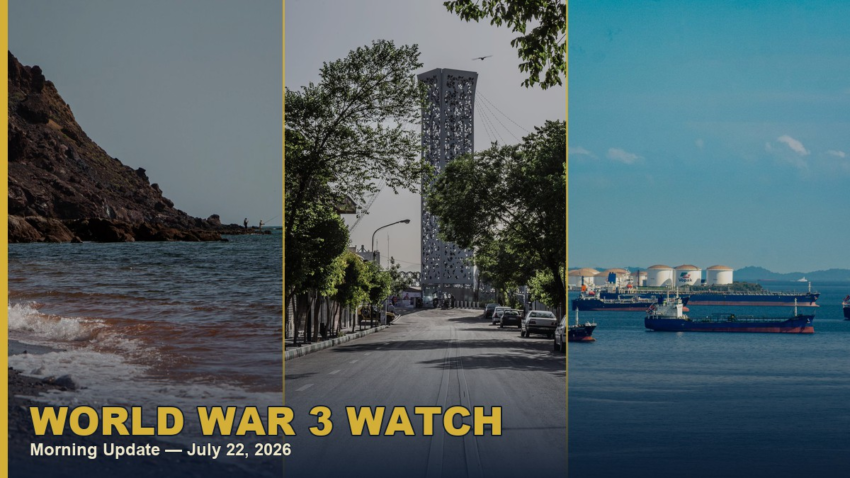
World War 3 Watch — Morning Update — July 22, 2026
- US forces completed the 11th consecutive night of airstrikes on Iran, expanding targets to Bushehr province (International Online, 2026, authors’ translation).
- President Trump threatened to strike Iran’s underground “Pickaxe Mountain” nuclear facility; Iran warned it would retaliate against all U.S. and allied interests in the region (Xinhua, 2026, authors’ translation).
- U.S. military deaths rose to 18 and wounded to 447; Iranian authorities report at least 50 killed and more than 500 wounded (Gold.cn, 2026, authors’ translation; Guangming Online, 2026, authors’ translation).
- A Kuwaiti oil tanker was attacked in the Strait of Hormuz, and Yemen’s Houthi movement announced an immediate maritime embargo on Saudi Arabia (Gold.cn, 2026, authors’ translation; CNR News, 2026, authors’ translation).
- Brent crude broke above $92 a barrel, hitting a five-week high, as the dual threats to the Strait of Hormuz and the Bab el-Mandeb converge (Gold.cn, 2026, authors’ translation).
- Qatar, Egypt, and Pakistan proposed a 10-day ceasefire; Trump said the U.S. has “no interest” in talks until Iran is ready for “meaningful” engagement (Gold.cn, 2026, authors’ translation).
Video: IRGC reports ‘massive fires’ on two oil tankers in Strait of Hormuz. Source: Al Jazeera English.
1. Eleventh Night of Strikes: US Expands Bombing to Bushehr
The United States military carried out its 11th consecutive night of strikes against Iranian targets on July 21, extending the campaign to Bushehr province on Iran’s southern coast, according to Iran’s Tasnim News Agency (Gold.cn, 2026, authors’ translation). The U.S. Central Command said the operation began at 7:00 p.m. Eastern Time (07:00 Beijing Time on July 22) and lasted 75 minutes, targeting “military operations centers, naval facilities, aircraft hangars, drone storage facilities, and military logistics infrastructure” (International Online, 2026, authors’ translation). The stated objective: to “further degrade Iran’s ability to threaten commercial shipping in the Strait of Hormuz.”
U.S. Central Command reported that, over the past three months, Iran has attacked more than 30 merchant vessels transiting the waterway — attacks it described as “unprovoked” and endangering hundreds of innocent crew members (International Online, 2026, authors’ translation). Despite the sustained bombing, the Command claimed the Strait of Hormuz remains open for commercial shipping, and that since early May the U.S. military has helped approximately 900 merchant ships and vessels carrying about 450 million barrels of crude oil transit safely (International Online, 2026, authors’ translation).
The expansion of strikes to Bushehr — home to Iran’s Bushehr Nuclear Power Plant and a key hub of the country’s nuclear energy industry — marks a notable geographic widening of the campaign. Earlier strikes had been concentrated in the southeastern provinces of Hormozgan and Sistan-Baluchestan (Gold.cn, 2026, authors’ translation). Chinese state media outlet International Online reported the strikes as “the 11th consecutive night of U.S. military strikes on Iran since July 11” (International Online, 2026, authors’ translation).
Meanwhile, the U.S. naval blockade of the Strait of Hormuz continues to tighten. On July 21, U.S. Central Command stated it had forced eight commercial vessels to alter course and disabled one of them (CNR News, 2026, authors’ translation). President Trump described the blockade as “comprehensive — in other words, no one can pass. No one can break through the blockade. It is like a steel wall” (Gold.cn, 2026, authors’ translation).
Video: Iran War – New U.S. Strikes – LIVE Breaking News Coverage. Source: Agenda-Free TV.
2. Pickaxe Mountain: Trump’s Nuclear Threat and Iran’s Response
President Trump escalated the conflict’s rhetorical stakes on July 21, telling reporters at the White House after meeting Lebanese President Joseph Aoun that the United States would “very soon” strike Iran’s “Pickaxe Mountain” underground nuclear facility (MSN, 2026; AP News, 2026). Pickaxe Mountain — known in Persian as Kuh-e Kolang — is located about 1.6 kilometers south of the Natanz nuclear facility in Isfahan province and is considered one of Iran’s most heavily fortified underground nuclear sites (AP News, 2026).
When asked whether Iran had moved centrifuges into the Pickaxe Mountain tunnels, Trump replied, “I think there is a possibility they have done so, but we have no solid record of it” (Xinhua, 2026, authors’ translation). He added, “We are tracking the material — that is the key thing” and warned that any strike would be “very powerful” (Xinhua, 2026, authors’ translation). The president also claimed that Iran “desperately wants to meet” but insisted that “until they are ready for a meaningful meeting, we do not even have an interest in talking” (Xinhua, 2026, authors’ translation).
Iran’s response was swift and unequivocal. In the early hours of July 22, the Khatam al-Anbiya Central Headquarters of the Iranian Armed Forces issued a statement declaring that if the United States attacks Iran’s nuclear facilities or other sensitive sites, Iran “will regard it as an escalation of regional war, and all interests belonging to the United States, its allies, and its supporters in the region will become targets of a powerful retaliatory strike by the Iranian armed forces” (CNR News, 2026, authors’ translation; Xinhua, 2026, authors’ translation).
The Pickaxe Mountain threat represents a significant departure from the previous round of U.S.-Iran hostilities, which focused on naval engagements around the Strait of Hormuz rather than nuclear infrastructure. As Guangming Daily commentator Tang Zhichao noted, “Unlike the previous round of conflict, which was focused on regime change and strikes on nuclear facilities, this round of conflict is primarily a struggle for control of the Strait of Hormuz” (Guangming Online, 2026, authors’ translation). Trump’s direct threat to a nuclear site therefore reopens a dimension of the conflict that had been sidelined since the June 18 memorandum of understanding.
Video: US and Israel 'again bombing what were clearly non-military sites' in Iran • FRANCE 24 English. Source: FRANCE 24 English.
3. Rising Toll: US Casualties Mount, Gulf States Caught in Crossfire
The human cost of the escalating conflict continues to climb. According to a Pentagon report cited by Russia’s Sputnik news agency on July 22, the number of U.S. military personnel wounded in operations against Iran has risen from 427 to 447 (Gold.cn, 2026, authors’ translation). Of the 447 wounded, the Army accounts for the largest share — 306 — followed by the Navy (68), the Air Force (54), and the Marine Corps (19) (Gold.cn, 2026, authors’ translation).
U.S. fatalities have also risen. The Defense Department confirmed on July 21 that a soldier who went missing on July 17 during an Iranian attack on Jordan’s Muwaffaq Salti Air Base is now “presumed dead,” bringing the total number of U.S. service members killed in the conflict to 18 (Gold.cn, 2026, authors’ translation). Earlier in the month, the Pentagon had confirmed at least three U.S. troop deaths and nearly 100 wounded from Iranian strikes on bases across the Middle East (Gold.cn, 2026, authors’ translation).
On the Iranian side, state media reports indicate that U.S. airstrikes have killed at least 50 people and wounded more than 500 (Guangming Online, 2026, authors’ translation). The disparity in reported casualty figures — 18 U.S. dead versus at least 50 Iranian dead — is consistent with the asymmetry of the conflict: the United States is conducting sustained air and naval strikes from standoff ranges, while Iran is responding with missile and drone attacks on U.S. bases that are often intercepted by allied air defenses.
Gulf states are increasingly caught in the crossfire. On July 21, the Kuwaiti oil tanker Kayvan was attacked while transiting the Strait of Hormuz, injuring multiple crew members (Gold.cn, 2026, authors’ translation). Kuwait’s Foreign Ministry summoned Iran’s ambassador, Mohammad Toutonji, and submitted a protest note, with Deputy Foreign Minister Hamad Al-Masha‘an calling the attack “a blatant violation of Kuwait’s sovereignty, territorial integrity, and interests, as well as a threat to the safety and freedom of international navigation” (Gold.cn, 2026, authors’ translation).
Jordan’s armed forces reported intercepting and shooting down three Iranian missiles on July 21, as well as five Iranian drones overnight between July 20 and July 21, without casualties or property damage (CNR News, 2026, authors’ translation). Iran’s Islamic Revolutionary Guard Corps claimed on July 21 to have struck U.S. military targets in Bahrain and Kuwait, destroying radar installations and Patriot air-defense systems (CNR News, 2026, authors’ translation).
The crisis is also straining alliances within the U.S.-led coalition. Chinese analyst Li Zixin of the China Institute of International Studies noted that “as the risks of war increase, the positions of U.S. allies are beginning to diverge,” pointing to deep internal divisions in Bulgaria over whether to authorize additional U.S. aerial refueling aircraft deployments out of fear of becoming an Iranian target (CNR News, 2026, authors’ translation).
4. From the Gulf to the Red Sea: Houthi Blockade Threatens Dual Chokepoint Crisis
The conflict is metastasizing beyond the Persian Gulf. On July 20, Yemen’s Houthi movement — which controls much of northern Yemen, including the capital Sanaa — announced an immediate “maritime embargo” on Saudi Arabia (CNR News, 2026, authors’ translation). The Saudi-led coalition responded by saying it had taken measures to protect member-state vessels transiting the Bab el-Mandeb Strait and would “respond decisively to any Houthi threat” (CNR News, 2026, authors’ translation).
The Houthi announcement follows a July 13 airstrike on Sanaa International Airport, which the Houthis blamed on Saudi Arabia. In retaliation, the group declared the end of a four-year ceasefire and attacked Saudi Arabia’s Abha International Airport in the southwest of the kingdom (Guangming Online, 2026, authors’ translation). On July 20, the Houthis issued a formal decree imposing a maritime ban on Saudi shipping (Guangming Online, 2026, authors’ translation).
The dual threat to the Strait of Hormuz and the Bab el-Mandeb — two of the world’s most critical energy chokepoints — has alarmed global markets. As Guangming Daily analyst Tang Zhichao warned, “The closure of both the Strait of Hormuz and the Bab el-Mandeb would again pose a severe challenge to the oil exports of Gulf states and to global energy supply security” (Guangming Online, 2026, authors’ translation).
President Trump, speaking at the White House on July 21, said the United States would “take action” if the Houthis blockade the Red Sea (CNR News, 2026, authors’ translation). Iraq’s “Islamic Resistance” militia also upped the ante on July 20, declaring that if the United States expands “its aggression against Iran,” the group “will directly participate in fighting the United States and will resolutely strike all U.S. interests and military bases in Iraq and the Middle East” (Guangming Online, 2026, authors’ translation).
The expansion of the conflict into the Red Sea and the potential involvement of Iraqi militias raises the prospect of a multi-front war in which U.S. forces must disperse air-defense and strike assets across a vastly larger theater, as Chinese analyst Li Zixin observed: “The Iraqi militias are in fact capable of using rockets and drones to attack U.S. bases in Iraq, Syria, and even the Gulf region, which would force the U.S. military to disperse its air-defense and combat resources and face simultaneous operations on multiple fronts” (CNR News, 2026, authors’ translation).
5. Diplomacy or Escalation? Ceasefire Proposal Meets Mutual Distrust
Amid the intensifying combat, diplomatic channels — though severely strained — remain open. According to reports, mediators from Qatar, Egypt, and Pakistan have presented the United States and Iran with a proposal for a 10-day temporary ceasefire, during which the two sides would negotiate a long-term arrangement for the Strait of Hormuz (Gold.cn, 2026, authors’ translation; Guangming Online, 2026, authors’ translation). U.S. Secretary of State Marco Rubio said on July 19 that the Trump administration “remains open to a diplomatic solution” (Guangming Online, 2026, authors’ translation). Iranian Foreign Ministry spokesperson Esmaeil Baghaei stated on July 20 that it is “incorrect to say that defense and diplomacy cannot go hand in hand” (Guangming Online, 2026, authors’ translation).
Yet both sides’ statements on July 21 and 22 suggest a deep chasm. Trump said Iran is “desperate to meet” but that the United States has “no interest” until Iran is ready for “meaningful” engagement (Xinhua, 2026, authors’ translation). Iran’s position, as articulated by Foreign Minister Abbas Araghchi, is that it “will not return to the negotiating table while under military attack” (Gold.cn, 2026, authors’ translation).
Chinese commentary from Guangming Daily offers essential context by tracing the current crisis back to ambiguities in the June 18 memorandum of understanding. Tang Zhichao, deputy director of the Chinese Academy of Social Sciences’ Institute of West Asian and African Studies, wrote that “the memorandum’s vagueness on the provisions concerning the Strait of Hormuz is one of the core triggers for the renewed conflict” (Guangming Online, 2026, authors’ translation). Under the memorandum — which both sides now treat as “effectively dead” — Iran was to allow free and safe passage of commercial vessels within 60 days, and would discuss with Oman a future management and service mechanism for the strait. But the text left unresolved whether Iran could charge fees after 60 days, whether the “sovereign rights of the strait’s littoral state” implied Iranian primacy over strait management, and which side would control the Omani-side shipping lane (Guangming Online, 2026, authors’ translation).
In Tehran’s reading, the memorandum recognized Iran’s sovereignty and its right to eventually levy transit fees. Washington read the same text as reserving the right to escort vessels through the Omani side — a move Tehran saw as undermining its control. That interpretive collision, Tang argues, is what reignited open conflict on July 7 after a lull of less than three weeks (Guangming Online, 2026, authors’ translation).
Our analysis of media framing across U.S., Israeli, Iranian, and BRICS outlets — documented in our narrative-comparison report on how US, Israeli, Iranian, and BRICS media each tell this war — shows that each side’s domestic audience is being prepared for a different version of events, and the gap between those narratives is itself an obstacle to any ceasefire.
6. Oil at Five-Week High as Strait Closure Bites
The crisis gripping the Strait of Hormuz — through which about one-fifth of the world’s oil passes — is now directly visible in global energy prices. On July 21, Brent crude oil futures rose $1.79, or 2%, to close at $91.01 a barrel, the highest settlement since June 10, while West Texas Intermediate crude rose $1.68, or 2%, to close at $84.91, the highest since June 11 (Gold.cn, 2026, authors’ translation). In early Asian trading on July 22, prices extended gains, with Brent briefly touching $92.66 a barrel — a fresh five-week high — and WTI reaching $85.75 (Gold.cn, 2026, authors’ translation).
The price surge reflects not only the effective closure of the Strait of Hormuz — where a U.S. naval blockade and Iranian attacks on shipping have brought normal commercial traffic to a near standstill — but also the new threat to the Bab el-Mandeb. Even if the Houthi maritime embargo on Saudi Arabia is not fully enforced, the mere announcement of a blockade is sufficient to drive up shipping insurance and security costs and to force many vessels to reroute (CNR News, 2026, authors’ translation). For Saudi Arabia and other Gulf producers that had been using Red Sea export routes as a workaround for the Hormuz closure, the Houthi threat now puts that alternative at risk.
Chinese news outlet Gold.cn noted that “the dual pressure on the Gulf and the Red Sea has pushed international oil prices to five-week highs, and the situation in the Middle East faces the risk of comprehensive escalation” (Gold.cn, 2026, authors’ translation).
Is This Actually World War 3?
Let’s be precise about what today’s sources actually show — and do not show.
What is happening: A direct, sustained U.S.-Iran military conflict that has entered its 12th day of continuous combat, with the U.S. conducting nightly airstrikes on Iranian territory and Iran retaliating with missile and drone attacks on U.S. bases and allied assets across at least six countries. The conflict has expanded geographically from the Persian Gulf to include the Red Sea/Bab el-Mandeb theater via Houthi-Saudi hostilities. A major Iraqi militia has threatened to intervene directly. A Gulf state — Kuwait — has been drawn in as a victim of an attack on its shipping. Oil prices are surging. Nuclear infrastructure is being explicitly threatened. Diplomatic channels are open but both sides show no willingness to compromise.
What is not happening: There is no evidence in any of today’s sources of direct combat between U.S. and Chinese forces, nor any indication of a Chinese invasion of Taiwan. The parallel China-Taiwan flashpoint — one of the two named axes of this series — has no coverage in today’s source set, meaning it is not escalating in parallel at this moment. NATO’s Article 5 has not been invoked. No Russian military intervention in the Middle East is reported in these sources. The conflict, while intense and expanding, remains regional — albeit a region that supplies the global energy market.
Assessment: The most honest label for what today’s sources describe is a regional interstate war with serious great-power dimensions. It is not yet World War 3. But it carries three of the hallmarks that analysts of major-power conflict watch for: (1) a direct U.S. military campaign on the territory of a significant regional power, (2) the explicit threat to a nuclear facility, which raises the risk of radiological release or nuclear escalation, and (3) the disruption of a global energy chokepoint, which creates economic pressures that ripple worldwide. The Houthi intervention and Iraqi militia threat both point toward further widening. The most realistic near-term risk is not a sudden world war but a protracted, multi-front, attritional conflict in the Gulf and Red Sea that grinds on for weeks or months — exactly the scenario Chinese analyst Li Zixin warned could become “a long-term stalemate and attritional war” (CNR News, 2026, authors’ translation).
What You Can Do Right Now
- Monitor energy and supply-chain exposure. If you drive, heat with oil, or rely on goods shipped through the Suez Canal or the Persian Gulf, expect price increases and potential shortages in the weeks ahead. Consider filling your tank early and, if possible, keeping an extra week’s worth of fuel or supplies on hand. Our survival skills and preparedness guide has practical advice on building supply buffers without panic-buying.
- Stay informed across media ecosystems. Both U.S. and Chinese state media in today’s sources present useful information, but each emphasizes different facts — for example, English-language outlets highlight U.S. military capability and Iranian “unprovoked” attacks on shipping, while Chinese outlets emphasize the memorandum’s broken terms, civilian casualties, and allied divisions. Reading both helps you see the full picture and recognize where each side’s coverage is selective.
- Prepare for information-disruption scenarios. Iranian attacks have reportedly damaged a U.S. Amazon data center in Bahrain (Guangming Online, 2026, authors’ translation). If critical digital infrastructure in the region is targeted, internet services, cloud storage, and financial systems could face interruptions. Keep offline copies of essential documents and consider testing alternative communication methods with your household or community.