
KEMETIC MINDS
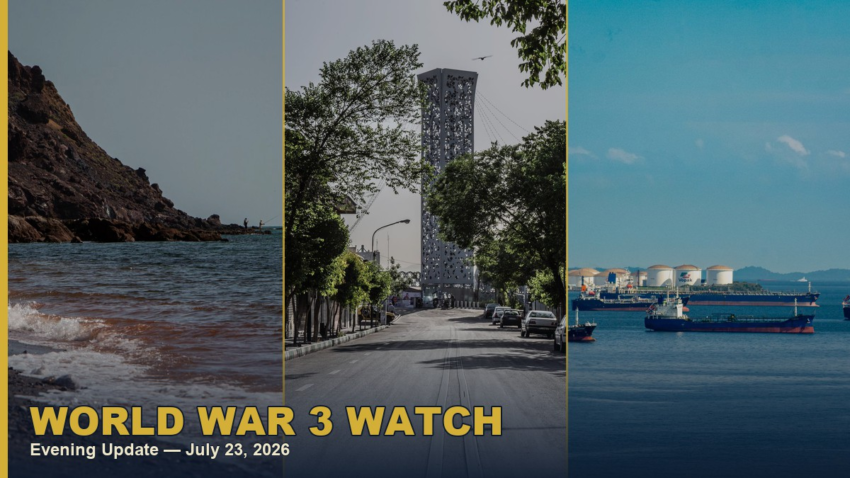
World War 3 Watch — Evening Update — July 23, 2026
- The U.S. military conducted its 13th consecutive night of strikes against Iran, targeting missile and drone storage facilities, coastal surveillance sites, and air defense assets (MSN, 2026; India Today, 2026).
- The U.S. House voted 214–208 to pass a war powers resolution directing President Trump to halt military action in Iran unless Congress approves, but the Senate blocked a separate similar measure hours later (St. Louis Post-Dispatch, 2026).
- The Strait of Hormuz is effectively closed to commercial shipping, with 6,000 seafarers trapped on 500 vessels, as the UN Secretary-General warns the situation is “spiraling out of control” and “on the brink of the unimaginable” (UN News, 2026, authors’ translation).
- Secretary of State Rubio warned Iran will pay a “heavy price” for attacking commercial shipping, while President Trump said he will use Iranian funds to “compensate” damaged ships and cargo (VOA Chinese, 2026, authors’ translation; New Beijing News, 2026, authors’ translation).
- China announced two days of live-fire military exercises off Dongshan Island in the Taiwan Strait, announced just after Secretary Rubio and Foreign Minister Wang Yi held talks in Manila (El Mundo America, 2026; RFI, 2026, authors’ translation).
1. US Launches 13th Night of Strikes on Iran as War Powers Clash in Congress
The U.S. military announced Thursday that it is conducting its 13th night of strikes against Iran, with U.S. Central Command stating the operations target Iranian military assets including maritime capabilities, missile and drone storage facilities, coastal surveillance sites, and air defense systems (MSN, 2026).
The strikes are being carried out “in response to the Iranian regime’s attacks on commercial shipping,” CENTCOM said (MSN, 2026). A separate report notes that the strikes are the 12th straight set of U.S. attacks on Iranian military assets and facilities (VOA Chinese, 2026, authors’ translation).
On the political front, the Republican-led U.S. House of Representatives voted 214–208 to adopt a war powers resolution demanding President Trump wind down the military campaign in Iran unless he obtains congressional approval (St.
Louis Post-Dispatch, 2026). The vote came just before lawmakers are set to break for a five-week recess.
Hours later, however, the Senate voted to block a separate similar measure, underscoring the deep partisan divide over the conflict (St. Louis Post-Dispatch, 2026). As the military and political dimensions of this conflict diverge, readers may refer to our narrative-comparison report on how US, Israeli, Iranian, and BRICS media each tell this war.
The Indian English-language coverage highlights that the strikes are ongoing as Houthi tanker attacks jolt oil markets, while the Chinese-language coverage from VOA Chinese emphasizes that U.S. Central Command says “these strikes further degrade Iran’s ability to attack civilian seafarers and merchant ships” (India Today, 2026; VOA Chinese, 2026, authors’ translation). The Chinese source also reports that the U.S. has reimposed a naval blockade on Iranian ports, diverting nine commercial vessels and disabling one ship to prevent entry to Iranian ports (VOA Chinese, 2026, authors’ translation).
Video: Qatar sends letters to the UN chief and Security Council condemning Iranian attacks. Source: Al Jazeera English.
2. Strait of Hormuz: 6,000 Seafarers Trapped, UN Warns of “Catastrophic Consequences”
United Nations Secretary-General António Guterres addressed the Security Council on Thursday, expressing regret over the escalating strikes and counterstrikes between the U.S. and Iran, warning that if the situation cannot be reversed it will bring “catastrophic consequences for the region and the world” (UN News, 2026, authors’ translation). “The situation is spiraling out of control, on the brink of the unimaginable,” Guterres said.
“One crisis triggers another, one escalation triggers the next. As this dynamic spreads, political goals are increasingly being obscured by the confrontation itself. It is time to step back” (UN News, 2026, authors’ translation).
The International Maritime Organization (IMO) reported to UN News that since hostilities resumed on July 12–13, attacks on vessels have resumed and “virtually no ships are now transiting” the narrow waterway (UN News, 2026, authors’ translation). IMO Secretary-General Arsenio Dominguez expressed deep concern for 6,000 seafarers trapped on approximately 500 vessels anchored in the Persian Gulf behind the Strait.
“We must remember that these are trained innocent workers, they have not received combat training, and these ships are not prepared to defend against missiles and drone attacks,” Dominguez said (UN News, 2026, authors’ translation). He stressed that seafarers play a vital role in global trade and that without them “shipping cannot function, 90% of shipped goods will not reach their final destination, and all of us will be affected” (UN News, 2026, authors’ translation).
Dominguez warned that the shipping industry has been “pushed to its limits” in recent years, citing the Black Sea shipping disruption following Russia’s full-scale invasion of Ukraine and the Red Sea uncertainty where Houthi separatists claimed attacks on two Saudi tankers and blocked the Bab el-Mandeb Strait, effectively cutting off shipping through the Suez Canal (UN News, 2026, authors’ translation). In peacetime, the Strait of Hormuz carries about 20% of global oil and gas supply from the Gulf region, Dominguez noted. He said vessels should not attempt to transit the waterway until the conflict is resolved, and that “any work on the future management of the Strait has made little progress because the reality is that we need de-escalation before we can continue negotiations” (UN News, 2026, authors’ translation).
Video: Iran war ‘has been a strategic disaster for the State of Israel’, analyst says • FRANCE 24 English. Source: FRANCE 24 English.
3. Trump Vows to Use Iranian Funds for Ship Compensation, Rubio Warns of “Heavy Price”
President Donald Trump said he will use Iranian funds to “compensate” damaged ships and cargo, according to a report from Chinese outlet New Beijing News (New Beijing News, 2026, authors’ translation). The brief report did not provide further details on the mechanism or legal basis for such compensation.
Speaking in Manila on the margins of the ASEAN foreign ministers’ meeting, U.S. Secretary of State Marco Rubio told reporters that Iran will pay a “heavy price” for violating the interim agreement with the U.S. and attacking commercial shipping (VOA Chinese, 2026, authors’ translation).
“Iran is directly or indirectly begging us to reach an agreement, to negotiate… Iran’s problem is that every time they reach an agreement, the people in power there either tear it up or want to change it,” Rubio said. “It seems they are not ready to reach an agreement. So, they will continue to pay the price, and the price will get higher every night” (VOA Chinese, 2026, authors’ translation).
Rubio also stated that the U.S. is pursuing a “nuclear-free Iran that will never have nuclear weapons,” adding “if we can have people in power who do not want nuclear weapons, that would make things much easier, but at the end of the day, that is our interest” (VOA Chinese, 2026, authors’ translation). U.S. Central Command reported that over the past three months, Iranian forces have attacked more than 30 merchant ships transiting the Strait of Hormuz (VOA Chinese, 2026, authors’ translation).
Video: UAE reports attacks as Iran‑US tensions flare over Hormuz. Source: DW News.
4. Iran Strikes Kuwait and Bahrain, US Deploys B-1 Bombers
Military operations escalated significantly on Thursday as Iran launched strikes against U.S. forces in Kuwait, causing multiple casualties, prompting the U.S. to deploy B-1 bombers, according to Chinese outlet Shangguan News (Shangguan News, 2026, authors’ translation). The report describes this as a “significant escalation” in military operations, though the full text was not available due to template formatting issues in the source.
Jordan, Kuwait, and Bahrain each reported responding to Iranian missile and drone attacks on Thursday. Jordan’s military said it intercepted and destroyed four Iranian missiles and six drones targeting the Kingdom’s territory over the past 24 hours, with no casualties or property damage reported (VOA Chinese, 2026, authors’ translation). Kuwait’s air defense said it was facing hostile drone attacks following “Iranian sinful aggression,” with Defense Ministry spokesman Major General Saud Abdulaziz Al-Otaibi reporting that Iranian drones attacked border crossings, causing material damage but no casualties (VOA Chinese, 2026, authors’ translation).
Bahrain said its air defense forces intercepted and destroyed multiple airstrikes launched by Iran on Wednesday. The Bahraini General Command stated in a Thursday statement that “the deliberate use of missiles and drones to attack civilian and private property clearly violates international humanitarian law” (VOA Chinese, 2026, authors’ translation). Iran’s Foreign Minister Abbas Araghchi said Wednesday that Iran will respond in kind to any attack on its infrastructure (VOA Chinese, 2026, authors’ translation).
5. China Holds Live-Fire Drills in Taiwan Strait Amid US-China Diplomacy
China announced Thursday that the People’s Liberation Army (PLA) has begun two days of live-fire military exercises in areas off the coast of Fujian province and in the Taiwan Strait, with the drills scheduled from 06:00 to 18:00 local time each day around Dongshan Island in the southern Taiwan Strait (RFI, 2026, authors’ translation; El Mundo America, 2026). The Chinese Maritime Safety Administration released coordinates showing the training zones are less than 12 kilometers from the coast of Fujian and will be closed to navigation during the maneuvers (El Mundo America, 2026).
Although the exercises do not involve a direct approach to Taiwan, they are part of a pattern that the Xi Jinping government has been perfecting in recent years: maintaining constant military pressure on the island without crossing the threshold of open warfare (El Mundo America, 2026). Beijing has never hidden its view that Taiwan is a “rebellious province” whose reunification, by force if necessary, is an irrevocable goal (RFI, 2026, authors’ translation; El Mundo America, 2026). For the past four years, intrusions by Chinese fighter jets, bombers, drones, and ships near the island have become routine rather than exceptional (El Mundo America, 2026).
The announcement came just after U.S. Secretary of State Rubio and Chinese Foreign Minister Wang Yi held talks in Manila covering a range of issues including Taiwan (RFI, 2026, authors’ translation).
In Taipei, officials have long described a “gray zone harassment” campaign: operations designed to psychologically and militarily wear down the adversary without triggering a conventional conflict (El Mundo America, 2026). Also becoming common are crossings of the median line of the Taiwan Strait, a tacit boundary that both sides informally respected for decades until the Chinese military stopped recognizing it after then-Speaker Nancy Pelosi’s August 2022 visit to Taipei (El Mundo America, 2026).
6. Is This Actually World War 3?
Today’s sources show two distinct but connected theaters of great-power tension. In the Middle East, the U.S.-Iran conflict continues to escalate with no diplomatic off-ramp visible: the 13th night of U.S. strikes, Iran striking U.S. forces in Kuwait, and the UN warning of “catastrophic consequences” all point to a regional war that is expanding, not contracting.
The U.S. political system is divided — the House voted to curb war powers, the Senate blocked the measure — meaning there is no unified domestic brake on further escalation. However, the conflict remains bilateral (U.S. vs. Iran) rather than a multi-theater great-power war.
In the Taiwan Strait, China’s live-fire exercises represent active military pressure but fall short of an invasion or blockade. The timing — immediately after U.S.-China talks in Manila — suggests Beijing is signaling resolve rather than preparing for immediate war. The “gray zone” framework described by both English and Chinese sources indicates deliberate restraint.
Neither theater has crossed into direct great-power confrontation: no U.S.-China or U.S.-Russia combat, no Article 5 invocation, no nuclear use. The situation is extremely dangerous and could tip at any moment, but today’s evidence does not support a “World War 3 is here” headline. That label remains a warning, not a description.
7. What You Can Do Right Now
- Monitor multiple source languages: English and Chinese-language coverage of the same events often report different facts and emphases. Cross-checking VOA Chinese, UN News, and outlets like MSN and El Mundo America reveals a fuller picture than any single source provides.
- Prepare for economic disruptions: The Strait of Hormuz carries 20% of global oil and gas, and UN data shows the war has pushed global trade value up 12.5% to $13.7 trillion in the first half of 2026, driven entirely by energy price increases (UN News, 2026, authors’ translation). Fuel and supply chain volatility are likely to continue. For practical steps, see our survival skills and preparedness guide.
- Track diplomatic windows: The June Memorandum of Understanding between Iran and the U.S. “remains in effect” and provides a basis for future negotiations, according to the IMO (UN News, 2026, authors’ translation). That diplomatic channel, however fragile, is the likeliest off-ramp from the current escalation trajectory.
Kemetic Minds Analysis
This roundup pulled directly from the day’s English- and Chinese-language wires side by side, because the gap between what each side chooses to report is often as informative as any single strike count. Treat the Key Takeaways above as the verified factual floor, and the framing differences noted in the sections above as the more interesting, harder-to-fake signal about where this war is actually headed next.
References
- MSN. (2026, July 23). US military says it’s launching new strikes on Iran as clashes escalate over shipping routes. msn.com
- Indiatoday. (2026, July 23). US strikes Iran for 13th night as Houthi tanker attacks jolt oil markets. indiatoday.in
- Stltoday. (2026, July 23). US House votes to curb Trump's Iran war powers but Senate backs president; airstrikes continue. stltoday.com
- El Mundo America. (2026, July 23). China maintains pressure on Taiwan with new military exercises involving live fire in the strait. mundoamerica.com
- UN News. (2026, July 23). 霍尔木兹海峡航运停滞,受困海员仍陷困境 [Hormuz Strait Shipping Grinds to a Halt, Stranded Sailors Remain in Limbo]. news.un.org
- 新京报. (2026, July 23). 特朗普:将用伊朗资金“赔偿”受损船只和货物 [Trump: Will use Iranian funds to 'compensate' damaged ships and cargo]. bjnews.com.cn
- 美国之音. (2026, July 23). 卢比奥国务卿称伊朗将为袭击船只付出“沉重代价”,美军连续第12次发动袭击 [Secretary of State Rubio says Iran will pay a "heavy price" for attacking ships, as U.S. military launches 12th consecutive strike.]. voachinese.com
- 上观新闻. (2026, July 23). 军事行动显著升级,伊朗打击科威特美军致多人伤亡,美祭出B-1轰炸机 – 上观新闻 [Iran launches strike on US military in Kuwait, inflicting multiple casualties, as US deploys B-1 bombers in response]. jfdaily.com
- RFI. (2026, July 23). 中国解放军在台湾海峡举行实弹军演 持续两天 [Chinese PLA holds two-day live-fire military drills in Taiwan Strait]. rfi.fr
Investigative Methodology: This roundup is generated on a fixed schedule (noon and evening, America/Chicago) from live English- and Chinese-language wire sources. Every claim is grounded in fetched source text with an APA7 in-text citation; translated Chinese-language quotes are marked “authors’ translation.” Every video embed is verified to be a real, existing video via YouTube’s oEmbed endpoint before publication — none are written by the drafting model. No Wikipedia sources are used.
Stay Connected

Kemetic Minds Editorial Desk
Verified NewsroomPrimary-sourced investigative intelligence on civil rights, voting rights, federal policy, and consumer protection. Sourced from primary legal filings, government statistics, and direct field reporting.