KEMETIC MINDS
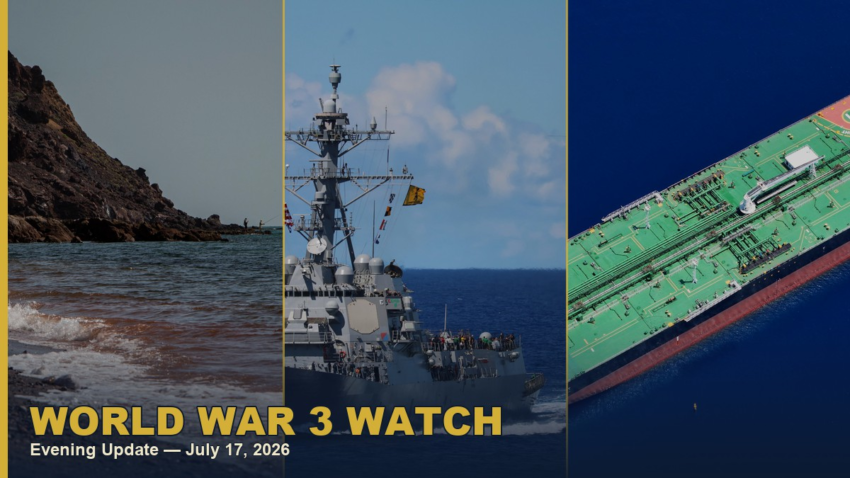
World War 3 Watch — Evening Update — July 17, 2026
- The US launched a seventh consecutive night of strikes on Iran, hitting bridges, a port tower, electrical infrastructure, and Iranshahr airport, killing at least 38 people and wounding more than 400 by Friday morning (The Guardian, 2026).
- Iran’s Islamic Revolutionary Guard Corps (IRGC) declared the Strait of Hormuz “completely closed” after two oil tankers hit mines and exploded; no shipping of oil or gas can pass until US military operations cease (京报网, 2026, authors’ translation).
- Iran retaliated by striking US allies’ civilian infrastructure, hitting water desalination plants in Kuwait, claiming destruction of a US unmanned boat base in Bahrain, and launching cruise missiles at a US Navy vessel in the northern Indian Ocean (Fox News, 2026; 央广网, 2026, authors’ translation).
- The US plans to send “dozens” of additional aerial refueling aircraft to Israel as President Trump weighs expanded military options including strikes on Iranian power plants and suspected nuclear facilities (Anadolu Ajansı, 2026; Axios, 2026).
- A leaked confidential report prepared for Iran’s presidency, titled “What Iran Wants,” found that only 9% of respondents support maintaining the status quo, while 53% call for fundamental reforms and more than 19% favor changing the political system outright (Fox News, 2026).
- Chinese state-owned energy giants, including Sinopec and PetroChina, are seeking long-term LNG supply contracts with exporters who do not require transit through the Persian Gulf, signaling a potential permanent shift away from Qatari gas (RFI, 2026, authors’ translation).
Video: Explosive Footage Shows US Strike Toppling Iran Navy Control Tower. Source: New York Post.
1. Seventh Night of US Strikes: Bridges, Power Grid, and Civilian Casualties
The United States military launched its seventh consecutive night of strikes against Iran on Friday, July 17, according to a statement from US Central Command posted on X (The Guardian, 2026). The strikes, which began at 7 p.m. GMT, were designed to “continue degrading Iranian military capabilities,” Central Command said (The Guardian, 2026). Reporting from Beijing, Chinese state media 央广网 confirmed that the US Central Command stated it had initiated a new round of strikes at 3 p.m. Eastern Time on July 17, marking the seventh straight night of aerial operations (央广网, 2026, authors’ translation).
Iranian media reported explosions or strikes carried out in the cities of Sirik, Ahvaz, and Yazd (The Guardian, 2026). Earlier on Friday, US airstrikes hit bridges in Iran’s southern Hormozgan province, killing at least seven people, Iranian state TV reported. The bridges were a key transit point for Bandar Abbas, Iran’s main port. Further US airstrikes brought down a tower in Chabahar port on the Gulf of Oman that the US military claimed the IRGC used to facilitate attacks on vessels in the Strait of Hormuz. The US also targeted key electrical infrastructure and Iranshahr airport (The Guardian, 2026).
The strikes on civilian infrastructure have drawn scrutiny. The Guardian (2026) noted that “strikes on civilian infrastructure not being used for military purposes could constitute a war crime, human rights experts have said.” Iran’s health ministry spokesperson, Hossein Kermanpour, reported that renewed US strikes had killed at least 38 people and wounded more than 400 in Iran by Friday morning (The Guardian, 2026). A separate toll from Iran’s Hormozgan province, reported via 央广网, indicated that US attacks on the province from the night of July 16 to the early morning of July 17 had killed 8 and wounded 19 (央广网, 2026, authors’ translation). Iran’s Foreign Ministry spokesperson, Esmaeil Baghaei, posted on his personal social media that “the United States is trying to show its so-called ‘power’ by attacking civilian infrastructure and killing civilians” (央广网, 2026, authors’ translation).
Iran’s energy ministry told citizens to reduce their use of electricity and air conditioning after the power grid came under strain due to US strikes on energy facilities, with the ministry stating that areas in the south were experiencing “extreme heat and attacks on power infrastructure” as temperatures soared (The Guardian, 2026).
2. IRGC Declares Hormuz “Completely Closed” After Two Tankers Explode
Late on Friday night, Iran’s Islamic Revolutionary Guard Corps (IRGC) issued a statement saying two oil tankers had hit mines in the Strait of Hormuz and exploded, with no further details on casualties or the vessels’ nationalities initially provided (The Guardian, 2026; 京报网, 2026, authors’ translation). The IRGC’s statement, carried by Beijing Daily Group’s 京报网, declared that the Strait of Hormuz is now “completely closed” due to recent US military operations. The statement emphasized that “until the United States stops its military operations against Iran, the strait cannot transport oil and gas,” and warned that vessels should avoid entering mined areas (京报网, 2026, authors’ translation).
The IRGC also affirmed that Iran still maintains complete control of the Strait of Hormuz, asserting that as long as US aggression continues, no oil or gas will be exported through the region (华尔街见闻, 2026, authors’ translation). This marks a significant escalation from the previous posture under the now-collapsed Pakistan-mediated memorandum of understanding (MoU) between Iran and the US. Iran’s Supreme Leader military adviser, Mohsen Rezaei, stated on July 17 that the US had violated the terms of the MoU, rendering it “dead in name only.” Rezaei listed specific US violations: Israel’s failure to withdraw from southern Lebanon; the US opening an illegal航道 alongside Iran’s legal one in Hormuz; failure to respect Iranian sovereignty and military attacks on Iran’s coastal areas; and failure to unfreeze Iranian assets (央广网, 2026, authors’ translation).
Chinese and English-language sources agreed on the core fact of the tanker explosions but differed in emphasis. The English-language Guardian report (2026) presented the tanker mine strikes as a late-breaking development without extensive commentary. Chinese state media 京报网 (2026, authors’ translation) placed the IRGC’s declaration of the strait’s “complete closure” as the headline event, framing it as a decisive Iranian escalation in response to US aggression.
3. Iran Retaliates: Strikes on Kuwait, Syria, Bahrain, and a US Navy Vessel
Iran dramatically expanded the theater of its retaliation on Friday, striking targets across three countries and at sea. According to Fox News (2026), Iranian missile strikes hit water desalination plants in Kuwait. The 华尔街见闻 financial news outlet reported that Iran’s Islamic Revolutionary Guard Corps issued a statement saying it had launched “large-scale strikes” on US targets in Kuwait, including a detection and tracking radar, several major weapons depots, two HIMARS rocket launcher positions, and an ammunition depot, causing a fire at the US base in Kuwait (华尔街见闻, 2026, authors’ translation). Kuwait’s military confirmed on July 17 that Iran had launched multiple drone strikes on its military facilities, wounding several soldiers. Kuwait’s Ministry of Electricity, Water, and Renewable Energy stated that a power generation and desalination facility was hit, causing severe damage to the facility and multiple generator units (华尔街见闻, 2026, authors’ translation). Kuwait’s Foreign Ministry condemned the attacks as a violation of its sovereignty and international law (华尔街见闻, 2026, authors’ translation).
For the first time since the war began this year, Iran publicly acknowledged striking targets inside Syria. The IRGC stated that it attacked a US special operations command center in the al-Tanf region of Syria, destroying a radar system and several special operations helicopters (华尔街见闻, 2026, authors’ translation). However, US Central Command immediately denied the claim, posting on social media that Iran’s assertions of attacking the Tanf base and killing or capturing US personnel were “false” and that no US personnel had been killed or captured in the area recently (华尔街见闻, 2026, authors’ translation). A Syrian military source told Reuters that Iran’s strikes landed in an empty desert area and did not hit the Tanf base itself, and that there were no US forces currently stationed there. No independent verification of Iran’s claimed damage was available (华尔街见闻, 2026, authors’ translation).
Additionally, Iran’s IRGC claimed to have struck and destroyed a US unmanned boat storage base in Bahrain, with a large number of unmanned boats burned by fire. The IRGC also stated it had completely destroyed Bahrain’s main artificial intelligence center with multiple ballistic missiles and dozens of drones (央广网, 2026, authors’ translation). Iran’s army separately announced that its navy had used shore-based cruise missiles to strike a US warship in the northern Indian Ocean, forcing the vessel to move out of Iran’s strike range (央广网, 2026, authors’ translation).
US Central Command also announced it was strictly enforcing a naval blockade against Iran, stating that in the three days since restoring the blockade on July 14, US forces had forced four commercial vessels to change course, disabled one vessel, and boarded and inspected another (央广网, 2026, authors’ translation).
Notably, the English-language Fox News (2026) report focused on Iran hitting “US allies’ civilian infrastructure” — specifically the Kuwaiti water desalination plants — while the Chinese-language 央广网 (2026, authors’ translation) gave equal or greater weight to Iran’s military claims of striking US bases in Bahrain and a US Navy vessel in the Indian Ocean. The 华尔街见闻 (2026, authors’ translation) report carefully noted the conflicting accounts regarding the Syria strike, presenting both the Iranian claim and the US/Syrian denials side by side without adjudicating.
4. US Military Buildup: Dozens of Refueling Aircraft Headed to Israel
The United States is preparing for a potential major expansion of its military campaign against Iran. Axios (2026), citing three US and Israeli officials, reported that the US plans to deploy “dozens” of additional aerial refueling aircraft to Israel. The Anadolu Ajansı (2026) report added detail, stating that the Trump administration was presented with several new military options during a Situation Room meeting on Tuesday, but that the president had not yet made a final decision. The proposals reportedly include strikes on Iranian power plants and other infrastructure, as well as additional attacks on suspected nuclear facilities, including an operation targeting the underground “Pickaxe Mountain” site (Anadolu Ajansı, 2026).
US and Israeli officials said Trump could order an escalation within days, aiming to pressure Tehran to reopen the Strait of Hormuz and accept Washington’s nuclear demands (Anadolu Ajansı, 2026). The US currently has about 30 refueling aircraft stationed at Ben Gurion International Airport near Tel Aviv and a similar number at Ramon Airport in southern Israel. Israeli officials said Washington wants to deploy several dozen more aircraft, restoring the fleet to roughly the level maintained at the beginning of the conflict (Anadolu Ajansı, 2026; Axios, 2026). The US military reportedly prefers Ben Gurion Airport because other regional bases are considered more exposed to Iranian attacks (Anadolu Ajansı, 2026).
The 华尔街见闻 (2026, authors’ translation) report noted that market observers viewed the refueling aircraft deployment as a significant new risk signal, distinct from the daily US-Iran mutual airstrikes that markets had begun to price in. The prospect of expanded US operations, backed by logistical capacity for deep strikes, pushed WTI crude above $82.20 per barrel and Brent above $87.70 per barrel by Friday afternoon, with both gaining more than 4% on the day (华尔街见闻, 2026, authors’ translation).
5. The Leaked “What Iran Wants” Report: 9% Support the Status Quo
Fox News (2026) reported on a leaked confidential report prepared for Iran’s presidency, titled “What Iran Wants,” which raises consequential questions for Washington and its allies about the potential vulnerability of the Islamic Republic to regime change. The classified document, compiled by Ali Rabiei, President Masoud Pezeshkian’s social adviser and a former government spokesman, was based on polling conducted by the Ara Opinion Research Center in May 2026 and was circulated among institutions within Iran’s governing structure in June, according to IranWire, which reported obtaining the document on July 13 (Fox News, 2026).
The report reportedly found that only 9% of respondents supported maintaining the status quo, with 53% calling for fundamental or structural reforms and more than 19% favoring changing the political system outright. Taken together, nearly three-quarters of those surveyed supported either deep structural reform or replacement of the existing system — findings that could strengthen arguments that Iran’s political crisis has moved beyond dissatisfaction with individual leaders or policies (Fox News, 2026). Miad Maleki, a senior fellow at the Foundation for Defense of Democracies, told Fox News Digital that the report should prompt a fresh assessment of the potential for political upheaval inside Iran. “If anything, this research understates the depth of Iranians’ rage,” Maleki said, noting that “a survey prepared for the regime’s own president, by its own pollsters, records anger levels above 63%, well beyond the highest rate Gallup has ever recorded anywhere in the world, alongside 81% struggling to put food on the table and a majority expressing hopelessness” (Fox News, 2026).
This story was not covered in any of the Chinese-language sources provided, representing a significant divergence in editorial focus. The omission may reflect a reluctance in Chinese state and commercial media to highlight domestic political fragility within Iran, a key Chinese energy partner.
6. China’s Energy Pivot: Seeking Non-Gulf LNG as Hormuz Disrupts Supply
The escalating conflict in the Persian Gulf is driving a fundamental shift in China’s energy procurement strategy. According to a report from RFI (2026, authors’ translation) citing Bloomberg and informed sources, major Chinese state-owned energy buyers, including Sinopec and PetroChina, are seeking long-term liquefied natural gas (LNG) supply contracts with exporters who do not require transit through the Persian Gulf. The companies are looking for delivery terms starting before 2030, with contract durations of at least ten years, and are considering Canada as one potential supply source (RFI, 2026, authors’ translation).
This shift is one of the most visible signs yet that the Iran war may permanently reshape the global LNG market. China, the world’s largest LNG importer, took nearly 30% of its LNG from Qatar last year, and the two countries had signed some of the industry’s largest-ever supply agreements in recent years, underpinning Qatar’s massive expansion plans (RFI, 2026, authors’ translation). However, the disruption in the Strait of Hormuz has made Qatari supply unreliable. Between April and June 2026, China imported only about 100,000 tons of LNG from Qatar, compared to 4.7 million tons in the same period last year (RFI, 2026, authors’ translation). Qatar had been working to rapidly restore facilities that were shut down by Iranian attacks in March, but the renewed conflict in the Strait has effectively paralyzed the waterway again, forcing Qatar to suspend the restart of Ras Laffan, the world’s largest LNG plant (RFI, 2026, authors’ translation).
Chinese sources also highlighted that while the rest of the world shuns Iranian crude under US sanctions, China continues to buy it. A commentary on 手机网易网 (2026, authors’ translation) argued that China’s ability to do so rests on three factors: yuan-denominated settlement that bypasses the dollar system and even barter trade (Iranian oil for Chinese infrastructure goods and industrial products); a “shadow fleet” of hundreds of tankers that turn off transponders, change names and flags, and use secret transshipment routes that avoid US monitoring; and the geopolitical reality that “the US does not dare” to fully cut off China, the world’s largest oil importer and manufacturer, for fear of triggering a global economic collapse. The piece concluded that “China insists on fair trade” and that this posture, far from being mere defiance, “is the calm and pattern that a major country should have” (手机网易网, 2026, authors’ translation, emphasis in original).
This Chinese source presents a narrative of Chinese agency and resilience that is almost entirely absent from the English-language coverage, which tends to focus on US military strategy and Iranian casualties. The contrast is stark: the English sources frame China as a passive victim of energy market disruption, while the Chinese source frames China as an active, capable shaper of alternative energy architecture.
7. Is This Actually World War 3?
Based solely on what today’s sources show, the conflict is expanding but remains contained within a definable geographical and military framework. The seventh straight night of US strikes on Iran, Iran’s multi-front retaliation against US allies’ infrastructure in Kuwait, the first-ever Iranian public claim of strikes inside Syria, and the naval blockade and tanker mine attacks in the Strait of Hormuz all point to a serious regional war that is intensifying rather than de-escalating.
However, the sources also reveal important limiting factors. Iran is not attacking Israel itself, and 华尔街见闻 (2026, authors’ translation) reported that Israeli officials believe Iran is refraining from doing so precisely because such an attack would trigger massive retaliation. The US has not yet authorized the wider campaign against Iranian nuclear facilities or power plants that was reportedly discussed in the Situation Room meeting — the option remains on the table but has not been executed. The leaked “What Iran Wants” report, if accurate, suggests that the Iranian regime faces profound domestic legitimacy problems that could constrain its capacity for a prolonged conflict. And critically, none of the sources — English or Chinese — report any direct confrontation between US/Israeli forces and China or Russia, the other great powers whose involvement would be the clearest marker of a true world war.
What we are witnessing is a rapidly escalating regional war with global economic consequences — particularly for energy markets — but it is not yet a world war. The risk of a wider conflagration, however, is visibly increasing with each night of strikes.
For deeper context on how different media systems are narrating this conflict, see our narrative-comparison report on how US, Israeli, Iranian, and BRICS media each tell this war.
8. What You Can Do Right Now
- Monitor energy price exposure: With Brent crude surging above $87.70 and WTI above $82.20 per barrel, review your household and business exposure to fuel and energy costs. The disruption in Qatari LNG supply to China (RFI, 2026, authors’ translation) signals that the price effects are already rippling through global energy markets.
- Prepare for potential supply chain disruptions: The ongoing blockade of the Strait of Hormuz and the halting of Qatari LNG production are concrete disruptions, not hypothetical scenarios. Review your supply chain for dependencies on goods routed through the Persian Gulf or the Suez Canal, and identify alternative sources where possible. Our survival skills and preparedness guide offers practical steps for a time of compounding global crises.
- Stay informed across information ecosystems: This update’s comparison of English and Chinese-language coverage demonstrates that each media ecosystem emphasizes different facts and narratives. The English sources lead with US military operations and Iranian domestic fragility; the Chinese sources lead with Iranian retaliation, the collapse of the MoU, and Chinese energy resilience. Reading across these systems is the only way to get a full picture.
Kemetic Minds Analysis
This roundup pulled directly from the day’s English- and Chinese-language wires side by side, because the gap between what each side chooses to report is often as informative as any single strike count. Treat the Key Takeaways above as the verified factual floor, and the framing differences noted in the sections above as the more interesting, harder-to-fake signal about where this war is actually headed next.
References
- MSN. (2026, July 17). US-Iran live: Hormuz heats up as Iran blocks 4 tankers passing with US help; 2 tankers on fire. msn.com
- The Guardian. (2026, July 17). US launches seventh night of Iran strikes as Hormuz conflict escalates. theguardian.com
- Fox News. (2026, July 17). Iran strikes US allies, Brent crude oil prices continue to rise. foxnews.com
- Anadolu Ajansı. (2026, July 17). US to send more refueling aircraft as Trump weighs wider Iran war: Report. aa.com.tr
- Axios. (2026, July 17). Scoop: U.S. sending dozens of refueling planes to Israel as Iran escalation looms. axios.com
- 京报网. (2026, July 17). 伊朗革命卫队:霍尔木兹海峡2艘油轮爆炸起火 [Iran’s Revolutionary Guard reports 2 oil tankers catch fire and explode in the Strait of Hormuz]. news.bjd.com.cn
- 央广网. (2026, July 17). 国际新闻早知道丨美军连续七晚空袭伊朗 墨西哥近海发生7.4级地震 [International News Update: US Military Conducts Airstrikes on Iran for 7 Consecutive Nights, 7.4-Magnitude Earthquake Hits Offshore Mexico]. news.cnr.cn
- 华尔街见闻. (2026, July 17). 中东局势再升级?伊朗首次打击叙利亚境内目标,美媒曝美国将向以增派空中加油机 [Mideast tensions escalate as Iran strikes targets in Syria for the first time, US media reveals plans to deploy air refueling tankers to Israel]. wallstreetcn.com
- RFI. (2026, July 17). 受伊朗战事影响 中企正寻求降低对卡塔尔液化天然气的依赖 [Chinese companies are seeking to reduce their reliance on Qatari liquefied natural gas due to the impact of the Iran conflict]. rfi.fr
- 手机网易网. (2026, July 17). 全世界都不敢买的伊朗石油,中国买 [The world is afraid to buy Iranian oil, but China is purchasing it]. 163.com
Investigative Methodology: This roundup is generated on a fixed schedule (noon and evening, America/Chicago) from live English- and Chinese-language wire sources. Every claim is grounded in fetched source text with an APA7 in-text citation; translated Chinese-language quotes are marked “authors’ translation.” Every video embed is verified to be a real, existing video via YouTube’s oEmbed endpoint before publication — none are written by the drafting model. No Wikipedia sources are used.
Stay Connected

Kemetic Minds Editorial Desk
Verified NewsroomPrimary-sourced investigative intelligence on civil rights, voting rights, federal policy, and consumer protection. Sourced from primary legal filings, government statistics, and direct field reporting.