KEMETIC MINDS
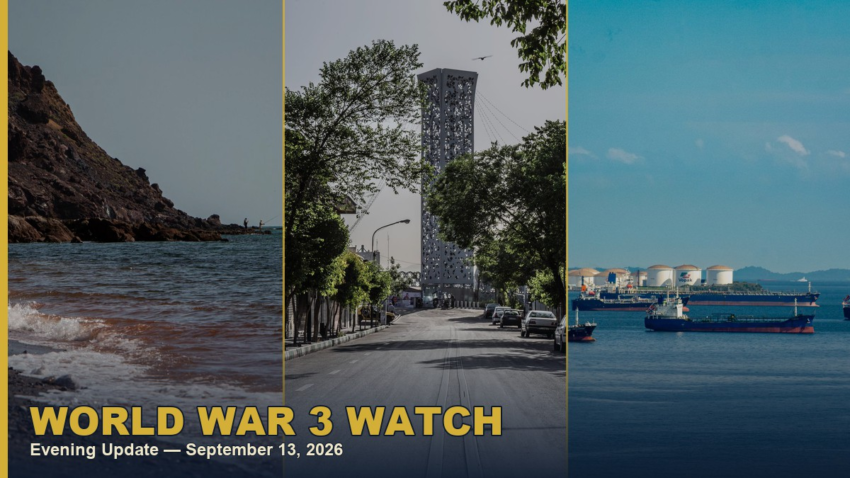
World War 3 Watch — Evening Update — September 13, 2026
- Oman postponed Monday’s Salalah meeting between Iran and Gulf countries on the future of the Strait of Hormuz, hours after Tehran announced it (RTHK News, 2026).
- Iranian state media said a commercial vessel was struck in the strait; a local official called it a “US attack” near Qeshm Island that killed one and injured three (Anadolu Ajansı, 2026; MSN, 2026).
- Trump told reporters in Ireland that the war “could end before the midterms, but it’ll end after the midterms” (Anadolu Ajansı, 2026).
- US gasoline averaged $4.31 a gallon Sunday, up from $3.19 a year earlier (Anadolu Ajansı, 2026).
- Iran’s Mehr News Agency called Trump’s account “absurd” (Anadolu Ajansı, 2026).
- A Chinese-language account describes more than 20 Iranian ballistic missiles fired at a base in Jordan and an Iranian plan for a maritime “sanctions zone” reaching the Arabian Sea (Sohu, 2026, authors’ translation).
The Story So Far
The meeting meant to reopen the Strait of Hormuz will not happen Monday. Oman announced the postponement of talks it was to host in Salalah between Iran and Gulf countries (RTHK News, 2026).
Tehran had said Iraq and Gulf countries would take part. No country in the region confirmed its attendance, and Bahrain ruled out attending (RTHK News, 2026).
The same day, Iranian state media said an Iranian commercial vessel was struck in the strait, killing one person. A local official blamed a “US attack” near Qeshm Island in southern Iran (MSN, 2026; Anadolu Ajansı, 2026).
Asked in Ireland whether Washington was responsible, President Donald Trump said: “I don’t want to say” (Anadolu Ajansı, 2026).
The blockade has now run more than six months, oil cleared $100 a barrel last week, and a Chinese-language report describes a 48-hour missile exchange the English wires barely touch (RTHK News, 2026; Sohu, 2026, authors’ translation).
Video: Iran Seeking Gulf States Support for Hormuz Plan. Source: Bloomberg Podcasts.
1. Hormuz Talks Collapse Before They Begin
Gulf diplomats and Iranian officials were set to meet without the United States to discuss an Omani plan for re-opening the strait to regular tanker traffic (MSN, 2026).
By Sunday, that plan was on hold. Oman’s news agency said the Salalah meeting was postponed “to a later date” so conditions could be created for “a constructive dialogue” (RTHK News, 2026).
Omani Foreign Minister Badr Albusaidi wrote on X that “we remain determined to promote dialogue that contributes to stability and lasting cooperation in our region” (RTHK News, 2026).
No new date has been given. That silence is the story: the one channel that could reopen the waterway is now unscheduled.
Why the strait closed in the first place
The Strait of Hormuz has faced an Iranian blockade, and later a US one, since February 28, when the US and Israel launched strikes on Iran (RTHK News, 2026).
A June accord between Washington and Tehran faltered over disagreements about Hormuz (RTHK News, 2026).
Before the war the strait was free to transit. Iran now requires vessels to obtain permission and is considering a mechanism to impose service fees (RTHK News, 2026).
Ships that do not comply are regularly targeted by Iranian strikes, while the United States periodically bombs the Iranian coastline to challenge Tehran’s control (RTHK News, 2026).
Separately, a blistering offensive by Yemen’s Houthis in recent days has given the Tehran-allied group leverage over a second waterway, the Bab al-Mandab (RTHK News, 2026).
Two chokepoints, both contested, and the negotiating table just went dark. Watch whether Oman names a new date this week.
Video: Iran Warns US Warships Amid Calls for Mass Attacks on Oil Tankers After Deadly Strike in Hormuz | 4K. Source: CRUX.
2. A Tanker Burns and Washington Won’t Say
Iranian state media claimed an Iranian commercial vessel was struck in the strait late Saturday, killing one person (MSN, 2026).
Fox News reported Iran’s claim that one person was killed in an attack on one of its trade vessels on Sunday, as the conflict escalates in Yemen (Fox News, 2026).
Anadolu Ajansı placed the strike early Sunday, near Qeshm Island in southern Iran. A local official said one person was killed and three injured in a “US attack” (Anadolu Ajansı, 2026).
The one-word answer that matters
Trump was asked directly, on departing Ireland, whether Washington was responsible. “I don’t want to say,” he told reporters (Anadolu Ajansı, 2026).
Note what the English-language sources do not agree on: MSN says late Saturday, Fox News says Sunday, and the casualty count holds at one dead. The timing and the shooter remain unresolved.
If the US struck an Iranian-flagged commercial ship, the Omani mediation track gets harder. If it did not, Tehran is describing an attack that Washington has not confirmed.
Video: What Role Does Diplomacy Play in Resolving Conflicts Between Iran and Arab Countries in the Middle E. Source: Daily Q&A.
3. Trump Puts a Date on the War
Trump said Tehran “wants to make a deal” and forecast a rapid fall in US fuel costs once fighting stops (Anadolu Ajansı, 2026).
“Look, it could end before the midterms, but it’ll end after the midterms,” he told reporters in Ireland, where he attended the Amgen Irish Open at his Trump International Golf Links resort (Anadolu Ajansı, 2026).
Gasoline prices, he said, are “going to drop like a rock” afterward (Anadolu Ajansı, 2026).
The number voters feel
US gasoline averaged $4.31 a gallon Sunday, up from $4.07 a month earlier and $3.19 a year ago, according to AAA (Anadolu Ajansı, 2026).
Trump said Iranian officials are “calling constantly” to secure an agreement, but warned: “I’m not going to make a deal that’s no good” (Anadolu Ajansı, 2026).
Iran’s Mehr News Agency rejected the assertions as “absurd,” arguing the US leader was trying to justify mounting domestic economic problems fueled by the confrontation (Anadolu Ajansı, 2026).
Trump restated the campaign’s core objective: “Iran cannot have a nuclear weapon, and they won’t have a nuclear weapon” (Anadolu Ajansı, 2026).
Then he shrugged at the Gulf talks
Asked about Gulf states engaging Tehran without Washington, Trump said: “I don’t care. That’s up to them” (Anadolu Ajansı, 2026).
He then raised keeping an American presence to control regional energy: “We will ultimately get out unless we decide to stay and keep the oil, like Venezuela” (Anadolu Ajansı, 2026).
The South China Morning Post published an opinion column Sunday under the headline “US-Israeli failure to bomb Iran into submission was preordained” (South China Morning Post, 2026).
The war is now in its seventh month (Anadolu Ajansı, 2026). November is the date Trump named; nothing in Sunday’s diplomacy suggests Tehran has agreed to it.
4. Iran’s Warning: A “Sanctions Zone” From Chabahar to the Arabian Sea
A Chinese-language account on Sohu describes the past 48 hours as the moment the US-Iran-Israel contest moved from proxy war to open confrontation (Sohu, 2026, authors’ translation).
It reports that US Central Command confirmed on September 9 that Iran’s Revolutionary Guard fired more than 20 ballistic missiles on September 8 at Muwaffaq Salti Air Base in Jordan — described as retaliation for a US strike on five Iranian oil tankers the same day (Sohu, 2026, authors’ translation).
Facing that barrage, Jordan sounded nationwide air defense alerts and fired more than 30 Patriot interceptors, according to a Jordanian air defense officer cited in the report (Sohu, 2026, authors’ translation).
In the exchange, one US A-10 attack aircraft was hit and had a wing break off, the report says. Eight F-15 fighters took minor damage and were repaired and returned to flight (Sohu, 2026, authors’ translation).
The threats, not the missiles, are the story
An Iranian official named in the report as Aziz warned US forces that Persian Gulf security is decided by Iran, and that remaining troops should “hurry and pack up equipment and go home” while they still can (Sohu, 2026, authors’ translation).
A Revolutionary Guard spokesman named as Mohebi said that if the enemy attacks two or three Iranian targets, Iran will destroy 20 in response (Sohu, 2026, authors’ translation).
The report also says Iran is planning a maritime “sanctions zone” stretching from near Chabahar port to the Oman Sea and the Arabian Sea — a zone that would sit astride the routes into Hormuz (Sohu, 2026, authors’ translation).
Trump, for his part, again raised striking the “Haoshan” nuclear facility — rendered literally as “Pickaxe Mountain” — which the report calls one of Iran’s most fortified underground nuclear sites; Iran’s Foreign Ministry spokesman called it a pretext for further aggression (Sohu, 2026, authors’ translation).
None of these military figures appear in Sunday’s English-language wires. Treat them as one outlet’s account until corroborated.
5. What Chinese-Language Coverage Carries That English Wires Don’t
Compare the headlines and the gap is immediate. VOA Chinese led with the cargo ship strike, Houthi expansion and rising global fear of an oil supply cutoff (VOA Chinese, 2026, authors’ translation).
English wire coverage of the same strike instead framed it as an Iranian claim amid escalation in Yemen (Fox News, 2026).
An explosion English readers never saw
Titles on Cztv report unexplained explosion booms in Iran and the sudden delay of the meeting on a new Hormuz corridor (Cztv, 2026, authors’ translation).
English-language reporting said the Salalah meeting was postponed to create conditions for constructive dialogue, with no mention of explosions (RTHK News, 2026). Same delay, two very different frames.
What English sources carried and the Chinese set did not: the Omani plan to re-open the strait to tanker traffic, Bahrain’s refusal to attend, and Trump’s line about staying to “keep the oil, like Venezuela” (MSN, 2026; RTHK News, 2026; Anadolu Ajansı, 2026).
What the Chinese set carried and the English wires did not: missile counts, aircraft damage, named Iranian commanders, and the “sanctions zone” plan (Sohu, 2026, authors’ translation).
Neither set is complete on its own. For how these divergent framings fit together, see our narrative-comparison report on how US, Israeli, Iranian, and BRICS media each tell this war.
Is This Actually World War 3?
No — not by today’s sources. What they show is a regional war in its seventh month, with two contested chokepoints and a mediation track that just stalled (RTHK News, 2026; Anadolu Ajansı, 2026).
That is serious. It is not the same as great powers shooting at each other.
The mechanisms that could widen it are visible, though: a Hormuz blockade since February 28, an Iranian permission-and-fee regime for shipping, US strikes on the Iranian coastline, and Houthi leverage over the Bab al-Mandab (RTHK News, 2026).
Add the claimed “sanctions zone” reaching to the Arabian Sea and the threat becomes structural rather than tactical — one navy able to squeeze global energy traffic (Sohu, 2026, authors’ translation).
Worth stating plainly: this series also tracks the China-Taiwan flashpoint, and no source in today’s set reports new developments there. Today’s escalation is entirely Middle East.
Three things to watch next: whether Oman names a new date for Salalah, whether Washington confirms or denies the Qeshm strike, and whether Iran formalizes its permission-and-fee system for tankers.
What You Can Do Right Now
- Watch the rescheduled meeting, not the rhetoric. Oman said only that the Salalah talks were postponed “to a later date,” with no new date given (RTHK News, 2026). A confirmed date is the first real de-escalation signal.
- Cross-check single-source claims before repeating them. Today’s most dramatic military details come from one Chinese-language account, while the strait strike is described differently by Iranian state media, Fox News and Anadolu Ajansı (Sohu, 2026, authors’ translation; Fox News, 2026; Anadolu Ajansı, 2026).
- Plan around price, not panic. Oil passed $100 a barrel last week and US gasoline averaged $4.31 a gallon Sunday (RTHK News, 2026; Anadolu Ajansı, 2026). For household-level fuel, water and supply steps, see our survival skills and preparedness guide.
Figure 1
Who is covering this
Note. Built from the WW3 Watch stories cited in this report.
Figure 2
Connecting the dots: names that keep appearing together
Note. Built from the WW3 Watch stories cited in this report. A line means two names appeared in the same sourced story — it shows overlap in the coverage, not a proven connection between them.
Black Excellence This Week
The hard news is real, and so is this. Wins reported by the Black press in the last 14 days:
- Another North Carolina HBCU shatters enrollment record as Black colleges surge
miamiherald.com · 2026-09-11 - 5 Things You May Not Know About XCEL Award Honoree Dr. Bernard Harris
blackenterprise.com · 2026-09-10 - HBCUs Are Building New Support Systems for Black Male Students
capitalbnews.org · 2026-09-08 - Florida HBCU Announces Historic Enrollment
miamiherald.com · 2026-09-02
What You Can Do This Week
Not just bad news — here is where to push.
- Call your U.S. senators and demand a public, recorded position on any new military authorization against Iran — Find your U.S. senators
- Attend your city council meeting and demand a briefing on local fuel-shortage and emergency plans if Hormuz shipping stops — Attend your city council meeting (USA.gov local officials)
- Check your voter registration now and confirm your polling place before November’s midterms, which Trump linked to the war’s end — Check your voter registration
SUPPORT KEMETIC MINDS
Enjoying this coverage? Back the work and find every way to connect with us in one place.
Support the Page →Kemetic Minds Analysis
This roundup pulled directly from the day’s English- and Chinese-language wires side by side, because the gap between what each side chooses to report is often as informative as any single strike count. Treat the Key Takeaways above as the verified factual floor, and the framing differences noted in the sections above as the more interesting, harder-to-fake signal about where this war is actually headed next.
References
- MSN. (2026, September 13). Iran meeting with Gulf countries to discuss Strait of Hormuz deal without the US. msn.com
- MSN. (2026, September 13). Iran reports commercial vessel struck in Strait of Hormuz. msn.com
- News. (2026, September 13). Oman says Hormuz talks with Iran postponed. news.rthk.hk
- Fox News. (2026, September 13). Iran says 1 killed on commercial ship in Strait of Hormuz; Houthis target Saudi Arabia. foxnews.com
- Anadolu Ajansı. (2026, September 13). Trump forecasts end to Iran war around November US midterm elections. aa.com.tr
- South China Morning Post. (2026, September 13). My Take | US-Israeli failure to bomb Iran into submission was preordained. scmp.com
- voachinese.com. (2026, September 13). 霍尔木兹海峡伊朗货轮遇袭,胡塞武装扩大战事,加剧全球对石油断供的忧虑 [Iranian cargo ship attacked in Strait of Hormuz as Houthis widen conflict, deepening global fears of an oil supply cutoff]. voachinese.com
- 新蓝网. (2026, September 13). 伊朗传出不明爆炸巨响 讨论霍尔木兹海峡新通道会议突然延迟 [Mysterious explosion heard in Iran; meeting on new Strait of Hormuz corridor suddenly delayed]. cztv.com
- Sohu. (2026, September 13). 美伊摊牌48小时,特朗普再提打击“镐山”,伊朗发出强硬警告! [US-Iran Showdown in 48 Hours: Trump Again Raises Striking “Pickaxe Mountain,” Iran Issues Stern Warning!]. m.sohu.com
Investigative Methodology: This roundup is generated on a fixed schedule (noon and evening, America/Chicago) from live English- and Chinese-language wire sources. Every claim is grounded in fetched source text with an APA7 in-text citation; translated Chinese-language quotes are marked “authors’ translation.” Every video embed is verified to be a real, existing video via YouTube’s oEmbed endpoint before publication — none are written by the drafting model. No Wikipedia sources are used.
Stay Connected

Kemetic Minds Editorial Desk
Verified NewsroomPrimary-sourced investigative intelligence on civil rights, voting rights, federal policy, and consumer protection. Sourced from primary legal filings, government statistics, and direct field reporting.