KEMETIC MINDS
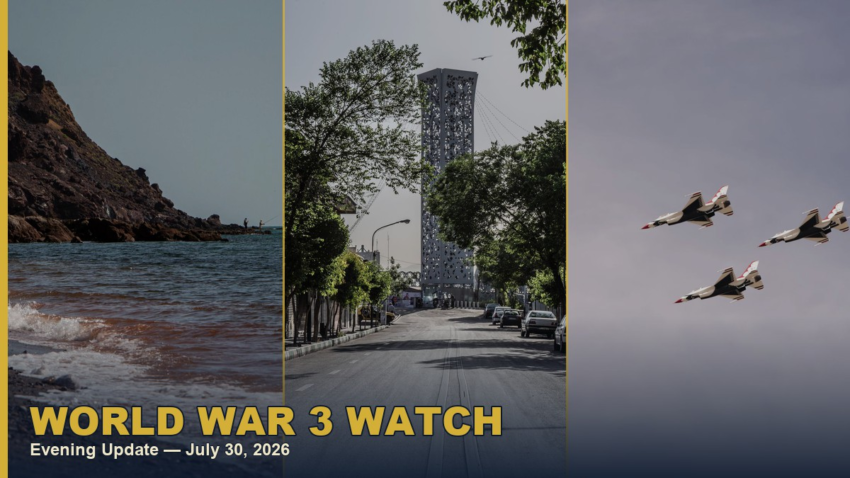
World War 3 Watch — Evening Update — July 30, 2026
- Senator Tom Cotton backs sustained U.S. airstrikes on Iran and a naval blockade, as the crypto market lost $80 billion following the conflict escalation (Cryptobriefing, 2026).
- Trump met with Saudi and Israeli leaders, who offered options for the war’s next phase as the conflict enters its sixth month (MSN, 2026a).
- The U.S. sanctions eight ships transporting Iranian oil to China and the UAE; over 100 vessels sanctioned since January (U.S. Embassy & Consulates in China, 2026, authors’ translation).
- Pakistan announces that Washington and Tehran are negotiating de-escalation, referencing the Islamabad Understanding Protocol, despite ongoing U.S. airstrikes (RFI, 2026, authors’ translation).
- The U.S. strikes “dozens” of IRGC targets inside Iran, including command centers and missile facilities, after Iran launched ballistic missiles at U.S. forces (RFI, 2026, authors’ translation).
1. Cotton Calls for Sustained Campaign as Crypto Bleeds
Senator Tom Cotton (R-AR) publicly endorsed President Trump’s military strikes on Iran, demanding sustained airstrikes paired with a “naval enforcement blockade” (Cryptobriefing, 2026).
The Arkansas Republican and Senate Intelligence Committee chair called Iran’s leadership “terrorists” and argued the only language they understand is force (Cryptobriefing, 2026).
Cotton’s position is consistent with his long-standing Iran hawk stance, having advocated for strikes as early as 2019 (Cryptobriefing, 2026).
The crypto market reacted sharply: roughly $80 billion in total market capitalization evaporated by July 2026, with Bitcoin and Ethereum absorbing the heaviest blows (Cryptobriefing, 2026).
U.S. forces had already struck over 80 Iranian military targets around July 7, 2026, in retaliation for Iranian missile and drone attacks on commercial shipping (Cryptobriefing, 2026).
The conflict has cost 19 U.S. service members and one contractor their lives, including six killed in a drone strike (Cryptobriefing, 2026).
Video: Brief: Iran closes Strait of Hormuz. Israel wants to continue its military occupation. Source: Al Jazeera English.
2. Diplomacy in Motion: Saudis, Israelis, and Pakistan
As the war enters its sixth month, Trump met with the Saudi defense minister and Israeli Prime Minister Benjamin Netanyahu to shape decisions on the conflict (MSN, 2026a).
Netanyahu counseled Trump on three options for the war, though specific details were not disclosed in the source (MSN, 2026a).
Pakistan, acting as a mediator, announced that Washington and Tehran are currently negotiating de-escalation (RFI, 2026, authors’ translation).
The Pakistani Foreign Ministry stated: “All parties are engaged in negotiations, especially on the Strait of Hormuz issue, to achieve de-escalation” (RFI, 2026, authors’ translation).
Pakistan claims it is doing everything possible to bring both sides back within the “Islamabad Understanding Protocol,” signed in mid-June to pave the way for peace talks (RFI, 2026, authors’ translation).
That process has been stalled since early July as the U.S. and Iran traded strikes (RFI, 2026, authors’ translation).
Video: 'NO OIL OR GAS FOR ANYONE': Iran Declares GLOBAL ECONOMIC BLOCKADE Over Trump's Hormuz Move?. Source: Times Of India.
3. War Spreads to New Maritime Domain, Risking NATO Crisis
The U.S.-Iran conflict has now spread to another major sea, risking a “new Suez crisis” for NATO (Newsweek, 2026).
The specific sea was not named in the source text, but the reference to a Suez-style disruption signals a potential chokepoint for global shipping routes (Newsweek, 2026).
This expansion threatens to draw NATO allies deeper into the conflict as shipping lanes become contested (Newsweek, 2026).
The development adds a new layer of great-power tension to an already volatile region (Newsweek, 2026).
In our narrative-comparison report, we previously examined how different media frames shape public understanding of these maritime flashpoints.
Video: Israel and US launch strikes on Iran, pushing Middle East into new conflict • FRANCE 24 English. Source: FRANCE 24 English.
4. US Targets Mahan Air’s China, India, Russia Network
The U.S. Treasury Department imposed sanctions on six individuals and entities in China, India, Russia, and Iran over alleged links to Iranian airline Mahan Air (Zeenews, 2026).
The sanctions target a “network providing commercial, logistical and financial support to Mahan Air,” which Washington has long accused of moving weapons and IRGC-Quds Force personnel (Zeenews, 2026).
Specifically, two Shanghai companies and a Chinese executive were targeted in the expanded pressure campaign (MSN, 2026b).
Treasury Secretary Scott Bessent said: “Those who provide commercial, logistical or financial support to the IRGC or Mahan Air are helping sustain a terrorist enterprise” (Zeenews, 2026).
The action follows separate sanctions against eight oil tankers and 10 corporate entities involved in Iran’s energy trade, with six of those companies based in China (Zeenews, 2026).
OFAC has designated over 100 maritime vessels since January to restrict Iran’s shipping revenue (Zeenews, 2026).
An IRGC-affiliated organization was also named for allegedly collecting intelligence on U.S. and Israeli military assets (Zeenews, 2026).
5. Iranian “Hormuz Safe” Scheme Sanctioned by Washington
The U.S. sanctioned the Persian Gulf Marine Insurance Company and the Hormuz Safe Marine Services Authority, both IRGC-supported entities (U.S. Embassy & Consulates in China, 2026, authors’ translation).
These entities are accused of operating a coercive “insurance” scheme that extorts money from international ships transiting the Strait of Hormuz (U.S. Embassy & Consulates in China, 2026, authors’ translation).
The Treasury described the program as requiring commercial ships to purchase mandatory maritime “insurance” against risks created by Tehran itself, including threats of vessel seizure (Zeenews, 2026; U.S. Embassy & Consulates in China, 2026, authors’ translation).
The revenue from this scheme is directed toward supporting the IRGC and Iran’s broader destabilizing activities (U.S. Embassy & Consulates in China, 2026, authors’ translation).
Separately, the U.S. also sanctioned eight companies operating ships that transported Iranian crude oil and petrochemicals to China and the UAE (U.S. Embassy & Consulates in China, 2026, authors’ translation).
The State Department explicitly linked these sanctions to “supporting President Trump’s NSPM-2” and the ongoing naval blockade of Iranian ports and coastlines (U.S. Embassy & Consulates in China, 2026, authors’ translation).
6. China Sources Detail Airstrikes and Sanctions
The U.S. Embassy in China published a statement on July 30 detailing the latest sanctions, framing the “Hormuz Safe” scheme as an Iranian exploitation of a key international waterway (U.S. Embassy & Consulates in China, 2026, authors’ translation).
The embassy highlighted that the sanctions support the U.S. Navy’s “blockade of Iranian ports and coastlines” (U.S. Embassy & Consulates in China, 2026, authors’ translation).
Meanwhile, Chinese-language coverage from RFI provided specific details on the airstrikes that the English-language sources omitted (RFI, 2026, authors’ translation).
According to RFI, the U.S. struck “dozens of Islamic Revolutionary Guard Corps (IRGC) targets inside Iran, including military command centers, missile and drone facilities, coastal surveillance and defense installations, and naval capabilities” (RFI, 2026, authors’ translation).
Iranian state media reported the strikes hit Khuzestan and Hormozgan provinces, claiming an attack on a residence killed a family of three (RFI, 2026, authors’ translation).
This contrasts with the English-language sources, which emphasized the maritime sanctions and diplomatic maneuvers rather than the human cost inside Iran (Cryptobriefing, 2026; MSN, 2026a; Newsweek, 2026).
The Chinese-language coverage framed the airstrikes as “fierce” and noted Trump’s warning to Iran: “We will hit them hard, they will be hit hard” (RFI, 2026, authors’ translation).
7. Global Escalation Footprint
The sanctions network now stretches across at least four countries: China, India, Russia, and Iran (Zeenews, 2026).
The crypto market bleeding of $80 billion signals that global financial markets are treating this conflict as a systemic risk (Cryptobriefing, 2026).
The war’s spread to a new major sea suggests a widening theater beyond the Persian Gulf and Strait of Hormuz (Newsweek, 2026).
U.S. airstrikes resumed July 29-30, striking Iranian territory directly, a significant escalation beyond the earlier July 7 strikes on military targets (RFI, 2026, authors’ translation; Cryptobriefing, 2026).
Is This Actually World War 3?
Not yet. But the pieces are assembling at a worrying pace.
Today’s updates show a conflict that is actively expanding: geographically into a second major sea, economically into the global financial system via crypto markets, and diplomatically into a four-continent sanctions dragnet.
The U.S. is now striking Iranian territory directly, not just maritime or IRGC assets outside Iran (RFI, 2026, authors’ translation; Cryptobriefing, 2026).
Pakistan’s simultaneous announcement of ongoing negotiations suggests all parties recognize the risk of uncontrolled escalation (RFI, 2026, authors’ translation).
However, the presence of China, India, and Russia entities in the sanctions list means this is no longer a bilateral U.S.-Iran conflict — it is a globalized pressure campaign with potential for retaliatory blowback.
No direct great-power military confrontation has occurred, but the theater is widening faster than any diplomatic channel can contain it.
What You Can Do Right Now
- Diversify your assets: The $80 billion crypto crash shows traditional safe-haven assumptions may not hold. Consider moving a portion of holdings into tangible, non-digital stores of value if possible. See our survival skills and preparedness guide for practical steps.
- Monitor shipping and trade routes: If your job or supply chain depends on Hormuz or Suez corridor transit, prepare for disruption. The war’s spread to a new major sea suggests more chokepoints may close.
- Track the Islamabad Understanding Protocol: Pakistan’s mediation is the only active peace track right now. Watch for signs of its collapse or revival; either event will produce market and security shocks.
Kemetic Minds Analysis
This roundup pulled directly from the day’s English- and Chinese-language wires side by side, because the gap between what each side chooses to report is often as informative as any single strike count. Treat the Key Takeaways above as the verified factual floor, and the framing differences noted in the sections above as the more interesting, harder-to-fake signal about where this war is actually headed next.
References
- Cryptobriefing. (2026, July 30). Tom Cotton backs Trump’s strikes on Iran, calls leaders terrorists as crypto markets bleed $80 billion. cryptobriefing.com
- MSN. (2026, July 30). Saudi, Israeli leaders try to shape Trump's decisions on Iran conflict. msn.com
- Newsweek. (2026, July 30). US-Iran War Spreads to Another Major Sea, Risking New Suez Crisis for NATO. newsweek.com
- MSN. (2026, July 30). US sanctions Mahan Air’s China network over alleged support for Iran’s IRGC. msn.com
- Zeenews. (2026, July 30). US sanctions Iran’s Mahan Air network: Why China, India and Russia-based entities are in Washington’s crosshairs. zeenews.india.com
- U.S. Embassy & Consulates in China. (2026, July 30). 抗击伊朗滥用霍尔木兹海峡的行径- 美国驻华大使馆和领事馆 – U.S. Embassy & Consulates in China [Countering Iran's Misuse of the Strait of Hormuz]. china.usembassy-china.org.cn
- RFI. (2026, July 30). 美国恢复空袭伊朗后 巴基斯坦宣布华盛顿与德黑兰正在谈判 [After US Resumes Airstrikes on Iran, Pakistan Says Washington and Tehran Negotiating]. rfi.fr
Investigative Methodology: This roundup is generated on a fixed schedule (noon and evening, America/Chicago) from live English- and Chinese-language wire sources. Every claim is grounded in fetched source text with an APA7 in-text citation; translated Chinese-language quotes are marked “authors’ translation.” Every video embed is verified to be a real, existing video via YouTube’s oEmbed endpoint before publication — none are written by the drafting model. No Wikipedia sources are used.
Stay Connected

Kemetic Minds Editorial Desk
Verified NewsroomPrimary-sourced investigative intelligence on civil rights, voting rights, federal policy, and consumer protection. Sourced from primary legal filings, government statistics, and direct field reporting.