
KEMETIC MINDS
Data Journalism — Explainer Series | July 24, 2026
Starting just after midnight on July 25, 2026, the United States is collecting new tariffs of 10% to 12.5% on imports from 60 countries — the government’s latest attempt to rebuild a tariff wall after the Supreme Court struck down President Trump’s original “reciprocal tariffs” in February. Here is what a tariff actually is, how we got from that White House chart of country-by-country percentages to today’s rules, and — using research from the Federal Reserve and Yale’s Budget Lab — who actually ends up paying for it.
1. What Is a Tariff, Really?
Strip away the politics and a tariff is simple: it’s a tax the U.S. government collects on goods when they cross the border into the country. Here’s the part that surprises most people — the foreign country doesn’t write a check to the U.S. Treasury. The American company importing the goods pays the tariff to U.S. Customs and Border Protection at the port of entry, the same way you’d pay sales tax at a register. If a U.S. retailer imports $1,000,000 worth of shoes from a country facing a 12.5% tariff, that retailer owes $125,000 in tariff duties before those shoes ever reach a store shelf. What happens next — whether that cost gets absorbed by the importer, split with the factory overseas, or passed on to you at checkout — is where the real economics of tariffs plays out, and it’s covered in detail below.
2. From “Reciprocal Tariffs” to the Supreme Court to Section 301
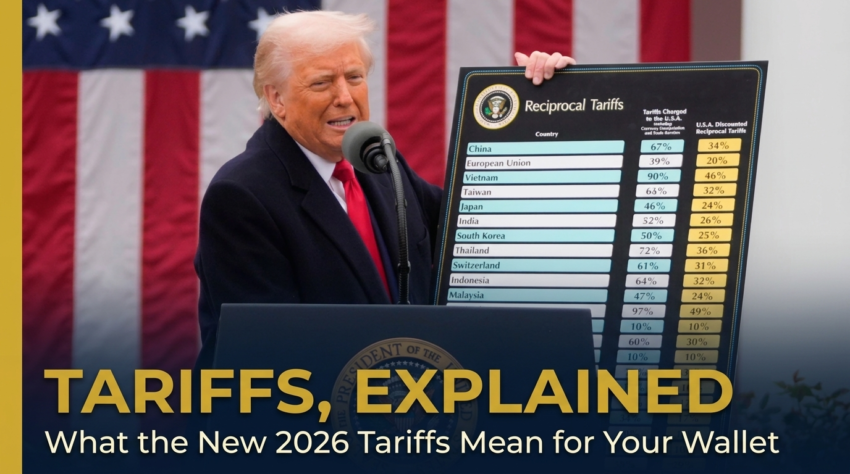
“Reciprocal tariffs” was the name President Trump gave to the sweeping, country-by-country tariff chart he unveiled in April 2025 — the same style of chart shown in the photo above, listing a specific percentage the U.S. said each country effectively charged American exports, alongside a lower “discounted” U.S. tariff rate applied in return. Those tariffs, along with a separate set aimed at Canada, Mexico, and China over fentanyl trafficking, were imposed using emergency powers under the International Emergency Economic Powers Act (IEEPA) — a law written for sanctions and asset freezes, not tariffs. On February 20, 2026, the Supreme Court ruled 6-3 that IEEPA does not give a president the power to impose tariffs at all, since the Constitution reserves taxing power for Congress. The Trump administration immediately ordered those IEEPA tariffs terminated, and Customs stopped collecting them on February 24, 2026.
Rather than abandon tariffs, the administration pivoted to a different, more legally durable law: Section 301 of the Trade Act of 1974, which lets the president impose tariffs after formally investigating a specific unfair trade practice — the same authority used for the first-term China tariffs that survived years of legal challenges. This time the investigation’s subject was forced labor: the U.S. Trade Representative’s office found that 60 trading partners, covering essentially all U.S. import volume, had failed to adequately ban or enforce bans on goods made with forced labor. “The United States has had a forced labour import ban for nearly a century, and rigorously enforces it; it’s well past time for our trading partners to do the same,” U.S. Trade Representative Jamieson Greer said announcing the action on July 23, 2026, after a process that included more than 2,100 public comments and consultations with over 45 governments. The new tariffs took effect at 12:01 a.m. Eastern time on July 25, 2026.
3. The New Tariff Map, Country by Country
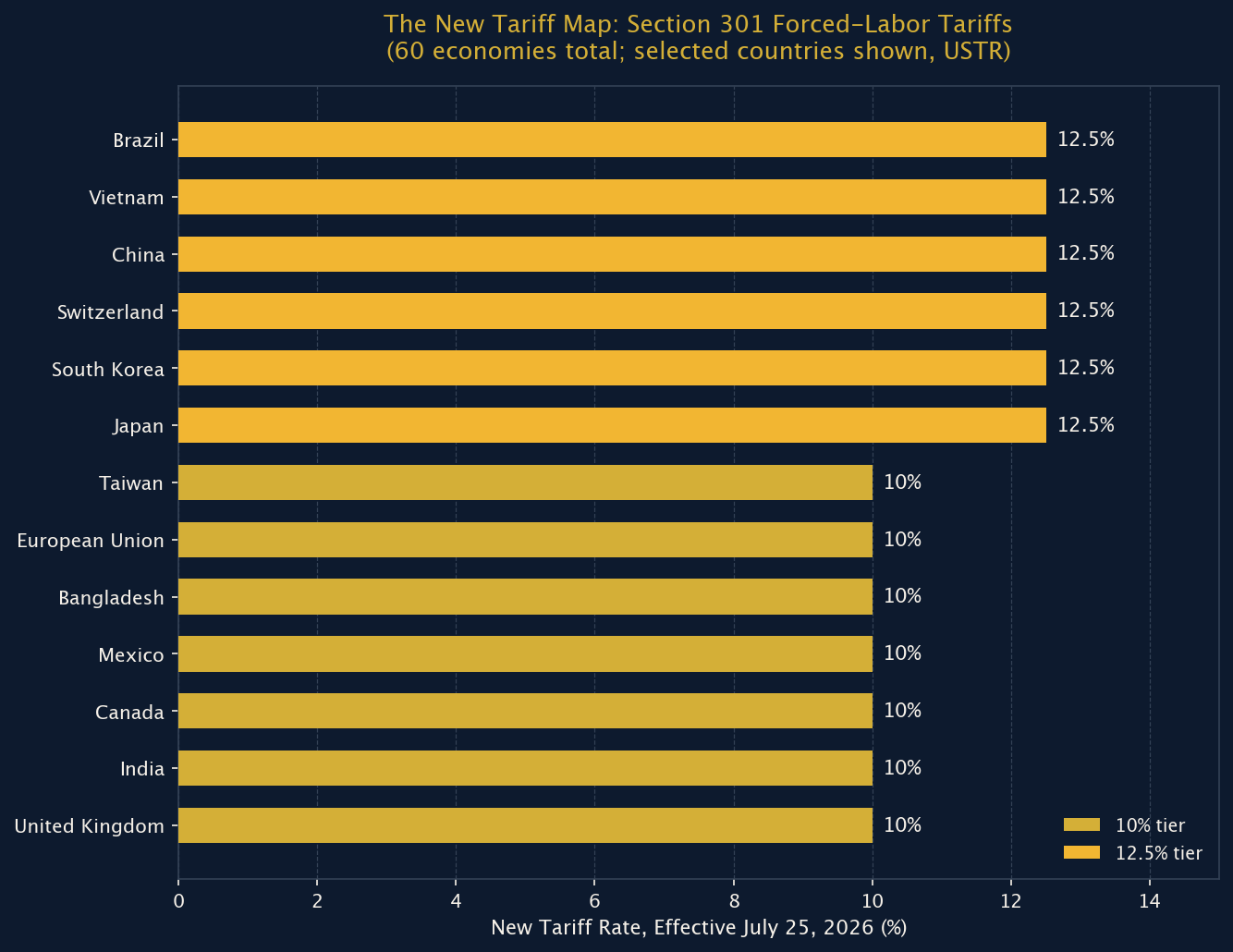
The new structure sorts countries into tiers by how seriously the U.S. judges their forced-labor enforcement to be. Seventeen countries — including the United Kingdom, Canada, Mexico, India, and Bangladesh — pay a flat 10% because they’ve adopted at least some forced-labor import restrictions. The European Union and Taiwan also land at an effective 10%, calculated on top of existing most-favored-nation duties. Japan, South Korea, and Switzerland pay 12.5% on that same net-of-MFN basis. The remaining 38 countries — including China, Vietnam, Brazil, and Russia — pay a flat 12.5% for having no meaningful forced-labor enforcement regime at all.
Figure 1
The New Tariff Map: Section 301 Forced-Labor Tariffs
4. Who Actually Pays — You, or the Foreign Country?
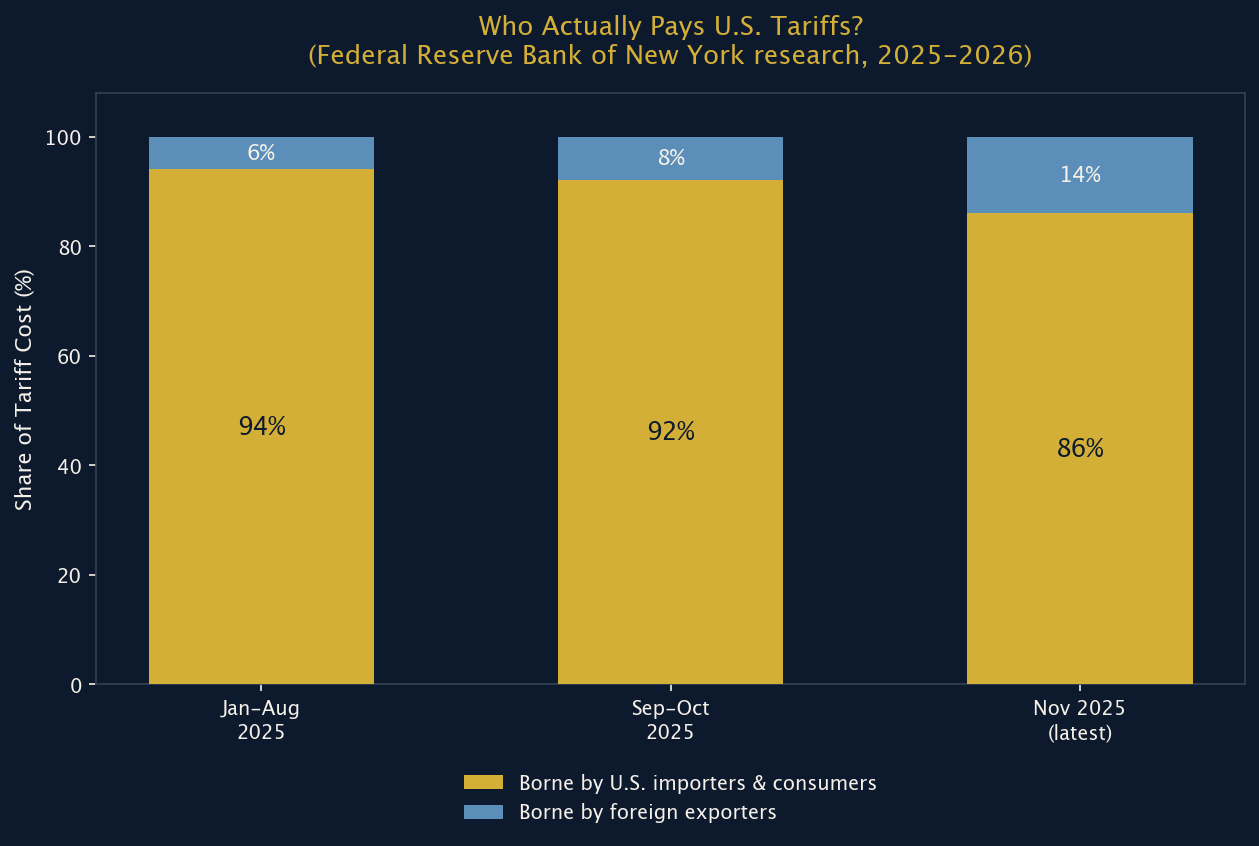
This is the question that actually determines whether tariffs show up in your grocery bill: when a 10% or 12.5% tariff gets slapped on an import, does the foreign supplier eat the cost by lowering their price, or does it flow through to the American buyer? Researchers at the Federal Reserve Bank of New York tracked this directly using detailed import-price data through 2025 and found the answer is overwhelmingly the latter. From January through August 2025, 94% of the tariff burden was borne by U.S. importers and consumers, with only 6% absorbed by foreign exporters cutting their prices. That U.S. share dipped slightly to 92% in September-October and 86% by November as some foreign suppliers began discounting — but even at its lowest point, the overwhelming majority of every tariff dollar was still landing on American businesses and households, not the countries the tariffs targeted. Separately, Peterson Institute for International Economics researcher Adam Posen has called the approach “one of the worst ways to impose a tax and one of the most regressive ways to redistribute income from poorer to richer Americans,” since tariffs apply the same rate regardless of a shopper’s income, so they take a bigger bite out of a lower-income household’s budget than a wealthier one’s.
Figure 2
Who Actually Pays U.S. Tariffs?
5. What It Means for Your Wallet
So what does 86%-94% pass-through actually add up to for a typical household? As of July 21, 2026, Yale’s Budget Lab put the average statutory U.S. tariff rate at 12.1% — and projected it would climb toward 12.8% by year’s end specifically because of the newly implemented Section 301 tariffs. Under current tariff policy, the Budget Lab estimates the ultimate impact on the overall consumer price level at roughly 0.4%, translating to an average household cost of about $550 a year. That figure isn’t spread evenly — it lands hardest on goods the U.S. imports heavily and can’t easily substitute domestically: clothing and shoes, electronics, furniture, toys, and auto parts. Durable goods and big-ticket items tend to see the clearest price increases because consumers have the least room to simply switch to a cheaper alternative, while services (which make up most of household spending and aren’t imported at all) are largely untouched.
Kemetic Minds Analysis
The through-line from April 2025’s chart-holding press conference to July 2026’s Section 301 rollout is that the administration lost a legal argument, not the policy fight. The Supreme Court didn’t rule that tariffs of this size are bad policy — it ruled that the specific law used to impose them didn’t actually grant that power. Section 301 does grant that power, explicitly, which is why these new tariffs are built to survive a legal challenge in a way the IEEPA ones weren’t. For consumers, the practical effect is similar either way: an extra 10-12.5% tax on hundreds of billions of dollars in imports, the large majority of which research shows gets passed through to the businesses and households buying those goods rather than absorbed by the countries selling them. The number worth watching over the next few months isn’t really 10% or 12.5% — it’s whether foreign exporters keep cutting their prices to soften the blow, the way the Fed’s data shows already happening at the margins, or whether that trend reverses as more of the cost gets locked in.
References
Methodology: Tariff rates and legal history are drawn directly from the U.S. Trade Representative’s own press release and the Congressional Research Service’s summary of the Supreme Court’s ruling. Pass-through/incidence figures are from a Federal Reserve Bank of New York staff research post using detailed import-price data. Household cost estimates are from Yale University’s Budget Lab tariff-tracking research. No figures were sourced from Wikipedia. Citations follow numbered footnote format with back-links to the in-text reference.
📱 Stay Connected

Kemetic Minds Editorial Desk
Verified NewsroomPrimary-sourced investigative intelligence on civil rights, voting rights, federal policy, and consumer protection. Sourced from primary legal filings, government statistics, and direct field reporting.