
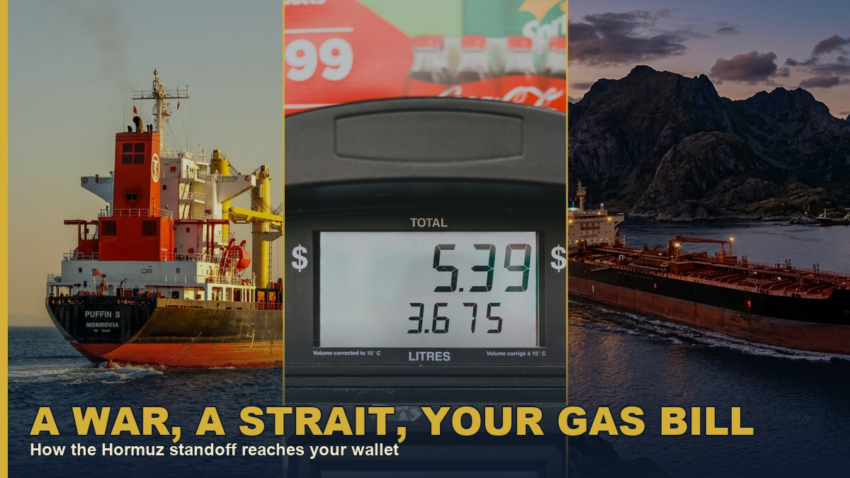
Gas prices at the pump are the clearest signal most Americans have felt from a war unfolding thousands of miles away. Here’s how a naval standoff in the Strait of Hormuz is actually reaching your wallet.
What’s happening in the strait
The Strait of Hormuz is the narrow waterway between Iran and the Arabian Peninsula that roughly 20 million barrels of oil a day normally pass through[1]. Renewed fighting between Iran, Israel, and the U.S. dramatically slowed that traffic: crossings peaked at 49 ships on July 7 but had slowed to just 25 ships by the following Wednesday[1].
An Omani delegation traveled to Tehran on July 24 to negotiate mechanisms for managing ship traffic through the strait[1]. The core disagreement remains unresolved: Iran wants to retain some authority over passage, while the U.S. position is that the ceasefire agreement’s memorandum of understanding calls for a fully open waterway within 60 days[1].
A quiet 24 hours, but not a resolution
As of July 25, the U.S. military had not announced new strikes on Iran for the first time in two weeks[2] — a genuinely notable pause, but one that follows a ceasefire-and-breakdown cycle that has already repeated multiple times since fighting began[3]. Iran’s navy previously declared the strait closed outright during an earlier escalation, prompting the U.S. to publicly demand it remain open to all shipping[4].
What it’s costing at the pump
The average U.S. price for a gallon of gas rose to $4.11 as of July 25, up 11 cents in a single week[1]. Since the war began in late February, American drivers are now paying 38% more at the pump than they were before the conflict started[1].
- That increase compounds fastest for lower-income households, who spend a larger share of their budget on gas and heating fuel and have less room to absorb the difference.
- Black households, which the Federal Reserve’s own Survey of Consumer Finances shows hold roughly six times less cash on hand in checking and savings than white households, have proportionally less buffer to weather a sustained fuel-price spike.
Why the on-again, off-again pattern matters
Markets price in expectations, not just events — which is part of why gas prices haven’t fully retreated even during quieter stretches. Every previous ceasefire in this conflict has broken down at least once[3], so a 24-hour pause in strikes is being read by markets as exactly that: a pause, not an end.
The Bottom Line
A war over a shipping lane on the other side of the world is showing up as an 11-cent-a-week rise at your local gas station. Until the Strait of Hormuz dispute over passage authority is actually settled — not just paused — expect gas prices to keep tracking the ceasefire’s ups and downs rather than settling down.
Have you changed your driving, budget, or spending because of rising gas prices this year? Let us know how it’s affecting your household in the comments.
References
- PBS News. (2026, July 24). Iran and U.S. reach an initial deal to extend the ceasefire and open the Strait of Hormuz but challenges remain. https://www.pbs.org/newshour/world/iran-and-u-s-reach-an-initial-deal-to-extend-the-ceasefire-and-open-the-strait-of-hormuz-but-challenges-remain ↩a ↩b ↩c ↩d ↩e ↩f
- CNN. (2026, July 25). US military does not announce new Iran strikes for first time in 2 weeks [Live updates]. https://www.cnn.com/2026/07/25/world/live-news/iran-war-trump ↩
- ABC News. (2026, July 24). How the US-Iran ceasefire and MOU broke down — a timeline. https://abcnews.com/Politics/us-iran-ceasefire-mou-broke-timeline/story?id=134622392 ↩a ↩b
- Al Jazeera. (2026, July 11). Iran war updates: IRGC navy declares Strait of Hormuz closed. https://www.aljazeera.com/news/liveblog/2026/7/11/iran-war-live-us-demands-iran-publicly-state-strait-of-hormuz-open-for-all ↩
Photo by Muhammed Zahid Bulut via Pexels · Photo by Erik Mclean via Pexels · AI image generated with Google Gemini

Kemetic Minds Editorial Desk
Verified NewsroomPrimary-sourced investigative intelligence on civil rights, voting rights, federal policy, and consumer protection. Sourced from primary legal filings, government statistics, and direct field reporting.