
KEMETIC MINDS
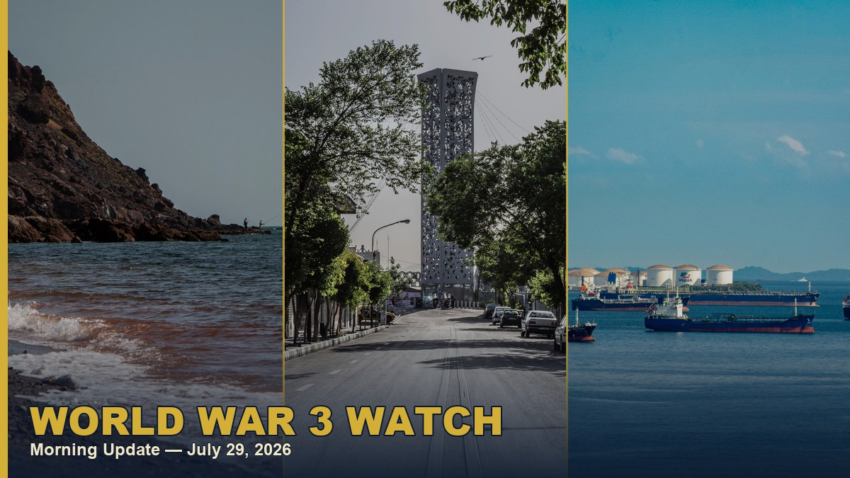
World War 3 Watch — Morning Update — July 29, 2026
- Iran fired multiple ballistic missiles at a US base in Jordan on July 28, 2026, breaking a brief pause in hostilities (华尔街见闻, 2026, authors’ translation).
- Iran rejected Oman’s proposal for equal joint management of the Strait of Hormuz, demanding dominant control over inbound shipping lanes (Sohu, 2026, authors’ translation).
- US and Saudi forces launched joint strikes against Iranian-backed Iraqi militias in retaliation for drone attacks on Saudi oil facilities (thepaper.cn, 2026, authors’ translation).
- China conducted a two-day live-fire drill in the Taiwan Strait on July 23–24, part of a pattern of expanding encirclement exercises (RFI, 2026, authors’ translation).
- Oil prices jumped more than 4% as Middle East tensions escalated (MSN, 2026).
Video: US-Iran Standoff Escalates Over Strait of Hormuz as Tensions Disrupt Global Shipping. Source: Al Jazeera English.
1. Top Story: Iran Rejects Hormuz Proposal, Fires Missiles at US Base
Iran launched multiple ballistic missiles at a US military base in Jordan on Tuesday, July 28, the first such attack since President Trump paused strikes on Iran to allow diplomatic talks (华尔街见闻, 2026, authors’ translation). The US Central Command said all missiles were intercepted, and US forces remain on high alert (华尔街见闻, 2026).
The missile strike occurred hours after Trump met with Israeli Prime Minister Netanyahu at the White House to discuss Iran (华尔街见闻, 2026). Trump told Axios that the US and Iran are in “very deep negotiations” but warned that if diplomacy fails, the US will resume “very strong military action,” adding that time is “running out” (thepaper.cn, 2026, authors’ translation).
Simultaneously, Iran refused Oman’s proposal to share control of the Strait of Hormuz on an equal basis. Instead, Tehran demands that all inbound shipping pass through waters under full Iranian control, with outbound lanes partially managed by Oman (Sohu, 2026, authors’ translation).
Iranian Deputy Foreign Minister Kazem Gharibabadi stated publicly that the Omani proposal “failed to address Iran’s security concerns” (华尔街见闻, 2026). He outlined Iran’s counterproposal: one lane must be entirely within Iranian waters, and the other also partly so. (Sohu, 2026, authors’ translation).
A US official rejected Iran’s demands, calling the Strait of Hormuz an international waterway and accusing Iran of “excessive demands” (华尔街见闻, 2026, authors’ translation). The English-language Reuters report (via MSN) focused on the 4% oil price spike, while Chinese-language sources provided far more detailed accounts of Iran’s negotiating stance and the breakdown of Omani mediation (华尔街见闻, 2026; Sohu, 2026).
Video: BREAKING: Iran's REVENGE Fury In Hormuz; 3 Ships 'BOMBED' After Hitting U.S. Base In Jordan. Source: Times Of India.
2. US-Saudi Strikes on Iraqi Militias Break Fragile Ceasefire
On July 29, the US and Saudi Arabia conducted joint airstrikes against Iranian-backed militia targets in Iraq. The US Central Command said the strikes were in response to more than 30 drone attacks on Saudi oil facilities over the previous 72 hours (thepaper.cn, 2026, authors’ translation).
This marks a rare direct Saudi military engagement in the conflict. Saudi Arabia had previously avoided open participation but launched covert strikes, according to US officials (thepaper.cn, 2026). Iranian state media denied any involvement in attacks on Saudi targets, calling such accusations a “serious misjudgment” (thepaper.cn, 2026, authors’ translation).
Iraqi Prime Minister Zaidi ordered an investigation into the militia-linked attacks, insisting Iraq must not be used as a launchpad for strikes against neighbors (thepaper.cn, 2026). The Iraqi militias denied involvement and blamed Houthi rebels, who have declared a Red Sea blockade (thepaper.cn, 2026).
This escalation shattered a brief pause after Trump’s decision to halt 13 consecutive nights of bombing on July 25. The New York Times reported that the pause was partly due to depleted Patriot interceptor stocks and fears of a refugee crisis and global economic fallout (thepaper.cn, 2026, authors’ translation).
English coverage (MSN) highlighted oil price jumps, while Chinese sources emphasized the political and military dynamics of the US-Saudi-Iraqi militia nexus.
Video: Highlights from first day of PLA Eastern Theater Command military exercises around Taiwan Island. Source: CGTN.
3. China Intensifies Military Drills Near Taiwan – Missile Test and Live-Fire Exercises
China conducted a live-fire exercise in the Taiwan Strait on July 23–24, issuing a navigation warning for ships to stay clear (RFI, 2026, authors’ translation). This drill is part of a pattern of increasingly frequent and expansive rings of military exercises around Taiwan, with seven such encirclement drills in the past three and a half years (RFI, 2026, authors’ translation).
Chinese media reported the drill as routine, but Taiwan’s National Security Council Deputy Secretary-General Lin Fei-fan said the purpose is clear: “to become a new military hegemon in the Indo-Pacific” through military aggression and expansion (RFI, 2026, authors’ translation).
On July 6, China test-launched a long-range ballistic missile “Julang” (巨浪) into the Pacific, carrying a simulated warhead (RFI, 2026, authors’ translation). This test came as Australia and Fiji signed a mutual defense treaty, widely seen as a counter to China’s regional influence. New Zealand government documents reportedly view such missile tests as likely becoming “normalized” (RFI, 2026, authors’ translation).
Taiwan’s Ministry of National Defense recorded over 5,400 Chinese military aircraft sorties near Taiwan last year, with 3,700 crossing the median line of the strait (RFI, 2026, authors’ translation). Taiwan is now developing “social resilience” by training 200,000 disaster-prevention personnel by year’s end, aiming for 2 million, so that one in 12 citizens can serve as first responders in a crisis (RFI, 2026, authors’ translation).
This section relies entirely on the Chinese-language RFI report, which provides detailed analysis of China’s military posture. No English source in the provided set covers this story, highlighting a divergence in international media focus: Western outlets concentrate on Iran, while Chinese state-aligned media emphasize Taiwan and Indo-Pacific tensions.
For a deeper dive into how media from different blocs shape the narrative, see our narrative-comparison report on how US, Israeli, Iranian, and BRICS media each tell this war.
4. Is This Actually World War 3?
Based solely on today’s sources, the situation is grave but not yet a global conflagration. Iran and the US are in a break-and-make cycle: missile attacks and strikes on proxies, yet diplomacy continues (thepaper.cn, 2026; 华尔街见闻, 2026). The Strait of Hormuz remains partially blocked, but oil price spikes suggest markets anticipate disruption, not immediate war (MSN, 2026).
The China-Taiwan axis remains a separate flashpoint, with drills and missile tests raising the temperature but no direct confrontation (RFI, 2026). The US is militarily engaged in the Middle East and diplomatically engaged in the Indo-Pacific, but not yet fighting on two fronts simultaneously in a coordinated way.
This is best described as a multi-theater crisis on the edge of major war, not World War 3 itself. The potential for escalation is high, especially if Hormuz is forcibly closed or if China’s drills trigger a miscalculation.
5. What You Can Do Right Now
- Monitor energy prices and supply chains: If you rely on global shipping or fuel, prepare for sustained volatility. The Strait of Hormuz chokepoint is not resolved.
- Review personal and community preparedness: With two potential fronts of conflict, ensure you have basic supplies, communication plans, and first-aid training. Our survival skills and preparedness guide offers actionable steps.
- Stay informed across sources: Compare English and Chinese coverage to detect blind spots in each narrative. The gap between what Reuters and Chinese state media report is itself a critical piece of intelligence.
Kemetic Minds Analysis
This roundup pulled directly from the day’s English- and Chinese-language wires side by side, because the gap between what each side chooses to report is often as informative as any single strike count. Treat the Key Takeaways above as the verified factual floor, and the framing differences noted in the sections above as the more interesting, harder-to-fake signal about where this war is actually headed next.
References
- MSN. (2026, July 29). Oil rises as US-Iran tension escalates after Iraq strikes, missile attack. msn.com
- 华尔街见闻. (2026, July 29). 拒绝阿曼“霍尔木兹海峡”提案、要求更多控制权,伊朗再向美军基地发射导弹 [Iran fires missiles at US military base, rejecting Oman's Hormuz proposal and demanding more control]. wallstreetcn.com
- Sohu. (2026, July 29). 伊朗要求霍尔木兹海峡通行船只须经伊朗水域 [Iran requires ships passing through the Strait of Hormuz to go through Iranian waters]. m.sohu.com
- 华尔街日报中文网. (2026, July 29). 伊朗拒绝阿曼共管霍尔木兹海峡的提议,要求更多控制权 [Iran rejects Oman's proposal for joint management of the Strait of Hormuz, seeking greater control]. cn.wsj.com
- thepaper.cn. (2026, July 29). 美国沙特联手打击伊朗支持的伊拉克民兵组织,报复其袭击沙特石油设施 [US and Saudi Arabia join forces to strike Iran-backed Iraqi militia in retaliation for attacks on Saudi oil facilities]. m.thepaper.cn
- RFI. (2026, July 29). 聚焦台海 – 中国在印太区域的军事扩张从导弹试射到台海周边军演 唯一目的就是要成为印太新军事霸权 [Focusing on the Taiwan Strait – China's military expansion in the Indo-Pacific region, from missile tests to military exercises around Taiwan, aims to establish itself as the new military hegemon in the region.]. rfi.fr
Investigative Methodology: This roundup is generated on a fixed schedule (noon and evening, America/Chicago) from live English- and Chinese-language wire sources. Every claim is grounded in fetched source text with an APA7 in-text citation; translated Chinese-language quotes are marked “authors’ translation.” Every video embed is verified to be a real, existing video via YouTube’s oEmbed endpoint before publication — none are written by the drafting model. No Wikipedia sources are used.
Stay Connected

Kemetic Minds Editorial Desk
Verified NewsroomPrimary-sourced investigative intelligence on civil rights, voting rights, federal policy, and consumer protection. Sourced from primary legal filings, government statistics, and direct field reporting.