
KEMETIC MINDS
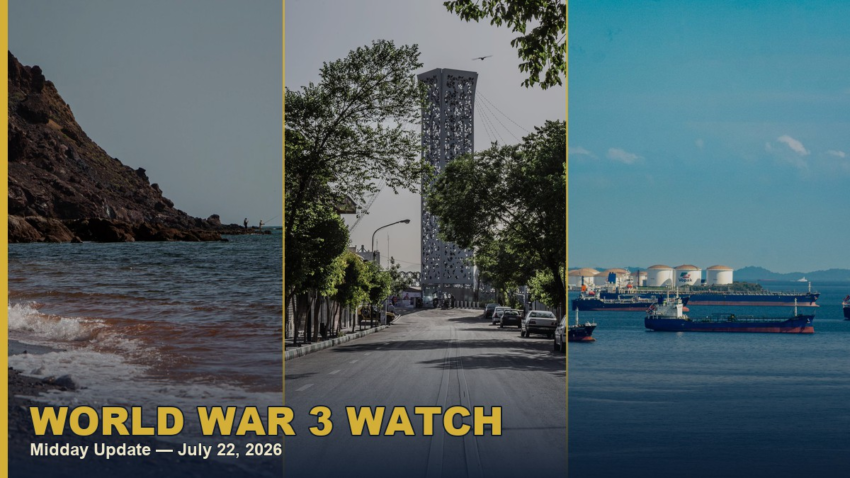
World War 3 Watch — Midday Update — July 22, 2026
- President Trump threatened to “bomb and destroy” an Iranian bridge or power plant for every new attack by Iran on a ship in the Strait of Hormuz (CBS News, 2026; VOA, 2026, authors’ translation).
- U.S. strikes have killed 53 people and injured 592 in Iran over the past month (Times of India, 2026).
- The war has cost the U.S. $375 billion so far, a 30% increase from a previous estimate of $290 billion (DW, 2026, authors’ translation).
- The World Bank warns a protracted conflict could push global inflation to 4.5% and reduce global economic growth to 1.3% (Cailianshe, 2026, authors’ translation).
Video: US launches 10th night of strikes on Iran as diplomacy hangs in the balance.. Source: Al Jazeera English.
1. Trump’s “Bridge for Ship” Ultimatum
President Donald Trump on Wednesday escalated his rhetoric against Iran, warning that the United States would “bomb and destroy” an Iranian bridge or power plant for every new attack on a ship in the Strait of Hormuz. In a post on Truth Social, he specifically threatened targets “including in or near the Iranian capital” (New York Times, 2026; VOA, 2026, authors’ translation). The U.S. military stated that Iran has attacked more than 30 commercial vessels through the strait over the past three months, with at least three vessels hit this week alone — actions the U.S. says violate the June 18 interim ceasefire agreement (VOA, 2026, authors’ translation).
Secretary of State Marco Rubio, speaking at the ASEAN foreign ministers’ meeting in Manila, reiterated that Washington remains open to diplomacy, but warned that Tehran lacks sincerity. He emphasized that the precedent of one nation controlling a vital international waterway is unacceptable (DW, 2026, authors’ translation). Meanwhile, Iran’s foreign ministry spokesperson Esmaeil Baghaei stated that repeated U.S. threats against Iran’s nuclear facilities violate international law and stressed that “the Iranian people stand resolute and united, ready to confront with full strength any act of US hostility” (Times of India, 2026).
Video: Iran War – New U.S. Strikes – LIVE Breaking News Coverage. Source: Agenda-Free TV.
2. U.S. Strikes Enter 11th Night; Iran Vows Retaliation
The U.S. Central Command conducted an 11th consecutive night of airstrikes on Iranian targets, hitting military command centers, naval capabilities, aircraft hangars, drone storage facilities, and logistics infrastructure. The command stated it aimed to “further diminish” Iran’s ability to threaten commercial shipping in the Strait of Hormuz (Financialexpress, 2026; CBS News, 2026; DW, 2026, authors’ translation). Iranian state media reported that air defense systems were activated in multiple areas of Tehran early Wednesday, and explosions were heard in the northeastern part of the capital — the first time during the latest escalation (DW, 2026, authors’ translation).
English-language sources highlighted that Iran’s military spokesman Abolfazl Shekarchi boasted that missile production never stopped, even during the 40-day war or after the memorandum of understanding was signed. Missiles are “moving directly from production to operational use while replenishing our stockpiles,” he said (Times of India, 2026). Chinese-language sources added that Iran’s Islamic Revolutionary Guard Corps warned “the enemy should prepare for waves of drones, and for even more decisive, more powerful missile strikes” if Trump follows through on his threat to hit a secret nuclear site (RFI, 2026, authors’ translation).
Iran has retaliated by striking U.S. facilities in Bahrain, Kuwait, and Jordan. Kuwait reported intercepting “hostile drones” and accused Iran of hitting its power and desalination plants. Jordan and Bahrain also announced they were struck by Iranian drones and missiles in the past 24 hours (RFI, 2026, authors’ translation; Times of India, 2026). According to an unnamed officer, Iran has used nearly 8,500 drones and missiles against targets in the Middle East since late February, with about 100 penetrating air defenses (Xinhua, 2026, authors’ translation).
Video: Iranian missile strikes injure more than 100 in southern Israel • FRANCE 24 English. Source: FRANCE 24 English.
3. War Costs Hit $375 Billion, Fueling Domestic Political Pressure
The financial and human toll of the war is mounting. U.S. Defense Secretary Pete Hegseth testified before the Senate that the conflict has already cost $375 billion, a 30% increase from a prior estimate of $290 billion, and is requesting an additional $670 billion for the Pentagon (DW, 2026, authors’ translation; RFI, 2026, authors’ translation). At least 18 U.S. service members have been killed, with 447 wounded; nearly 100 were injured in the past two weeks alone, with most suffering mild concussions (Xinhua, 2026, authors’ translation; Times of India, 2026).
U.S. media outlets reported that on Wednesday, President Trump attended a “dignified transfer” for four U.S. soldiers killed in recent Iranian attacks. This comes amid growing public discontent, with a Reuters/Ipsos poll showing only 37% approval for the military campaign and 80% of Americans expecting the war to be a long one (RFI, 2026, authors’ translation). Chinese-language sources provided more context on the political cost, noting that rising gasoline prices and cost-of-living increases pose a political risk for Trump’s Republican Party ahead of the November midterm elections, potentially costing the party its majority in the House or even the Senate (RFI, 2026, authors’ translation).
4. Diplomacy Stalls as Rubio Signals Openness, Pakistan Seeks $100 Billion
Diplomatic efforts appear to be limping. While Secretary Rubio stated the U.S. is willing to negotiate, President Trump was more pessimistic, saying the U.S. has “no intention to meet” (RFI, 2026, authors’ translation). Italy’s foreign minister Antonio Tajani announced another round of U.S.-mediated talks between Israel and Lebanon, set for August 4 in Italy (CBS News, 2026). These talks, however, involve only the Lebanese government, not Hezbollah, which has labeled the process “appeasement” (CBS News, 2026).
In a development reported exclusively by the Chinese-language source DW, Pakistan — which mediated in the Iran war negotiations — is now asking the U.S. for a $10 billion foreign exchange stabilization facility to bolster its reserves and ease pressure on its currency (DW, 2026, authors’ translation). The U.S. Treasury declined to comment. On a separate track, the U.S. is also reportedly finalizing a nuclear cooperation agreement with Saudi Arabia, allowing it to conduct uranium enrichment for its civilian program, a move that has drawn concern from some U.S. lawmakers and Israeli officials (DW, 2026, authors’ translation).
5. Cross-Narrative Comparison: What Each Side Chooses to Report
The differences in English-language and Chinese-language coverage today are telling. English-language sources, such as CBS News and the Financialexpress, focus heavily on the operational details of the U.S. airstrikes, President Trump’s specific “bridge for ship” threat, and the official justification of keeping the Strait of Hormuz open. They also extensively report Iran’s missile production and threats, but often frame these as defiant provocations. Human cost numbers, such as the 53 killed in Iran, appear primarily in the Times of India and CBS News, but with less emphasis than the U.S. military toll.
Chinese-language sources (VOA, RFI, DW, Xinhua) often feature a broader, more critical lens. For instance, RFI’s analysis explicitly frames the war as a potential “political cost” for Trump, linking it to a potential Republican defeat in the midterm elections — a dimension largely absent from English-language briefs. DW’s report on Pakistan’s $10 billion request and the Saudi nuclear deal is a major story that no English-language source in today’s feed touches. Xinhua’s report focuses on the 100 U.S. soldiers injured, providing detailed accounts of Iranian strikes and the Pentagon’s alleged obfuscation of casualty numbers. Cailianshe’s (CLS) piece is entirely about the World Bank’s macroeconomic warning, a subject that gets far less airtime in the Western press. This reinforces our ongoing observation that U.S. media are more operations-focused, while Chinese and other outlets are more attuned to political and economic consequences and new diplomatic angles. For a deeper dive into how this war is framed by different media, see our narrative-comparison report on how US, Israeli, Iranian, and BRICS media each tell this war.
6. World Bank Warns of Global Inflation Spiral, Growth Risk
The World Bank’s chief economist, Indermit Gill, issued a stark warning on Tuesday, arguing that the escalating U.S.-Iran war could reignite global inflation, drive interest rates higher, and slow global economic growth from 2.9% last year to as low as 1.3% (Cailianshe, 2026, authors’ translation). Gill stated that the worst-case scenario modeled by the World Bank in June — a conflict lasting six months or more — is now “close to becoming reality.” Under that scenario, global headline inflation would rise to 4.5%.
The war is already disrupting shipping in the Strait of Hormuz, which handles about one-fifth of the world’s oil and LNG trade, and Houthi threats to the Bab el-Mandeb Strait are adding pressure. Gill warned that sustained conflict and damage to oil infrastructure could disturb the transport of fertilizers, helium, and sulfur needed for agriculture, worsening food insecurity for poor nations already reeling from the COVID-19 pandemic. He cautioned that high-debt countries could face severe difficulty in the coming months as interest rates rise, with 40% of low- and middle-income countries already in or at risk of debt distress (Cailianshe, 2026, authors’ translation).
7. Is This Actually World War 3?
Based strictly on today’s sources, the situation is not yet a global war, but it is arguably the most intense conventional conflict between two major state powers since the U.S.-led invasions of the early 2000s. Today’s update confirms a direct, kinetic war between the U.S. and Iran, with the Strait of Hormuz as the central battlefield. Iranian strikes on U.S. bases in Bahrain, Kuwait, and Jordan (and vice versa) are overt and sustained. The involvement of Houthi allies threatening the Red Sea and the activation of Gulf state air defenses show a widening regional ring. However, no source today shows direct combat involving NATO allies beyond the U.S., nor any direct military confrontation between the U.S. and China over Taiwan. The World Bank’s warning of a global economic shock is the most serious “third-order effect” reported, but it is an economic forecast, not a military escalation. The label “World War 3” remains a potent metaphor for the scope and danger of this crisis, but the conflict is currently a U.S.-Iran war with regional ripple effects, not a global conflagration.
8. What You Can Do Right Now
- Monitor your exposure to volatile oil prices. With Brent crude breaking $94 and the World Bank warning of a 4.5% inflation spike, review your household budget and investment portfolio for sensitivity to rising energy and food costs.
- Access practical preparedness resources. As the global economic outlook darkens and war costs climb, having basic survival skills and supplies is a prudent step. Review our survival skills and preparedness guide for actionable advice.
- Stay informed via cross-source comparison. As this update shows, different media outlets prioritize vastly different facts. Follow the links in this report to read both English and Chinese-language sources to build a fuller picture of the conflict’s military, political, and economic dimensions.
Kemetic Minds Analysis
This roundup pulled directly from the day’s English- and Chinese-language wires side by side, because the gap between what each side chooses to report is often as informative as any single strike count. Treat the Key Takeaways above as the verified factual floor, and the framing differences noted in the sections above as the more interesting, harder-to-fake signal about where this war is actually headed next.
References
- Financialexpress. (2026, July 22). Iran-US war LIVE updates: Iran threatens to strike US-linked bridges, energy sites if Washington attacks its structures. financialexpress.com
- MSN. (2026, July 22). Trump threatens strikes on Iran bridges, power plants over Strait of Hormuz attacks. msn.com
- The New York Times. (2026, July 22). Iran War Live Updates: Trump Threatens Retaliation Against Civilian Targets if Iran Strikes in Strait. nytimes.com
- MSN. (2026, July 22). US-Iran tensions soar as strikes hit Gulf, tanker attacked in Strait of Hormuz. msn.com
- Times of India. (2026, July 22). US-Iran War Live Updates: 'Iran has iron will over Hormuz' – Tehran warns of retaliation if US hits bridges, power plants. timesofindia.indiatimes.com
- Cbsnews. (2026, July 22). Iran War Updates: Trump threatens to bomb a bridge or power plant for every ship attacked in Strait of Hormuz. cbsnews.com
- 美国之音. (2026, July 22). 特朗普总统警告德黑兰,每袭击一次商船,美国就将摧毁伊朗基础设施一次 [President Trump warns Tehran that the US will destroy Iranian infrastructure every time a commercial ship is attacked]. voachinese.com
- RFI. (2026, July 22). 要闻解说 – 无休止的美伊战争费用高昂 亦将给特朗普带来政治代价? [In-Depth: Will the High Cost of the Endless US-Iran War Also Come with a Political Price for Trump?]. rfi.fr
- 财联社. (2026, July 22). 世行警告:中东冲突升级或推高全球通胀 经济增速恐降至1.3% [The World Bank warns that escalating Middle East conflicts may drive up global inflation, with economic growth possibly slowing to 1.3%]. m.cls.cn
- 新华网客户端. (2026, July 22). 遭伊朗猛烈打击 美军过去两周近百人受伤 [US military suffers nearly 100 injuries in intense Iranian strikes over the past two weeks]. app.xinhuanet.com
- DW.com. (2026, July 22). 美连续11晚对伊空袭 美防长称伊朗战争已耗375亿美元 [US conducts 11 consecutive nights of airstrikes against Iran, US Defense Secretary says Iran war has cost $37.5 billion]. dw.com
Investigative Methodology: This roundup is generated on a fixed schedule (noon and evening, America/Chicago) from live English- and Chinese-language wire sources. Every claim is grounded in fetched source text with an APA7 in-text citation; translated Chinese-language quotes are marked “authors’ translation.” Every video embed is verified to be a real, existing video via YouTube’s oEmbed endpoint before publication — none are written by the drafting model. No Wikipedia sources are used.
Stay Connected

Kemetic Minds Editorial Desk
Verified NewsroomPrimary-sourced investigative intelligence on civil rights, voting rights, federal policy, and consumer protection. Sourced from primary legal filings, government statistics, and direct field reporting.
1 thought on “Earth Changes · Jul 22, 2026Iran-US war LIVE updates: Iran threatens to strike US”