KEMETIC MINDS
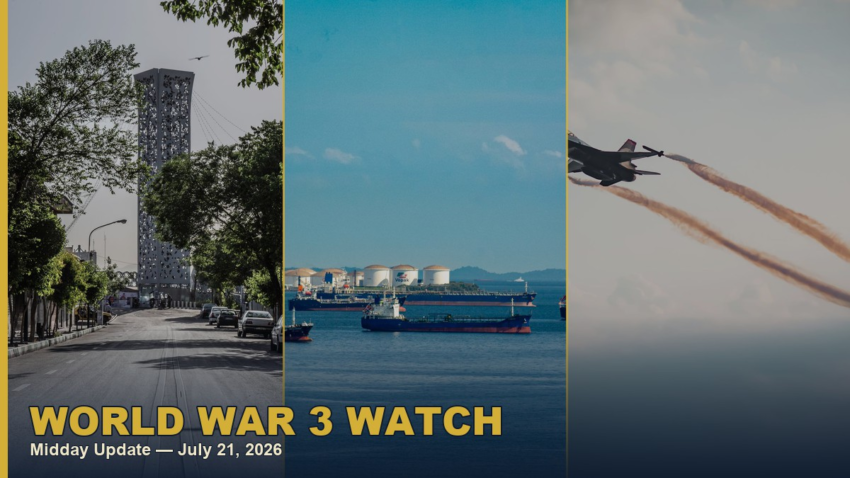
World War 3 Watch — Midday Update — July 21, 2026
- The US completed its tenth consecutive night of strikes against Iran, hitting military command centers, maritime capabilities, and launch sites in southern and western Iran (Usatoday, 2026; CNBCTV18, 2026; TBS News, 2026).
- Iran’s Revolutionary Guard retaliated by striking US radar and air-defense systems in Kuwait, Bahrain, and Jordan, and—for the first time—hit an Amazon facility in Bahrain in response to a US strike on Iran’s Darhowein nuclear site (TBS News, 2026; CRI, 2026, authors’ translation).
- Yemen’s Houthis announced a naval blockade against Saudi Arabia, prompting Saudi oil tankers bound for China and India to turn back in the Red Sea (CNBCTV18, 2026; MSN, 2026).
- Treasury Secretary Scott Bessent said China has cut Iranian oil purchases by roughly 40%, and the US froze $130 million in cryptocurrency wallets linked to the IRGC and Iran’s central bank (Epoch Times, 2026, authors’ translation; NetEase, 2026, authors’ translation).
- China’s new Xiang’an Airport, located less than 3 km from Taiwan-held Kinmen Island, is set to open by the end of 2026, raising military and flight-safety concerns in Taiwan (BBC Chinese, 2026, authors’ translation).
Video: IRGC reports ‘massive fires’ on two oil tankers in Strait of Hormuz. Source: Al Jazeera English.
1. US-Iran: Tenth Night of Strikes, Retaliation Expands to Bahrain
The United States and Iran traded blows for the tenth consecutive night on Tuesday, July 21, with each side expanding both the geographic scope and the nature of their targets (Usatoday, 2026; CNBCTV18, 2026). US Central Command said it had struck Iranian military command centers, maritime capabilities, missile and drone launch sites, and air-defense systems across multiple provinces, including Fars (Shiraz), Hormozgan (Konarak and Chabahar), Sistan-Baluchestan, and Ilam and Khorramabad in the west (TBS News, 2026; CRI, 2026, authors’ translation).
Iran’s Islamic Revolutionary Guard Corps (IRGC) responded with what it described as a “radar clearance operation,” targeting US radar and air-defense systems at military bases in Kuwait (Ali Al Salem Airbase), Bahrain, and Jordan (TBS News, 2026; CRI, 2026, authors’ translation). The IRGC also struck an MQ-9 drone hangar at Ali Al Salem. In a separate statement, the Guard said it had hit an Amazon infrastructure facility in Bahrain with cruise missiles, explicitly framing the strike as retaliation for an earlier US attack on Iran’s Darhowein nuclear facility under construction (CRI, 2026, authors’ translation). The strikes on desalination and power-generation facilities in Kuwait this week also drew attention: fires caused by earlier attacks had been extinguished by Tuesday and repairs were under way, but the targeting of civilian infrastructure—particularly water—underscores a dangerous new dimension to the conflict (TBS News, 2026).
A key difference in coverage emerges between English and Chinese-language sources. While English outlets such as TBS News and CNBCTV18 emphasize the broad regional spread of Iran’s retaliatory strikes and the Houthi blockade, the Chinese state-affiliated CRI report provides granular detail on the Amazon strike, including the explicit linkage to the Darhowein nuclear facility—a detail that English-language outlets do not mention. Chinese coverage also directly quotes the IRGC’s warning that “as long as the US continues its aggression, the Strait of Hormuz will remain closed” (CRI, 2026, authors’ translation).
Video: Iran War – New U.S. Strikes – LIVE Breaking News Coverage. Source: Agenda-Free TV.
2. Houthi Naval Blockade Opens New Front in the Red Sea
The conflict expanded significantly beyond the Gulf on Tuesday, as Yemen’s Iran-aligned Houthi movement announced a naval blockade against Saudi Arabia, threatening to target shipping “in any location” loading or discharging cargo at Saudi ports (CNBCTV18, 2026; TBS News, 2026). The warning, delivered via an email to shipping companies seen by Reuters, has already caused tangible disruption: Saudi oil tankers bound for China and India made U-turns in the Red Sea rather than risk attack (MSN, 2026).
This development, as CNBCTV18 (2026) notes, “puts another major global trade and energy route at risk” alongside the already-closed Strait of Hormuz. The Houthi blockade is particularly significant because it had not been a feature of the earlier phase of the war, which was focused on the Gulf. Its announcement came one day after the Houthis said they would impose such a blockade, and it signals a potentially prolonged disruption for Asian refiners who depend on Saudi crude (MSN, 2026; TBS News, 2026). The US State Department issued a new “worldwide caution” for Americans due to “heightened tensions in the Middle East” (TBS News, 2026).
Video: Iranian missile strikes injure more than 100 in southern Israel • FRANCE 24 English. Source: FRANCE 24 English.
3. Trump Pledges Support for Lebanon as Hezbollah Disarmament Framework Advances
On the diplomatic front, President Donald Trump hosted Lebanese President Joseph Aoun at the White House on Tuesday—the first such visit by a Lebanese leader since 2009—and pledged US help for Lebanon “a lot,” though he offered no concrete details (OrlandoSentinel, 2026). Aoun’s four-day visit to Washington came as Lebanon and Israel pursue a “framework agreement” announced on June 26, which sets a plan for Israeli withdrawal from southern Lebanon and the disarmament of Hezbollah (OrlandoSentinel, 2026). Trump said Israeli forces are “in the process of redeploying” but did not elaborate.
The meeting highlights a tension in US policy: Washington is pushing for peace in Lebanon while simultaneously escalating a major war with Iran, Hezbollah’s primary patron (OrlandoSentinel, 2026). Aoun told Trump, “Your vision is peace,” calling it the president’s “legacy,” to which Trump joked that Aoun “knows how to get to me.” The visit underscores that the Lebanon track and the Iran war track are running on parallel but increasingly disconnected rails, as the US and Israel coordinate in Lebanon while the US alone—without Israel—appears to be leading the military campaign against Iran (CRI, 2026, authors’ translation).
For a deeper look at how US, Israeli, Iranian, and BRICS media each frame these overlapping wars, see our narrative-comparison report.
4. China-Iran Oil: US Sanctions Bite, But Market Forces Also Drive Drop
Treasury Secretary Scott Bessent told Fox Business on Tuesday that China’s purchases of Iranian crude have fallen by approximately 40% in recent months, delivering a significant blow to Tehran’s oil revenue (Epoch Times, 2026, authors’ translation; NetEase, 2026, authors’ translation). Bessent credited US sanctions on Chinese private “teapot” refineries and on major refiner Hengli Petrochemical, as well as the freezing of $130 million in cryptocurrency wallets linked to the IRGC and Iran’s central bank (Epoch Times, 2026, authors’ translation).
However, Chinese-language analysis from NetEase (2026, authors’ translation) offers a more nuanced picture. While China’s June crude imports did fall 41.3% year-on-year to 7.12 million barrels per day—the lowest since October 2016—and Iranian imports specifically dropped below 800,000 bpd in June and to just 556,000 bpd in early July, the analysis notes multiple non-sanction factors: high oil prices, weak domestic demand, declining refinery margins, competition from other Gulf producers offering $5–8/barrel discounts, and China’s substantial strategic petroleum reserves (estimated at 1.3–1.5 billion barrels). One Chinese private refiner was reported to have purchased 12 million barrels from Iraq, Abu Dhabi, and Saudi Arabia instead of Iran (NetEase, 2026, authors’ translation).
The NetEase analysis also reports that Iran loaded approximately 30–34.5 million barrels of oil between June 15 and July 6, much of it aboard tankers now steaming toward Malaysian waters—a common transshipment route into China. This suggests that while monthly import figures have dipped, the trade has not been severed, and volumes could rebound once those cargoes arrive. The report concludes that it would be inaccurate to say “China has stopped buying Iranian oil”; rather, purchases have dropped significantly under a combination of US sanctions and market logic (NetEase, 2026, authors’ translation).
5. China-Taiwan Flashpoint: Xiang’an Airport Brings the Front Line 3 km from Kinmen
While the world’s attention is fixed on the Middle East, a significant development unfolded in the Taiwan Strait that adds a parallel great-power flashpoint to the “World War 3 Watch” brief. China’s new Xiang’an International Airport, built on reclaimed land on Dadeng Island in Xiamen, is set to open by the end of 2026, located less than 3 km from Taiwan-held Kinmen (Quemoy) Island (BBC Chinese, 2026, authors’ translation).
According to BBC Chinese (2026, authors’ translation), a reporter who visited Kinmen’s Guan’ao Beach described the view: “The control tower, terminal, and runways are clearly visible.” The airport’s first phase includes dual runways and a capacity of 45 million passengers per year—equivalent to Taiwan’s Taoyuan Airport. Chinese planners have reserved a “dedicated passage” for Kinmen passengers and even set aside land for a “Kinmen terminal,” as well as planned a cross-sea bridge connecting Xiamen, Dadeng Island, and Kinmen (BBC Chinese, 2026, authors’ translation).
Taiwanese military experts interviewed by BBC Chinese expressed concern about “grey zone” coercion. Researcher Jie Zhong of the Prospect Foundation warned that once the airport is operational, Chinese maritime police vessels are likely to conduct routine patrols around Kinmen, ostensibly to “protect航道安全” (fairway safety), and may begin inspecting or detaining Taiwanese vessels. “When that happens, our maritime police will have to intervene. The tension may not escalate into conflict, but maritime law-enforcement friction will certainly increase” (BBC Chinese, 2026, authors’ translation).
Analyst Satoru Nagao of the Hudson Institute noted that while Xiang’an is officially a civilian airport, its design—with rail links, large warehouses, and rapid-transshipment facilities—also has military value. In peacetime, China could use it to deploy military aircraft; in a conflict scenario, it could serve as a logistics hub for an invasion force. However, both Nagao and Jie Zhong noted that Xiang’an is vulnerable: Taiwan’s HIMARS rocket systems (range ~80 km, or up to 300 km with tactical missiles) could strike it from Kinmen or central Taiwan. Jie Zhong assessed that the airport would only become usable in the initial phase of an amphibious assault after Taiwan’s long-range strike capabilities had been suppressed (BBC Chinese, 2026, authors’ translation).
Is This Actually World War 3?
Based solely on what today’s sources show, the answer is: not yet, but the architecture of a wider war is assembling more rapidly than at any point in this series.
The US-Iran conflict has now entered its tenth night with no pause, and the Houthi blockade of Saudi Arabia has opened a second major maritime front. The targeting of civilian infrastructure—desalination plants in Kuwait, an Amazon facility in Bahrain, and earlier attacks on power generation—indicates that the traditional “red lines” around economic and civilian targets are eroding. Meanwhile, the Strait of Hormuz remains effectively closed to commercial traffic (CRI, 2026, authors’ translation).
Yet two key factors keep this below the “World War 3” threshold. First, as an Iranian political analyst told CRI (2026, authors’ translation), the US is still acting independently of Israel in the Iran theater, and neither Israel nor Iran has launched a preemptive strike against the other. Second, China—the great power that would elevate a regional war into a global one—is not militarily engaged. Its role is as Iran’s buyer of last resort, and even that role is being squeezed by a combination of US sanctions and market forces. The Xiang’an Airport development, while alarming, remains a “grey zone” probe, not a combat operation.
What changes the risk profile is the sheer number of connected flashpoints now burning simultaneously: the Gulf, the Red Sea, the Eastern Mediterranean (Lebanon/Israel), and the Taiwan Strait. History suggests that such multi-front pressure increases the probability of miscalculation. The risk of a wider war is higher today than it was yesterday, but it is not yet a done deal.
What You Can Do Right Now
- Monitor maritime supply chains: If you work in logistics, shipping, or commodities trading, the Houthi blockade of Saudi ports and the closure of the Strait of Hormuz are directly affecting crude and container flows. Check the status of your cargoes and update routing contingency plans. For personal preparedness, see our survival skills guide for practical steps to secure food, water, and fuel supplies during prolonged disruptions.
- Track the crypto-front: The Treasury’s freeze of $130 million in IRGC-linked crypto wallets (Epoch Times, 2026, authors’ translation) signals that digital assets are now a key enforcement tool in the economic war on Iran. Anyone transacting in stablecoins or DeFi instruments should verify OFAC compliance screening—this is no longer a theoretical risk.
- Watch Taiwan Strait “grey zone” activity: The opening of Xiang’an Airport within weeks will likely trigger an increase in Chinese maritime patrols around Kinmen. If you are a journalist, analyst, or resident in the region, document any changes in vessel behavior or flight paths; these low-level moves are the precursors to a potential crisis.
Kemetic Minds Analysis
This roundup pulled directly from the day’s English- and Chinese-language wires side by side, because the gap between what each side chooses to report is often as informative as any single strike count. Treat the Key Takeaways above as the verified factual floor, and the framing differences noted in the sections above as the more interesting, harder-to-fake signal about where this war is actually headed next.
References
- Usatoday. (2026, July 21). Iran targets US bases. Trump meets with Lebanese president. Live updates. usatoday.com
- Cnbctv18. (2026, July 21). US-Iran War Live Updates: Donald Trump says US to strike suspected Iranian centrifuge site very heavily. cnbctv18.com
- Tbsnews. (2026, July 21). Iranian forces target Bahrain and Kuwait after US hits Iran’s south. tbsnews.net
- Orlandosentinel. (2026, July 21). Trump promises US help for Lebanon during a White House meeting with its president. orlandosentinel.com
- MSN. (2026, July 21). Saudi oil tankers bound for China and India make U-turn after Houthi threat in Red Sea. msn.com
- 国际在线. (2026, July 21). 总台记者观察丨美军扩大对伊打击范围 伊朗袭击巴林美企设施 [US military expands scope of strikes against Iran, following Iranian attack on US company facility in Bahrain]. news.cri.cn
- BBC. (2026, July 21). “两岸之间只剩三公里”:金门对面多了一座巨型机场,台湾忧军事与飞航安全 [Only 3 kilometers apart”: A massive new airport emerges across from Kinmen, sparking Taiwan’s concerns over military and aviation safety]. bbc.com
- 大纪元. (2026, July 21). 貝森特:中國對伊朗石油購買量大幅下降 [Bloomberg: China’s purchases of Iranian oil have plummeted sharply]. epochtimes.com
- 手机网易网. (2026, July 21). 美国财长称:中国6月少买四成伊朗石油,德黑兰卖油收入承压 [US Treasury Secretary says China bought 40% less Iranian oil in June, putting pressure on Tehran’s oil revenue]. 163.com
- 手机网易网. (2026, July 20). 伊朗封海第8天中国发声,穆杰塔巴盟友算盘为何落空 [Iran’s blockade enters 8th day, China speaks out, why Moktada al-Sadr’s allies’ plan fell through]. 163.com
Investigative Methodology: This roundup is generated on a fixed schedule (noon and evening, America/Chicago) from live English- and Chinese-language wire sources. Every claim is grounded in fetched source text with an APA7 in-text citation; translated Chinese-language quotes are marked “authors’ translation.” Every video embed is verified to be a real, existing video via YouTube’s oEmbed endpoint before publication — none are written by the drafting model. No Wikipedia sources are used.
Stay Connected

Kemetic Minds Editorial Desk
Verified NewsroomPrimary-sourced investigative intelligence on civil rights, voting rights, federal policy, and consumer protection. Sourced from primary legal filings, government statistics, and direct field reporting.