
KEMETIC MINDS
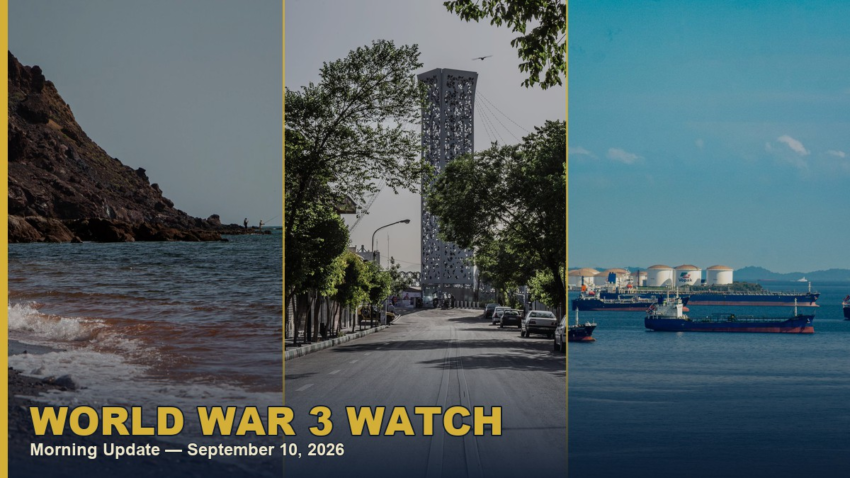
World War 3 Watch — Morning Update — September 10, 2026
- Iran said it attacked more than a dozen vessels trying to pass through the Strait of Hormuz on Wednesday and announced an expanded no-go zone outside the waterway (MSN, 2026).
- Brent crude hovered above $100 a barrel on Thursday — the third time in six months the global benchmark has crossed that mark (MSN, 2026; AOL, 2026).
- President Donald Trump said he does not expect the war to end, or oil prices to fall, until after November’s midterm elections (AOL, 2026).
- The IAEA has accused Iran of non-compliance after going more than a year without inspecting key nuclear sites; Iran says US attacks made access unsafe (MSN, 2026).
- Chinese-language coverage framed the week as the largest exchange of shipping attacks since the war began, with the Middle East under a “two-front” war (Shanghai Observer, 2026, authors’ translation).
- Cailianshe reported the war is rapidly draining global oil inventories and that the EIA has raised its price forecasts for this year and next (Cailianshe, 2026, authors’ translation).
The Story So Far
Iran said it attacked more than a dozen vessels trying to pass through the Strait of Hormuz on Wednesday, then announced it was expanding a no-go zone outside the waterway (MSN, 2026).
By Thursday morning, Brent crude was hovering above $100 a barrel — the third time in six months the global benchmark has cleared that line (MSN, 2026; AOL, 2026).
The war began in February, when the US and Israel attacked Iran. It has since spread across the Middle East, with Iran firing missiles and drones at Israel and at Arab states hosting US military facilities (AOL, 2026).
In Washington, Trump tied the war’s end to the November midterms, telling reporters Iran’s leaders “can’t hold out any longer” (AOL, 2026).
The nuclear file is moving the other way. The IAEA has accused Iran of non-compliance after more than a year without inspecting key sites (MSN, 2026).
Video: Iran strikes ships, expands no-go zone outside Hormuz strait • FRANCE 24 English. Source: FRANCE 24 English.
1. Iran Hits a Dozen Ships and Widens Its No-Go Zone
Iran’s announcement was blunt: more than a dozen vessels were attacked while trying to transit the Strait of Hormuz on Wednesday (MSN, 2026).
The same statement said the no-go zone would expand outside the strategic waterway itself (MSN, 2026). How far out that zone now reaches was not specified in the report.
This is the second half of a two-way fight.
The US has imposed a naval blockade on Iran’s ports and has recently begun striking Iranian tankers, in response to attacks on warships and other vessels (AOL, 2026).
So the Hormuz traffic lane is now contested from both directions — Iranian fire on merchant shipping, American fire on Iranian tankers (MSN, 2026; AOL, 2026).
Chinese state-affiliated outlet Shanghai Observer described it as the “largest mutual shipping attacks” since the US-Iran war began (Shanghai Observer, 2026, authors’ translation).
For a crew on a container ship, the calculation is simple and grim: the strait is the only route, and both navies are now shooting at ships in it.
Video: US-Iran War News Live: Trump Says Iran War Will End After Midterm Elections | Donald Trump News. Source: India Today.
2. Oil Above $100 and Trump’s Election Timetable
Oil prices hovered above $100 a barrel on Thursday, the day after Iran said it struck the ships (MSN, 2026).
Brent crude, the global benchmark, has now risen above $100 three times over the past six months (AOL, 2026).
The mechanism is not mysterious. Iranian attacks have forced production stoppages in Gulf states and disrupted exports through the Strait of Hormuz (AOL, 2026).
Trump’s bet: short-term pain, post-election relief.
“I think the war’s going to end immediately after the election because they can’t hold out any longer,” Trump said of Iran’s leaders on Wednesday (AOL, 2026).
“Right after the election, oil prices are going to be tumbling downward,” he told reporters. Pressed on timing, he added: “I think it’s going to take a little bit longer than the midterm” (AOL, 2026).
He made the comments heading to Texas for the Republican Party’s first midterm election convention, and repeated them there, arguing short-term economic pain was worth it to prevent Iran from developing nuclear weapons (AOL, 2026).
Trump is facing falling polling numbers and pressure from within his own party to end the war (AOL, 2026). At the Texas convention he acknowledged the discontent, recalling Americans telling him, “I wish you didn’t do the war in Iran” (AOL, 2026).
The supply side may not wait for November.
Financial outlet Cailianshe reported that the war is rapidly consuming global petroleum inventories, and that the EIA has raised its oil price forecasts for both this year and next (Cailianshe, 2026, authors’ translation).
That is the tension in Trump’s timeline: markets price inventories, not election calendars.
Video: US-Iran War: Powerful Explosion Rocks Southern Iran As US Military Launches New Strikes | WION. Source: WION.
3. The Nuclear File: IAEA Says Non-Compliance
The UN nuclear watchdog has accused Iran of non-compliance, and it has now gone more than a year without inspecting key sites (MSN, 2026).
Iran’s explanation is that US attacks have made access unsafe (MSN, 2026).
Tehran has repeatedly denied it is seeking nuclear weapons and insists its program is solely peaceful (AOL, 2026).
Trump’s unproven election claim.
Trump said Iran was “desperate to try and affect the election, so that we can get a nice weak group of people in there” — an apparent reference to Democrats — “and leave them alone and let them have their nuclear weapon” (AOL, 2026).
He provided no proof for the election claim (AOL, 2026).
Two clocks are now running against each other: a war the president says ends in November, and an inspections regime that has already been dark for more than a year.
4. Damaged Jets and the Warning Over Pickaxe Mountain
A-10 Thunderbolt and F-15 fighter jets were “damaged in Iranian strikes on US bases,” according to live coverage of the war (MSN, 2026).
The same report said Trump claimed the US could strike Pickaxe Mountain, after construction activity was seen at the deeply buried complex (MSN, 2026).
Here the English and Chinese reports converge.
Sina’s headline said Trump warned Tehran over activity at the Pickaxe Mountain facility, and paired that with US and Iranian attacks on merchant ships near the Strait of Hormuz (Sina, 2026, authors’ translation).
That is a notable alignment. Two press systems that frame this war very differently both treated the buried site and the shipping war as the same week’s news (MSN, 2026; Sina, 2026, authors’ translation).
What is not yet in the record: what activity was observed at the site, or what a US strike there would target. Neither source says.
5. What Chinese-Language Coverage Led With — and What It Skipped
Shanghai Observer’s headline led with scale: the “largest mutual shipping attacks since the US-Iran war began,” oil “soaring to $100,” and a Middle East “tormented” by a two-front war (Shanghai Observer, 2026, authors’ translation).
The phrase used is 两线战火 — literally “two lines of war fire.” It presents the conflict as two simultaneous fronts, not one war with a maritime chapter (Shanghai Observer, 2026, authors’ translation).
Cailianshe went straight to the economic ledger: the war is rapidly drawing down global oil stocks, and the EIA has lifted its price forecasts for this year and next (Cailianshe, 2026, authors’ translation).
What each side left out.
None of the three Chinese-language headlines mention Trump’s election timetable or the IAEA’s non-compliance finding — both prominent in the English-language coverage (MSN, 2026; AOL, 2026).
In the other direction, the English-language reports here do not mention the EIA’s revised forecasts or the drain on global inventories (Cailianshe, 2026, authors’ translation).
Read together, the two press ecosystems describe the same week through different stakes: one through domestic politics and nuclear inspections, the other through shipping volume and oil supply.
For a fuller breakdown of those framing divides, see our narrative-comparison report on how US, Israeli, Iranian, and BRICS media each tell this war.
Is This Actually World War 3?
By the evidence in today’s sources, no — and it is worth being precise about why.
What exists is a regional war with global reach. The US and Israel attacked Iran in February; Iran retaliated against Israel and against Arab states hosting US military facilities; the conflict spread across the Middle East (AOL, 2026).
Add a naval blockade of Iran’s ports, US strikes on Iranian tankers, Iranian strikes on US bases that damaged aircraft, and a benchmark oil price above $100 (AOL, 2026; MSN, 2026).
That is a serious war. It is not, on today’s record, a great-power war.
Two honest caveats.
First, none of today’s sources report direct fighting between the US and either China or Russia, and none report anything on Taiwan — so today’s file offers no new evidence on that flashpoint either way.
Second, the mechanisms that turn regional wars into larger ones are already running: a blockade, attacks on merchant shipping in a chokepoint, and an oil shock (AOL, 2026; MSN, 2026). Those are the transmission belts, not the war itself.
The next hard date is November’s midterm elections, which the US president has named as the moment the war and the price of oil are supposed to turn (AOL, 2026).
What You Can Do Right Now
- Watch the price, not the headlines. Brent has cleared $100 three times in six months (AOL, 2026). How long it stays above that line this time is the clearer signal than any single day’s statement.
- Mark November on your calendar. Trump says the war ends and oil falls immediately after the midterms (AOL, 2026). Whether that holds is the single biggest variable for fuel, food, and shipping costs this autumn.
- Prepare for the boring parts. Fuel and supply disruptions are the practical downstream effect of a chokepoint fight (MSN, 2026). See our survival skills and preparedness guide for what to do before prices move again.
Figure 1
Who is covering this
Note. Built from the WW3 Watch stories cited in this report.
Figure 2
Connecting the dots: names that keep appearing together
Note. Built from the WW3 Watch stories cited in this report. A line means two names appeared in the same sourced story — it shows overlap in the coverage, not a proven connection between them.
Black Excellence This Week
The hard news is real, and so is this. Wins reported by the Black press in the last 14 days:
- By Us Beauty: The Best Black-Owned Beauty Launches From August 2026
essence.com · 2026-09-09 - HBCUs Are Building New Support Systems for Black Male Students
capitalbnews.org · 2026-09-08 - Florida HBCU Announces Historic Enrollment
miamiherald.com · 2026-09-02
What You Can Do This Week
Not just bad news — here is where to push.
- Call your U.S. senators and demand a War Powers vote and public accounting before further U.S. strikes near the Strait of Hormuz. — Find your U.S. senators
- Check your voter registration now, since Trump says the Iran war ends only after November’s elections, and turnout determines oversight. — Check your voter registration
- Track your gasoline and grocery costs, then file a consumer complaint about price gouging as oil spikes toward $100 after Iranian ship attacks. — File a consumer complaint (CFPB)
SUPPORT KEMETIC MINDS
Enjoying this coverage? Back the work and find every way to connect with us in one place.
Support the Page →Kemetic Minds Analysis
This roundup pulled directly from the day’s English- and Chinese-language wires side by side, because the gap between what each side chooses to report is often as informative as any single strike count. Treat the Key Takeaways above as the verified factual floor, and the framing differences noted in the sections above as the more interesting, harder-to-fake signal about where this war is actually headed next.
References
- MSN. (2026, September 10). Iran strikes ships, expands no-go zone outside Strait of Hormuz. msn.com
- MSN. (2026, September 9). Oil prices flare as Iran tightens grip on Hormuz. msn.com
- MSN. (2026, September 10). US-Israel-Iran war latest live news: Trump says Iran cannot sustain war, claims Tehran is ‘desperate to affect election’. msn.com
- MSN. (2026, September 10). IAEA accuses Iran of ‘non-compliance’: Why, and what now?. msn.com
- AOL. (2026, September 10). Iran war won’t end until after crucial November elections, says Trump. aol.com
- MSN. (2026, September 10). Iran war live: A-10 and F-15 fighter jets ‘damaged in Iranian strikes’. msn.com
- 上观新闻. (2026, September 10). 美伊开战以来最大航运互袭!油价飙至100美元,中东被“两线战火”折磨 [Biggest shipping attacks since US-Iran war began! Oil surges to $100 as Middle East suffers ‘two-front conflict]. jfdaily.com.cn
- 新浪网. (2026, September 10). 特朗普就镐山设施活动向德黑兰发出警告 美伊在霍尔木兹海峡附近相互袭击商船 [Trump Warns Tehran Over Activity at Pickaxe Mountain Facility as U.S. and Iran Exchange Attacks on Merchant Ships Near the Strait of Hormuz]. finance.sina.cn
- 财联社. (2026, September 10). 伊朗战争迅速消耗全球石油库存 EIA上调今明两年油价预测 [Iran war rapidly depleting global oil inventories; EIA raises oil price forecasts for this year and next]. cls.cn
Investigative Methodology: This roundup is generated on a fixed schedule (noon and evening, America/Chicago) from live English- and Chinese-language wire sources. Every claim is grounded in fetched source text with an APA7 in-text citation; translated Chinese-language quotes are marked “authors’ translation.” Every video embed is verified to be a real, existing video via YouTube’s oEmbed endpoint before publication — none are written by the drafting model. No Wikipedia sources are used.
Stay Connected

Kemetic Minds Editorial Desk
Verified NewsroomPrimary-sourced investigative intelligence on civil rights, voting rights, federal policy, and consumer protection. Sourced from primary legal filings, government statistics, and direct field reporting.