KEMETIC MINDS
World War 3 Watch — Evening Update — July 29, 2026
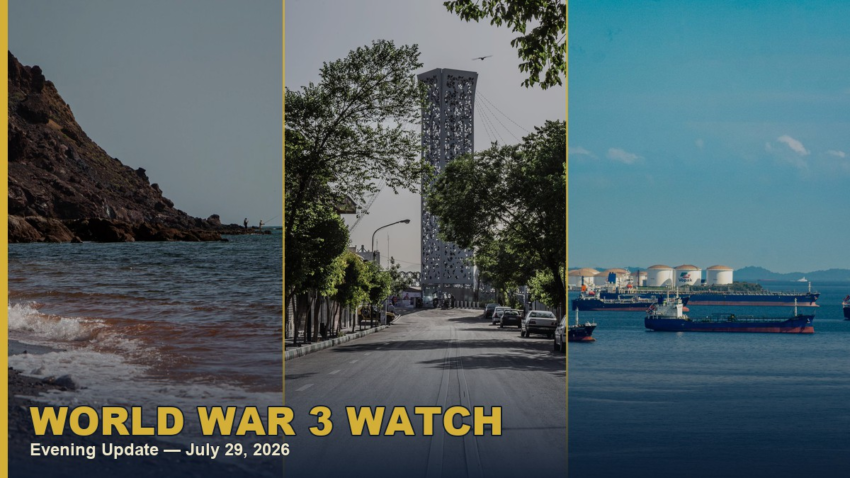
Collage: Photo: Melika Hazrati via Pexels (source); Photo: Mehdi Khoshnejad via Pexels (source); Photo: Zifeng Xiong via Pexels (source)
- Iran launched a barrage of missiles at U.S. forces in the Middle East early Wednesday, all of which were intercepted; President Trump vowed the U.S. would now “hit them hard” (Fox News, 2026, as cited in Yahoo, 2026).
- The United States and Saudi Arabia conducted joint airstrikes against Iranian-backed militias in Iraq, killing at least 20 fighters, marking a significant escalation and a new phase of direct Saudi military involvement (AP, 2026; VOA, 2026, authors’ translation).
- The U.S. Treasury announced a first-of-its-kind sanctions package targeting Iran’s “toll network” in the Strait of Hormuz, blacklisting insurers, shipping firms, and multiple oil tankers that help Iran collect fees from passing vessels (Wall Street CN, 2026, authors’ translation).
- China is maintaining direct contact with Yemen’s Houthi movement to ensure safe passage for its oil tankers through the Red Sea, even as the Houthis, with Iranian backing, plan to impose their own tolls on the waterway (RFI, 2026, authors’ translation).
- In a quiet Oval Office meeting, President Trump and Israeli Prime Minister Netanyahu discussed the “big three” options — military, diplomatic, and economic — for ending Iran’s nuclear program, with Netanyahu insisting that only Israel has both “the will and capability” to fight alongside the U.S. (AOL, 2026; MSN, 2026).
- The U.S. also sanctioned eight Chinese and Hong Kong shipping companies accused of operating vessels in Iran’s “shadow fleet,” a move China has previously denounced as illegal unilateral action (Phoenix News, 2026, authors’ translation).
Video: Iran rejects Oman’s Hormuz proposal, demands partial control of Omani route. Source: Al Jazeera English.
1. Missile Attack, Interception, and the Joint U.S.-Saudi Strikes in Iraq
Iran launched five ballistic missiles at U.S. forces in the Middle East early Wednesday. All were intercepted (Chuan Guan News, 2026, authors’ translation; Yahoo, 2026).
The attack came as the U.S. and Saudi Arabia conducted joint airstrikes in eastern Iraq against the Hashed al-Shaabi, a coalition of Iranian-backed militias (AP, 2026; VOA, 2026). The strikes killed at least 20 fighters (VOA, 2026).
The U.S. Central Command stated the targeted militias had launched over 30 drone attacks against U.S. forces and Saudi energy infrastructure in the preceding three days (AP, 2026).
Saudi Arabia described its participation as self-defense, adding that it “does not seek escalation” but would act again if attacked (AP, 2026). Iraq condemned the airstrikes as a violation of its sovereignty (VOA, 2026, authors’ translation).
2. Trump’s “Hitting Them Hard” Vow and the Oval Office “Big Three” Session
Trump told reporters the missile attack meant “it is our turn” to strike. He said Iran had asked the U.S. not to retaliate, but “we will give them a lesson” (Chuan Guan News, 2026, authors’ translation).
Earlier in the week, Trump and Netanyahu held a private, hour-long Oval Office meeting, focusing on the “big three” options — military, diplomatic, and economic — for ending Iran’s nuclear program (MSN, 2026).
A senior Israeli official said Trump is the “senior partner” and Netanyahu the “junior partner” in the relationship (ABC News, 2026, as cited in Yahoo, 2026).
Netanyahu claimed Secretary of War Pete Hegseth had told him that only Israel possesses both the “will and capability” to fight alongside the U.S. (AOL, 2026). The White House has not confirmed the remark.
3. The Economic Front: U.S. Targets Iran’s Hormuz “Toll Network”
In a major expansion of sanctions, the U.S. Treasury targeted Iran’s system of charging “tolls” for ships transiting the Strait of Hormuz (Wall Street CN, 2026, authors’ translation).
The sanctions blacklisted the Persian Gulf Marine Insurance Company and the HormuzSafe Marine Services Authority, which the Treasury says are backed by the Islamic Revolutionary Guard Corps (IRGC) and run a “coercive” insurance scheme for vessels (VOA, 2026, authors’ translation; Wall Street CN, 2026, authors’ translation).
Ten shipping entities and eight oil tankers were added to the blacklist (VOA, 2026, authors’ translation). Treasury Secretary Bessent said Iran is “using its geography to turn international shipping into a tool for illicit revenue” (Wall Street CN, 2026, authors’ translation).
This is the first time the U.S. has treated the Hormuz toll system as an independent sanctions target, separate from oil export restrictions (Wall Street CN, 2026, authors’ translation).
4. China’s Balancing Act: Shadow Fleet Sanctions and Houthi Contacts
In a related move, the U.S. sanctioned eight Chinese and Hong Kong shipping companies, accusing them of running vessels that move Iranian oil to China as part of a “shadow fleet” (Phoenix News, 2026, authors’ translation).
China has previously called such actions “illegal unilateral sanctions without basis in international law” (Phoenix News, 2026, authors’ translation) and in May issued a ban blocking U.S. sanctions on five Chinese refineries (Phoenix News, 2026, authors’ translation).
Simultaneously, Reuters and RFI reported that China is maintaining direct contact with Yemen’s Houthi movement to ensure its oil tankers can safely cross the Red Sea (RFI, 2026, authors’ translation).
Yemen’s information minister said the Houthis, with IRGC assistance, are planning to impose their own “tolls” on ships passing the Bab al-Mandab Strait, potentially mirroring Iran’s Hormuz model (RFI, 2026, authors’ translation).
China’s dual approach — challenging U.S. sanctions while securing passage via the Houthis — highlights its pragmatic non-alignment in the conflict, a contrast to the “with us or against us” framing that dominates U.S. coverage. For a deeper comparison of how different media narrate these dynamics, see our narrative-comparison report on how US, Israeli, Iranian, and BRICS media each tell this war.
5. Cross-Source Comparison: What the Chinese and English Coverage Diverged On
English-language sources (AP, Yahoo, MSN) focused heavily on the missile exchange, the joint U.S.-Saudi strikes, and Trump’s rhetorical escalation. Chinese-language sources (Wall Street CN, VOA, RFI) dedicated far more space to the sanctions architecture, the toll-network concept, and China’s own maneuvering to protect its energy supply.
The Chinese outlets gave extensive treatment to the Hormuz toll system as an independent policy target — a detail that English coverage mentioned only briefly, if at all. Similarly, the Houthi toll plan and China’s separate contacts with the group were absent from the English sources provided.
Meanwhile, Chinese outlets omitted the specific detail that Netanyahu called Trump the “senior partner,” and downplayed the internal Israeli debate over military options — a point the English sources noted in detail via the ABC News report (Yahoo, 2026).
Video: Video released of Iranian soldiers storming ships in the Strait of Hormuz | ABC NEWS. Source: ABC News (Australia).
Is This Actually World War 3?
Not yet. The evidence from July 29 shows a dangerous expansion of the conflict into a new phase (joint U.S.-Saudi ground strikes in Iraq, a direct Iranian missile salvo at U.S. forces, and an economic war now explicitly targeting the Hormuz toll infrastructure), but it remains contained within the Middle East theater. China is not engaged militarily, and the great-power dimension is still economic and diplomatic. The Houthi announcement of a Red Sea toll scheme, if implemented, would extend the chokehold on global energy routes, but that is a future risk, not a current reality. The diplomatic track is fractured but not dead: a framework deal was signed in June, even if both sides continue to strike each other.
What You Can Do Right Now
- Track the sanctions list. If you work in shipping, finance, or insurance, check the OFAC designations from July 29 — the new toll-network targets (Persian Gulf Marine Insurance Co., HormuzSafe) and the eight shadow-fleet vessels are now off-limits for any U.S.-connected business.
- Review your supply chain for dual-Hormuz/Red Sea exposure. With both straits potentially subject to Iranian and Houthi toll regimes, reroute planning and insurance costs should be reassessed immediately. Our survival skills and preparedness guide includes checklists for business continuity during maritime chokepoint disruptions.
- Watch for China’s next move. Beijing has now been directly hit by sanctions and is simultaneously negotiating safe passage with the Houthis. A formal Chinese protest or retaliatory measure is likely in the coming days.