
KEMETIC MINDS
World War 3 Watch — Midday Update — July 29, 2026
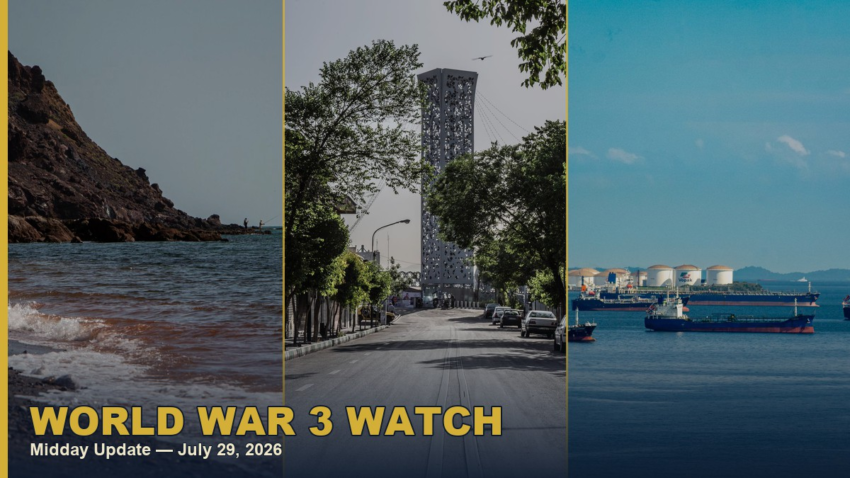
Collage: Photo: Melika Hazrati via Pexels (source); Photo: Mehdi Khoshnejad via Pexels (source); Photo: Zifeng Xiong via Pexels (source)
- Iran rejected an Omani proposal to jointly manage the Strait of Hormuz, declaring the waterway would “never return to its prewar situation” (MSN, 2026).
- The IRGC launched multiple ballistic missiles at U.S. forces in Jordan; Trump pledged the U.S. will “hit them hard” (AOL, 2026).
- U.S. and Saudi Arabia struck Iranian-backed targets in Iraq; six Iranian advisers were killed (CNBCTV18, 2026).
- New U.S. sanctions target eight tankers and IRGC-backed “insurance schemes” in the Strait of Hormuz (Arabianbusiness, 2026).
- China continues to import Iranian oil via Malaysian floating storage, bypassing both the blockade and U.S. sanctions (Caus.com, 2026).
Video: Iran says it seeks control over Strait of Hormuz reopening talks. Source: Al Jazeera English.
1. Iran Rejects Hormuz Deal, Strikes U.S. Forces in Jordan
Tehran has rejected an Omani proposal to divide control of the Strait of Hormuz equally, declaring the waterway would “never return to its prewar situation” (MSN, 2026).
Hours later, Iran’s Islamic Revolutionary Guard Corps (IRGC) launched multiple ballistic missiles at U.S. forces in Jordan (AOL, 2026). U.S. Central Command described the attack as an “attempted surprise attack” (AOL, 2026).
Jordan shot down five of the incoming missiles (AOL, 2026). President Donald Trump told Fox News, “We’ll be hitting them hard” and added, “they’re going to get a beating” (AOL, 2026).
Xinhua reports that Iran’s Foreign Minister Araqchi spoke with his Omani and Saudi counterparts on July 27 to discuss the Strait, emphasizing “the necessity of strengthening cooperation” (Xinhua, 2026, authors’ translation).
Chinese coverage highlights that talks and fighting are now occurring in parallel. Xinhua writes, “The U.S. and Iran have no mutual trust, and each believes that ‘the advantage lies with me'” (Xinhua, 2026, authors’ translation).
Video: 12-day war: videos reveal Iranian missile strikes censored by Israel | The Observers | FRANCE 24. Source: The France 24 Observers.
2. U.S.-Saudi Strikes on Iraq and New Sanctions
Overnight, the U.S. and Saudi Arabia carried out joint airstrikes on Iranian-backed targets in Iraq (CNBCTV18, 2026). Six Iranian advisers were killed, according to reports (CNBCTV18, 2026).
U.S. Central Command said the strikes targeted “terrorist logistics and weapons strongholds” in response to more than 30 drone attacks orchestrated by Iran over the past 72 hours (Xinhua, 2026, authors’ translation).
The Iraqi militia “Popular Mobilization Forces” reported that at least 20 people were killed and 32 wounded (Xinhua, 2026, authors’ translation). Another Iraqi group, the “Islamic Resistance in Iraq,” denied involvement in attacks on Saudi Arabia, calling the Saudi claims “fabricated” (Xinhua, 2026, authors’ translation).
Meanwhile, the U.S. Treasury and State Department announced new sanctions targeting IRGC-backed entities running “coercive ‘insurance’ schemes” to extort vessels in the Strait (AOL, 2026). Eight tankers, eight overseas shipping companies, and two Iranian maritime bodies were also sanctioned (Arabianbusiness, 2026).
Video: The real message behind PLA drills around Taiwan. Source: CGTN.
3. Texas Oil Tycoon Plans $5bn Refinery to Bypass Hormuz
A Texas oil tycoon is plotting a $5 billion oil refinery in the Gulf of Oman to bypass Iran’s blockade of the Strait of Hormuz (AOL, 2026).
Marc Gunderson of MWG Enterprises has partnered with two Middle East investment funds to develop the terminal under a U.S.-Saudi joint venture called Mera Oil (AOL, 2026). Potential sites include Fujairah in the UAE and Sohar in Oman (AOL, 2026).
The facility would have a refining capacity of about 200,000 barrels per day and would serve as an export hub for the entire Gulf Cooperation Council (AOL, 2026).
Gunderson stated, “The sponsor partnership is assembled, the development concept and capital strategy are defined, and we are now choosing our host” (AOL, 2026).
Oil prices rose 4% to $88 a barrel on Wednesday as tensions escalated (AOL, 2026).
4. China Bypasses Blockade, Imports Iranian Oil Through Malaysia
Despite the war and U.S. naval blockade, China continues to import Iranian crude oil through a well-established route via Malaysian floating storage (Caus.com, 2026).
Iranian crude’s share of China’s total oil imports rose from 15% in February to over 24% in May, before falling to 18% in June (Caus.com, 2026). Official Chinese customs data has recorded no Iranian imports since 2022 (Caus.com, 2026).
China also successfully moved four supertankers carrying Saudi crude through the Bab el-Mandeb Strait after Houthi forces granted them safe passage — vessels broadcasting that their crews and owners were Chinese (Caus.com, 2026).
As MST Financial’s energy research head Saul Kavonic put it, “Fuel security is an important geopolitical bargaining chip. China is a big oil importer and has historically been vulnerable to shocks, but China has gone to great lengths to reduce that risk” (Caus.com, 2026).
Chinese sources also note that Iran’s continued control over the Strait “has strengthened China’s advantage in this geopolitical bargaining chip” (Caus.com, 2026). For deeper analysis on how different media systems cover this conflict, see our narrative-comparison report on how US, Israeli, Iranian, and BRICS media each tell this war.
5. Is This Actually World War 3?
Today’s sources show a clear escalation but not yet a global conflagration. The conflict remains regionally contained to the Persian Gulf, Iraq, Jordan, and Yemen (Xinhua, 2026; AOL, 2026).
No major power beyond the U.S. and its regional allies has committed combat forces. China is actively trading with both sides — importing Iranian oil via sanctions-evasion networks and Saudi crude under Chinese-flagged protection (Caus.com, 2026).
The “World War 3” framing is not yet supported by the empirical record of this single day’s reporting. However, the global economic disruption is real: oil at $88/barrel, Hormuz traffic reduced to single-digit daily transits, and a $5 billion emergency refinery being planned (AOL, 2026; Xinhua, 2026).
The label remains a question of trajectory, not current reality. For practical guidance on navigating these disruptions, see our survival skills and preparedness guide.
6. What You Can Do Right Now
- Monitor oil and fuel prices — With Brent above $87 and sanctions tightening, expect continued volatility at the pump. Plan commutes and supply purchases accordingly.
- Diversify news sources — As this update demonstrates, English and Chinese outlets report dramatically different facts. Cross-reference at least one non-Western source before drawing conclusions.
- Review emergency supplies — Hormuz disruptions affect global shipping, not just oil. Keep a 72-hour kit of food, water, and medicine in case supply chains tighten further.
Kemetic Minds Analysis
This roundup pulled directly from the day’s English- and Chinese-language wires side by side, because the gap between what each side chooses to report is often as informative as any single strike count. Treat the Key Takeaways above as the verified factual floor, and the framing differences noted in the sections above as the more interesting, harder-to-fake signal about where this war is actually headed next.
References
- MSN. (2026, July 29). Iran rejects Hormuz deal and launches surprise strike on US forces in Jordan. msn.com
- AOL. (2026, July 29). Texas oil tycoon plots $5bn Saudi oil refinery to break Hormuz blockade. aol.com
- Saudi strike: Reports. (2026, July 29). US-Iran War Live Updates: Six Iranian advisers killed in a U.S.. cnbctv18.com
- AOL. (2026, July 29). Iran live updates: Trump says US will hit Iran 'hard' following Jordan missile attack. aol.com
- Arabianbusiness. (2026, July 29). US ramps up pressure on Iran with sweeping new sanctions. arabianbusiness.com
- 新华网. (2026, July 29). 国际观察丨这边谈罢那边打,美以伊渐入新博弈 [International Observations: While Talking on One Side, Fighting on the Other, the US, Israel, and Iran are Gradually Entering a New Game of Chess]. news.cn
- 美国之音. (2026, July 29). 美国和沙特打击伊拉克境内伊朗支持的武装组织,伊朗冲突再度升级 [US and Saudi Arabia strike Iranian-backed armed groups in Iraq, escalating conflict with Iran.]. voachinese.com
- 新京报. (2026, July 29). 消息人士:阿曼提出联合管理霍尔木兹海峡新机制 [Sources: Oman proposes new joint management mechanism for Strait of Hormuz]. bjnews.com.cn
- 财联社. (2026, July 29). 特朗普称美国将强力打击伊朗 中东局势升级推动国际油价大幅飙升 [Trump says US will strike Iran hard, escalating Middle East tensions sends oil prices soaring.]. cls.cn
- 加美财经. (2026, July 28). 中东战火蔓延之际,中国这个超级石油买家还是找到了办法继续进口 [Amid Middle East Conflict, China, the Super Oil Buyer, Finds a Way to Keep Importing]. caus.com
Investigative Methodology: This roundup is generated on a fixed schedule (noon and evening, America/Chicago) from live English- and Chinese-language wire sources. Every claim is grounded in fetched source text with an APA7 in-text citation; translated Chinese-language quotes are marked “authors’ translation.” Every video embed is verified to be a real, existing video via YouTube’s oEmbed endpoint before publication — none are written by the drafting model. No Wikipedia sources are used.
Stay Connected

Kemetic Minds Editorial Desk
Verified NewsroomPrimary-sourced investigative intelligence on civil rights, voting rights, federal policy, and consumer protection. Sourced from primary legal filings, government statistics, and direct field reporting.