
KEMETIC MINDS
Policy & Data Analysis | July 22, 2026
A year and a half into the second Trump administration, Black communities are absorbing the concentrated impact of five overlapping policy shifts: a Justice Department that has stopped enforcing disparate-impact civil rights law, a federal DEI rollback that eliminated jobs and protections built up since 1965, a budget law that cuts Medicaid and SNAP programs Black households rely on at disproportionate rates, an EPA that unlawfully cancelled $2.8 billion in environmental justice grants, and a Supreme Court ruling that is accelerating the dismantling of Black-opportunity voting districts. None of this happens in a vacuum — it lands on a population that already carries a Black unemployment rate 1.8 times the white rate and a poverty rate 1.7 times the national average. Here is what the data actually shows, and what communities can do about it right now.
1. The Justice Department Has Stopped Enforcing Disparate-Impact Civil Rights Law
Eighteen months into the second Trump administration, the DOJ Civil Rights Division has narrowed its mandate to “intentional discrimination” only, ending decades of enforcement built on Title VI’s disparate-impact standard — the legal theory that let the department investigate facially neutral policies that fell disproportionately on Black Americans and other protected groups. Harmeet Dhillon, the division’s new head, withdrew the DOJ from numerous police-reform consent decrees nationwide and reassigned senior officials who had overseen litigation on policing misconduct and affirmative action (Al Jazeera, 2025). More than 200 former DOJ employees signed an open letter in December 2025 describing the division’s “destruction,” and the department confirmed it deleted the National Law Enforcement Accountability Database built under the Biden administration to flag officers with histories of misconduct before rehiring (Al Jazeera, 2025).
The practical effect: communities that previously relied on DOJ pattern-or-practice investigations into police departments, housing discrimination, and employment bias now have one enforcement door largely closed. State attorneys general and private civil rights litigation have become the primary remaining channel.
2. Federal DEI Rollback Reversed Six Decades of Workforce Policy
On January 21, 2025, President Trump signed “Ending Illegal Discrimination and Restoring Merit-Based Opportunity,” rescinding Executive Order 11246 — the 1965 order requiring federal contractors to run affirmative-action programs — along with a slate of Biden-era DEI directives. The Office of Personnel Management directed every federal agency to close DEIA offices and place staff on leave (govdocs.com, cited in search results; corpgov.law.harvard.edu, 2025). The workforce effect is concentrated: in 2023, Black employees made up 18% of the federal workforce, well above their 14% share of the U.S. population, making federal civil-service jobs an outsized source of stable, well-paid Black employment for generations. Analysts project the order will suppress Black federal hiring and retention “for years to come” (govdocs.com; ACLU, 2025).
This isn’t an abstract personnel change. Research on Minorities’ Diminished Returns finds that even when Black workers reach professional-class jobs, the health and economic benefits those jobs typically confer are systematically weaker for Black Americans than for white Americans in the same occupational tier (Assari, 2025) — meaning a federal job has historically been one of the few channels where that gap narrows, largely because of pay transparency and civil-service protections DEI-era policy reinforced.
3. Medicaid and SNAP Cuts in the 2025 Budget Law Hit Black Households Hardest
The One Big Beautiful Bill Act, signed July 4, 2025, imposed new work-requirement and eligibility-verification rules on Medicaid and SNAP. The Congressional Budget Office found the law reduces poor families’ ability to obtain food and health care (Capital B News, 2025). The demographic exposure is disproportionate on its face: Black Americans are roughly 14% of the U.S. population but account for about 20% of Medicaid enrollees and nearly 26% of SNAP participants — approximately 10.2 million people (Capital B News, 2025; NAACP Legal Defense Fund, 2025). As an estimated 15 million people nationally lose health insurance to the law’s Medicaid and ACA marketplace cuts, that coverage loss falls hardest on the population already overrepresented in the affected programs (NAACP Legal Defense Fund, 2025).
The stakes of that coverage loss are well documented in the peer-reviewed literature: ACA Medicaid expansion was independently associated with measurable reductions in Black-white racial disparities in receipt of timely treatment for advanced cancer (Adamson et al., 2021). Coverage rollbacks run that finding in reverse.
4. The EPA Unlawfully Cancelled $2.8 Billion in Environmental Justice Grants
In May 2025, following two Trump executive orders targeting renewable-energy funding and federal DEI, the EPA terminated its Environmental and Climate Justice Block Grant Program — $2.8 billion earmarked for pollution-reduction and infrastructure projects in historically overburdened communities, many of them majority-Black. In June 2026, U.S. District Judge Richard Gergel ruled the termination “arbitrary and capricious and unlawful” and voided the EPA’s cancellation guidance, siding with a March 2025 lawsuit brought by the Southern Environmental Law Center and Public Rights Project on behalf of affected cities and nonprofits (Inside Climate News, 2026). The ruling was a legal win, but a limited one: Judge Gergel stopped short of ordering the EPA to actually resume administering the program, citing the agency’s already-dismantled staff and a looming statutory deadline (Inside Climate News, 2026) — meaning the money remains in legal limbo even after a court found its cancellation illegal.
5. The Voting Rights Act Is Being Dismantled From the Bench and the Statehouse Simultaneously
The Supreme Court’s ruling in Louisiana v. Callais significantly weakened Section 2 of the Voting Rights Act, and the Trump administration’s own Solicitor General urged the Court to go further — arguing that partisan advantage, not racial fairness, should govern how legislative districts are drawn, and that using the VRA to protect Black- or Latino-opportunity districts should end. Southern legislatures moved within weeks of the ruling to redraw Black-majority congressional districts in Louisiana, Texas, Tennessee, and Alabama; Texas alone added five new Republican-favoring districts at the Trump administration’s explicit request (search results, Spokesman-Recorder 2026; AOL News 2026). Voting rights advocates connect the speed and coordination of this redistricting wave to Project 2025, the Heritage Foundation blueprint staffed substantially by former Trump officials.
6. The Baseline These Policies Are Landing On
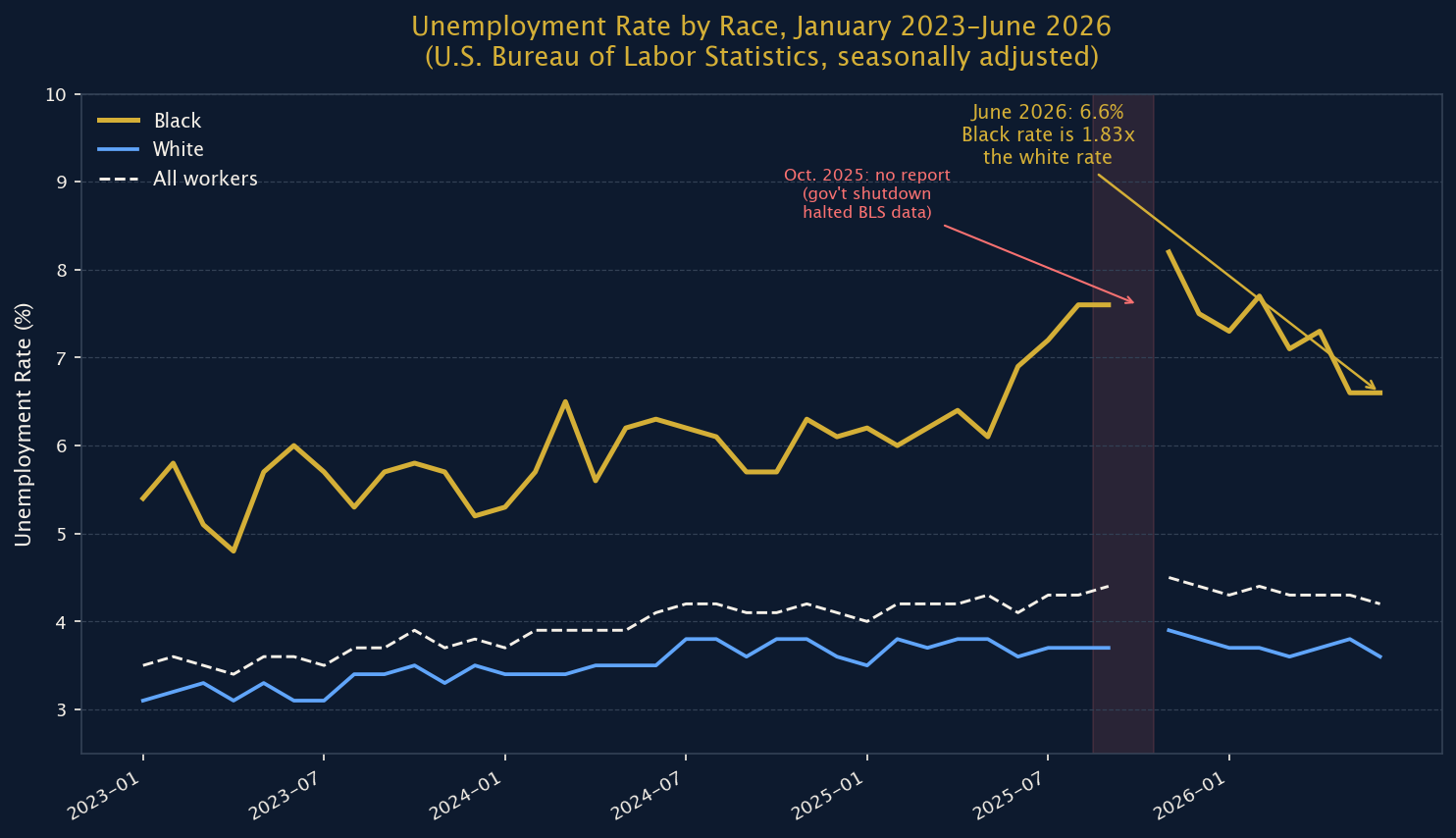
None of this is happening to a population starting from parity. The Black unemployment rate was 6.6% in June 2026 versus 3.6% for white workers and 4.2% overall — a Black rate 1.83 times the white rate, a gap that has held roughly steady across the entire period charted below (U.S. Bureau of Labor Statistics, 2026). Notably, the Bureau of Labor Statistics did not publish an October 2025 unemployment report at all, a data gap caused by that month’s federal government shutdown — itself a reminder of how exposed federal-adjacent data infrastructure has become.
Figure 1
Unemployment Rate by Race, January 2023–June 2026
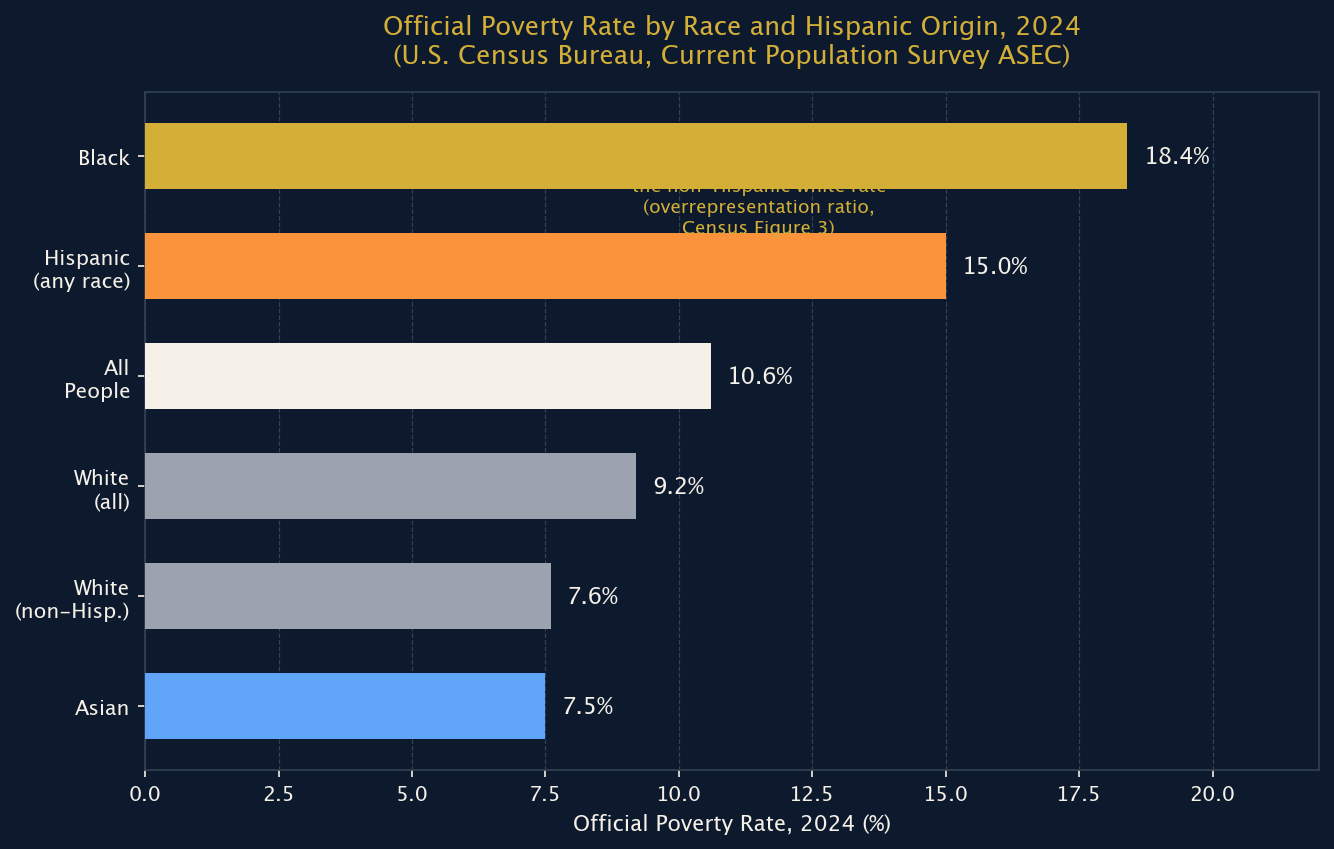
The Census Bureau’s newest poverty report tells a parallel story: the 2024 official poverty rate was 10.6% nationally, but 18.4% for Black Americans versus 9.2% for White Americans overall and 7.6% for non-Hispanic White Americans specifically — a ratio the Census Bureau’s own Figure 3 flags as a statistically significant 1.7x overrepresentation (Shrider & Bijou, 2025). Under the Supplemental Poverty Measure, which accounts for taxes, noncash benefits, and geographic cost of living, the Black poverty rate rose significantly, from 18.5% in 2023 to 20.7% in 2024 — the only racial or Hispanic-origin group in the report with a statistically significant year-over-year increase (Shrider & Bijou, 2025). It is worth being precise about timing: this 2024 calendar-year data was collected before the policies described above took effect in 2025-2026, so it is a pre-policy baseline, not a measurement of these policies’ effects — but it is the baseline the cuts described above are landing on.
Figure 2
Official Poverty Rate by Race and Hispanic Origin, 2024
Simple Solutions: What Communities Can Do Right Now
None of the five policy shifts above are individually reversible by any one household. But the gap between “systemic problem” and “nothing to do” is where mutual aid, legal literacy, and civic participation have always lived in Black American history — and each has a concrete, near-term action attached to it.
1. Know your rights — and document everything
With DOJ disparate-impact enforcement effectively paused, individuals and local advocacy groups are the front line. Keep dated records of discriminatory incidents at work, in housing, or in policing encounters. State attorneys general in California, New York, and other states have continued to bring civil rights and environmental justice cases even where DOJ has stepped back — a case that federal authorities won’t touch can often still be filed at the state level or with a private civil rights law firm.
2. Check Medicaid/SNAP eligibility before a renewal notice lapses
New work-requirement and eligibility-verification rules under the 2025 budget law are causing coverage losses through paperwork lapses, not just income changes. Call your state Medicaid office directly to confirm your renewal date and any new documentation requirements rather than waiting for a mailed notice, and use a local community health center (which cannot turn patients away for inability to pay) as a backstop if coverage is interrupted.
3. Build (or join) a mutual aid network
Black mutual aid societies predate the Civil Rights Act by more than a century, and the underlying model — pooled dues covering emergencies, small-business seed capital, and burial/medical costs — still works today as a hedge against gaps in public assistance. Local chapters of the National Black United Fund and church-based benevolent societies are active in most major metro areas.
4. Support HBCUs and Black-owned financial institutions directly
Black-owned banks and credit unions (certified as Minority Depository Institutions) recirculate deposits into Black neighborhoods at far higher rates than the banking system overall, and HBCUs remain a comparatively insulated pipeline for the credentials whose federal-workforce doors have narrowed. Moving even a portion of savings to an MDI, and directing scholarship or mentorship dollars to an HBCU, are concrete, individually achievable steps.
5. Register, verify, and show up — especially in off-cycle and local elections
The current wave of mid-decade redistricting is a state-legislature fight, which means state and local elections (often lower-turnout, off-cycle races) now carry outsized weight in whether Black-opportunity districts survive the next map-drawing cycle. Confirm registration status well before any deadline (re-registration is sometimes required after a district is redrawn), and prioritize state legislative and secretary-of-state races, not only presidential-year contests.
Kemetic Minds Analysis
What distinguishes this moment from a normal partisan policy swing is the alignment across enforcement, funding, and representation simultaneously: the agency that would investigate discriminatory impact (DOJ Civil Rights Division) has stood down at the same time as the funding that would cushion it (Medicaid, SNAP, EPA environmental justice grants) has been cut, and the electoral mechanism that would let affected communities vote out the officials responsible (Black-opportunity congressional districts) is being redrawn out of existence in the states most affected. Each piece, taken alone, has precedent in prior administrations of both parties. The overlap of all three in an 18-month window does not. The peer-reviewed research on Minorities’ Diminished Returns (Assari, 2025) and employment discrimination’s mental-health toll (Abrams et al., 2026) both predate this administration — they describe a pattern where formal advances (a job, a degree, a benefit) deliver less protection for Black Americans than for others holding the identical credential. The policy changes catalogued here don’t create that pattern; they remove several of the partial offsets — enforcement, funding, representation — that had been narrowing it.
References
- AFRO American Newspapers. (2026, July). A year in, No. 47’s spending cuts hit hardest in Black communities. afro.com
- Abrams, L. R., Zhang, Y. S., Munsey, A. D., Farah, M. A., & Brown, L. L. (2026). Working through it: Lifetime experiences of employment discrimination among older Black Americans and implications for labor force participation, job dissatisfaction, and mental health in older adulthood. Journal of Aging and Health, 38(3–4), 136–147. https://doi.org/10.1177/08982643241259781
- Adamson, B. J. S., Cohen, A. B., Gross, C. P., Estévez, M., Magee, K., Williams, E., Meropol, N. J., & Davidoff, A. J. (2021). ACA Medicaid expansion association with racial disparity reductions in timely cancer treatment. American Journal of Managed Care, 27(7), 274–281. https://doi.org/10.37765/ajmc.2021.88700
- Al Jazeera. (2025, December 9). Former US Justice Department staff says civil rights division ‘destroyed.’ aljazeera.com
- Assari, S. (2025). Black Americans’ diminished health returns of professional occupations: A thirty-year follow-up study of middle-aged and older adults. Journal of Racial and Ethnic Health Disparities, 12(4), 2103–2114. https://doi.org/10.1007/s40615-024-02034-9
- Capital B News. (2025). Trump’s ‘Big Beautiful Bill’ targets Medicaid, SNAP, and student loans. capitalbnews.org
- Inside Climate News. (2026, June 12). Trump’s EPA unlawfully cancelled environmental justice grants, judge rules. insideclimatenews.org
- NAACP Legal Defense Fund. (2025). President Trump’s ‘One Big Beautiful Bill Act,’ explained. naacpldf.org
- Shrider, E. A., & Bijou, C. (2025). Poverty in the United States: 2024 (Current Population Reports, P60-287). U.S. Census Bureau. census.gov
- St. Louis American. (2026). Black Americans feel deepest impact of Trump budget law. stlamerican.com
- U.S. Bureau of Labor Statistics. (2026). Labor force statistics from the Current Population Survey: Unemployment rate — Black or African American; White (Series LNS14000006, LNS14000003). FRED, Federal Reserve Bank of St. Louis. fred.stlouisfed.org
- Word In Black. (2026, July). A year in, Trump’s spending cuts hit hardest in Black communities. wordinblack.com
Methodology: Unemployment figures are the U.S. Bureau of Labor Statistics’ Current Population Survey series (LNS14000006, LNS14000003, UNRATE), downloaded directly via FRED. Poverty figures are drawn directly from the Census Bureau’s official Poverty in the United States: 2024 report (P60-287, Shrider & Bijou, 2025), read from the source PDF. All news citations link to the original outlet; peer-reviewed sources include full DOI links verified against CrossRef. No figures were estimated or sourced from Wikipedia.
📱 Stay Connected

Kemetic Minds Editorial Desk
Verified NewsroomPrimary-sourced investigative intelligence on civil rights, voting rights, federal policy, and consumer protection. Sourced from primary legal filings, government statistics, and direct field reporting.