
KEMETIC MINDS
The Iran War’s Ripple Effects — A Plain-Language Guide to the Money, the World, and What to Do — July 15, 2026
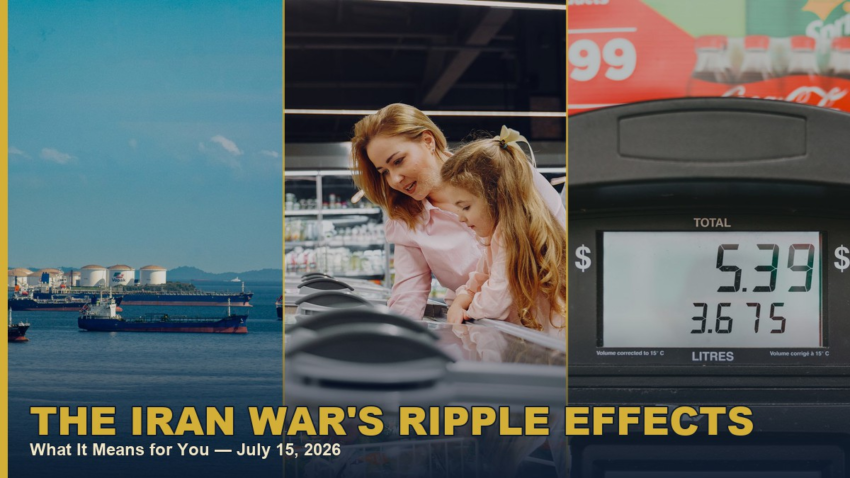
The Iran war has already cost the average American household about $1,000 this year in higher gas, grocery, and interest costs, with gas prices up roughly 23% — driven in part by disruption to the Strait of Hormuz, which carries about a fifth of the world’s oil. Below is a plain-language breakdown of why prices are moving and the specific steps financial planners recommend to protect your budget right now.
1. What’s Actually Happening, in Plain English
The United States and Iran have been fighting a war since earlier this year, and one of the biggest reasons it affects your wallet — even if you’ve never been near the Middle East — comes down to one narrow stretch of ocean: the Strait of Hormuz. It sits between Iran and Oman, it’s only about 21 miles wide at its narrowest point, and roughly one-fifth of all the oil the entire world uses passes through it every single day. When fighting closes it, slows it down, or scares ships away from it, oil gets harder and more expensive to move — and almost everything you buy depends, directly or indirectly, on oil.
That single chokepoint is why a war on the other side of the planet shows up in your gas tank, your grocery bill, and your paycheck. The rest of this guide breaks down exactly how, using real numbers from economists and reporters who track this for a living — not guesswork.
2. How This Is Hitting the Rest of the World
Before this war, about 30% of the world’s fertilizer shipments also passed through the Strait of Hormuz. Fertilizer is what farmers use to grow enough food to feed everyone, so when that supply gets cut off or delayed, crops shrink and food gets more expensive — not just in the Middle East, but everywhere. The United Nations’ World Food Program has warned the disruption could have a “devastating impact” on crop yields and food availability for months to come (PBS NewsHour, 2026).
Michigan State University food economist David Ortega says “we’re likely still looking at inflationary pressure on food in the coming months” (PBS NewsHour, 2026) — meaning grocery prices climbing faster than normal isn’t over yet. Shipping companies are feeling it too: container ships carrying everything from electronics to clothing have seen 2-3% of global capacity disrupted, and ShipStation Global’s Josh Steinitz says shoppers could see higher shipping costs and empty shelves “for quite some time” (PBS NewsHour, 2026).
Countries in Asia and Africa that rely heavily on Middle Eastern oil have already had to close schools and government offices, and send workers home, just to cut down on energy use during the worst of the disruptions (PBS NewsHour, 2026). This isn’t an American story or a Middle East story — it’s a global one.
3. How This Is Hitting Americans, Dollar by Dollar
Here’s where it gets personal. Moody’s Analytics chief economist Mark Zandi put an actual price tag on it: the average American household has spent about $1,000 more this year because of the war. He broke it down like this — about $300 extra on gas, $100 extra on flights (because jet fuel got more expensive too), $200 extra on groceries and everyday shopping (because the trucks that deliver food run on diesel, which has risen even faster than regular gas), $250 in extra military-related tax costs, and $150 in higher interest and credit costs. Zandi said plainly: “My estimate that the Iran war has cost the typical American household $1,000 and counting is, if anything, conservative,” adding, “It’s fair to ask whether it was worth it” (Fortune, 2026).
Harvard Kennedy School economist Linda Bilmes estimates that if you count the full cost — rebuilding, veterans’ care, restocking military equipment — the long-term bill per household could reach as high as $7,500 (Fortune, 2026).
The national average price for a gallon of gas is now $3.84 — about 23% higher than a year ago (Fortune, 2026). Consumer prices overall (what economists call inflation) hit 3.3% a year, the highest reading in two years, and the part of inflation the Federal Reserve watches most closely is expected to hit 4% by the end of the year — double the Fed’s target (CBS News, 2026). The Federal Reserve is simply the U.S. central bank; its main job is trying to keep prices and the overall economy stable, and a war-driven price spike makes that job much harder. Economists have also trimmed their forecast for how fast the U.S. economy will grow this year, from 2.1% down to about 1.8% (CBS News, 2026) — a modest but real drag.
4. How Long Will This Last?
Nobody can say for certain, but the economists tracking this closely aren’t expecting a quick snap-back. EY-Parthenon economist Lydia Boussour says “full normalization will still take time” because of “lingering impacts” that don’t disappear the moment the fighting stops (CBS News, 2026). Cato Institute economist Scott Lincicome put it simply: “We should expect things to remain higher than what people want” (CBS News, 2026). On the food side, agricultural bank Rabobank projects that war-related food inflation will actually peak in Europe next year, not this year — meaning some of the worst grocery-price pain may still be ahead, not behind us (PBS NewsHour, 2026).
5. What You Can Do Right Now
None of this is a reason to panic — it’s a reason to plan. Here are concrete, practical steps that don’t require any special knowledge or money you don’t have:
- Do a quick “budget reset.” Certified financial planner Mark Sanaiha of Macallen Capital in Phoenix puts it bluntly: “Cut subscriptions before you cut anything else. The average household is paying for streaming services, apps and memberships they forgot they signed up for” (CNBC, 2026). Go through your bank statement for the last month and cancel anything you’re not actively using.
- Find cheaper gas without extra effort. Free apps like GasBuddy, or your AAA membership if you have one, will show you the lowest gas prices near you. Warehouse clubs like Costco, Sam’s Club, or BJ’s often sell gas below the average price, and grocery-store fuel-rewards programs can shave a few cents off every gallon (CNBC, 2026).
- Trim discretionary spending gently, not all at once. Cutting eating out from twice a week to once a week is a realistic, sustainable change — you don’t have to eliminate every small joy to feel the difference in your budget.
- Keep a basic 3-day emergency kit at home. Government emergency-preparedness guidance recommends one gallon of water per person per day for at least three days, a three-day supply of non-perishable food, a flashlight, a battery-powered or hand-crank radio, extra batteries, a first-aid kit, a phone charger or spare battery, and a small amount of cash in case card payment systems go down (Ready.gov/FEMA, 2020). This isn’t specific to this war — it’s the same standing readiness recommended for any emergency, and it costs very little to put together over a few grocery trips.
- Stay informed through outlets that show their sources, and revisit your plan monthly rather than reacting to every single headline. Prices and forecasts are changing quickly; a level head serves you better than constant worry.
Kemetic Minds Analysis
The throughline across all of this reporting is that the pain is real, it’s measurable in actual dollars, and economists on the record — not internet speculation — expect it to continue for months, not days. But the same reporting also makes clear this is a manageable, gradual squeeze on budgets, not a sudden collapse: a $1,000 hit spread across a year is serious for many families, but it is also the kind of cost a modest budget reset and a few practical habits can meaningfully offset. The most useful thing you can do with this information is treat it the way the financial planners quoted above do — as a prompt to trim waste and build a small buffer, not as a reason for fear.
References
- Bove, T. (2026, July 1). ‘It’s fair to ask whether it was worth it’: The Iran war has cost Americans $1,000 per household—and that’s a conservative estimate, Mark Zandi says. Fortune. fortune.com
- CBS News. (2026, April 27). In 8 weeks, the Iran war has dented the U.S. economy. The damage could linger, economists say. cbsnews.com
- CNBC. (2026, July 8). Gas prices could rise as Iran conflict escalates—a ‘budget reset’ may help absorb the added cost, financial planners say. cnbc.com
- PBS NewsHour. (2026, June 16). Higher prices for gas, groceries and flights will outlast Iran war, analysts say. pbs.org
- Ready.gov / Federal Emergency Management Agency. (2020, June 12). How to build a kit for emergencies. fema.gov
A Note on Sources and Language: Every figure and quote in this guide is sourced to a named outlet with a direct link, and every quote was checked against the original published article before inclusion. Technical terms (inflation, the Federal Reserve, the Strait of Hormuz) are defined in plain language the first time they appear, because understanding what’s happening to your money shouldn’t require an economics degree. No Wikipedia sources were used. Citations follow APA 7th edition format.
Stay Connected

Kemetic Minds Editorial Desk
Verified NewsroomPrimary-sourced investigative intelligence on civil rights, voting rights, federal policy, and consumer protection. Sourced from primary legal filings, government statistics, and direct field reporting.