KEMETIC MINDS
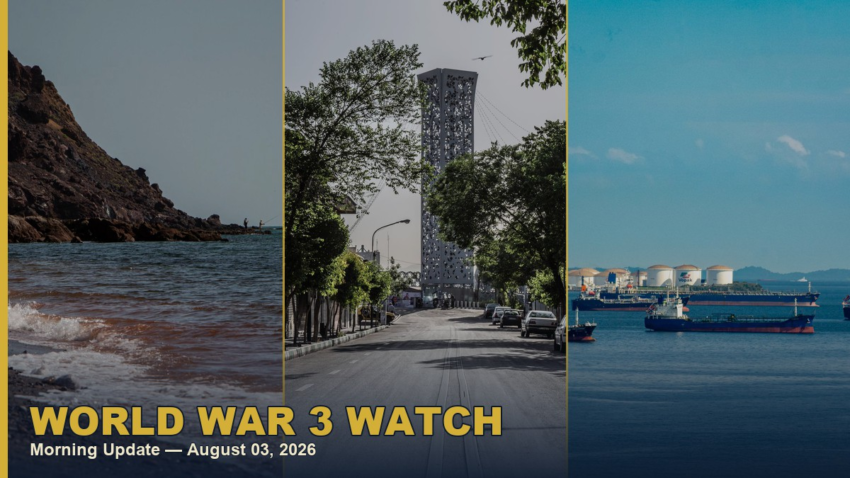
World War 3 Watch — Morning Update — August 03, 2026
- President Donald Trump announced U.S.-Iran talks will begin Monday afternoon, canceling a planned “massive” strike after requests from Gulf allies (Courant, 2026).
- Iranian officials dismissed Trump’s claim that Tehran asked for a halt to attacks as “a new lie,” insisting its forces are at “the highest level of readiness” (Xinhua, 2026, authors’ translation).
- Iran’s foreign minister says talks with Oman on managing the Strait of Hormuz are in their “final stage,” while downplaying expectations of a swift reopening (ChinaNews, 2026, authors’ translation).
- Fighting continues: Iran’s Revolutionary Guard shot down a U.S. MQ-9 drone over the Strait of Hormuz on Monday (Beijing News, 2026, authors’ translation).
- Israeli officials admitted being “left in the fog” by Washington’s cancellation of the strike but warn they will still act against Iran’s nuclear program (Xinhua, 2026, authors’ translation; RFI, 2026, authors’ translation).
- Prices are spiking: Brent crude futures have jumped 24% since the April ceasefire broke down, deepening global economic strain (RFI, 2026, authors’ translation).
1. Talks, Threats, and a Downed Drone
President Donald Trump announced Sunday that negotiations with Iran will begin Monday afternoon, after he agreed to hold off on threatened strikes (Courant, 2026).
The announcement came just as Iran’s Islamic Revolutionary Guard Corps shot down a U.S. MQ-9 drone over the Strait of Hormuz (Beijing News, 2026, authors’ translation).
Here is what we know on this critical morning of the five-month war.
Video: Strait of Hormuz: How a threat became a playbook | Al Jazeera Explains. Source: Al Jazeera English.
2. Diplomacy or Deception? Trump vs. Iran’s ‘New Lie’
Trump says he canceled a planned “massive” strike — an operation he described as “the biggest attack since World War II” — at the urging of Qatar, Saudi Arabia, and the UAE (Courant, 2026).
He also claimed unnamed Iranian officials requested the halt and that “we are now talking to them in the form of a negotiation” (Courant, 2026).
In his own social media posts, Trump framed the emerging deal as including the “immediate, complete and thorough” reopening of the Strait of Hormuz and an end to Iran’s nuclear threat (Cailian Press, 2026, authors’ translation).
But Tehran is publicly rejecting Washington’s narrative. An Iranian military official told Mehr News that Trump’s claim Iran asked for a halt is “a new lie” (Cailian Press, 2026, authors’ translation).
The official added: “Whether he continues aggression or retreats, our forces are at the highest level of readiness” (Cailian Press, 2026, authors’ translation).
Adding to the confusion, Iran’s foreign ministry says Tehran is not currently holding negotiations with the United States (Courant, 2026).
The cross-source split is stark: English-language wires report the diplomatic moves, while Chinese state media lead with Iran’s counter-claim that Washington is lying about the backchannel (Xinhua, 2026, authors’ translation).
Video: 'Stop Dreaming About Hormuz': Iran Broadcasts Shock Message For Trump Amid Attacks. Source: Times Of India.
3. Hormuz Reopening: The Oman Track and Its Limits
While the U.S. and Iran trade accusations, a parallel diplomatic track is moving in Muscat.
Iranian Foreign Minister Abbas Araghchi says negotiations with Oman on managing the Strait of Hormuz have entered their “final stage” (Xinhua, 2026, authors’ translation).
Under a proposed traffic separation scheme, Iran and Oman are working to chart a new shipping lane that protects “both sides’ sovereign rights and Iran’s national interests” (ChinaNews, 2026, authors’ translation).
Yet Tehran warns this new route does not mean the strait will be reopened (Xinhua, 2026, authors’ translation).
Foreign Ministry spokesman Baghaei insisted that reopening Hormuz is “a completely different issue” from the Oman talks, blaming the closure on U.S. violations and a naval blockade (ChinaNews, 2026, authors’ translation).
This aligns with MSN reporting that Iran sees an end to U.S. and Israeli military action as the true precondition for reopening the waterway, not maritime coordination alone (MSN, 2026).
For a deeper look at how these competing narratives are deployed, see our narrative-comparison report on how US, Israeli, Iranian, and BRICS media each tell this war.
Video: Life in Tehran since the ceasefire: How Iranian society is evolving • FRANCE 24 English. Source: FRANCE 24 English.
4. Israel ‘Left in the Fog’ as Washington Shifts
Trump’s sudden reversal has rattled Israel’s leadership, which was reportedly kept in the dark about the true status of the planned strike (Xinhua, 2026, authors’ translation).
Israeli Channel 12 reports that Prime Minister Netanyahu and Defense Minister Katz learned the strike was called off via Trump’s Truth Social platform (Xinhua, 2026, authors’ translation).
One senior Israeli official asked: “This is frustrating, we don’t understand what the US President’s ultimate purpose is” (Xinhua, 2026, authors’ translation).
Despite the canceled attack, Israel is not standing down. Energy Minister Cohen warned that Israel will strike Iran if it tries to restart its nuclear program or advance its ballistic missile industry (RFI, 2026, authors’ translation).
The IDF is maintaining “high readiness” given the unpredictability of the U.S. position (Xinhua, 2026, authors’ translation).
5. Fighting Rages: F-35s Destroyed and an MQ-9 Downed
Diplomatic overtures are unfolding against a backdrop of intense military action.
Over the weekend, Iran’s IRGC Aerospace Force struck the U.S. base at Azraq, Jordan, and the Ahmed Al Jaber Air Base in Kuwait with ballistic missiles, claiming 3 U.S. F-35 fighter jets were destroyed (Cailian Press, 2026, authors’ translation).
Meanwhile, Israeli strikes on Gaza killed at least 17 people over the weekend, including a 4-year-old child, according to hospitals in Gaza (Courant, 2026).
The U.S. State Department has issued a broad security warning for American citizens across the Middle East, urging them to consider evacuating now (Cailian Press, 2026, authors’ translation).
Notably, the Chinese-language Cailian Press is the only provided source to carry the Iranian claims of destroying F-35s in Jordan and Kuwait — a framing placing U.S. military vulnerability front and center that is absent from the English-language wires (Cailian Press, 2026, authors’ translation).
6. Global Shockwaves: Oil, Markets, and the Region
The war has wreaked havoc on global energy markets. International benchmark Brent crude futures have surged 24% since the April ceasefire collapsed (RFI, 2026, authors’ translation).
Analysts polled by Reuters expect prices to climb further in the coming months (RFI, 2026, authors’ translation).
The front has widened, with fighting spreading from the Gulf to the Red Sea and even striking a facility on Egypt’s Mediterranean coast (RFI, 2026, authors’ translation).
Trump’s negotiating team reportedly includes his son-in-law Kushner, Middle East envoy Witkoff, and Secretary of State Rubio (RFI, 2026, authors’ translation).
Iran, meanwhile, says the UK, Bulgaria, and Ukraine have all contacted Tehran in the past 24 hours to confirm they will not participate in a war against Iran (Xinhua, 2026, authors’ translation).
7. Is This Actually World War 3?
We don’t hype. We assess. Today’s sources show a brutal, expanding regional war — but not yet a true world war.
The U.S. and Iran are now directly exchanging fire: American drones are being shot down, and Iranian missiles are hitting U.S. bases in Jordan and Kuwait (Beijing News, 2026, authors’ translation; Cailian Press, 2026, authors’ translation).
However, there is no evidence in today’s sources of NATO activation, wider great-power mobilization, or a multi-continent conflict. The China-Taiwan flashpoint remains a separate crisis.
What this looks like is a deepening U.S.-Iran war with regional spillover — one that could still pull in greater powers if a miscalculation widens the conflict.
8. What You Can Do Right Now
- Energy and fuel prices are climbing fast as the April ceasefire breaks down (RFI, 2026, authors’ translation). Factor supply shocks into your household budget now.
- If you or family members are in the Middle East, follow the U.S. State Department warning: prepare documents and an exit plan immediately (Cailian Press, 2026, authors’ translation).
- Start practical preparedness. See our survival skills and preparedness guide for concrete steps on navigating times of war and supply disruption.
Kemetic Minds Analysis
This roundup pulled directly from the day’s English- and Chinese-language wires side by side, because the gap between what each side chooses to report is often as informative as any single strike count. Treat the Key Takeaways above as the verified factual floor, and the framing differences noted in the sections above as the more interesting, harder-to-fake signal about where this war is actually headed next.
References
- MSN. (2026, August 3). Hormuz reopening in sight? Iran eyes safe route with Oman, says no talks with US. msn.com
- Courant. (2026, August 3). Trump says talks on Iran war will begin on Monday after he holds off on ‘massive’ strikes. courant.com
- 新华网. (2026, August 3). 特朗普说美伊将谈判 伊朗称在霍尔木兹海峡划新航线 [Trump says US and Iran will negotiate, Iran announces new shipping route in the Strait of Hormuz]. news.cn
- chinanews.com.cn. (2026, August 3). 伊朗:与阿曼涉霍尔木兹海峡谈判进入最后阶段 [Iran: Negotiations with Oman over the Strait of Hormuz enter final stage]. chinanews.com.cn
- 新京报. (2026, August 3). 伊朗称在霍尔木兹海峡上空击落一架MQ-9无人机 [Iran claims to have shot down an MQ-9 drone over the Strait of Hormuz]. bjnews.com.cn
- 财联社. (2026, August 3). 特朗普称应伊方要求同意取消打击 伊朗反驳:并未要求停战! [Trump claims he canceled strike at Iran's request; Iran refutes: We never asked for a truce!]. cls.cn
- RFI. (2026, August 2). 特朗普暂缓对伊朗动武 以色列警告仍可能发动打击 [Trump delays military action against Iran, Israel warns it may still launch a strike]. rfi.fr
Investigative Methodology: This roundup is generated on a fixed schedule (noon and evening, America/Chicago) from live English- and Chinese-language wire sources. Every claim is grounded in fetched source text with an APA7 in-text citation; translated Chinese-language quotes are marked “authors’ translation.” Every video embed is verified to be a real, existing video via YouTube’s oEmbed endpoint before publication — none are written by the drafting model. No Wikipedia sources are used.
Stay Connected

Kemetic Minds Editorial Desk
Verified NewsroomPrimary-sourced investigative intelligence on civil rights, voting rights, federal policy, and consumer protection. Sourced from primary legal filings, government statistics, and direct field reporting.