
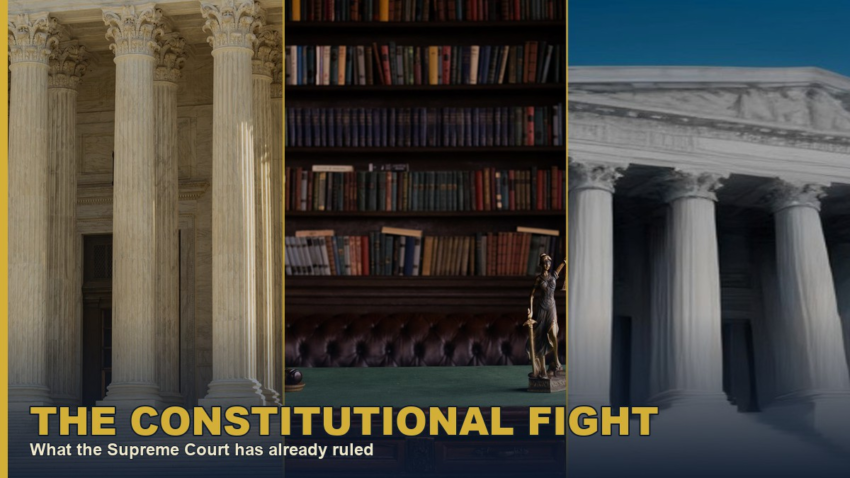
Congress can write any bill it wants. Whether that bill survives a constitutional challenge is a separate question — and on the specific question of the federal government stripping someone’s citizenship without their consent, the Supreme Court has already ruled twice. Here’s what those rulings actually say, in their own words.
This is not legal advice
This post explains existing case law and how S.3283’s own text intersects with it. It is legal background, not a prediction of how any future case would be decided, and not a substitute for advice from an immigration or constitutional attorney about your own situation.
The Fourteenth Amendment’s Citizenship Clause
The starting point is the Constitution itself. The Fourteenth Amendment states: “All persons born or naturalized in the United States, and subject to the jurisdiction thereof, are citizens of the United States[1].” That single sentence is the textual anchor for every Supreme Court ruling on whether, and how, citizenship can be taken away.
Afroyim v. Rusk (1967): Congress can’t strip citizenship without consent
Beys Afroyim, a naturalized U.S. citizen, voted in an Israeli election in 1951. Under the law at the time, the State Department treated that as an automatic loss of his U.S. citizenship and refused to renew his passport. The Supreme Court sided with Afroyim, ruling 5-4 that the Fourteenth Amendment protects every citizen against having their citizenship forcibly destroyed by Congress, and that Congress has no general power to strip a person of citizenship without their own assent[2].
That holding is the single biggest legal obstacle facing any bill that tries to make dual citizenship trigger automatic, involuntary loss of U.S. citizenship — which is exactly what Section 4(b) of S.3283 does for anyone who acquires a foreign citizenship after enactment.
Vance v. Terrazas (1980): the government must prove you meant it
Thirteen years later, the Court refined the standard in Vance v. Terrazas. Laurence Terrazas, a dual U.S.-Mexican citizen by birth, signed a formal statement of allegiance to Mexico. The Court held that Congress can treat certain acts as relinquishing citizenship, but only if the government proves the person specifically intended to give up their citizenship when they did it, by a preponderance of the evidence — intent can’t simply be assumed from the act itself[3].
That’s the tension worth watching in S.3283. Section 4(b) says voluntarily acquiring foreign citizenship after enactment is automatically treated as relinquishing U.S. citizenship[4] — without the individualized proof-of-intent step Vance v. Terrazas requires. Section 4(c)(2), the “deemed to have voluntarily relinquished” language for existing dual citizens who miss the one-year deadline, leans on the same legal theory[4].
Why the bill’s drafters wrote it this way anyway
The bill’s findings section frames the problem as a matter of national interest in undivided allegiance, not as an attempt to override Afroyim[4]. Congress routinely passes bills whose constitutionality is contested; that’s a normal, expected part of how contested legislation gets tested. If S.3283 were enacted as written, the most direct legal fight would likely center on whether Section 4(b)’s automatic-relinquishment mechanism, and Section 4(c)(2)’s deemed-relinquishment-by-inaction mechanism, satisfy the individual-intent requirement Vance v. Terrazas actually demands — or whether they’re a version of the involuntary stripping Afroyim already ruled unconstitutional.
What this means for you right now
Existing case law is exactly why current U.S. immigration law already treats loss of citizenship as something that generally requires either a truly voluntary, intentional act (like formally renouncing) or a status the person themselves chose. That legal backdrop doesn’t change because a bill was introduced. Nothing in Afroyim or Vance v. Terrazas is altered unless and until a new law actually passes and takes effect — and even then, a lawsuit challenging it as unconstitutional would likely follow quickly.
Up next: a practical guide for people who want to make sure they keep their U.S. citizenship, dual-citizen status and all — what actually protects you today.
References
- Legal Information Institute, Cornell Law School. (2026, August). U.S. Constitution, Fourteenth Amendment. https://www.law.cornell.edu/constitution/amendmentxiv ↩
- Legal Information Institute, Cornell Law School. (1967, May). Afroyim v. Rusk, 387 U.S. 253. https://www.law.cornell.edu/supremecourt/text/387/253 ↩
- Legal Information Institute, Cornell Law School. (1980, January). Vance v. Terrazas, 444 U.S. 252. https://www.law.cornell.edu/supremecourt/text/444/252 ↩
- U.S. Congress. (2025, December 1). S.3283 – Exclusive Citizenship Act of 2025, bill text. https://www.congress.gov/bill/119th-congress/senate-bill/3283/text ↩a ↩b ↩c
Photo by Leandro Paes Leme via Pexels · Photo by KATRIN BOLOVTSOVA via Pexels · AI image generated with Sana (via pollinations.ai)
SUPPORT KEMETIC MINDS
Enjoying this coverage? Back the work and find every way to connect with us in one place.
Support the Page →
Kemetic Minds Editorial Desk
Verified NewsroomPrimary-sourced investigative intelligence on civil rights, voting rights, federal policy, and consumer protection. Sourced from primary legal filings, government statistics, and direct field reporting.