
Kemetic Minds — Mental Health & Community Data, June 2026
WHY THIS DATA MATTERS
In a recent post on X, Kemetic Minds explored three things that help fight depression as a Black man in America and examined social media’s role in the mental health crisis facing young Black men (read the full thread here). The personal insights in that post are grounded in a reality that the data now confirms: young Black men are experiencing a suicide crisis unlike any documented in U.S. history, and social media is one of the accelerants. This companion piece puts hard numbers behind that story.
1. The Crisis Is Historic — and the Numbers Prove It
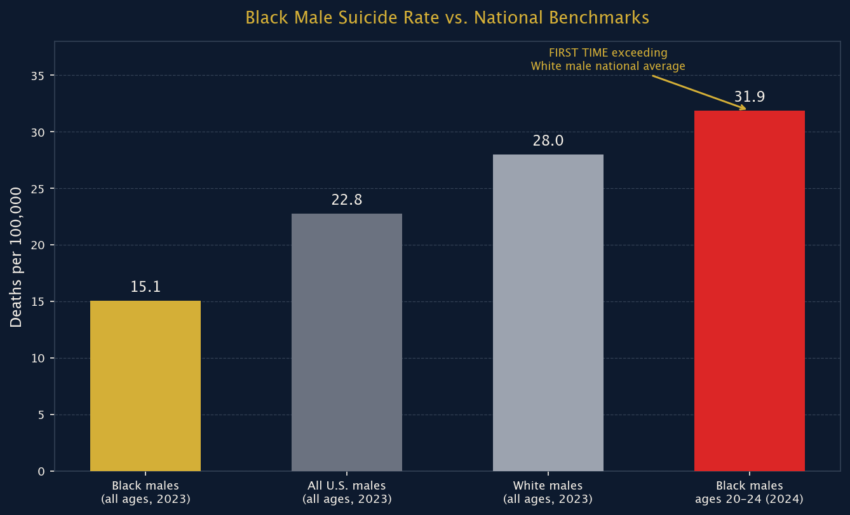
Between 2014 and 2024, suicide death rates among Black Americans climbed by 53% — a pace ten times faster than the increase among white Americans and more than twice the rate for Latino and Native American communities (Mahoney, 2026). That single statistic deserves to be read twice. It means the Black community is not experiencing a gradual drift; it is experiencing a rapid acceleration that other communities are not. The sharpest point of that acceleration sits in one age bracket: Black men ages 20–24. CDC data analyzed by Capital B News shows that this group is now dying by suicide at a rate of 31.9 per 100,000 — making them, for the first time in recorded U.S. data, more likely to die by suicide than young white men of the same age (Mahoney, 2026). The National Institute of Mental Health places the overall U.S. male suicide rate at 22.8 per 100,000 for 2023, and the overall white male rate at 28.0 per 100,000 (NIMH, 2024). Young Black men have now crossed both thresholds. What this chart illustrates is convergence — and then crossing. A group historically at lower statistical risk has, within a single decade, moved past the national male average and past the white male rate in its peak years. That does not happen without structural causes operating in the background. Firearms account for more than half of youth suicides across all groups (Mahoney, 2026). For Black men already navigating over-policing, economic precarity, and social stigma around seeking help, that statistic carries additional weight: access plus hopelessness is a lethal combination, and hopelessness is exactly what structural inequality and social media pressure manufacture at scale.2. Geography Is Not Random — It Follows Inequality
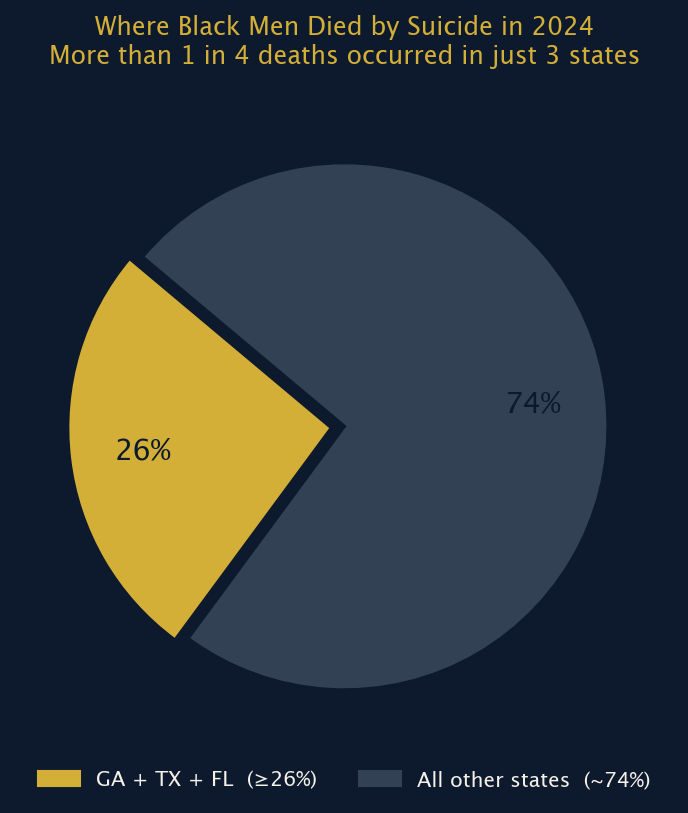
More than 1 in 4 Black men who died by suicide in 2024 lived in Georgia, Texas, or Florida (Mahoney, 2026). Three states. Out of fifty-one jurisdictions. That concentration is not a coincidence.Figure 3 Geographic Concentration of 2024 Black Male Suicide Deaths
3. What Social Media Is Actually Doing to Young Black Men
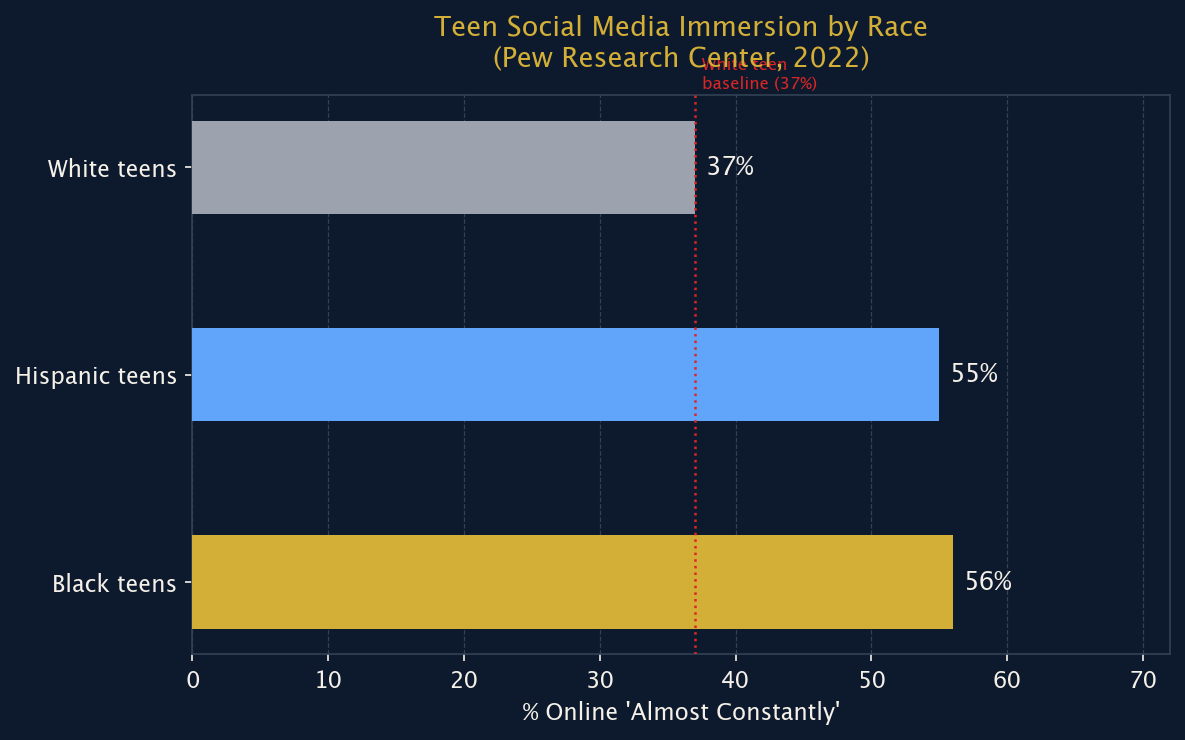
The original post described social media as a major factor in this crisis, citing Pew Research on usage patterns among young adults (Gottfried & Park, 2025) and the observations of mental health professionals about how these platforms create impossible comparisons. The data from Pew Research Center’s youth study gives that observation specific weight (Vogels et al., 2022).Figure 2 Percentage of Teens Who Are Online ‘Almost Constantly,’ by Race/Ethnicity (2022)
- Celebrity wealth and status dominate the algorithmic feed.
- Normal life — a Black electrician, a Black father walking with his kids, a Black student finishing an assignment — is algorithmically deprioritized and rarely goes viral.
- The monetization path is shown as open to everyone but quietly closes for many creators of color.
- Trolling, sextortion, and public humiliation are ambient risks with real-world consequences.
4. The Evidence Behind the Three Solutions
The original post offered three practical strategies for young Black men battling hopelessness. Each has a research basis worth naming.Gratitude Practice: Name Three Things That Went Right
The practice of daily gratitude recall — naming even small positive events — is among the most replicated interventions in positive psychology. A meta-analysis published in the Journal of Positive Psychology found that gratitude interventions consistently reduced depressive symptoms and increased life satisfaction across diverse populations (Wood et al., 2010). The mechanism is straightforward: deliberate recall of positive events competes with the negativity bias that depression amplifies. It does not require a therapist, a prescription, or money. It requires only the habit.Sunlight and Exercise
Wang et al. (2023) documented a direct association between sunlight exposure and improved mental well-being in a population with severely restricted outdoor access, finding that increased sunlight exposure boosted overall mental health scores. For Black men specifically, sunlight carries an additional physiological relevance: melanin-rich skin requires longer sun exposure to synthesize equivalent vitamin D levels, and vitamin D deficiency is associated with higher rates of depression (Shaffer et al., 2014). Exercise independently triggers endorphin release, reduces cortisol, and has been demonstrated to reduce depression symptoms comparably to pharmacological intervention in mild-to-moderate cases (Blumenthal et al., 2007). In combination, a daily walk outside is one of the most evidence-backed, zero-cost mental health interventions available to any person, and it carries specific added value for Black men.Always Have Something to Look Forward To
Anticipatory thinking — orienting toward a future positive event — is a core component of what psychologists call “hope theory.” Snyder (2002) defined hope as the perceived capacity to find pathways to desired goals and the motivational agency to use those pathways. Research consistently finds that hope — even in small doses, even around modest goals — is one of the strongest predictors of resilience under stress. The intervention does not require the goal to be large. It requires only that it be real and genuinely anticipated.5. What We Should Be Demanding
The data points toward a set of actions that communities, platforms, and policymakers can take:A DATA-INFORMED AGENDA
- Targeted intervention in Georgia, Texas, and Florida. More than a quarter of 2024 deaths are concentrated in three states. Crisis counseling, community-based mental health outreach, and school-based programs in those states would have a disproportionate impact on national numbers.
- Algorithmic accountability. Platforms that profit from engagement should be required to publish third-party audits of what content is amplified to young Black male users. The answer to “why does the feed look this way?” should not be a trade secret.
- Culturally competent care. Black men are significantly less likely to seek mental health treatment, in part because the mental health workforce does not reflect them and in part because of well-founded historical distrust of medical institutions. Funding pipelines for Black male therapists and community-based counselors is not a diversity initiative — it is a public health strategy.
- Community masculinity norms. As the original post noted, silence is enforced by social expectations that equate asking for help with weakness. Visible community leaders normalizing mental health conversations — not as performance, but as practice — can shift those norms over time.
- Economic investment. Inequality is not a background condition. It is an active driver. The geographic clustering of deaths in high-inequality states points directly at the connection between economic hopelessness and suicidal ideation. Workforce development, entrepreneurship programs, and fair lending in Black communities address the root, not just the symptom.
Closing: The Statistics Are About People
The number 31.9 per 100,000 is not an abstraction. It represents young men — in their twenties, at the beginning of their adult lives — deciding they do not want to continue. Each one of those statistics has a mother, a friend group, a neighborhood that felt that loss. The rate climbing 53% in a decade means that more families are going through that loss every year, and that the environment producing it is getting worse, not better. The Kemetic Minds post that inspired this piece ended with this: “It’s ok to be you, don’t let nobody tell you otherwise.” That sentence carries more weight when you understand the size of the forces telling young Black men that who they are, and what they have, is not enough. The data confirms the problem is real. The solutions — community, sunlight, hope, and structural change — are also real. If you or someone you know is struggling, the 988 Suicide & Crisis Lifeline is available 24/7 by call or text at 988. The Crisis Text Line is available by texting HOME to 741741.References
Blumenthal, J. A., Babyak, M. A., Doraiswamy, P. M., Watkins, L., Hoffman, B. M., Barbour, K. A., Herman, S., Craighead, W. E., Brosse, A. L., Waugh, R., Hinderliter, A., & Sherwood, A. (2007). Exercise and pharmacotherapy in the treatment of major depressive disorder. Psychosomatic Medicine, 69(7), 587–596. https://doi.org/10.1097/PSY.0b013e318148c19a
Christin, A., & Lu, Y. (2023). The influencer pay gap: Platform labor meets racial capitalism. New Media & Society. Advance online publication. https://doi.org/10.1177/14614448231164995
Gottfried, J., & Park, E. (2025, November 20). Americans’ social media use 2025. Pew Research Center.
Mahoney, A. (2026, June 15). Young Black men are now dying by suicide at a historic rate. Capital B News.
Martin, E. (2018, February 6). The 10 most unequal states in America. CNBC.
National Institute of Mental Health. (2024). Suicide. U.S. Department of Health and Human Services.
Shaffer, J. A., Edmondson, D., Wasson, L. T., Falzon, L., Homma, K., Ezeokoli, N., Li, P., & Davidson, K. W. (2014). Vitamin D deficiency is associated with depressive symptomatology in cardiovascular disease: A cross-sectional analysis of a nationally representative sample. Journal of Nervous and Mental Disease, 202(8), 604–607. https://doi.org/10.1097/NMD.0000000000000093
Snyder, C. R. (2002). Hope theory: Rainbows in the mind. Psychological Inquiry, 13(4), 249–275. https://doi.org/10.1207/S15327965PLI1304_01
Vogels, E. A., Gelles-Watnick, R., & Massarat, N. (2022, August 10). Teens, social media and technology 2022. Pew Research Center.
Wang, J., Wei, Z., Yao, N., Li, C., & Sun, L. (2023). Association between sunlight exposure and mental health: Evidence from a special population without sunlight in work. Risk Management and Healthcare Policy, 16, 1049–1057. https://doi.org/10.2147/RMHP.S420018
Wood, A. M., Froh, J. J., & Geraghty, A. W. A. (2010). Gratitude and well-being: A review and theoretical integration. Clinical Psychology Review, 30(7), 890–905. https://doi.org/10.1016/j.cpr.2010.03.005

Kemetic Minds Editorial Desk
Verified NewsroomPrimary-sourced investigative intelligence on civil rights, voting rights, federal policy, and consumer protection. Sourced from primary legal filings, government statistics, and direct field reporting.