
KEMETIC MINDS
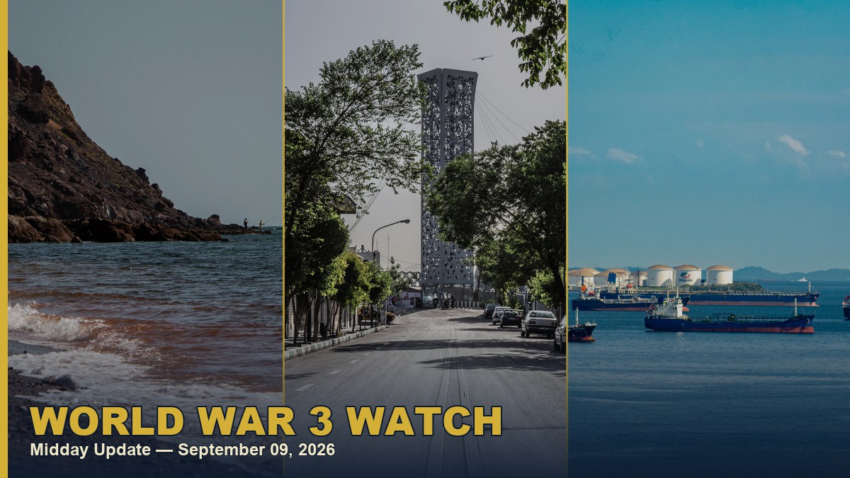
World War 3 Watch — Midday Update — September 09, 2026
- Iran says it struck 10 “noncompliant” vessels — two US ships and eight oil tankers — after Washington destroyed five Iranian crude carriers overnight (The Guardian, 2026).
- Brent crude crossed $100 a barrel for the first time since July, and Wall Street fell as fuel and food costs climbed (The Guardian, 2026; RFE/RL, 2026).
- Only six commercial vessels crossed the Strait of Hormuz on September 8, well below the recent average (RFE/RL, 2026).
- Second-quarter traffic through Hormuz fell to 4.9 million barrels a day, from 21.6 million in late 2025 (IBTimes, 2026).
- Chinese-language coverage led with Iran’s claim that it seized a US unmanned submarine, and with a US tally of 10 Iranian tankers destroyed since September 1 (Lianhe Zaobao, 2026, authors’ translation; VOA Chinese, 2026, authors’ translation).
- Trump declined to push back on Britain’s new sanctions on Israeli settlements, as UK-Israel ties hit their lowest point since the Jewish state’s founding (Yahoo News, 2026).
1. The Story So Far
Iran says it attacked 10 vessels around the Strait of Hormuz on September 9, hours after the United States destroyed five Iranian crude carriers (The Guardian, 2026).
This is the biggest declared maritime exchange of the six-month war, and it pushed Brent crude above $100 a barrel for the first time since July (MSN, 2026; The Guardian, 2026).
Both sides dispute what actually happened at sea. Iran’s Islamic Revolutionary Guard Corps (IRGC) claims two US vessels were among the ships it hit; US Central Command says every “attempted attack failed” (The Guardian, 2026).
The same news cycle carried new cracks beyond the Gulf, from a Taiwan defense-budget fight to a public US-Israel rupture (Chosun Ilbo [Chinese edition], 2026, authors’ translation; Yahoo News, 2026).
Video: Iran attacks US forces in Jordan, US sinks Iranian oil tankers as war escalates. Source: LiveNOW from FOX.
2. The Tanker War Hits the Shipping Lanes
US Central Command says it destroyed five Iranian crude oil carriers on September 8, after the IRGC launched two attempted ballistic-missile attacks against a US Navy warship over two days (IBTimes, 2026).
Among the tankers struck were M/T Kaviz, M/T Charminar, M/T Horizon 1 and M/T Riesco in the Gulf of Oman, plus M/T Derya near Kharg Island (IBTimes, 2026). Crews were ordered to abandon their ships before the vessels were hit, and no US personnel were injured (IBTimes, 2026).
It came two days after US forces struck three more Iranian carriers — M/T Downy off Kharg Island, M/T Stark 1 near Jask, and the unladen M/T Kylo in the Gulf of Oman — bringing the total to eight tankers hit in four days (IBTimes, 2026).
Washington’s rationale is blunt. The three tankers hit on September 5 are “part of a multibillion-dollar shadow network that funds the IRGC and its regional proxies,” CENTCOM said, adding: “Iran has no means by which to defend them” (IBTimes, 2026).
The exchanges are “the sharpest flare-up of strikes in weeks,” as both sides struggle to break a deadlock in a six-month-old war (The Guardian, 2026).
Iran answered with its largest claimed maritime strike of the conflict. The IRGC says it hit two US vessels and eight oil tankers it described as “noncompliant” — a likely reference to ships trying to pass the waterway without its permission (The Guardian, 2026).
At least one sailor was killed and another is missing, the Guardian reported. Washington denies any of its vessels were hit (The Guardian, 2026).
The escalation spread beyond the strait. A tanker in Iraqi waters was struck by a drone, and Iran fired 20 ballistic missiles toward Jordan, which says it intercepted 18 while two landed in unpopulated areas (The Guardian, 2026; RFE/RL, 2026).
An unnamed Iranian official says Tehran has no intention of backing down in the face of an American naval blockade and attacks on its oil tankers (Moneycontrol, 2026).
Video: Iran Attacks 10 Ships In Hormuz? 2 US Vessels & 8 Tankers Targeted After US Strikes | Scary Visuals. Source: MIRROR NOW.
3. Who Really Controls the Strait of Hormuz?
Control of the waterway is the war’s central argument. Iran has effectively closed the strait since the war began in February, and it set up its own shipping route hugging the Iranian coastline (RFE/RL, 2026).
Tehran has threatened any vessel using a US-backed route along Oman’s coast, and the United Kingdom Maritime Trade Operations reported that “several” ships were “subject to disabling fire as part of ongoing military activity in the region” (RFE/RL, 2026).
Iran keeps widening the map. The IRGC for the first time added parts of the Gulf of Oman and the Arabian Sea to a new “prohibited zone,” and warned tanker crews in ports in Kuwait and Bahrain to evacuate (RFE/RL, 2026).
Language tells a different story. English-language wires focused on the tanker toll and the oil price, but one Chinese-language outlet led its coverage with Iran’s claim that it had seized an American unmanned submarine in the strait (Lianhe Zaobao, 2026, authors’ translation).
Mainland Chinese financial coverage framed the ship attacks as the two sides probing each other’s “red lines” and pushing regional tensions higher — an analytical angle absent from the English headlines in this roundup (Eastmoney, 2026, authors’ translation).
Even the counts do not line up across languages. The English reports in this set tally eight Iranian tankers destroyed over September 5–8 (IBTimes, 2026), while VOA Chinese reports CENTCOM saying 10 Iranian oil tankers have been destroyed since US ships were attacked on September 1 (VOA Chinese, 2026, authors’ translation).
The Guardian, meanwhile, relays Iranian state television’s claim that the US strikes followed a “complex intelligence and operational action at dawn” tied to a US underwater drone (The Guardian, 2026).
For a deeper look at why the same war reads so differently by market and by language, see our narrative-comparison report on how US, Israeli, Iranian, and BRICS media each tell this war.
Video: 'WARSHIPS ATTACKED': Iran Unleashes New Missile In Hormuz, US Navy Destroyers 'Under Fire'. Source: Times Of India.
4. The Home Front: What $100 Oil Means
Brent crude’s jump above $100 a barrel is not an abstract number. Rising energy prices feed inflation and the cost of goods, and stocks fell on Wall Street as the news landed (The Guardian, 2026).
The human stakes are political. Higher fuel and food prices will further frustrate the Trump administration, which faces a midterm election with an unpopular war and a cost-of-living crisis (The Guardian, 2026).
The flow data explains the price shock. The US Energy Information Administration estimates only 4.9 million barrels a day of crude and petroleum liquids moved through Hormuz in the second quarter of 2026, down from 21.6 million barrels a day in late 2025 (IBTimes, 2026).
On September 8, just six commercial vessels crossed the strait all day — well below the recent average (RFE/RL, 2026).
The shipping paralysis predates this week’s strikes. Even as the Gulf fights over its own oil lane, a Chinese-language business report projects that by 2028 Asia will absorb 70 percent of Canada’s oil exports, with China as the largest buyer (IDNFinancials, 2026, authors’ translation).
The global energy map is re-routing around the war even while the war is still being fought.
5. The Taiwan Flashpoint Goes Budgetary
Alongside the Gulf, this watch tracks the China-Taiwan front — and there, the most concrete development today is fiscal, not naval.
A Chinese-language report from Chosun Ilbo says Taiwan’s opposition parties have cut the defense budget, and that the US described the move as a concession to the Chinese Communist Party (Chosun Ilbo [Chinese edition], 2026, authors’ translation).
No English-language source in this roundup carried that story. Readers following only the Western wires got the Gulf and the UK-Israel crisis, while Chinese-language readers woke up to a Taiwan budget fight framed in Washington as a strategic concession (Chosun Ilbo [Chinese edition], 2026, authors’ translation).
The timing matters: this lands while the US is already fighting a six-month war in the Gulf and pressing allies for cohesion (The Guardian, 2026; Yahoo News, 2026).
6. The US-Israel Alliance Frays in Public
The same hours brought a Washington-Tel Aviv split into plain view. British Prime Minister Andy Burnham called US President Donald Trump to inform him of new trade sanctions on West Bank settlements before the announcement by Foreign Secretary Ed Miliband (Yahoo News, 2026).
Trump, according to Axios and the Times of Israel, “did not push back or ask Mr Burnham to change course” (Yahoo News, 2026). US Secretary of State Marco Rubio refused to condemn the British move, noting that “the president has not commented on this” (Yahoo News, 2026).
The omission was a surprise. US Ambassador to Israel Mike Huckabee had warned that “without a doubt” Washington would react to the measure (Yahoo News, 2026).
Britain’s sanctions were coordinated with France and Canada and endorsed publicly by nine other European countries (Yahoo News, 2026). Miliband called settlers “terrorists” carrying out “ethnic cleansing” — language Israel dismissed as an “outrageous lie” (Yahoo News, 2026).
Israel retaliated by ordering the closure of Britain’s consulate in East Jerusalem, expelling diplomats, and banning 11 left-wing MPs — including Jeremy Corbyn and Diane Abbott — from entering the country (Yahoo News, 2026).
The result is the lowest point in UK-Israel relations since the birth of the Jewish state (Yahoo News, 2026).
Trump’s refusal to condemn Britain is the latest sign of his acrimonious relationship with Netanyahu. The pair have disagreed over strategies for the Iran war and the Gaza peace process, and Washington has told Israel not to formally annex occupied territory for fear of alienating Arab and Muslim allies (Yahoo News, 2026).
Is This Actually World War 3?
Today’s sources describe a severe regional war that is contaminating the global economy — not yet a great-power war with all major powers shooting.
Iran and the US are trading blows across the Strait of Hormuz, the Gulf of Oman, the Arabian Sea, Iraq, and Jordan (The Guardian, 2026; RFE/RL, 2026). Iran is targeting civilian oil shipping, and Washington is systematically destroying what it calls the shadow fleet funding the IRGC (IBTimes, 2026).
Oil above $100 affects every household on Earth that buys fuel or food (The Guardian, 2026). That is a world war’s economic signature without a world war’s order of battle.
China appears in these sources only in the wings: as a projected buyer of Canadian crude and as the reason Washington is watching Taiwan’s defense budget (IDNFinancials, 2026, authors’ translation; Chosun Ilbo [Chinese edition], 2026, authors’ translation). Taiwan’s fight is political and fiscal, not kinetic — for now.
The honest label is a warning, not a fact: two dangerous flashpoints are tightening simultaneously, and the alliance meant to hold the line is publicly fracturing over Israel.
What You Can Do Right Now
- Treat the $100 barrel as a household budget signal: fuel, food, and shipping costs are already moving, so review your monthly buffer before prices pass through to your area (The Guardian, 2026).
- Do not relay viral “hit” claims without checking them — today’s two official narratives cannot both be right, and the difference between them is the difference between war and propaganda (The Guardian, 2026; RFE/RL, 2026). Monitor CENTCOM, UKMTO, and independent shipping-data trackers cited in this roundup.
- If you live in a port city or on a fuel-dependent supply chain, build a basic household resilience stock now — start with our survival skills and preparedness guide.
Figure 1
Who is covering this
Note. Built from the WW3 Watch stories cited in this report.
Figure 2
Connecting the dots: names that keep appearing together
Note. Built from the WW3 Watch stories cited in this report. A line means two names appeared in the same sourced story — it shows overlap in the coverage, not a proven connection between them.
Black Excellence This Week
The hard news is real, and so is this. Wins reported by the Black press in the last 14 days:
- HBCUs Are Building New Support Systems for Black Male Students
capitalbnews.org · 2026-09-08 - Florida HBCU Announces Historic Enrollment
miamiherald.com · 2026-09-02
What You Can Do This Week
Not just bad news — here is where to push.
- Ask your U.S. representative to demand a congressional vote before any further U.S. strikes on Iranian tankers near Hormuz. — Find your U.S. representative
- Call your U.S. senators to request an emergency briefing on the Strait of Hormuz tanker conflict and surging oil prices. — Find your U.S. senators
- Check your voter registration today so you can hold lawmakers accountable for escalating Gulf strikes without authorization. — Check your voter registration
SUPPORT KEMETIC MINDS
Enjoying this coverage? Back the work and find every way to connect with us in one place.
Support the Page →Kemetic Minds Analysis
This roundup pulled directly from the day’s English- and Chinese-language wires side by side, because the gap between what each side chooses to report is often as informative as any single strike count. Treat the Key Takeaways above as the verified factual floor, and the framing differences noted in the sections above as the more interesting, harder-to-fake signal about where this war is actually headed next.
References
- MSN. (2026, September 9). Iran says it hit 10 ships after US destroys five tankers as Hormuz crisis deepens. msn.com
- The Guardian. (2026, September 9). Iran claims to have attacked 10 ships near strait of Hormuz after US strikes. theguardian.com
- Ibtimes. (2026, September 9). Tanker War Erupts in the Gulf as US and Iran Trade Blows Around Hormuz. ibtimes.sg
- Moneycontrol. (2026, September 9). Iran warns of ‘more intense war’ as US strikes tankers, Tehran vows to step up counterattacks. moneycontrol.com
- Rferl. (2026, September 9). US, Iran Trade Strikes On Shipping As Oil Prices Surge Above $100 A Barrel. rferl.org
- Yahoo. (2026, September 9). Trump did not push back on Burnham’s Israel sanctions. yahoo.com
- 联合早报. (2026, September 8). 伊朗称在霍尔木兹海峡扣押一艘美国无人潜艇 [Iran says it seized a U.S. unmanned submarine in the Strait of Hormuz.]. zaobao.com
- 东方财富网. (2026, September 9). 美伊互袭船只试探彼此“红线” 推高地区紧张态势 [US and Iran strike each other's ships, testing "red lines" and raising regional tensions.]. wap.eastmoney.com
- 美国之音. (2026, September 9). 中央司令部:自9月1日美舰遭袭以来,已有10艘伊朗油轮被摧毁 [CENTCOM: 10 Iranian Oil Tankers Destroyed Since September 1 Attack on U.S. Vessels]. voachinese.com
- 朝鮮日報中文版. (2026, September 9). 台湾在野党削减国防预算…美国称“这是向中共让步” [Taiwan's opposition parties cut defense budget… US says this is ceding ground to Chinese Communists.]. cnnews.chosun.com
- IDNFinancials. (2026, September 9). 2028年亚洲将吸收加拿大70%的石油出口,中国是最大买家 [By 2028, Asia Will Absorb 70% of Canada's Oil Exports, with China as the Largest Buyer]. idnfinancials.com
Investigative Methodology: This roundup is generated on a fixed schedule (noon and evening, America/Chicago) from live English- and Chinese-language wire sources. Every claim is grounded in fetched source text with an APA7 in-text citation; translated Chinese-language quotes are marked “authors’ translation.” Every video embed is verified to be a real, existing video via YouTube’s oEmbed endpoint before publication — none are written by the drafting model. No Wikipedia sources are used.
Stay Connected

Kemetic Minds Editorial Desk
Verified NewsroomPrimary-sourced investigative intelligence on civil rights, voting rights, federal policy, and consumer protection. Sourced from primary legal filings, government statistics, and direct field reporting.