
KEMETIC MINDS
Special Report — Extreme Earth Changes Watch | September 5, 2026
Key Takeaways
- What: Anak Krakatau, in Indonesia’s Sunda Strait, is erupting as of 4:40 a.m. WIB on September 5, 2026, with six separate eruptions recorded overnight and a bright red glow visible from the crater[1].
- Ongoing since: The volcano has been erupting repeatedly since its alert status was raised to Level III on July 2[1].
- Risk assessment: Indonesia’s disaster agency says the volcano’s regrown edifice remains too small to trigger a collapse-driven tsunami like the one in 2018[2].
- On the ground: A 3-km exclusion zone is enforced around the crater; monitoring cameras on the island have been destroyed by ejected material[2].
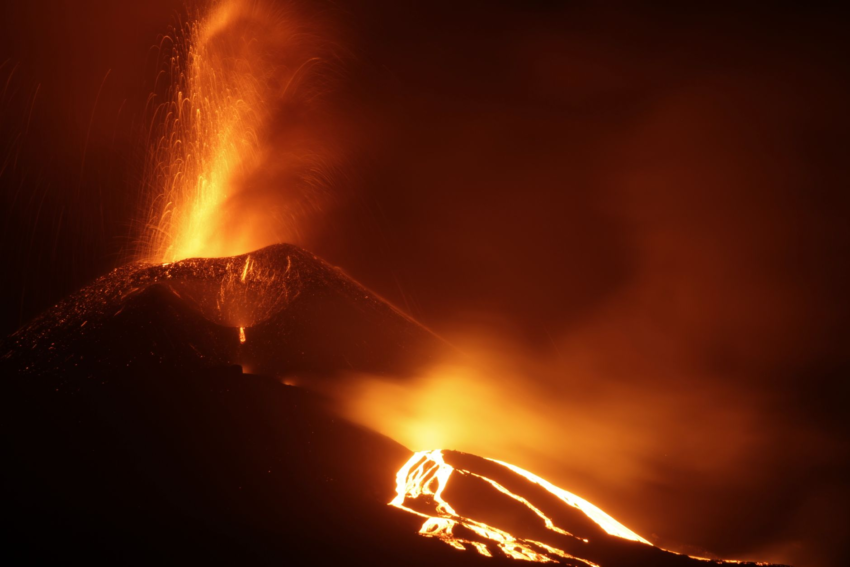
Anak Krakatau — the “child of Krakatoa” that rose from the caldera left by the catastrophic 1883 eruption — is erupting again, with a bright red glow visible over the crater before dawn on September 5, 2026, in a sequence that has continued almost without pause for more than two months[1]. The exact height of the ash column has not been measured by observers, but the glow was described as clearly visible from monitoring posts[1].
Photo by Carlos via Pexels — representative image, not Anak Krakatau itself
What Happened Overnight
The eruption began around 11:07 p.m. local time on September 4 and continued through the overnight observation window[2]. Indonesia’s Geological Agency recorded six separate eruptions through 12:01 a.m. local time Saturday, with one seismograph reading showing a maximum amplitude of 33 millimeters over a 14-second duration[1].
Separately, a single eruption earthquake was recorded with 70 millimeters of amplitude lasting roughly six hours — a longer, larger signal than the individual eruptions Anadolu Agency logged, and evidence the overall sequence has stayed unusually sustained[3]. Ejected material destroyed a field surveillance camera on the island, temporarily cutting off one of the ways scientists watch the crater in real time[2].
Two Months of Escalation
This is not an isolated event. Indonesia’s Center for Volcanology and Geological Hazard Mitigation (PVMBG) raised Anak Krakatau to Alert Level III on July 2, 2026, and the volcano has erupted repeatedly since. An August 16 eruption was the volcano’s tenth in a single week, and MAGMA Indonesia — the country’s public geological-hazard monitoring platform — had logged 31 separate Anak Krakatau eruption events for 2026 as of that count, out of 4,035 recorded nationwide — Mount Semeru led all volcanoes with 1,643[4].
“[The public, visitors and climbers should] not approach within 3 km of the active crater.”
— PVMBG, per Databoks/Katadata Indonesia
The exclusion zone, in numbers:
- Alert Level III (Siaga) in effect since July 2, 2026
- 3-kilometer radius closed around the active crater
- 31 recorded eruption events at Anak Krakatau alone in 2026[4]
Video: GUNUNG ANAK KRAKATAU DI SELAT SUNDA ERUPSI DISERTAI LAVA AIR MANCUR, TERDENGAR SUARA GEMURUH. Source: Tribun Jogja Official.
What Officials Are Saying About Tsunami Risk
The question hanging over any Anak Krakatau eruption is whether it can collapse the way it did in December 2018, when a flank of the volcano slid into the sea and triggered a tsunami that killed 437 people along the coasts of Sumatra and Java with no seismic warning at all[5]. Indonesian officials say that risk remains low for now.
“[The volcano’s] regrown edifice remained relatively small and was not considered capable of collapsing on a scale that could trigger a tsunami.”
— Berton Panjaitan, Acting Head, Indonesia’s National Disaster Management Agency (BNPB), per Free Malaysia Today
That assessment matters because the 2018 disaster is a documented case of a volcanic flank collapse that produced almost no precursory shaking — the landslide itself, not an explosive blast, generated the wave, and it struck without the kind of warning an eruption normally provides[5]. Officials are watching the volcano’s physical growth, not just its eruptive activity, for that reason.
Life and Travel Around the Strait
So far, the eruption’s disruption has stayed local and manageable. No aviation NOTAM closure has been issued for Jakarta’s Soekarno-Hatta airport, and ferry service across the Merak-Bakauheni crossing continues to run, since the ash plume has stayed largely over water and below flight corridors[3].
Boat-tour operators running trips out of Anyer, Carita, and Kalianda have paused close approaches to the crater and are rerouting visitors to Peucang Island and the Ujung Kulon coastline instead, offering fee-free date changes while the Level III alert remains active[3].
Kemetic Minds Analysis
Anak Krakatau’s current sequence is, by the numbers Indonesian scientists have published, a large and sustained eruption rather than a single dramatic event — more than two months of near-continuous activity, dozens of recorded eruptions, and now an ash column at the upper end of what this volcano typically produces. What makes this volcano different from most on Earth is not its size but its history: it sits inside the caldera of the 1883 Krakatoa eruption, one of the deadliest and most consequential eruptions ever recorded, and it produced its own deadly tsunami as recently as 2018 through a mechanism — a flank collapse — that gave almost no seismic warning. Indonesian officials’ central claim right now is a measurable one: that the cone has not regrown large enough to collapse the way it did in 2018. That is a testable scientific judgment, not a guarantee, which is exactly why PVMBG and BNPB keep publishing the underlying monitoring data rather than asking the public to simply trust the all-clear.
References
- Anadolu Agency. (2026, September 5). Indonesia’s Mt. Anak Krakatau erupts, spews rocks, volcanic ash. https://aa.com.tr/en/asia-pacific/indonesias-mt-anak-krakatau-erupts-spews-rocks-volcanic-ash/4048004 ↩a ↩b ↩c ↩d ↩e
- Free Malaysia Today. (2026, September 5). Indonesia’s Anak Krakatau continues to erupt. https://www.freemalaysiatoday.com/category/highlight/2026/09/05/indonesia-s-anak-krakatau-continues-to-erupt ↩a ↩b ↩c ↩d
- Travel Market News. (2026, September 5). Anak Krakatau Eruption September 2026: Caution. https://travelmarketnews.com/anak-krakatau-eruption-travel-caution-september-2026 ↩a ↩b ↩c
- Databoks, Katadata Indonesia. (2026, August 16). Alert! Anak Krakatau Volcano Erupts Again Tonight. https://databoks.katadata.co.id/en/demographics/statistics/15a6b1f9f9858b8/alert-anak-krakatau-volcano-erupts-again-tonight-sunday-16-august-2026 ↩a ↩b
- Grilli, S.T., et al. (2019, October 4). Modelling of the tsunami from the December 22, 2018 lateral collapse of Anak Krakatau volcano in the Sunda Straits, Indonesia. Scientific Reports. https://www.nature.com/articles/s41598-019-48327-6 ↩a ↩b
Black Excellence This Week
The hard news is real, and so is this. Wins reported by the Black press in the last 14 days:
- Drumma Boy reveals secrets behind hip hop’s biggest hits
rollingout.com · 2026-09-05 - ATL Labor Day Classic Kicks Off With HBCU Football Rivalry
blackenterprise.com · 2026-09-03 - Florida HBCU Announces Historic Enrollment
miamiherald.com · 2026-09-02
What You Can Do This Week
Not just bad news — here is where to push.
- Apply for assistance before the deadline if you took damage — FEMA disaster assistance
- Find the nearest distribution point for water and food — Find a food bank (Feeding America)
- Save the crisis line — displacement is a mental-health event too — 988 Suicide & Crisis Lifeline
SUPPORT KEMETIC MINDS
Enjoying this coverage? Back the work and find every way to connect with us in one place.
Support the Page →
Kemetic Minds Editorial Desk
Verified NewsroomPrimary-sourced investigative intelligence on civil rights, voting rights, federal policy, and consumer protection. Sourced from primary legal filings, government statistics, and direct field reporting.