KEMETIC MINDS
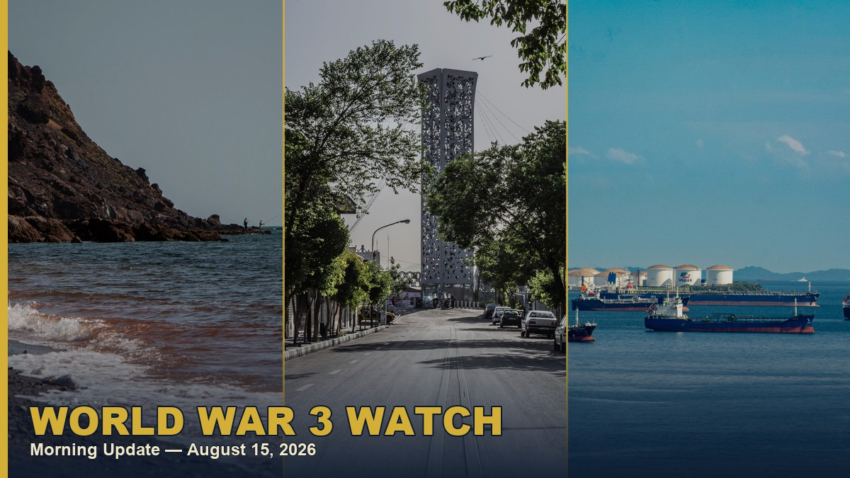
World War 3 Watch — Morning Update — August 15, 2026
- Trump said “pretty soon” he will declare the Strait of Hormuz a U.S. territory, and Treasury Secretary Scott Bessent promised economic measures Iran has “never seen” (Al Jazeera, 2026).
- Iran’s Deputy Foreign Minister Kazem Gharibabadi replied that the strait “will remain Iranian” and the blockade continues until Washington accepts “the reality of defeat” (RTE, 2026; MSN, 2026).
- A vessel belonging to Abu Dhabi National Oil Company was attacked in the strait on the night of August 14, with no casualties (National Business Daily, 2026, authors’ translation).
- U.S. gasoline averaged $4.08 a gallon, up 29 percent from a year earlier, and Trump says the sacrifice is worth denying Iran nuclear weapons (RTE, 2026).
- The Islamic Revolutionary Guard Corps shot down a U.S. MQ-9 Reaper, and U.S. Reaper losses may already exceed $1.3 billion (Huasheng Online, 2026, authors’ translation).
- Iran’s foreign minister said Tehran will not extend the ceasefire, accusing Washington of violating the June memorandum of understanding (National Business Daily, 2026, authors’ translation).
The Story So Far
The war the United States and Israel launched on February 28 is grinding into its sixth month with no off-ramp in sight (RTE, 2026). At sea, a commercial bulk carrier was struck by an unknown projectile in the Strait of Hormuz; on land, Washington and Tehran are trading territorial threats and ultimatums (MSN, 2026).
Trump told a New York rally he will “pretty soon” declare the strait U.S. territory, while Tehran insists it “will remain Iranian” and the blockade holds until Washington accepts defeat (Al Jazeera, 2026; MSN, 2026). The economics are biting on both sides — $4.08 gasoline in America, inflation in Iran — and the diplomatic track is in ruins (RTE, 2026).
China’s state-aligned press is filling in details Western wire coverage skipped, from the shootdown of U.S. Reaper drones to a new multinational “Falcon Strike” task force (Huasheng Online, 2026, authors’ translation). Here is the morning of August 15, 2026, in five acts.
Video: US IRAN WAR Live: Trump Issues Ultimatum To Iran, Threatens 'WALL OF STEEL' Naval Blockade On Hormuz. Source: ET Now World.
1. Trump’s Territorial Gambit Meets Tehran’s Defiance
The provocation came from Garden City, New York. Speaking at a political rally on Friday, Trump said with a chuckle: “Pretty soon I’ll be declaring the Hormuz Strait a territory of the United States” (Al Jazeera, 2026; MSN, 2026).
The French international broadcaster RFI, in its Chinese-language service, noted the line seemed to carry a joking tone (RFI, 2026, authors’ translation). It landed, though, in a speech where Trump promised Iran a severe economic blow and told Americans he will “never apologize” for the war (RFI, 2026, authors’ translation).
Trump also repeated his claim that the U.S. has “controlled” the strait — a claim Iran calls a lie (RFI, 2026, authors’ translation). In reality, Iran has blockaded the waterway since the war began while the U.S. blockades Iranian ports (RFI, 2026, authors’ translation).
Iran’s reply arrived within hours. Deputy Foreign Minister Kazem Gharibabadi wrote on X that “the Strait of Hormuz cannot be seized by a tweet or an aircraft carrier, by issuing an order or by delivering an election speech” (RTE, 2026).
In the version carried by Chinese media, he added: “The Strait of Hormuz was, is, and will be Iran’s. Its opening and closing can only be controlled by Iran” (Sina Military, 2026, authors’ translation). Iran, he said, neither fears threats nor bows to displays of force, and the U.S. has already suffered a strategic defeat (Sina Military, 2026, authors’ translation).
Foreign Minister Abbas Araqchi closed the door on diplomacy for now, telling Iranian outlet Shahrara News that Iran has not decided to resume talks and that Washington must meet conditions on the strait before shipping can restart (RTE, 2026). He also ruled out extending the ceasefire, saying the U.S. violated the June 17 memorandum of understanding and that “war has reignited” (National Business Daily, 2026, authors’ translation).
The memorandum’s collapse is documented in the Chinese report: Washington published the text on June 17 with a 60-day negotiation commitment, then struck Iran on July 7–8 in response to Iranian attacks on commercial ships in the strait (National Business Daily, 2026, authors’ translation). Iran answered with missiles and drones against U.S. facilities in Bahrain, Kuwait, Qatar, and Jordan, and Trump declared the memorandum “ended” at a NATO summit in Turkey (National Business Daily, 2026, authors’ translation).
Video: Trump insists Strait of Hormuz will become US territory after winning Iran war, addresses gas prices. Source: USA TODAY.
2. Tankers Under Fire in the Strait of Hormuz
The maritime front was active overnight. A commercial bulk carrier was struck in the Strait of Hormuz by an unknown projectile, with no casualties reported (MSN, 2026).
Regional shipping, the same account notes, has faced repeated projectile and drone strikes while transiting the waterway (MSN, 2026).
Chinese coverage supplies what the English reports leave out: a named victim (National Business Daily, 2026, authors’ translation). Citing the Emirates News Agency, the National Business Daily reported that a vessel belonging to Abu Dhabi National Oil Company was attacked the night of August 14 while sailing through the strait — again, no casualties (National Business Daily, 2026, authors’ translation).
The same report notes that the UAE Foreign Ministry said early on August 14 that two ADNOC oil tankers were attacked by Iran the night before while passing through Hormuz (National Business Daily, 2026, authors’ translation). English-language coverage of the newer strike attributes it only to an “unknown projectile” (MSN, 2026) — a sharp divergence in what each bloc is willing to name.
These attacks are happening on a waterway that carried one-fifth of the world’s oil before the war (RTE, 2026). Tanker traffic through the strait remains halted, and the war shows no sign of moving toward peace (RTE, 2026).
3. Oil, Inflation, and the Politics of $4 Gasoline
On the American home front, the war is being priced by the gallon. The average price of a gallon of gasoline was about $4.08 on Friday, up 29 percent from a year earlier, according to the American Automobile Association (RTE, 2026).
RFI’s Chinese-language service put the rise at more than 35 percent above pre-war prices (RFI, 2026, authors’ translation).
Trump’s pitch to voters is blunt. He told the rally that paying “a tiny little bit more for your gasoline” is worth ensuring “a very evil country” cannot have a nuclear weapon (RTE, 2026).
“If you have to pay a little more for gasoline, that’s fine. … I will never apologize. I made the right decision” (RFI, 2026, authors’ translation).
Vice President JD Vance offered a different rationale on Fox News: the primary goal is keeping oil and gasoline prices low, the second is preventing a nuclear Iran, and “I think we are achieving both goals” (RFI, 2026, authors’ translation).
Democrats are already making the war’s economic fallout an issue in November’s congressional elections (RTE, 2026). RFI’s report says Trump’s approval ratings have fallen sharply as living-cost discontent spreads (RFI, 2026, authors’ translation).
Iran is hurting too. President Masoud Pezeshkian blamed high inflation on the U.S. blockade of Iranian ports and sanctions on Iran’s oil exports (RTE, 2026).
The Australian’s Wall Street Journal coverage frames the contest as an economic war: Trump doubling down on sanctions and blockade while Tehran bets high oil prices will force Washington to relent (The Australian, 2026).
4. The Drone War Over the Gulf
The air war over Hormuz is now being measured in downed drones. Iran’s Islamic Revolutionary Guard Corps shot down a U.S. MQ-9 Reaper over Hormozgan province, though the exact time was not disclosed (Huasheng Online, 2026, authors’ translation).
The Reaper has become an expensive habit. U.S. officials disclosed on August 13 that the military has lost at least 45 Reapers in the war with Iran — about a quarter of its inventory (Huasheng Online, 2026, authors’ translation).
At $30–50 million per aircraft, those losses could exceed $1.3 billion, and some drones crashed after losing contact with their operators (Huasheng Online, 2026, authors’ translation).
On the water’s edge, Iranian video shows black oil coating the shoreline of Qeshm Island, near the strait (Huasheng Online, 2026, authors’ translation). Iran’s environmental agency says the slick originated at sea and drifted ashore under currents and monsoon winds; Gharibabadi attributed the pollution to foreign military aggression and said it proves the need for Iran’s own management mechanism for the strait (Huasheng Online, 2026, authors’ translation).
On the American side, U.S. Central Command announced the formation of a “Falcon Strike” task force, described as the first multinational joint attack-drone unit integrating one-way attack drones from allied air, sea, and underwater platforms (Huasheng Online, 2026, authors’ translation). Which countries will join remains unclear (Huasheng Online, 2026, authors’ translation).
Chinese analysts cited in the same report warn the weapon could backfire. With military and civilian targets intermingled in the strait, a targeting error could make the unit a liability, and basing attack drones on allied territory invites Iranian missile and drone retaliation against those allies (Huasheng Online, 2026, authors’ translation).
5. Two Language Blocs, One War
Today’s sources read like two different wars. English-language outlets led with Trump’s “territory” quip and its domestic politics (Al Jazeera, 2026; RTE, 2026), while The Independent’s live headline framed the day around Iran telling Trump to “accept the reality of defeat” and keep Hormuz closed (The Independent, 2026).
Chinese-language coverage carried the same Gharibabadi quotes, plus operational detail the Western wires skipped: named ADNOC attacks, the Reaper shootdown, the 45-drone loss estimate, Qeshm oil pollution, and the “Falcon Strike” task force (National Business Daily, 2026, authors’ translation; Huasheng Online, 2026, authors’ translation). Even a bare mobile alert from Sina pushed the same Trump “territory” line to Chinese-language phones (Sina News, 2026, authors’ translation).
The diplomatic thread is also richer on the Chinese side. Pakistan’s deputy prime minister met the U.S. charge d’affaires on August 14 to push for implementation of the U.S.–Iran memorandum of understanding (Huasheng Online, 2026, authors’ translation).
Qatar and Pakistan are exchanging information with Tehran as mediators, though Iran insists that is not the same as negotiations (National Business Daily, 2026, authors’ translation).
For readers triangulating the truth, the gaps matter as much as the overlap. our narrative-comparison report on how US, Israeli, Iranian, and BRICS media each tell this war breaks down whose coverage names the attacker and whose names only the missile.
Is This Actually World War 3?
Based only on today’s sources: no — and keeping the distinction sharp matters. Every development in this morning’s reporting is confined to the Persian Gulf theater: tanker attacks in the strait, drone losses over the Gulf, sanctions, and dueling rhetoric between Washington and Tehran.
None of today’s sources mention the China–Taiwan flashpoint this series also tracks, and none report fighting beyond the Gulf. What makes the war feel global is its economic reach — the strait carried one-fifth of the world’s oil before the fighting (RTE, 2026) — and the explicit “economic war” framing now driving U.S. sanctions and Iranian retaliation (The Australian, 2026).
That is a world-spanning pressure campaign, not yet a world war. The honest label for today is a grinding regional conflict with global price tags — and that is more than enough to keep watching.
What You Can Do Right Now
- Compare at least one Chinese-language and one English-language report on the same event before sharing it; today’s “unknown projectile” versus “attacked by Iran” gap is the difference between rumor and attribution (MSN, 2026; National Business Daily, 2026, authors’ translation).
- Strengthen your household’s buffer against the inflation and supply disruption this war is driving — our survival skills and preparedness guide is built for exactly this kind of uncertainty (RTE, 2026).
- If you drive, monitor official fuel-price trackers the way the American Automobile Association tracks its $4.08 national average, and budget for supply spikes — the war is explicitly being fought through oil markets (RTE, 2026; The Australian, 2026).
SUPPORT KEMETIC MINDS
Enjoying this coverage? Back the work and find every way to connect with us in one place.
Support the Page →Kemetic Minds Analysis
This roundup pulled directly from the day’s English- and Chinese-language wires side by side, because the gap between what each side chooses to report is often as informative as any single strike count. Treat the Key Takeaways above as the verified factual floor, and the framing differences noted in the sections above as the more interesting, harder-to-fake signal about where this war is actually headed next.
References
- Theaustralian. (2026, August 15). US and Iran escalate economic war over vital Strait of Hormuz oil route. theaustralian.com.au
- MSN. (2026, August 15). US-Israel-Iran war live: Bulk carrier vessel struck in Strait of Hormuz by unknown projectile; no casualties reported. msn.com
- MSN. (2026, August 15). Iran says Strait of Hormuz 'will remain Iranian' after Trump warning. msn.com
- RTE. (2026, August 15). Iran calls on US to accept defeat over Strait of Hormuz. rte.ie
- Al Jazeera. (2026, August 15). Iran war live: Trump vows to make Hormuz US territory ‘pretty soon’. aljazeera.com
- independent.co.uk. (2026, August 15). Iran tells Trump to ‘accept the reality of defeat’ and Hormuz to remain closed: Live. independent.co.uk
- 新浪新闻_手机新浪网. (2026, August 15). 特朗普称“很快将宣布霍尔木兹海峡为美国领土” [Trump claims to soon announce the Strait of Hormuz as US territory]. news.sina.cn
- 新浪军事. (2026, August 15). 特朗普说“很快宣布霍尔木兹海峡为美国领土”,伊朗回应 [Trump says "will soon announce the Strait of Hormuz as US territory", Iran responds]. mil.news.sina.com.cn
- 每日经济新闻. (2026, August 15). 霍尔木兹大消息,多艘油轮遭袭!伊朗:美国已遭受战略惨败,伊方无意延长与美方的停火协议 [Hormuz hit with major incident, multiple oil tankers attacked; Iran: US has suffered strategic defeat, no intention to extend ceasefire agreement with US]. nbd.com.cn
- RFI. (2026, August 14). 特朗普称等击败伊朗后,将“宣布霍尔木兹海峡属于美国领土” [Trump says after defeating Iran, he will 'declare the Strait of Hormuz U.S. territory]. rfi.fr
- 华声在线. (2026, August 15). 特朗普称将宣布霍尔木兹海峡为“美国领土” 伊朗称击落美军无人机 [Trump says he will declare the Strait of Hormuz as "US territory", Iran claims to have shot down a US drone]. m.voc.com.cn
Investigative Methodology: This roundup is generated on a fixed schedule (noon and evening, America/Chicago) from live English- and Chinese-language wire sources. Every claim is grounded in fetched source text with an APA7 in-text citation; translated Chinese-language quotes are marked “authors’ translation.” Every video embed is verified to be a real, existing video via YouTube’s oEmbed endpoint before publication — none are written by the drafting model. No Wikipedia sources are used.
Stay Connected

Kemetic Minds Editorial Desk
Verified NewsroomPrimary-sourced investigative intelligence on civil rights, voting rights, federal policy, and consumer protection. Sourced from primary legal filings, government statistics, and direct field reporting.