
KEMETIC MINDS
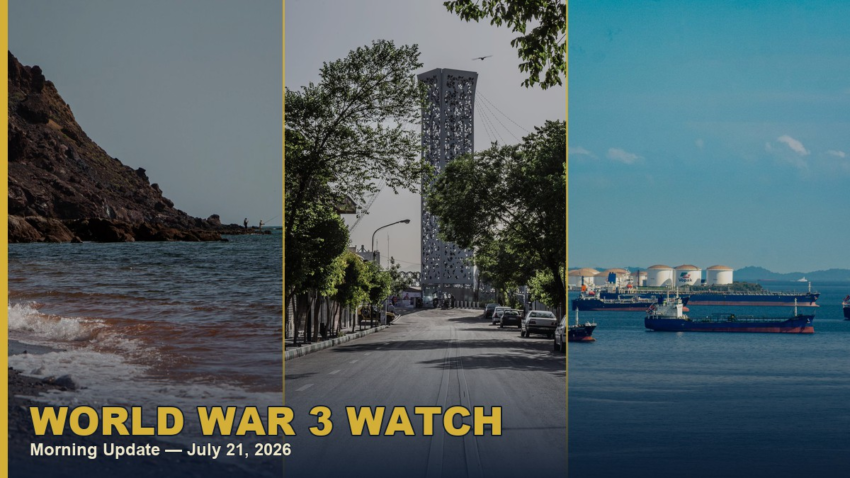
World War 3 Watch — Morning Update — July 21, 2026
- U.S. forces completed a tenth consecutive night of airstrikes on Iran, targeting military command centers, missile and drone launch sites, and air defense systems — the Pentagon described the objective as degrading Iran’s ability to attack shipping in the Strait of Hormuz (Fox News, 2026; Xinhua, 2026, authors’ translation).
- Iran retaliated with missile and drone strikes on U.S. facilities in Bahrain, Kuwait, and Jordan, claiming to have “destroyed” radar systems and Patriot batteries (Xinhua, 2026, authors’ translation; MSN, 2026).
- At least three U.S. service members have been killed across recent attacks; the Pentagon confirmed a third fatality on July 19 in Iraq and disclosed that nearly 100 personnel have been wounded since July 7 (Voice of America, 2026; Xinhua, 2026, authors’ translation).
- An Iranian Revolutionary Guard Navy source claimed that Strait of Hormuz shipping traffic has dropped to zero and that the waterway will remain closed as long as U.S. “provocations” continue (Xinhua, 2026, authors’ translation).
- Qatar, Egypt, and Pakistan have presented Washington and Tehran with a 10-day ceasefire proposal; the Trump administration is reportedly studying the possibility while also preparing for an all-out war scenario (MSN, 2026; Xinhua, 2026, authors’ translation).
Video: IRGC reports ‘massive fires’ on two oil tankers in Strait of Hormuz. Source: Al Jazeera English.
1. Tenth Night of Strikes and Iranian Retaliation
For the tenth consecutive night, U.S. Central Command conducted airstrikes against Iranian military targets, striking command centers, naval capabilities, missile and drone launch positions, and air defense systems. According to Central Command, the aim is to “degrade Iran’s ability to continue attacking merchant ships in the Strait of Hormuz” (Xinhua, 2026, authors’ translation; Fox News, 2026). Iran’s Islamic Revolutionary Guard Corps (IRGC) responded by launching missiles and drones at U.S. facilities in Bahrain and Kuwait, claiming to have “completely destroyed” a radar system on Muharraq Island in Bahrain and a Patriot air defense system at Riffa, as well as targets at Kuwait’s Ahmed al-Jaber Air Base and Ali al-Salem Air Base, where several MQ-9 drones were “destroyed or severely damaged” (Xinhua, 2026, authors’ translation).
English-language coverage highlights that the U.S. campaign is entering its tenth day, with the latest strikes coming hours after Iran hit sites in Jordan and Bahrain (MSN, 2026). Chinese sources emphasize the Iranian narrative in greater detail, reporting that Kuwait’s Ministry of Electricity, Water, and Renewable Energy said multiple power and desalination plants were attacked on July 20 — the fourth consecutive day of Iranian strikes on Kuwait (Xinhua, 2026, authors’ translation). Jordan’s armed forces said they intercepted three Iranian missiles and shot down five drones “without casualties or material damage” (Xinhua, 2026, authors’ translation).
Video: Iran War – New U.S. Strikes – LIVE Breaking News Coverage. Source: Agenda-Free TV.
2. Casualties and the Human Toll
The Pentagon has acknowledged the deaths of three U.S. service members in recent days. Voice of America reported that on July 19, a U.S. soldier — Sergeant Michael Emmanuel Swinton, 30, from Fayetteville, North Carolina — died while performing a controlled detonation of a downed Iranian one-way attack drone at Erbil Air Base, Iraq (Voice of America, 2026). Two other U.S. personnel were killed over the weekend when Iranian missiles and drones struck a base in Jordan; a fourth service member remains missing, with unidentified remains being tested (Voice of America, 2026; Xinhua, 2026, authors’ translation).
Chinese sources note that a Pentagon spokesperson confirmed on July 20 that nearly 100 U.S. troops have been wounded since July 7, most suffering “mild concussions” (Xinhua, 2026, authors’ translation). English-language outlets have largely echoed this, with the Washington Post cited as noting that the figure underscores the intensity of Iranian strikes on U.S. installations over the past two weeks (Xinhua, 2026, authors’ translation).
Video: Iranian missile strikes injure more than 100 in southern Israel • FRANCE 24 English. Source: FRANCE 24 English.
3. Hormuz Blockade and Shipping Under Fire
The Strait of Hormuz remains the strategic centerpiece of the conflict. Iran’s Fars News Agency, cited by Xinhua, reported that shipping traffic through the strait “has dropped to zero” and that Iran will not issue any transit permits as long as U.S. “confrontational behavior” continues (Xinhua, 2026, authors’ translation). Iran’s Foreign Ministry spokesperson, Esmail Baghaei, stated on July 20 that Iran will “never allow the Strait of Hormuz to be misused to threaten Iran’s security and national interests,” and that Tehran is working with Oman to safeguard its interests (Xinhua, 2026, authors’ translation).
Meanwhile, the U.K. Maritime Trade Operations (UKMTO) reported at least three attacks on merchant vessels since Sunday: a ship east of Dibba, UAE, was struck by an unidentified projectile; a vessel off Kumzar, Oman, was hit by an unknown object causing a fire; an oil tanker off Limah, Oman, was struck, forcing the crew to abandon ship (Voice of America, 2026). U.S. Central Command countered Iran’s blockade claim by stating that commercial shipping continues to transit the waterway, noting that CENTCOM forces have assisted “approximately 900 merchant ships and 450 million barrels of crude oil” since early May (Voice of America, 2026).
4. Ceasefire Talks: A 10-Day Window?
Mediators from Qatar, Egypt, and Pakistan have presented the United States and Iran with a proposal for a 10-day ceasefire, according to multiple sources. Axios reported, citing unnamed officials, that the Trump administration is studying the possibility of a truce while simultaneously preparing for full-scale war (Xinhua, 2026, authors’ translation). The same report indicated that if a 10-day ceasefire is agreed upon, negotiations would begin on long-term arrangements for the Strait of Hormuz, including options for Iran to collect a “reasonable service fee” for maritime security and environmental protection, or channeling fees into a joint fund managed by the International Maritime Organization (Xinhua, 2026, authors’ translation).
English-language media also highlight that Trump reportedly believes the Iran war is approaching a “decisive turning point.” U.S. and Israeli officials have outlined two scenarios: a ceasefire negotiation to reopen Hormuz, or a large-scale joint U.S.-Israeli military operation aimed at “forcing Iran to surrender” (Xinhua, 2026, authors’ translation). One article notes that the White House is urging Israel not to take actions that would “close the diplomatic window” (Xinhua, 2026, authors’ translation; MSN, 2026). Unlike the Chinese coverage, English sources such as MSN stress that the strikes may continue for “several more days” before the ceasefire offer receives serious consideration (MSN, 2026).
5. Regional Flashpoints: Israel, Lebanon, and the Gulf
Israeli Chief of Staff Lieutenant General Herzi Halevi said on July 19 that the Israeli Defense Forces are “on high alert” and have prepared operational plans to “immediately resume fighting” against Iran, should escalation require it (Xinhua, 2026, authors’ translation). An English-language report confirms that Israel remains on the sidelines for now but is drawing up plans for further escalation in the U.S.-Iran conflict (MSN, 2026).
On the Lebanon front, Lebanese President Joseph Aoun met with President Donald Trump at the White House on July 21 — the first such visit by a Lebanese leader since 2009. The meeting focused on implementing a “framework agreement” signed on June 26, under which Israeli forces would withdraw from southern Lebanon, Hezbollah would disarm, and the Lebanese army would assume full control. The U.S. State Department announced that operations in a “pilot zone” of three villages had begun, though Israeli forces remain in one of them. The Lebanese army said it is preparing for the Israeli withdrawal from Zawtar al-Gharbieh and began deploying troops on Tuesday (The Baltimore Sun, 2026). This diplomatic push proceeds in parallel with the wider Iran conflict, highlighting how Washington is juggling multiple theaters.
6. Great-Power Dynamics and the China-Taiwan Parallel
The Iran-Hormuz conflict continues to draw attention away from other hotspots. As noted in our narrative-comparison report on how US, Israeli, Iranian, and BRICS media each tell this war, the framing of the war varies widely across blocs. Today’s Chinese-language coverage from Xinhua and other outlets places heavy emphasis on the humanitarian and infrastructure damage suffered by U.S. allies (Kuwait, Bahrain) and on Iran’s diplomatic stance, while English-language outlets focus on U.S. military operations and the ceasefire proposal. Notably, Chinese sources omit the Lebanon encounter and the global travel warning issued by the U.S. State Department on July 20, while English sources barely mention the Iranian claim that Hormuz traffic is at zero. This discrepancy illustrates the competing narratives that are shaping perceptions of the conflict in different media ecosystems.
Meanwhile, the China-Taiwan flashpoint remains a parallel concern. While today’s sources do not directly address that theater, the massive U.S. force deployment to the Middle East — including dozens of fighter jets and tankers — necessarily reduces the resources available for contingency operations in the Indo-Pacific. The war’s trajectory, particularly any prolonged blockade or escalation into a ground campaign, will have profound implications for great-power competition with China.
7. Is This Actually World War 3?
Based strictly on today’s sources, the conflict between the U.S. and Iran is intense but remains a bilateral regional war with limited direct involvement by other major powers. Neither China nor Russia has entered the fighting, and Israel is holding back. The 10-day ceasefire proposal, if accepted, could de-escalate the crisis. However, the prospect of a large-scale joint U.S.-Israeli military operation to “force Iran to surrender” (Xinhua, 2026, authors’ translation) indicates that the door to a wider war is not closed. The Strait of Hormuz — through which about 20% of global oil transits — remains effectively contested, with Iran claiming zero traffic and the U.S. reporting continued commercial shipping. A prolonged blockade would trigger a global economic crisis that could drag in other nations. For now, this is a high-intensity regional war with global economic implications, but it has not yet escalated into a World War III scenario. The parallel China-Taiwan situation, though linked by U.S. force posture, has not been activated.
8. What You Can Do Right Now
- Review our survival skills and preparedness guide for practical steps on emergency food storage, communication plans, and medical supplies — especially if you live near strategic infrastructure or fuel-dependent areas.
- Monitor credible sources from multiple sides of the conflict. Compare narratives using outlets such as Xinhua, Voice of America, and the MSN reports cited here; always cross-check claims about shipping, casualties, and ceasefire timelines.
- If you rely on global supply chains or fuel-dependent transportation (including delivery services or commuting), consider stockpiling essentials now. A prolonged Hormuz closure would disrupt oil and natural gas flows, driving up costs for everything from gasoline to plastic goods.
Kemetic Minds Analysis
This roundup pulled directly from the day’s English- and Chinese-language wires side by side, because the gap between what each side chooses to report is often as informative as any single strike count. Treat the Key Takeaways above as the verified factual floor, and the framing differences noted in the sections above as the more interesting, harder-to-fake signal about where this war is actually headed next.
References
- Iran war. (2026, July 21). A Red Sea blockade threatens a new front in US.. msn.com
- day ceasefire. (2026, July 21). U.S. strikes Iran and Houthis threaten Saudi Arabia shipping as mediators push 10. msn.com
- MSN. (2026, July 21). Why Iran is risking so much over the Strait of Hormuz. msn.com
- Fox News. (2026, July 21). US military hits Iran in push to degrade regime’s ability to target ships in Strait of Hormuz. foxnews.com
- MSN. (2026, July 21). On sidelines of Iran war, Israel is readying plans in case of escalation. msn.com
- The Baltimore Sun. (2026, July 21). Lebanon’s president meets with Trump in Washington to push for Israeli troop withdrawal. baltimoresun.com
- 新京报. (2026, July 21). 美军连续第十晚打击伊朗 调解方提议美伊停火十日 [US military strikes Iran for the tenth consecutive night as mediators propose a 10-day ceasefire between the US and Iran]. bjnews.com.cn
- 美国之音. (2026, July 21). 美国军方完成第十轮袭击,五角大楼公布第三名在中东阵亡的军人身份 [The US military has completed its 10th round of strikes, the Pentagon releases the identity of the third US service member killed in the Middle East]. voachinese.com
- 新华网客户端. (2026, July 21). 美军又有人员死亡 以军称“做好对伊恢复战斗准备” [US military suffers more casualties, Israeli military says "ready to resume fighting against Iran]. app.xinhuanet.com
- 新华网. (2026, July 20). 伊朗外交部称将坚定维护在霍尔木兹海峡的国家利益 [Iran's Foreign Ministry vows to firmly uphold national interests in the Strait of Hormuz]. news.cn
- 新华网. (2026, July 21). 遭伊朗猛烈打击 美军过去两周近百人受伤 [US forces suffer nearly 100 casualties in intense Iranian strikes over past two weeks]. news.cn
Investigative Methodology: This roundup is generated on a fixed schedule (noon and evening, America/Chicago) from live English- and Chinese-language wire sources. Every claim is grounded in fetched source text with an APA7 in-text citation; translated Chinese-language quotes are marked “authors’ translation.” Every video embed is verified to be a real, existing video via YouTube’s oEmbed endpoint before publication — none are written by the drafting model. No Wikipedia sources are used.
Stay Connected

Kemetic Minds Editorial Desk
Verified NewsroomPrimary-sourced investigative intelligence on civil rights, voting rights, federal policy, and consumer protection. Sourced from primary legal filings, government statistics, and direct field reporting.