
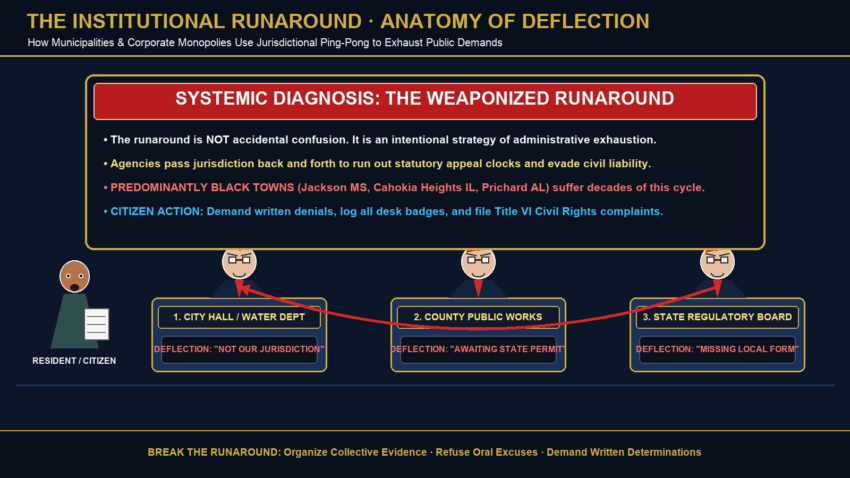
Civil Rights · Municipal Accountability · October 12, 2026
Key Facts
- The “Runaround” Defined: In administrative law, the runaround is not accidental incompetence; it is a documented deflection mechanism known as administrative burden or jurisdictional ping-pong, designed to exhaust complainants, avoid financial liability, and evade legal deadlines.
- Impact on Black Towns: Predominantly Black municipalities—including Jackson, Mississippi; Cahokia Heights, Illinois; and Prichard, Alabama—have suffered decades of crumbling water, sewage, and road infrastructure while city, county, and state agencies passed blame in an unbroken circle.
- The Core Mechanism: Public bodies rely on oral dismissals, procedural resets (“missing supplemental forms”), and closed-door sessions to prevent citizens from creating an appealable, written administrative record.
- The Citizen Defense: Breaking the loop requires refusing verbal brush-offs, demanding written statutory denials, deploying state open-records requests, and filing federal Title VI civil rights complaints with oversight agencies.
Millions of residents have faced the same exhausting wall. You report a broken water main or an erroneous utility bill, only to be turned away. The city claims it belongs to the county, the county points to the state, and the state claims city hall never filed the right forms.
By the time you loop back to the first office, months or years have passed. The officials have changed, your original paperwork has supposedly vanished, and you are told to begin the entire application from day one.[1].
In common parlance, this is called “the runaround.” But in institutional sociology and administrative law, it is recognized as a weaponized administrative strategy. It is not an accident of poor communication. It is a systematic deflection strategy used by corporations, municipal utility boards, and government authorities to wear down public resistance, suppress fiscal claims, and avoid court-ordered remedies without ever issuing a formal, appealable rejection on paper.[2].
What Exactly Is “The Runaround”?
At its core, a bureaucratic runaround is the deliberate substitution of procedural motion for substantive resolution. An institution appears to be processing your grievance, yet every procedural step is engineered to terminate in another procedural step rather than an outcome.
Authorities use four primary deflection tactics to keep residents trapped in this administrative carousel:
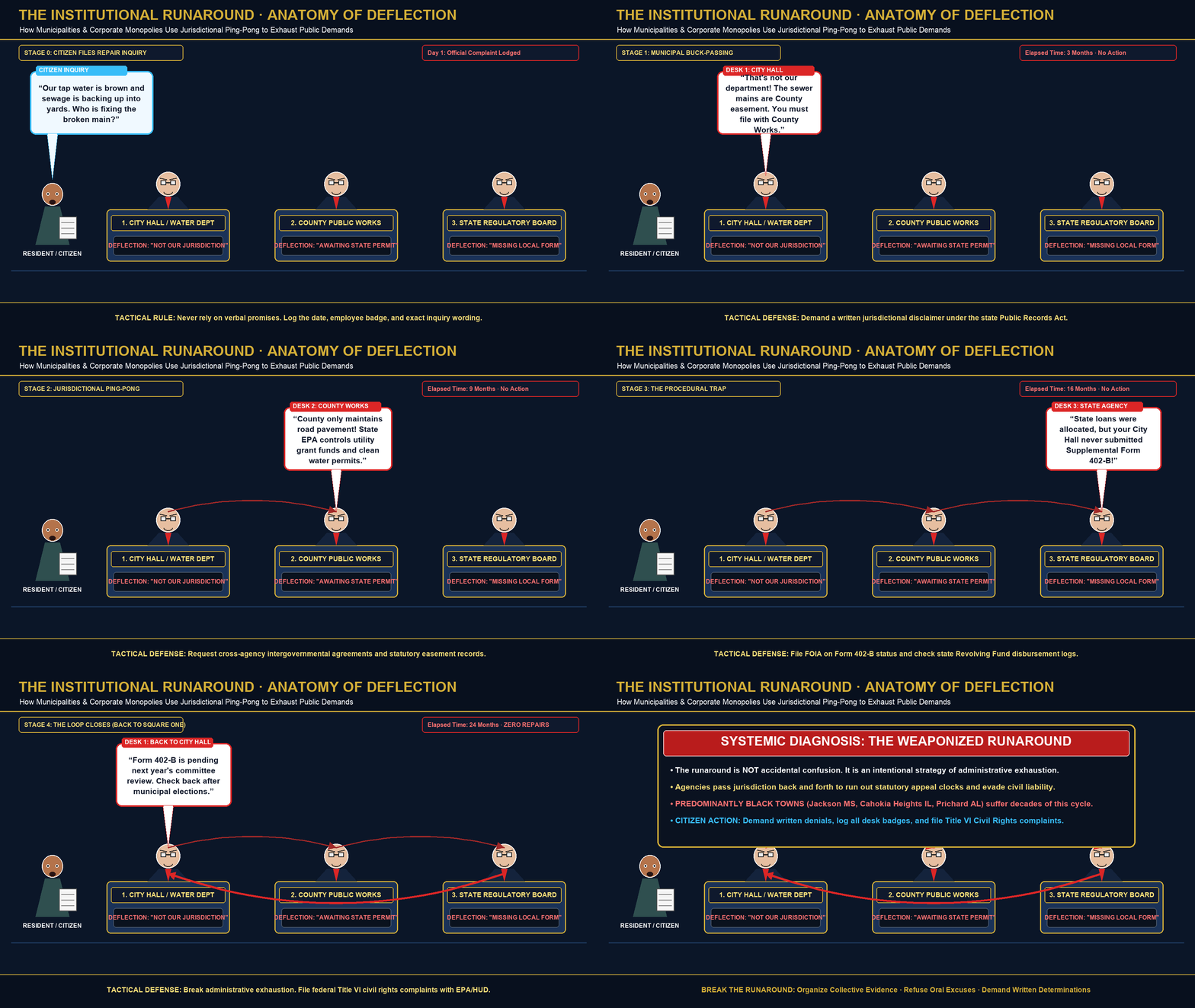
- 1. Jurisdictional Ping-Pong: The agency divides overlapping responsibilities into microscopic silos. City Hall claims it only controls surface pipes, the County claims it only owns the road easements, and the State claims it only provides financing. Complainants are bounced between desks until they give up.
- 2. The Oral Brush-Off (Refusal to Create a Paper Trail): Bureaucrats routinely provide oral excuses—such as “we’re looking into it” or “that’s not our department”—because oral statements carry zero legal weight. An oral dismissal cannot be submitted to an administrative law judge, cannot be appealed to a governing board, and leaves no evidence of municipal negligence.
- 3. The “Phantom Form” & Procedural Reset: When a resident corners an agency with proof, the agency introduces obscure, unpublished prerequisites. Complainants are informed that their filing is invalid because it lacks an unadvertised supplemental affidavit or because the filing window closed during the period they were waiting for a return call.
- 4. Closed-Door Executive Retreat: When community coalitions attend public meetings to demand answers, elected bodies frequently declare sudden “executive sessions” citing pending litigation, or cancel meetings altogether due to an alleged “lack of quorum,” shutting down the public record.
How the Runaround Works, Step by Step
The animated infographic below illustrates the anatomical lifecycle of the bureaucratic runaround. It demonstrates how a simple citizen request for basic infrastructure maintenance is systematically passed through a multi-agency loop until the complainant is returned to square one—two years later, with zero repairs made.
Case Studies: How the Runaround Stalls Predominantly Black Towns
While the runaround frustrates individual consumers nationwide, its most devastating and prolonged impacts occur in predominantly Black municipalities. In these communities, the runaround is weaponized across decades to starve vital infrastructure of capital improvements while insulating state and regional bodies from legal accountability.[3].
1. Jackson, Mississippi (94% Black): The Clean Water Pass-the-Buck
For more than twenty years, residents of Jackson faced recurring boil-water notices, raw water intake freezing, and catastrophic pressure losses that left schools, hospitals, and homes without running water. When city residents demanded systemic overhauls of the aging O.B. Curtis water treatment facility, a decades-long game of jurisdictional ping-pong unfolded.[4].
State officials pointed fingers at municipal leadership over revenue billing discrepancies and meter contracts. In turn, state regulatory authorities systematically withheld and restricted access to federal Clean Water and Safe Drinking Water State Revolving Fund (SRF) loan disbursements. State lawmakers even attempted to strip the municipality of governing authority by creating a state-controlled regional utility district. It was only when the U.S. Department of Justice and the Environmental Protection Agency intervened under the Safe Drinking Water Act—appointing an independent federal court administrator—that the institutional runaround was broken.[4].
2. Cahokia Heights (Centreville), Illinois (95% Black): The Sewage Labyrinth
In Cahokia Heights (formerly Centreville), Illinois, residents have endured raw human sewage bubbling up into backyards, bathtubs, and ditches after every heavy rainstorm for over three decades.[5].
When residents demanded repairs, they were caught in a multi-jurisdictional maze: Centreville Township claimed it only maintained drainage ditches; St. Clair County asserted the trunk lines belonged to local utility districts; the Commonfields of Cahokia Public Water District claimed lack of revenue; and the Illinois Environmental Protection Agency treated complaints as local civil disputes. Residents formed Centreville Citizens for Change, documented pump station failures on video, and joined legal counsel to file federal Clean Water Act lawsuits against multiple overlapping entities simultaneously, finally forcing state infrastructure grant releases.[5].
3. Prichard, Alabama (86% Black): The Leaking Pipes & Ghost Bills
In Prichard, Alabama, the municipal water board (PWWSB) lost an estimated 50% to 60% of its treated water to underground pipe leaks, while residents were billed exorbitant rates to cover the utility’s $55 million bond debt.[6].
When homeowners organized against water shutoffs and demanded pipe replacements, city council officials declared they had no legal authority over the independent utility board; the board claimed Mobile County and state agencies failed to grant right-of-way easements; and state regulators took no corrective enforcement action. The runaround only halted when citizen forensic audits and litigation compelled a Mobile County circuit judge to place the utility into receivership.[6]
The Citizen Action Blueprint: 6 Rules to Break the Loop
You cannot defeat a bureaucratic runaround by playing by the agency’s informal rules. The runaround relies entirely on your willingness to accept oral answers, leave without receipts, and restart procedures alone. To break the cycle, citizens must convert informal conversations into binding legal records.
How to Overcome Administrative Exhaustion
- Rule 1: Never Leave with an Oral Rejection (Demand the Written Denial): When a clerk or administrator says, “We can’t help you with that,” reply: “Please provide your formal denial in writing citing the applicable municipal code section, so I may submit it to the administrative appeals board.” Because officials know a written denial creates an appealable record, they will often escalate the matter immediately rather than sign their name to an unauthorized refusal.
- Rule 2: Maintain a Strict Chronological Contact Log: Every phone call and office visit must be recorded: Date, Time, Full Name of Employee, Title, Direct Desk Extension, and the exact statement made. Following any verbal conversation, send an immediate follow-up email: “Thank you for speaking with me today at 2:15 PM. As we discussed, you stated that City Hall has not taken action because…” This creates a contemporaneous written record.
- Rule 3: Deploy Statutory Public Records Requests (FOIA): Stop asking for status updates; demand records. File formal state Open Records/FOIA requests for: (a) all intergovernmental agreements between city and county regarding the site, (b) maintenance work orders logged for that address in the past 24 months, and (c) all internal emails mentioning your street. Public records laws carry strict statutory deadlines (typically 5 to 14 business days).
- Rule 4: File Federal Title VI Civil Rights Complaints: If a local agency or state department receives any federal funding (such as EPA, HUD, or DOT grants) and provides disparate service to a predominantly minority neighborhood, file an administrative Title VI complaint under the Civil Rights Act of 1964 directly with the federal agency’s Office of Civil Rights. Federal investigations bypass local political machines.
- Rule 5: Flood Public Comment at Council Meetings: Bring a coalition to council meetings during open public comment. State the facts plainly into the microphone: “On March 4, Clerk X told us Y. On June 12, Director Z told us W. Here are the 42 logged complaints.” Council meeting minutes are legal public records and cannot be erased by desk clerks.
- Rule 6: Organize Evidence for Injunctive Relief (Writ of Mandamus): When government officials refuse to perform a mandatory statutory duty (such as repairing clean water connections or enforcing environmental codes), an organized group of citizens can petition a state court for a Writ of Mandamus—a court order commanding officials to perform their legal duty under penalty of contempt.
How to Verify This Yourself
Read the official federal consent decrees and oversight audits covering municipal utility deflections directly at the EPA Jackson Water Resource Center and review enforcement mandates under Title VI of the Civil Rights Act of 1964.
References
- Herd, P., & Moynihan, D. P. (2018). Administrative Burden: Policymaking by Other Means. Russell Sage Foundation. Investigates how bureaucratic barriers and procedural hurdles are weaponized to ration public rights. ↩
- Lipsky, M. (2010). Street-Level Bureaucracy: Dilemmas of the Individual in Public Service. Russell Sage Foundation. Explores how front-line public workers ration services through delay, paperwork, and discretion. ↩
- Bullard, R. D. (2000). Dumping in Dixie: Race, Class, and Environmental Quality. Westview Press. Foundational documentation on environmental racism and municipal disinvestment in Southern Black communities. ↩
- U.S. Department of Justice (2022). United States v. City of Jackson, Mississippi, Case No. 3:22-cv-686, Order Appointing Interim Third-Party Manager over Jackson Water System. Primary federal court record. ↩
- U.S. Environmental Protection Agency (2021). EPA Region 5 Response & Community Fact Sheet: Centreville / Cahokia Heights Environmental Injustice & Infrastructure Task Force. ↩
- Alabama Department of Environmental Management & Mobile County Circuit Court (2023). Synovus Bank v. Prichard Water Works and Sewer Board, Case No. CV-2023-901416, Order of Receivership. Official state judicial filing. ↩
Investigative methodology: this analysis was produced by Kemetic Minds using primary judicial consent decrees, EPA Title VI enforcement guidance, and documented municipal public utility records. All historical infrastructure cases cited are verified against federal court filings and state utility receivership dockets.

Kemetic Minds Editorial Desk
Verified NewsroomPrimary-sourced investigative intelligence on civil rights, voting rights, federal policy, and consumer protection. Sourced from primary legal filings, government statistics, and direct field reporting.