KEMETIC MINDS
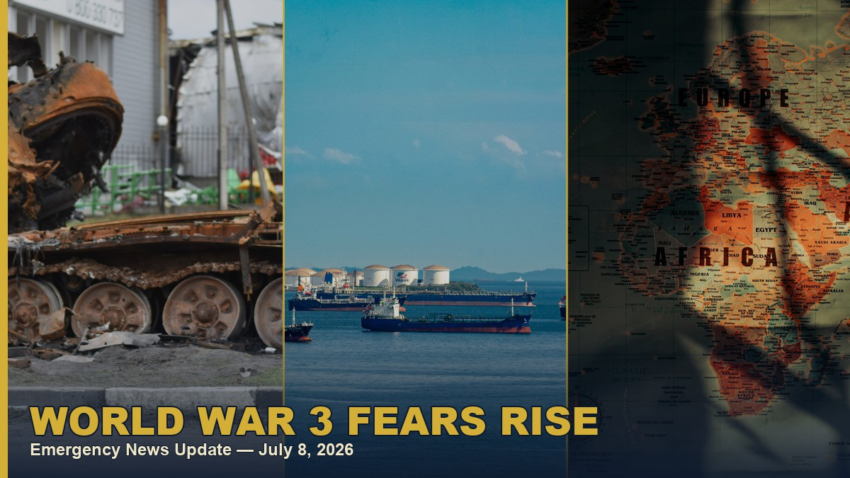
Emergency News Update — July 8, 2026
“World War 3” is trending, but the reason isn’t a confirmed global war — it’s a real, escalating set of events: a tanker attack in the Strait of Hormuz that spiked oil prices, the expiration of the last U.S.-Russia nuclear arms treaty, and a funeral for Iran’s Supreme Leader drawing millions even as ceasefire talks continue. This piece separates the verified escalation from the panic, and shows what experts actually mean when they call the risk elevated rather than inevitable.
1. The Real War Driving the Fear
The searches for “World War 3” spiking this week aren’t coming from nowhere. The United States and Israel have been at war with Iran since February 2026, a conflict that escalated sharply after a U.S.-Israeli strike killed Iranian Supreme Leader Ayatollah Ali Khamenei on February 28 (Al Jazeera, 2026c). This week, his funeral procession drew millions of mourners across Tehran and Qom before his burial at the Imam Reza Shrine in Mashhad (Al Jazeera, 2026a).
At the same time, diplomacy has not collapsed. Qatar, acting as mediator, reported “positive progress” after indirect U.S.-Iran technical talks concluded in Doha, tied to a memorandum of understanding the two sides signed on June 17, 2026 (Al Jazeera, 2026b). That combination — active fighting and funeral rites in the same week as constructive backchannel talks — is the actual, complicated picture, not a single clean storyline in either direction.
2. This Week’s Flashpoint: The Strait of Hormuz
The sharpest escalation came on July 7, 2026, when projectiles struck two commercial vessels in the Strait of Hormuz: the Qatari-owned LNG tanker Al Rekayat, which suffered an engine-room fire that put it at risk of explosion, and the Saudi-flagged supertanker Wedyan (Bloomberg, 2026). Qatar publicly blamed Iran; Iranian state media suggested the same without an official claim of responsibility (The National, 2026).
Energy markets reacted immediately. Brent crude settled 3% higher at $74.16 a barrel and U.S. West Texas Intermediate rose 2.8% to $70.44 (CNBC, 2026). In response, the U.S. Treasury reimposed sanctions on Iranian oil exports that had been lifted under the Islamabad Memorandum, and U.S. Central Command (CENTCOM) launched a new wave of strikes on Iranian military sites near the strait (NBC News, 2026; CNBC, 2026). Roughly a fifth of the world’s oil and gas transits the Strait of Hormuz, which is why a handful of missile strikes on two ships can move a global market within hours.
3. The Nuclear Backdrop: No Treaty, No Limits
Separate from the Iran war, a quieter but structurally significant shift happened five months ago: New START, the last remaining treaty limiting U.S. and Russian strategic nuclear arsenals to 1,550 deployed warheads each, expired on February 5, 2026 without replacement (United Nations, 2026). For the first time in more than fifty years, the two countries holding the overwhelming majority of the world’s nuclear weapons have no binding limit on their arsenals (Council on Foreign Relations, 2026).
Russian President Vladimir Putin offered in September 2025 to keep observing the treaty’s limits for up to one additional year if the United States reciprocated; as of this week, Washington has not formally accepted or rejected that offer (United Nations, 2026). That unresolved status — not a new arms race announcement, but an old safeguard quietly lapsing — is part of why analysts describe global tension as structurally higher in 2026 than at any point since the Cold War’s end, even without a single new nuclear-armed conflict (Council on Foreign Relations, 2026).
4. Is This Actually “World War 3”?
The honest answer, per the available reporting and expert risk analysis, is no — not yet, and not confirmed as inevitable. Eastern Europe, the Taiwan Strait, and the Middle East are the three flashpoints where a local conflict could plausibly widen into something larger, and the Middle East is currently seeing its most widespread fighting since 1973 (Foreign Policy, 2026). Public fear has risen accordingly: polling in Western countries shows the share of people who believe a major war is imminent climbing from roughly 30% to over 40% in some countries (Foreign Policy, 2026).
But the same analysis that documents elevated risk also documents real brakes on escalation: nuclear deterrence, deep economic interdependence between major powers, and diplomatic channels that remain open and functioning — the same Doha talks producing “positive progress” this week are a concrete example of that last point (Al Jazeera, 2026b; Foreign Policy, 2026). Treat any single source, official or social media, that declares World War 3 has definitively started as a claim to verify against primary reporting like the sources cited in this article — not as settled fact.
5. What You Can Do Right Now
Get your updates from primary wire and regional reporting — Al Jazeera’s live blog, Reuters, and the Associated Press are updating this story multiple times a day — rather than from unsourced social media posts, which spread faster than verification during exactly this kind of event.
If rising oil prices are already hitting your household budget, this is a good week to fill your tank early and review your fuel and grocery spending; a sustained Hormuz disruption historically shows up at the pump within days, not weeks. Keep a basic emergency kit and a few days of supplies on hand as a standing practice, not a panic purchase — the same preparedness principles we’ve covered for extreme weather apply here.
Finally, it’s worth naming directly: near-constant conflict coverage measurably raises anxiety. It’s reasonable to set a specific time of day to check verified updates rather than refreshing a live blog continuously, especially if you have children asking questions about what they’re overhearing.
Kemetic Minds Analysis
What’s actually new this week isn’t a declaration of world war — it’s the stacking of three independently serious developments into the same seven days: a major regional war’s most volatile moment yet, a direct hit on global energy shipping, and a nuclear safeguard that quietly expired months ago finally getting public attention. None of those, alone or together, meets the bar for a confirmed global war. But dismissing the fear as pure overreaction misses that every one of the underlying facts driving it — the tanker strikes, the funeral, the lapsed treaty — is real and independently verifiable. The responsible read is neither panic nor denial: it’s tracking the primary sources, understanding what has and hasn’t actually happened, and treating the still-active Doha diplomatic channel as the thing actually worth watching most closely.
References
- Al Jazeera. (2026a, July 6). Iran war updates: Khamenei funeral draws millions; Israel bombs Lebanon. aljazeera.com
- Al Jazeera. (2026b, July 1). Iran war updates: Qatar says ‘positive progress’ made in US-Iran talks. aljazeera.com
- Al Jazeera. (2026c, July 7). Iran war updates: US says launched new strikes after attacks on vessels. aljazeera.com
- Al Jazeera. (2026d, July 7). Saudi, Qatari tankers hit as Strait of Hormuz risks worsen. aljazeera.com
- Bloomberg. (2026, July 7). Hormuz sees biggest day of attacks since US-Iran peace deal. bloomberg.com
- CNBC. (2026, July 7). Oil prices rise after attacks on tankers in Strait of Hormuz, U.S. revokes Iran sale authorization. cnbc.com
- Council on Foreign Relations. (2026). Nukes without limits? A new era after the end of New START. cfr.org
- Foreign Policy. (2026, March 12). The irresistible urge to invoke World War III as wars rage in Middle East, Ukraine. foreignpolicy.com
- NBC News. (2026, July 7). Oil prices jump 5% after U.S. revokes Iran oil sanctions waiver following ship attacks. nbcnews.com
- The National. (2026, July 7). Qatar blames Iran after LNG tanker struck in Strait of Hormuz. thenationalnews.com
- United Nations, Office of the Secretary-General. (2026, February 5). Statement by the Secretary-General on the occasion of the expiration of the New START Treaty. un.org
Investigative Methodology: Sourced from Al Jazeera’s live conflict coverage, Bloomberg, CNBC, NBC News, The National, the United Nations Secretary-General’s official statement, the Council on Foreign Relations, and Foreign Policy’s expert risk analysis. No Wikipedia sources and no tweets or social-media posts were used as sourcing. Citations follow APA 7th edition format.
Stay Connected

Kemetic Minds Editorial Desk
Verified NewsroomPrimary-sourced investigative intelligence on civil rights, voting rights, federal policy, and consumer protection. Sourced from primary legal filings, government statistics, and direct field reporting.