

Kemetic Minds — Global Black Wealth Series | July 8, 2026
✈️ The Gap, at a Glance
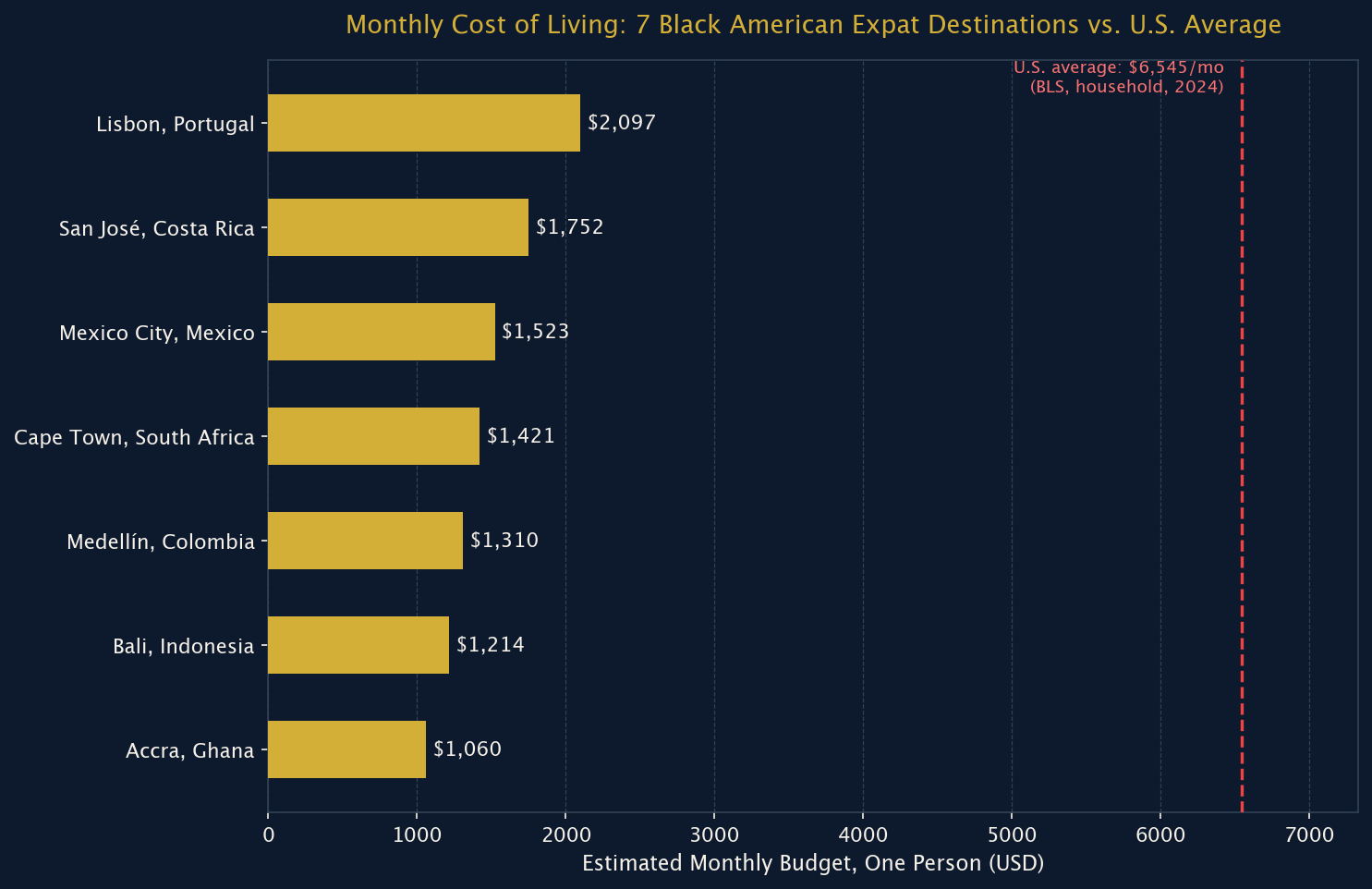
The average American household spends $6,545/month (U.S. Bureau of Labor Statistics, 2024). A single person can cover rent, food, transportation, and utilities in Accra, Ghana for roughly $1,060/month — and even the most expensive destination on this list, Lisbon, Portugal, still runs well below the U.S. household average.
Why More Black Americans Are Choosing to Leave
A growing number of Black Americans are relocating abroad in a trend commentators have nicknamed “Blaxit.” The New York Amsterdam News reported that destinations from Ghana and Portugal to South Africa, Costa Rica, Mexico, and Colombia are drawing people who say the math and the quality of life abroad simply work better — Stephanie Perry, co-founder of the ExodUS Summit, told the paper: “The U.S. was never designed to be a safe, welcoming place for us…if you can live better on less money elsewhere, let’s try it” (Carrillo, 2026).
The motivations are not purely financial. TheGrio reported that a 2025 Congressional Black Caucus Foundation survey found roughly 40% of Black Americans who had not previously considered leaving the country began considering it after the 2024 election (Robinson-Celeste, 2026). Capital B News has documented Black Americans, especially women, describing a “racism respite” abroad — lower stress, less surveillance, and in many cases lower cost of living freeing up money for healthcare and quality of life (Capital B News, n.d.).
This guide compares real, sourced monthly cost-of-living data for seven of the most talked-about Black American expat destinations against the U.S. average, and lays out how real people — retirees, remote workers, teachers, and entrepreneurs — actually fund the move.
A note on the numbers: Destination figures are single-person monthly cost-of-living estimates from Numbeo (crowdsourced, updated continuously; retrieved late June–early July 2026), converted to USD using exchange rates retrieved July 4, 2026. The U.S. figure of $6,545/month is the Bureau of Labor Statistics’ average household (“consumer unit”) spending for 2024, not a single-person figure — the two are directionally comparable but not perfectly apples-to-apples. Treat every number here as an estimate for planning, not a guarantee.
Figure 1
Estimated Monthly Budget: 7 Destinations vs. U.S. Average
Seven Destinations, Seven Different Deals
1. Accra, Ghana — roughly $1,060–$1,464/month
Ghana has actively courted the diaspora since its 2019 “Year of Return” marking 400 years since enslaved Africans arrived in Jamestown, Virginia, followed by the decade-long “Beyond the Return” program. At least 1,500 Black Americans have relocated to Ghana since 2019, and the African American Association of Ghana counts more than 300 paid members (Armstrong, 2024a). In November 2024, Ghana granted citizenship to 524 people in a single ceremony tied to the initiative (Armstrong, 2024b). Popular neighborhoods for American expats include East Legon, Airport Residential Area, and Osu (Expat Life Ghana, n.d.).
2. Bali, Indonesia — roughly $1,214–$1,564/month
Bali has long attracted American digital nomads building online businesses while living abroad. The best-known Black American example is designer Kristen Gray, who publicized her life and remote business on the island in 2021 — a story that also sparked a wider debate about “foreigner privilege,” gentrification, and race among expat communities before she was deported for visa violations (Coconuts Bali, n.d.; Quartz, n.d.). It is a useful reminder that lower cost of living abroad does not erase the need to follow visa rules or think carefully about your impact on the local community.
3. Medellín, Colombia — roughly $1,310–$1,567/month
Medellín is named alongside Ghana, Portugal, South Africa, and Costa Rica as a top Blaxit destination, with organizations such as Nomadness, Black Expats in Panama, Travel Noire, and the ExodUS Summit actively facilitating community and relocation support for Black Americans exploring Latin America (Carrillo, 2026).
4. Cape Town, South Africa — roughly $1,421–$1,761/month
South Africa is home to an estimated 10,000-plus American expats, with the American Society of South Africa maintaining active branches in both Cape Town and Johannesburg (IBN Business Consultants, n.d.). Essence has profiled Black American women who relocated to South Africa describing it as a chance to “start over” on their own terms (Essence, n.d.).
5. Mexico City, Mexico — roughly $1,523–$1,928/month
Facebook communities such as “Brothas & Sistahs In Mexico City” and “Black Expats in Mexico (drama free)” count thousands of members, and Black-owned businesses like the soul-food restaurant Blaxicocina have become community anchors (Capital B News, n.d.). Capital B notes that a majority of Black American expats in Mexico are college-educated and securely middle class — this is not, for most, a story of financial desperation but of choosing a different quality of life (Capital B News, n.d.).
6. San José, Costa Rica — roughly $1,752–$1,935/month
Retirees Devon and Lavanson Austin, who moved to Costa Rica in 2016, cite the country’s abolished military (1948) and national healthcare system as major draws (The Black Expat, n.d.). The Afro-Caribbean coastal town of Puerto Viejo has become a particular hub for Black American expats — though Atmos has also reported on real gentrification and displacement tensions this has created for longtime local residents, a tension worth weighing honestly before moving anywhere (Atmos, n.d.).
7. Lisbon, Portugal — roughly $2,097–$2,503/month
Lisbon is the most expensive destination on this list, but still comes in well under the U.S. household average. “Black In Portugal” is a Lisbon-based community that hosts monthly meetups for Black expats (Travel Noire, n.d.), and National Geographic has covered how Black travelers and residents are “reclaiming” the city (National Geographic, n.d.). Chrishan Wright, founder of the platform Blaxit Global, left the U.S. for Lisbon in September 2023 and has spoken publicly about building a life and a business there (Tourism Lens with Lily, 2026).
@caracelestewest Why I don’t miss the US as a Black American living abroad #livinginportugal #blackinportugal #blaxit #blackexodus #movingtoportugal #escapefromamerica
♬ original sound – Cara | Digital Nomad Mom
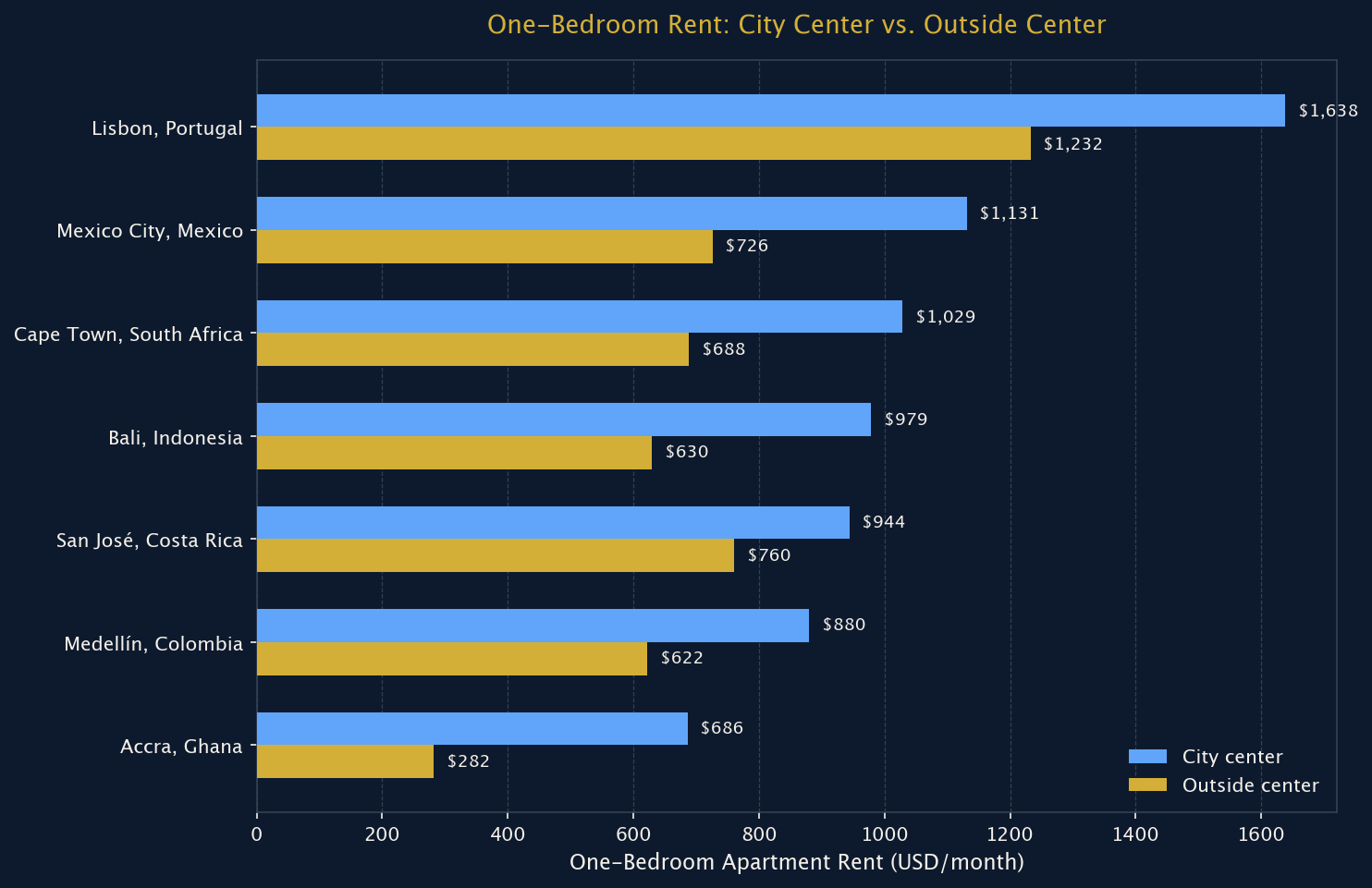
Figure 2
One-Bedroom Apartment Rent: City Center vs. Outside Center
How Real People Actually Afford to Live Abroad
Moving abroad is not just for the independently wealthy. Here are four real, common paths people use to fund the move:
- Social Security, collected abroad. U.S. citizens with at least 40 work credits (about 10 years of work history) can generally continue collecting Social Security retirement benefits while living in most foreign countries, with no reduction. The average monthly retired-worker benefit in 2026 is about $2,071 (Social Security Administration, n.d.) — on its own, enough to cover the full estimated monthly budget in five of the seven destinations above.
- Teaching English abroad (TEFL). ESL teaching pay typically runs $900–$2,500/month in much of the world, and $2,000–$6,000/month in higher-paying markets like the UAE, Japan, South Korea, and Taiwan — often with housing stipends included (The TEFL Org, n.d.). Travel Noire has specifically covered how Black expats choose TEFL certification programs before relocating (Travel Noire, n.d.).
- Remote work and digital nomad visas. Portugal offers a dedicated Digital Nomad Visa for remote workers earning foreign income, and NPR has reported on a broader, TikTok-amplified wave of Americans working remotely from Southeast Asia — the American population living in that region grew from roughly 32,000 in 1990 to about 88,000 in 2024 (NPR, 2026).
- Online business and freelancing. Several of the community builders named above — Chrishan Wright’s Blaxit Global, Kristen Gray’s design business in Bali — funded their relocation by building location-independent businesses rather than relying on a traditional local job, which most destinations restrict for tourist/visitor visas anyway.
Before You Go: The Honest Version
None of this is a shortcut. U.S. citizens owe U.S. taxes on worldwide income no matter where they live — a 2026 MyExpatTaxes survey found that more than half of Americans already living abroad have considered renouncing citizenship, in part over the compliance burden (MyExpatTaxes, as cited in Business Insider Markets, 2026). Visa rules vary enormously by country and by income level, healthcare systems abroad range from excellent to inconsistent, and — as the Bali and Costa Rica examples above show — American arrivals can also drive up local costs and strain the communities they move into. Research the specific visa category, tax treaty, and healthcare system for your destination before you book a one-way ticket, and be honest with yourself about the difference between visiting somewhere and changing its housing market.
What Happens Next
The Blaxit conversation is not going away. Watch for proposed legislation like the “Exclusive Citizenship Act of 2025,” introduced in the Senate in December 2025, which would require dual nationals to renounce foreign citizenship within a year or risk losing U.S. citizenship (Carrillo, 2026) — a sign that lawmakers are paying attention to exactly this trend. Whatever you decide, the first practical step is the same one it’s always been: get or renew your passport, and start reading the specific visa requirements for the place you have in mind.
References
Armstrong, J. (2024a, November 23). Ghana wants Black Americans to ‘come home.’ Many are accepting the invitation. The Philadelphia Inquirer. inquirer.com
Armstrong, J. (2024b, November 26). Ghana made history last week as it granted citizenship to 524 people. The Philadelphia Inquirer. inquirer.com
Atmos. (n.d.). Black Americans’ complicated search for paradise. atmos.earth
Business Insider Markets. (2026, May 4). MyExpatTaxes survey finds over 50% of Americans abroad have considered renouncing US citizenship. markets.businessinsider.com
Tourism Lens with Lily. (2026). What two years in Lisbon taught me: Blaxit Global’s Chrishan Wright [Video]. YouTube. youtube.com
Capital B News. (n.d.). How Black American migrants are faring in Mexico. capitalbnews.org
Carrillo, K. J. (2026, January 15). Why some Black Americans are making a ‘Blaxit’ out of the US. New York Amsterdam News. amsterdamnews.com
Coconuts Bali. (n.d.). On foreigner privilege, gentrification, and racism: How one American digital nomad’s Twitter thread about Bali sparked backlash. coconuts.co
Essence. (n.d.). Expat diaries: Black women on what it’s like to start over — in South Africa. essence.com
Expat Life Ghana. (n.d.). Black Americans moving to Ghana: Your complete Blaxit guide 2026. expatlifeghana.com
IBN Business Consultants. (n.d.). Communities for American expats living in South Africa. ibn.co.za
National Geographic. (n.d.). How Black travelers are reclaiming Portugal. nationalgeographic.com
Numbeo. (2026). Cost of living in Accra, Bali, Cape Town, Lisbon, Medellín, Mexico City, and San José, Costa Rica [Data set]. Retrieved June–July 2026 from numbeo.com
NPR. (2026, April 23). How TikTok is driving American expats to Southeast Asia. npr.org
Quartz. (n.d.). Why Indonesia kicked out an American who was promoting Bali tourism. qz.com
Robinson-Celeste, J. (2026, January 27). The rise of BLAXIT: Why some Black families are quietly leaving the United States. TheGrio. thegrio.com
Social Security Administration. (n.d.). What is the average monthly benefit for a retired worker? ssa.gov
The Black Expat. (n.d.). The retirees: Devon & Lavanson Austin [Costa Rica]. theblackexpat.com
The TEFL Org. (n.d.). Teaching English abroad salaries: Top regions & countries. tefl.org
Travel Noire. (n.d.). ‘Black In Portugal’ is creating community for expats: Meet the Black women behind it. travelnoire.com
U.S. Bureau of Labor Statistics. (2025, December 19). Consumer expenditures—2024 [News release]. bls.gov
Methodology: Destination cost figures combine Numbeo’s single-person “cost of living excluding rent” estimate with its one-bedroom rent estimate (city center and outside center), converted to USD at exchange rates retrieved July 4, 2026 from a public FX API. Numbeo data is crowdsourced and continuously updated, current as of late June–early July 2026. The U.S. figure is the Bureau of Labor Statistics’ 2024 average household (“consumer unit”) monthly spending, not a single-person figure. This is general information for planning purposes, not personalized financial, tax, or immigration advice — consult a licensed professional before making an international move.
📱 Stay Connected

Kemetic Minds Editorial Desk
Verified NewsroomPrimary-sourced investigative intelligence on civil rights, voting rights, federal policy, and consumer protection. Sourced from primary legal filings, government statistics, and direct field reporting.
2 thoughts on “Financial Literacy · Jul 8, 2026Cost of Living in the U.S. vs. 7 Popular Black American Expat Destinations”