KEMETIC MINDS
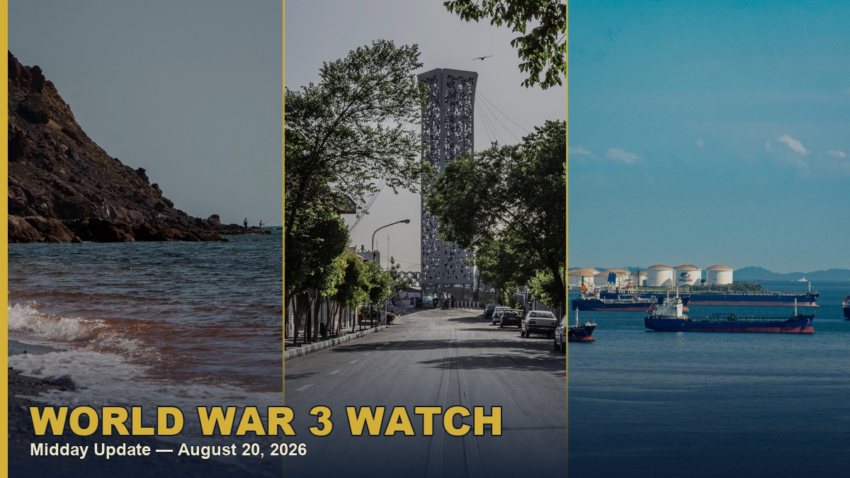
World War 3 Watch — Midday Update — August 20, 2026
- DoD has disclosed that more than 750 Americans have been injured in the conflict the U.S. began in late February (Plummer, 2026).
- Treasury Secretary Scott Bessent is preparing “the toughest sanctions in history” as a “one-two punch” with the naval blockade — and pressing China to cooperate (Firstpost, 2026; Reuters, 2026).
- China’s two state shipping giants, COSCO Shipping Energy and China Merchants, stopped routing tankers through Hormuz and Bab el-Mandeb in late July, switching to ship-to-ship transfers outside the Gulf (QQ News, 2026, authors’ translation).
- Kpler data show just six ships transited Hormuz on Aug. 18, versus a pre-war daily average of 24 (QQ News, 2026, authors’ translation).
- Iran and Oman say talks on a joint Hormuz transit mechanism are in their final stage — despite a reported Trump threat to bomb Oman (CNR, 2026, authors’ translation).
- U.S.-listed Star Bulk is delivering cargoes to Iran, a trade its industry press calls “completely legal” (TradeWinds, 2026).
Video: Big! Iran refuses to surrender, rejects Trump’s Economic D-day threat as POTUS’ diversion tactics. Source: ANI News.
The Story So Far
Washington is escalating its economic war on Iran just as the shooting war approaches six months. President Donald Trump warned Thursday that any country providing “any type of lifeline to Iran” will face economic consequences (Reuters, 2026).
Behind him stands Treasury Secretary Scott Bessent, promising “the toughest sanctions in history” as a complement to the naval blockade — “a one-two punch,” as he put it (Firstpost, 2026).
But the day’s other headlines tell a different war. The Pentagon confirmed more than 750 U.S. wounded (Plummer, 2026), while Chinese shipping giants quietly rerouted their tanker fleets around the blockaded strait (QQ News, 2026, authors’ translation).
And in the Gulf, Iran and Oman are close to a negotiated transit deal — one that reportedly has Trump threatening to bomb a longtime U.S. ally (CNR, 2026, authors’ translation).
Video: BREAKING: Trump announces “ECONOMIC D-DAY” against Iran, supporting allies | Sunrise. Source: The Hill.
1. Washington’s ‘Economic D-Day’
The video headline on NBC News sets the tone: “Trump warns Iran of ‘Economic D-Day’ as war nears 6 months” (NBC News, 2026).
The substance came from Bessent, who said the U.S. will impose “the toughest sanctions in history” on Iran and will outline details at a news conference Monday (Firstpost, 2026; Reuters, 2026).
He called it “a one-two punch” — the naval blockade already in place, plus unprecedented financial pressure (Firstpost, 2026).
Washington is warning allies and China alike to join the campaign to isolate Iran’s economy and “collapse” the government in Tehran (Firstpost, 2026).
The China pressure is pointed. Beijing buys more than 80% of Iran’s shipped oil, per 2025 Kpler data, and the U.S. “risks retaliation” if it escalates economic warfare against China (NBC News, 2026).
Bessent nonetheless urged Beijing to help reopen the Strait of Hormuz, arguing that economic pressure could “avert a wider military escalation” (Firstpost, 2026).
Tehran answered in kind. Iran’s foreign ministry called the sanctions “economic terrorism” and “crimes against humanity,” and said the “perpetrators and instigators” deserve trial and punishment (Firstpost, 2026).
Separate coverage confirms Iran has publicly dismissed the U.S. economic threats (Twincities, 2026).
2. China’s Quiet Bypass
The day’s most consequential shipping news is barely visible in Washington.
Reuters reported Aug. 18, citing industry executives, tanker-tracking agencies and ship brokers, that COSCO Shipping Energy and China Merchants stopped sending tankers through Hormuz and Bab el-Mandeb in late July (QQ News, 2026, authors’ translation).
The two state-owned giants control more than 100 VLCCs, each able to carry about two million barrels, and handled roughly half of China’s Middle East crude before the war (QQ News, 2026, authors’ translation).
Their solution is to bypass the strait entirely: supertankers wait in the Gulf of Oman near Fujairah and receive crude through ship-to-ship transfers (QQ News, 2026, authors’ translation).
The move was coordinated with Beijing — both companies made the decision after communicating with relevant central departments (QQ News, 2026, authors’ translation).
The numbers show how fast the switch happened. Gulf of Oman transfers involving Chinese and Hong Kong vessels exceeded 600,000 barrels per day in June and July, after near-zero activity in April and May (QQ News, 2026, authors’ translation).
Freight economics explain the pivot. Oman-to-China VLCC rates have climbed to about $140,000 per day, with daily ship profits near $110,000, versus $30,000-$40,000 before the war (QQ News, 2026, authors’ translation).
China also simply buys less — imports are down roughly 40%, from 11.6 million barrels per day before the war to about 7 million. June imports hit 29.27 million tonnes, down 41% year on year, the lowest since October 2016 (QQ News, 2026, authors’ translation).
The gap is being managed with strategic reserves and a surge in EV adoption. Chinese coverage sums up the strategy in one line: “buy less, switch routes, and make up the gap with reserves” (QQ News, 2026, authors’ translation).
“Iran blocks its strait; China goes its own way,” the QQ News analysis concludes (QQ News, 2026, authors’ translation).
3. The Human Toll
The war’s human accounting reached the U.S. public Thursday. More than 750 Americans have been injured in the conflict, the Department of Defense disclosed (Military.com, 2026).
Military.com’s report anchors the number to the war’s origin — “the conflict that the U.S. began in late February” (Plummer, 2026).
A photo caption in the same report places Trump and Defense Secretary Pete Hegseth with Iraq’s Prime Minister Ali al-Zaidi at the White House on July 14 — a sign of how wide the war’s diplomatic front has become (Plummer, 2026).
Reuters, in a report carried by NBC, supplies the context the toll implies: thousands have been killed, Gulf nations were quickly drawn in, and global markets were shocked by Iran’s ability to curb shipping (Reuters, 2026).
4. The Battle for the Strait
On the water, the blockade is real but contested.
Chinese coverage recounts the IRGC’s escalation: full control declared in March, a “management system” in May requiring documents and escort codes, the collapse of a temporary peace deal in June, and multiple tankers blocked or detained in July (QQ News, 2026, authors’ translation).
An IRGC commander put the stakes on live television: “Any ship that attempts to pass through the Strait of Hormuz will be destroyed; we will not allow a single drop of oil to flow out of this region” (QQ News, 2026, authors’ translation).
The traffic data contradict the boast. Kpler counted just six ships transiting Hormuz on Aug. 18, against a pre-war daily average of 24 (QQ News, 2026, authors’ translation).
Chinese state media draws the sharper conclusion. Continued attacks on ships, and oil flows far below pre-war levels, show that neither the U.S. nor Iran truly “fully controls” the strait (China National Radio, 2026, authors’ translation).
Even the blockade’s edges are porous. TradeWinds reports that U.S.-listed Star Bulk is delivering cargoes to Iran — and calls the trade “completely legal” (TradeWinds, 2026).
5. Tehran’s Diplomatic Counter-Move
While Washington escalates, Tehran is building an alternative lane. Iran said Thursday that negotiations with Oman on a joint mechanism for ship passage through the Strait of Hormuz are in their final stage, with a memorandum of understanding under discussion (CNR, 2026, authors’ translation).
The reported breakthrough has frustrated Trump. On Aug. 17 he threatened to bomb Oman — a Gulf ally — if it “obstructs” the U.S. reopening of the strait (CNR, 2026, authors’ translation).
The diplomatic track is broader than the headlines suggest. Iran’s foreign minister flew to Beijing in May to discuss Hormuz, and China’s response was restrained: “Only by achieving a comprehensive ceasefire as soon as possible can the necessary conditions be created to ease the tense situation in the strait” (QQ News, 2026, authors’ translation).
Note the asymmetry. Today’s English briefs treat Hormuz as a waterway Washington must force open, while Chinese coverage reports regional states negotiating a new transit order around it (CNR, 2026, authors’ translation; Firstpost, 2026).
6. Divergent Narratives: The Same War, Two Brains
Feed today’s English and Chinese sources side by side and you get two different wars from the same data.
English-language coverage leads with Washington’s coercion — the “toughest sanctions in history,” the “one-two punch,” a headline demand that China “get with the programme,” and the newly disclosed U.S. wounded tally (Firstpost, 2026; Plummer, 2026; Reuters, 2026).
Chinese coverage starts from the same raw material — Kpler’s vessel counts, import volumes, freight rates — and builds a story of Chinese autonomy and Iranian miscalculation. The QQ News analysis concludes Tehran’s move produced “not a strategic victory” but “strategic self-harm” (QQ News, 2026, authors’ translation).
Even the headline style signals the gap. QQ News frames the IRGC’s “total blockade” as a punch that landed “on cotton” — a blow that hits nothing (QQ News, 2026, authors’ translation).
Neither side invents the facts — both cite Kpler — but each chooses which facts matter. That pattern is exactly what our narrative-comparison report on how US, Israeli, Iranian, and BRICS media each tell this war maps in detail.
Is This Actually World War 3?
Today’s sources describe a big war, but not yet the third world war. The conflict Washington began alongside Israel is nearly six months old, has killed thousands, pulled in Gulf nations and shocked global markets (Reuters, 2026).
The great-power ingredient is what makes the label tempting. Kpler data show China buying more than 80% of Iran’s shipped oil, Trump has threatened “economic consequences” for any country offering Iran a lifeline, and NBC flags the risk of retaliation if Washington escalates economic warfare with Beijing (NBC News, 2026).
Yet Beijing’s response is economic, not military: rerouted tankers, ship-to-ship transfers, reserves and EV substitution (QQ News, 2026, authors’ translation). The administration’s own argument is that the sanctions campaign exists to “avert a wider military escalation” (Firstpost, 2026).
The honest label is a regional war with an unresolved great-power economic front — one that could still widen if the pressure campaign hits China’s remaining imports the way the blockade already has (NBC News, 2026; QQ News, 2026, authors’ translation).
What You Can Do Right Now
- Hormuz transits have collapsed from 24 ships a day to six, and international oil prices have at times risen more than 60% — supply-chain shocks remain a live risk (QQ News, 2026, authors’ translation). Review our survival skills and preparedness guide and stress-test your fuel, food and cash buffers.
- Watch Monday’s news conference. Bessent will detail the “toughest sanctions in history,” so expect immediate price and diplomatic moves within days (Firstpost, 2026).
- Don’t read one press culture. Today’s English and Chinese sources share data but tell opposite stories; our narrative-comparison report shows how to read across them.
SUPPORT KEMETIC MINDS
Enjoying this coverage? Back the work and find every way to connect with us in one place.
Support the Page →Kemetic Minds Analysis
This roundup pulled directly from the day’s English- and Chinese-language wires side by side, because the gap between what each side chooses to report is often as informative as any single strike count. Treat the Key Takeaways above as the verified factual floor, and the framing differences noted in the sections above as the more interesting, harder-to-fake signal about where this war is actually headed next.
References
- Tradewindsnews. (2026, August 20). US-listed Star Bulk is delivering cargoes to Iran, and it’s completely legal. tradewindsnews.com
- Twincities. (2026, August 20). Iran dismisses US economic threats and other developments in the Middle East. twincities.com
- NBC News. (2026, August 20). Trump warns of economic consequences for any country that supports Iran. nbcnews.com
- Military. (2026, August 20). Department of Defense Reveals Number of Americans Wounded in Iran War. military.com
- Firstpost. (2026, August 20). US threatens ‘toughest sanctions in history’ on Iran, urges China to ‘get with the programme’. firstpost.com
- MSN. (2026, August 20). Bessent says US will impose toughest ever sanctions on Iran, urges China to cooperate. msn.com
- 央广网. (2026, August 20). 伊朗与阿曼就霍尔木兹海峡船舶通行机制谈判接近尾声 [Iran, Oman Near End of Talks on Hormuz Passage Mechanism]. cnr.cn
- QQ News. (2026, August 19). 伊朗封锁霍尔木兹,中国油轮掉头就走,革命卫队这一拳打在了棉花上 [Iran Blocks Hormuz, Chinese Tankers Turn Back — Revolutionary Guard's Move Falls Flat.]. news.qq.com
Investigative Methodology: This roundup is generated on a fixed schedule (noon and evening, America/Chicago) from live English- and Chinese-language wire sources. Every claim is grounded in fetched source text with an APA7 in-text citation; translated Chinese-language quotes are marked “authors’ translation.” Every video embed is verified to be a real, existing video via YouTube’s oEmbed endpoint before publication — none are written by the drafting model. No Wikipedia sources are used.
Stay Connected

Kemetic Minds Editorial Desk
Verified NewsroomPrimary-sourced investigative intelligence on civil rights, voting rights, federal policy, and consumer protection. Sourced from primary legal filings, government statistics, and direct field reporting.