KEMETIC MINDS
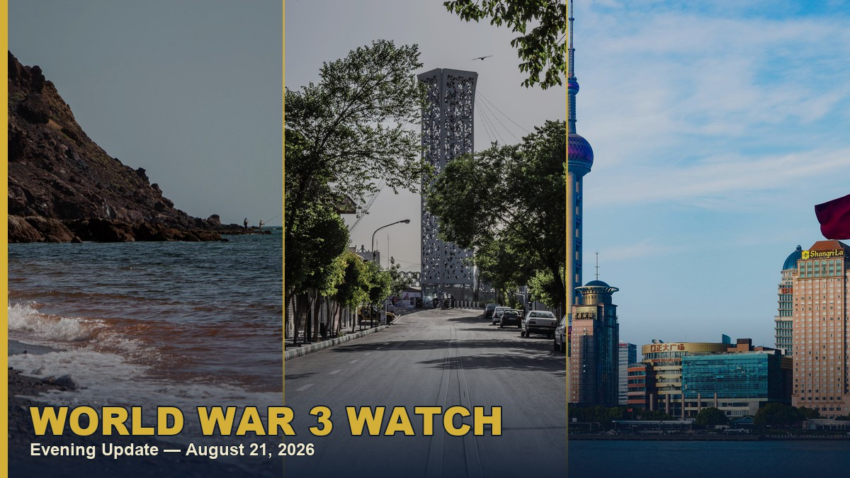
World War 3 Watch — Evening Update — August 21, 2026
- CENTCOM has redirected 68 commercial vessels and boarded two more in the Hormuz blockade, supported by more than 20 US warships (Times Now News, 2026).
- Iran’s navy claims “complete control” over the sea approaches to Hormuz and vows “a major, historic, unforgettable lesson” at sea (Sina News, 2026, authors’ translation).
- Trump’s “economic D-Day” hit Wall Street first: US stocks posted their worst three-week losses as national debt crossed $40 trillion (Al Jazeera, 2026b).
- China refused to join the sanctions campaign, opposing “illegal unilateral sanctions,” even as its Iranian crude imports fell to about 534,000 barrels per day (Wallstreetcn, 2026, authors’ translation; VOA Chinese, 2026, authors’ translation).
- The last US carrier in Asia, USS George Washington, has left for the Gulf, eroding “the overall effectiveness of the US-led regional deterrence against China” (Al Jazeera, 2026c).
- Regional fronts multiplied: Houthi drones hit Saudi Aramco, the UAE reported Iranian missiles, and 12 Arab/Islamic states condemned Israeli strikes on Syria (Times of India, 2026; Times Now News, 2026).
The Story So Far
The Strait of Hormuz remains the center of gravity. Washington insists the waterway is “open and operating” while its warships turn back commercial traffic; Tehran insists it will not fully reopen until its conditions are met (Times of India, 2026).
In parallel, the economic war escalated — Trump promised “economic warfare and isolation on an unprecedented scale,” and the first casualty was Wall Street, with stocks posting their worst losses in three weeks and US debt crossing $40 trillion (Al Jazeera, 2026b).
Beijing refused to join the pressure campaign even as China’s Iranian oil imports halved, and the last US aircraft carrier left Asian waters for the Gulf (VOA Chinese, 2026, authors’ translation; Al Jazeera, 2026c).
Tonight’s briefings trace how the Gulf war, the sanctions war and the Pacific deterrence gap are tightening into a single conflict system — and who is already paying the price.
Video: Trump's new strategy, claiming Hormuz for US & more | Military experts on Iran. Source: CNN.
1. Hormuz: ‘American Territory’ vs ‘Complete Control’
Trump now describes the Strait of Hormuz as “American territory,” telling reporters at Andrews Joint Base in Maryland that Washington holds “complete control over the entire region around the Strait of Hormuz, including its hinterland and land areas” (Times Now News, 2026; Sina News, 2026, authors’ translation). Iran “very much wants a deal” but is “not yet ready for the right deal,” he added, asserting that US forces have removed mines and other vessels are free to pass (Times of India, 2026; Sina News, 2026, authors’ translation).
On the water, the blockade is tightening daily. CENTCOM reported on August 21 that its forces have redirected 68 commercial vessels, disabled three and boarded two, with more than 20 warships supporting the operation — up sharply from the 48 redirections recorded earlier in August (Times Now News, 2026).
Iran answered with a rival claim of maritime dominance. Navy Commander Shahram Irani said the sea approaches to Hormuz and the Gulf of Oman are under Tehran’s “complete control,” monitored around the clock, and that Iran will soon deliver “a major, historic, unforgettable lesson” to its enemies at sea (Sina News, 2026, authors’ translation).
The standoff is squeezing Oman, which has been negotiating shipping-management mechanisms with Tehran while US officials object to parts of the emerging arrangement (Times of India, 2026). Regional officials said Trump threatened to bomb Oman if it “gets in the way” of US objectives (Times of India, 2026).
The costs are already visible in shipping data: Kpler recorded a significant decline in confirmed Hormuz crossings, and a projectile damaged the engine room of a vessel near Oman, causing a crew casualty, according to the UK Maritime Trade Operations centre (Times of India, 2026).
Tehran’s senior figures dismiss Trump’s claims outright. Deputy Foreign Minister Kazem Gharibabadi mocked the “American territory” depiction, and Supreme National Security Council chief Mohsen Rezaei called Washington’s claim of control “far removed from reality” (Times of India, 2026).
Video: US NEWS Live: Donald Trump Announces Nuke Action Against Iran? | Iran War | Nuclear War. Source: MIRROR NOW.
2. ‘Economic D-Day’ Hits Wall Street First
Trump escalated the economic front Wednesday with a Truth Social post promising “economic warfare and isolation on an unprecedented scale” and warning that any country providing “any type of lifeline” to Iran would face “TREMENDOUS Economic Consequences” (Al Jazeera’s markets breakdown, 2026b).
Treasury Secretary Scott Bessent said the administration would apply a “combination punch”: “We have implemented the blockade, and will implement the most severe sanctions in history,” adding, “We will crush this regime” (VOA Chinese, 2026, authors’ translation). He called the coming campaign “the largest, most coordinated economic isolation in history” and scheduled a Monday press conference to unveil the measures (Wallstreetcn, 2026, authors’ translation; VOA Chinese, 2026, authors’ translation).
Trump insists the pivot to economics does not mean military options are constrained; asked directly, he said it “just means we are watching how things develop” (Sina News, 2026, authors’ translation).
The first casualty, though, was American. US stocks posted their worst losses in three weeks, crude rose to $86.70 a barrel from $86.20, and total US debt surpassed a record $40 trillion this week (Al Jazeera, 2026b). Roughly 20 percent of global oil and natural gas supplies moved through Hormuz before the war — the closure now feeds the price pain (Al Jazeera, 2026b).
Iran answered with layered defiance. Foreign Minister Abbas Araghchi called the threats “doomed to fail,” arguing the sanctions menace the global economy (Al Jazeera, 2026a). He ticked through 14 years of “harshest sanctions,” eight years of “maximum pressure” and five months of “unconditional surrender” demands — all failed — and wrote: “We have seen this script before, the same lies, just a different group of bullies” (Wallstreetcn, 2026, authors’ translation).
President Masoud Pezeshkian struck a more conciliatory note: “It is better that we bring the war to an end now as we are in a position of power and dignity” (The Independent, 2026). Chinese coverage of the same remarks stresses that Tehran seeks to end the war “endowed with both strength and dignity” — a negotiation from strength, not capitulation (Wallstreetcn, 2026, authors’ translation).
Vice President JD Vance called the campaign a “subtle game,” acknowledging that as Washington pressures Tehran, Tehran will pressure back — though “the past few weeks have shown that the pressure they feel is far greater than ours” (Sina News, 2026, authors’ translation). Iran’s Parliament Speaker Qalibaf, visiting Baghdad, framed the pivot as a forced choice: the US and Israel realize they cannot defeat Iran and Iraq militarily, so they have turned to cognitive and economic warfare (Sina News, 2026, authors’ translation).
The UAE has already picked a side, suspending all trade, commercial dealings and financial transactions with Iran (Sina News, 2026, authors’ translation). Chinese-language analysis notes that the move strikes Iran’s most important trade partner and re-export lifeline, but argues Washington cannot fully close off Iran’s trade — money will detour through informal and underground channels (Sina News, 2026, authors’ translation).
Video: LIVE: Strait of Hormuz vessel traffic as US threatens 'toughest sanctions'. Source: Reuters.
3. China Draws the Line on Sanctions
Beijing delivered the day’s clearest rebuff. Foreign Ministry spokesman Lin Jian reiterated that China opposes “illegal unilateral sanctions” without a basis in international law or UN Security Council authorization, and that “military means and sanctions pressure do not help solve problems — they only aggravate tensions and escalate the situation” (Wallstreetcn, 2026, authors’ translation).
The rebuff lands directly on Bessent’s request. He has publicly urged China to cooperate, noting that “China gets 50 percent of its energy from the Gulf region,” so joining would be “of great benefit to themselves” (VOA Chinese’s detailed account, 2026, authors’ translation).
The pressure is already visible in the numbers. Kpler estimates China’s Iranian crude imports have fallen from about 1.4 million barrels per day in 2025 to roughly 534,000 bpd in August (VOA Chinese, 2026, authors’ translation). China’s July imports from Malaysia — a key transshipment route for Iranian oil — dropped about 65 percent year on year, and some Iranian cargoes have flipped to a premium of about $2 over Brent (VOA Chinese, 2026, authors’ translation).
The US Treasury says Hengli Petrochemical’s Dalian refinery has received Iranian crude from sanctioned tankers since 2023, with some transactions channeling hundreds of millions of dollars to a sales network controlled by Iran’s military (VOA Chinese, 2026, authors’ translation). China’s Commerce Ministry answered in May with a blocking order prohibiting Chinese entities from recognizing, executing or complying with US sanctions on five Chinese refiners (VOA Chinese, 2026, authors’ translation).
The next escalation could target banks rather than tankers. Columbia University’s Erica Downs argues that many refiners and shadow-fleet vessels “may not care about losing access to the dollar financial system,” but they depend on banks that do — and Washington has already warned two unnamed Chinese banks about potential secondary sanctions (VOA Chinese, 2026, authors’ translation). Beijing holds counter-leverage: it has shown it can restrict rare-earth exports to impose costs on Washington (VOA Chinese, 2026, authors’ translation).
The coverage gap is revealing. English-language accounts this week note only that China “does not support” additional sanctions on Iran (Al Jazeera, 2026a), while Chinese-language outlets report the full texture of the standoff — the blocking order, the bank warnings, the import collapse (VOA Chinese, 2026, authors’ translation). Phoenix News frames Iran as planning a counterattack aimed precisely at Trump’s “soft spot,” a storyline entirely absent from the English sources reviewed here (Ifeng News, 2026, authors’ translation).
4. The Pacific Pays the Price
The war’s longest shadow is falling on the Pacific. The USS George Washington — the last US aircraft carrier in Asia — has been moved from Japan to the Middle East to relieve the USS Abraham Lincoln (Al Jazeera’s report on US allies in Asia, 2026c). Lincoln has been deployed for nine months and, per multiple reports, endured food shortages, broken toilets and showers, and at least one sailor who tried to jump overboard (Al Jazeera, 2026c).
The carrier gap compounds earlier drains on Asian deterrence. Parts of the THAAD system were moved from South Korea for use against Iran, and US missile and munitions stockpiles have been drawn down to sustain the war (Al Jazeera, 2026c).
Viewed as part of a larger trend, the deployment “certainly is creating an impact on the overall effectiveness of the US-led regional deterrence against China,” said William Yang of the International Crisis Group (Al Jazeera, 2026c).
The timing is uncomfortable: “the Chinese fleet has increasingly ventured beyond the First Island Chain” — the arc running from north of Japan through Taiwan and the northern Philippines to Borneo — just as the American carrier presence empties out (Al Jazeera, 2026c).
Chinese-language sources in this evening’s set say nothing about the carrier movement or the THAAD drawdown; their focus is Bessent’s rebuff, not the Pacific balance of power. Each side’s press is telling its audience the war it wants them to see.
The Pentagon is already weighing the aftermath. Officials told The Washington Post that US military presence in the Middle East could be reduced after the war, with around 50,000 troops and roughly 20 bases in the region — though no formal review has been ordered by Defense Secretary Pete Hegseth (The Independent, 2026).
5. A Wider Regional War
Around the region’s edges, the conflict keeps adding fronts. Iran-backed Houthi rebels claimed a drone attack on a Saudi Aramco oil facility, and the UAE reported two ballistic missiles launched from Iran toward its territory — a claim Tehran denied (Times of India, 2026). Fresh violence in Gaza is widening the fallout, according to one evening live blog (Times Now News, 2026).
Israel’s strikes are provoking collective Arab and Islamic condemnation. Foreign ministers from 12 countries, including Saudi Arabia, Qatar, Türkiye and Pakistan, called the Israeli attack on Syria’s Abu al-Duhur airbase a “dangerous escalation” and a violation of Syrian sovereignty (Times Now News, 2026).
The war’s cost to Washington is mounting too. More than 750 US military personnel have been injured since the war began, with 18 killed, and more than 50 names were added to the Pentagon’s casualty database on Wednesday (The Independent, 2026). At home, two men and a teenage boy admitted an arson attack on the UK office of a Persian media company (The Independent, 2026).
None of these regional threads appears in the Chinese-language sources reviewed for this edition — no Houthis, no UAE missiles, no Syrian airbase, no US casualties. Beijing’s media ecosystem is narrating a sanctions-and-diplomacy war; the English-language ecosystem is narrating an expanding battlefield.
Egypt, meanwhile, has suggested that an Iran-Oman agreement could create conditions for Washington and Tehran to return to negotiations — the one diplomatic off-ramp visible in today’s record (Times of India, 2026).
Is This Actually World War 3?
By the evidence of tonight’s sources, not yet — but the boundaries between the wars are dissolving. The US-Iran war is real and hot, dragging into its sixth month since late February, with 18 US dead and more than 750 injured (The Independent, 2026; Al Jazeera, 2026c).
The structural risk is in the China dimension. Washington is funding the Gulf war by draining the Pacific’s deterrence tools — the last carrier, the THAAD battery, the munitions stockpiles — at the moment Beijing’s fleet pushes beyond the First Island Chain (Al Jazeera, 2026c). China is not sending warships to the Gulf; it is waging economic war by other means, refusing sanctions cooperation, blocking US enforcement at home and holding rare-earth restrictions in reserve (Wallstreetcn, 2026, authors’ translation; VOA Chinese, 2026, authors’ translation).
Even the war’s name is contested. Al Jazeera labels it the “US-Israel war on Iran”; US outlets call it the “Iran war”; Tehran’s officials call it America’s latest failed project (Al Jazeera, 2026c; Sina News, 2026, authors’ translation). Those frames decide what each audience is allowed to see — which is why we built our narrative-comparison report on how US, Israeli, Iranian, and BRICS media each tell this war.
The Taiwan flashpoint stays a background condition in tonight’s record, not a headline. But the pattern is the warning: if the Gulf war spends down the Pacific deterrent, the next flashpoint may not wait for this one to end.
What You Can Do Right Now
- Check your exposure to energy-price shocks — fuel, food, variable-rate contracts — because the Hormuz closure is already moving US markets and crude prices (Al Jazeera, 2026b).
- Work through our survival skills and preparedness guide while there is still time and shelf space; a hot Gulf war plus a thinning Pacific deterrent is not the moment to improvise.
- Read our narrative-comparison report on how US, Israeli, Iranian, and BRICS media each tell this war — the frame you consume determines the threat you prepare for.
SUPPORT KEMETIC MINDS
Enjoying this coverage? Back the work and find every way to connect with us in one place.
Support the Page →Kemetic Minds Analysis
This roundup pulled directly from the day’s English- and Chinese-language wires side by side, because the gap between what each side chooses to report is often as informative as any single strike count. Treat the Key Takeaways above as the verified factual floor, and the framing differences noted in the sections above as the more interesting, harder-to-fake signal about where this war is actually headed next.
References
- Timesnownews. (2026, August 21). US-Iran War Live Updates: Trump Says He Views Strait of Hormuz As ‘American Territory’. timesnownews.com
- Times of India. (2026, August 21). US Iran War News Live Updates: US Iran War: Trump says Iran wants deal but is not ready for ‘right deal’. timesofindia.indiatimes.com
- Al Jazeera. (2026, August 21). Iran war live: Iran, Oman discuss Hormuz; Tehran dismisses Trump’s threats. aljazeera.com
- The Independent. (2026, August 21). Iran war live: Tehran president says it is time to end war ‘in position of strength’. independent.co.uk
- Al Jazeera. (2026, August 21). Trump’s ‘economic D-Day’ claims first victim: Not Iran, but US markets. aljazeera.com
- Al Jazeera. (2026, August 21). US allies in Asia wary as Trump moves military assets for Iran war. aljazeera.com
- 华尔街见闻. (2026, August 21). 伊朗回应美国经济战威胁:美方“注定失败”,中国表态:反对非法单边制裁 [Iran Responds to US Economic War Threats: Washington 'Doomed to Fail'; China Opposes Illegal Unilateral Sanctions]. wallstreetcn.com
- 新浪新闻_手机新浪网. (2026, August 21). 伊朗称美经济战“注定失败” 特朗普否认军事选项受限 [Iran says US economic war 'doomed to fail' as Trump denies military options are limited.]. news.sina.com.cn
- 凤凰网. (2026, August 21). 凤凰女记者:伊朗谋划反攻,精准打击特朗普“软肋” [Phoenix Female Reporter: Iran Plots Counterattack Targeting Trump's Weak Spot]. news.ifeng.com
- 美国之音. (2026, August 21). 贝森特促中国配合对伊施压 华盛顿是否会二级制裁中国金融机构引关注 [Bessent urges China to cooperate on pressuring Iran as Washington's potential secondary sanctions on Chinese financial institutions draw scrutiny.]. voachinese.com
Investigative Methodology: This roundup is generated on a fixed schedule (noon and evening, America/Chicago) from live English- and Chinese-language wire sources. Every claim is grounded in fetched source text with an APA7 in-text citation; translated Chinese-language quotes are marked “authors’ translation.” Every video embed is verified to be a real, existing video via YouTube’s oEmbed endpoint before publication — none are written by the drafting model. No Wikipedia sources are used.
Stay Connected

Kemetic Minds Editorial Desk
Verified NewsroomPrimary-sourced investigative intelligence on civil rights, voting rights, federal policy, and consumer protection. Sourced from primary legal filings, government statistics, and direct field reporting.