KEMETIC MINDS
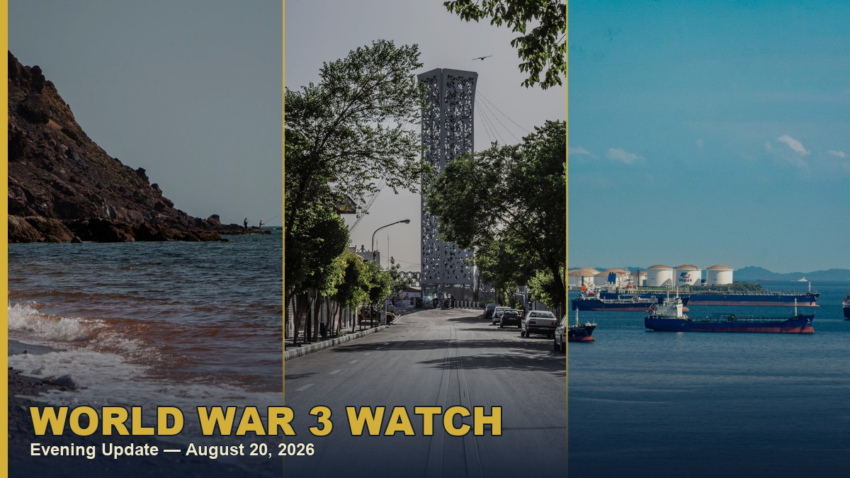
World War 3 Watch — Evening Update — August 20, 2026
- Trump declared “economic D-Day” on Iran, promising “the most crushing economic operation ever taken against any country” and threatening secondary sanctions on anyone who trades with Tehran (Yahoo, 2026).
- U.S. forces have assisted about 1,300 commercial vessels carrying 660 million barrels of crude through the Strait of Hormuz since early May, CENTCOM says (VOA Chinese, 2026, authors’ translation).
- Iran’s foreign minister dismissed the pressure as a “doubling down on failed policies” that “will only bring further defeat” (CBS News, 2026; Daily News, 2026).
- The U.S. Treasury sanctioned ten people tied to a cash-smuggling network feeding Hezbollah, including Turkish courier manager Yunus Alper Yilmazs (CBS News, 2026).
- Analysts read the economic offensive as “clearly targeting China,” now Iran’s largest trading partner after the UAE severed financial ties (Wenxuecity, 2026, authors’ translation).
- U.S. officials say the southern Hormuz route is under American control, moving about 10 million barrels a day — roughly half of pre-war volume (QQ News, 2026, authors’ translation).
The Story So Far
The war the United States and Israel began against Iran at the end of February has outlasted its own ceasefire and shifted its center of gravity from the battlefield to the balance sheet (Yahoo, 2026). The 60-day truce expired Monday with no diplomatic settlement, and President Trump has answered the stalemate by declaring “economic D-Day” (Yahoo, 2026).
On Wednesday evening, Trump promised “Economic Warfare and Isolation on an unprecedented scale” and warned that any country providing a “lifeline” to Iran would face “TREMENDOUS Economic Consequences” (Yahoo, 2026; Daily News, 2026).
Tehran rejected the ultimatum. Foreign Minister Abbas Araghchi called it a “doubling down on failed policies” that “will only bring further defeat” (CBS News, 2026; Daily News, 2026).
Yet even as both sides trade threats, the oil keeps moving. CENTCOM says U.S. forces have assisted about 1,300 vessels carrying 660 million barrels of crude through the Strait of Hormuz since May (VOA Chinese, 2026, authors’ translation) — and Chinese-language reporting details the military machinery quietly keeping that waterway open (QQ News, 2026, authors’ translation).
Video: This is Just The Start of Bitcoin's Breakout! | Arthur Hayes. Source: Crypto Insider.
1. Hormuz Keeps Flowing: The Blockade’s Other Side
English-language headlines framed Thursday around Iran’s insistence that Trump’s “economic D-Day” will fail and that Strait of Hormuz shipping traffic remains unchanged (Fox News, 2026). Chinese-language outlets told a more operational story, citing U.S. officials via Axios: a U.S.-run corridor quietly keeping the oil flowing (QQ News, 2026, authors’ translation).
CENTCOM told VOA that since early May, American forces have assisted about 1,300 commercial vessels carrying 660 million barrels of crude through the strait (VOA Chinese, 2026, authors’ translation). Spokesman Capt. Tim Hawkins said “multiple routes remain free and open for commercial transportation,” with mine-clearing still underway to widen the channel (VOA Chinese, 2026, authors’ translation).
Reporting out of the U.S. describes a secret shipping lane running along Oman’s coast, used by 15 to 20 tankers a day (QQ News, 2026, authors’ translation). Current flows are about 10 million barrels daily, roughly half the pre-war level, and the U.S. is also escorting empty tankers into the Gulf to load at UAE, Bahraini, and Kuwaiti ports (QQ News, 2026, authors’ translation).
“For two months, we have been controlling the southern route of the Strait of Hormuz,” a U.S. military official told Axios (QQ News, 2026, authors’ translation). “The Iranian Revolutionary Guard can make trouble, but control of the strait is not in their hands — it’s in ours” (QQ News, 2026, authors’ translation).
The operation is coordinated from the 82nd Airborne Division headquarters at Fort Bragg, with nightly convoy windows, multiple checkpoints, and Air Force fighters overhead intercepting Iranian drones and cruise missiles (QQ News, 2026, authors’ translation). CENTCOM itself declined to comment on the secret-lane reports (VOA Chinese, 2026, authors’ translation).
Trump, for his part, declared Wednesday that “large amounts of oil are continuously flowing out of the Strait of Hormuz” (QQ News, 2026, authors’ translation).
Video: Morning News NOW Full Episode – Aug. 20. Source: NBC News.
2. ‘Economic D-Day’: What Trump Announced
Trump’s Wednesday posts were sweeping but light on specifics (Yahoo, 2026; Daily News, 2026). He called the campaign “the most crushing economic operation ever taken against any country” and listed the targets: “Oil smuggling, swap lines, cash transfers, exchange houses, ship registries, front companies — it all needs to stop NOW. You know who you are” (Yahoo, 2026).
The threat reaches far beyond Iran. “ANY country that allows its financial institutions, businesses, airports, or government entities to provide any type of lifeline to Iran will itself face TREMENDOUS Economic Consequences,” Trump wrote (Yahoo, 2026). He also said the U.S. could return to talks “at some point,” but that the “situation is so good” he did not need to now (CBS News, 2026).
Bessent doubled down with a CNBC promise of “the greatest coordinated economic isolation in the history of the world” and a demand that allies choose a side (Daily News, 2026). Via VOA Chinese, he warned that anyone still transferring funds, buying Iranian oil, or carrying out ship-to-ship transfers will face the full force of the U.S. Treasury (VOA Chinese, 2026, authors’ translation).
“We will dismantle this regime,” he said, arguing the blockade-plus-sanctions combination will leave Iran unable to fund its military and proxies (VOA Chinese, 2026, authors’ translation). He will detail the package at a Monday press conference (VOA Chinese, 2026, authors’ translation).
Vice President JD Vance described the shift as a “new phase where the most effective tool that we have is the economic pressure that we can apply to them” (CBS News, 2026). He called it a “delicate dance” — “We apply economic pressure to them, they’re going to try to apply economic pressure to us” — but said “they felt a lot more pressure than we have” (CBS News, 2026).
Trump is also under home-front pressure: with midterms approaching in November, he faces scrutiny over what the war is costing American consumers (Yahoo, 2026).
The first ally has already moved. The UAE said it is severing all financial and economic ties with Iran, a day after detecting two Iranian ballistic missiles targeting maritime traffic, both of which landed in the sea (Yahoo, 2026). Araghchi countered that U.S. “economic terrorism threatens the global economy and the national sovereignty of countries around the world” (Daily News, 2026) — and Chinese-language coverage of the same remarks stressed that the new measures “continue the same policies” and will deepen Iranian resentment (VOA Chinese, 2026, authors’ translation).
3. China in the Crosshairs
Trump never named China in his posts, but analysts read the economic war as aimed squarely at Beijing (Wenxuecity, 2026, authors’ translation). “This is one of the ways the U.S. opens a new front or expands the economic war battlefield,” Georgetown University in Qatar professor Paul Musgrave said — “and it is clearly targeting China” (Wenxuecity, 2026, authors’ translation).
The trade numbers explain the analytical focus. After the UAE suspended trade and financial ties on August 18, China became Iran’s largest trading partner (Wenxuecity, 2026, authors’ translation).
Al Jazeera data cited by Chinese media put China at 26 percent of Iran’s imports, about $17.8 billion, with Iran supplying China mineral fuels, oil, organic chemicals, and plastics in return (Wenxuecity, 2026, authors’ translation).
World Bank figures in the same analysis show Iranian exports to China of $22.4 billion in 2022 and imports of $15.6 billion (Wenxuecity, 2026, authors’ translation). English-language coverage made the same point in one sentence — China and India are major buyers of Iranian oil, though Bessent did not name them (Daily News, 2026).
By 2024, China led Iran’s export destinations at $14.6 billion, ahead of Iraq, the UAE, Turkey, and Afghanistan; on the import side, the UAE led at $21 billion, followed by China and Turkey (Wenxuecity, 2026, authors’ translation).
The exposure reaches well past Beijing. Germany exported $1.1 billion to Iran last year and imported $275 million, while India traded $1.1 billion with Iran between April and December 2025, exporting basmati rice, tea, sugar, fresh fruit, and pharmaceuticals (Wenxuecity, 2026, authors’ translation). In 2022, Iran exported goods to 147 countries and imported from 114 — which is why secondary sanctions would ripple widely (Wenxuecity, 2026, authors’ translation).
Even so, Musgrave credited Beijing with restraint. If Trump really launches tough secondary sanctions against China, “the economic standoff is likely to keep expanding,” he warned — while doubting Trump will risk wrecking the U.S.-China economic relationship (Wenxuecity, 2026, authors’ translation).
Beijing’s public line, reported by VOA Chinese, is that pressure will not help solve the problem (VOA Chinese, 2026, authors’ translation).
4. Hezbollah Cash Network Hit
While Washington squeezes Tehran’s state finances, it is also cutting the cash lines to its proxies. The Treasury Department sanctioned ten people smuggling millions of dollars to the Iran-backed Hezbollah militia in Lebanon (CBS News, 2026), and CNN’s coverage of the day led with exactly that pairing of ramped-up economic pressure and new Hezbollah sanctions (CNN, 2026).
The network was previously run by Iranian Gen. Behnam Shahriyari, killed in an Israeli airstrike in western Iran in June (CBS News, 2026). Among those now sanctioned is Turkish businessman Yunus Alper Yilmazs, described by Treasury as the manager of the courier network (CBS News, 2026).
Here the coverage split along language lines. The Hezbollah sanctions anchored English-language updates (CBS News, 2026; CNN, 2026) but were absent from all three Chinese-language reports in this roundup, which stayed on Hormuz oil flows and China’s exposure (QQ News, 2026, authors’ translation; VOA Chinese, 2026, authors’ translation; Wenxuecity, 2026, authors’ translation).
5. The Military Backdrop: Drones, Missiles, and Carriers
The economic offensive overlays a military campaign that has not stopped (MSN, 2026; CBS News, 2026). CENTCOM forces enforcing the blockade have redirected 67 commercial vessels, disabled 3, and boarded 2 in the Arabian Sea (MSN, 2026).
Chinese-language reporting describes a U.S. military that believes it has the upper hand. A two-week CENTCOM strike, per the reports, crippled Iran’s radar and maritime surveillance, leaving Tehran essentially “half-blind” and able to fire drones and cruise missiles mainly at likely transit zones — most of which U.S. forces intercept (QQ News, 2026, authors’ translation).
Monday night alone, American forces shot down eight Iranian drones and two cruise missiles (QQ News, 2026, authors’ translation).
The Navy is rotating its carriers, too. The USS George Washington arrived in the Middle East on Wednesday to replace the USS Abraham Lincoln, whose crew drew family concern over deteriorating mental health after a nearly nine-month deployment (CBS News, 2026).
Trump framed the battlefield as already leaning his way, saying Iran is “purely wasting time” in negotiations and that “negotiating with them is a waste of effort” (QQ News, 2026, authors’ translation). He added that Iran “still has some combat capability, but its overall strength is far less than before” (QQ News, 2026, authors’ translation).
6. Gaza and Israel’s Other Fronts
Beyond the Iran theater, the wider Middle East kept generating news Thursday. Six European nations condemned Israel over a settlement project, and Doctors Without Borders criticized the Israeli military for declining to open a criminal investigation into two strikes that killed four of the aid group’s staff (Daily News, 2026).
MSF said the decision shows Israel “won’t take responsibility for attacking civilians” and is now calling for an impartial investigation (Daily News, 2026). In Gaza City, a mass funeral was held for 50 people killed in Israeli airstrikes nearly three years ago, whose remains were only just recovered (Daily News, 2026).
None of the Chinese-language reports in this roundup touched the Israel-Gaza thread; their coverage stayed on the Strait and on Beijing (QQ News, 2026, authors’ translation; VOA Chinese, 2026, authors’ translation; Wenxuecity, 2026, authors’ translation).
Is This Actually World War 3?
The honest read of today’s sources: a widening economic war layered on a contained military one, with a great-power standoff that has not yet turned hot. The U.S. is enforcing a naval blockade against Iran (MSN, 2026) while simultaneously running a military escort operation to keep Hormuz oil moving (VOA Chinese, 2026, authors’ translation; QQ News, 2026, authors’ translation).
The closest thing to a great-power clash today is economic. Trump’s secondary-sanctions threat reaches every country doing business with Iran, and China — now Iran’s largest trading partner — is the most exposed (Wenxuecity, 2026, authors’ translation). Yet Beijing is responding with restraint, and analysts doubt Washington will risk severing the U.S.-China economic relationship (Wenxuecity, 2026, authors’ translation).
What today’s sources actually show is three overlapping conflicts: the U.S.-Iran war, an Israel-centered front running from Gaza to Hezbollah, and a U.S.-China economic cold war fought through oil and secondary sanctions (CBS News, 2026; Daily News, 2026; Wenxuecity, 2026, authors’ translation). No source in this roundup reports direct U.S.-China combat — which is precisely why the question mark stays in the series title.
It is also why we keep mapping how each side narrates the same overlapping war, in our narrative-comparison report on how US, Israeli, Iranian, and BRICS media each tell this war.
What You Can Do Right Now
- Track the enforcement targets, not just the rhetoric: Trump’s list — “oil smuggling, swap lines, cash transfers, exchange houses, ship registries, front companies” — is an early map of where secondary sanctions will bite, especially for businesses touching Gulf trade finance (Yahoo, 2026).
- Budget for energy volatility: Iran has been able to constrain Hormuz traffic since the war began, and restored flows remain roughly half of pre-war volume, so fuel prices are likely to keep swinging (Yahoo, 2026; QQ News, 2026, authors’ translation). Our survival skills and preparedness guide covers the basics of weathering exactly this kind of supply shock.
- Read across media ecosystems before you form conclusions: today’s English-language sources led with policy and sanctions, while Chinese-language sources led with oil flows and China’s exposure. Start with our narrative-comparison report on how US, Israeli, Iranian, and BRICS media each tell this war.
SUPPORT KEMETIC MINDS
Enjoying this coverage? Back the work and find every way to connect with us in one place.
Support the Page →Kemetic Minds Analysis
This roundup pulled directly from the day’s English- and Chinese-language wires side by side, because the gap between what each side chooses to report is often as informative as any single strike count. Treat the Key Takeaways above as the verified factual floor, and the framing differences noted in the sections above as the more interesting, harder-to-fake signal about where this war is actually headed next.
References
- Fox News. (2026, August 20). Iran says Trump’s ‘economic D-Day’ will fail as Strait of Hormuz shipping traffic remains unchanged. foxnews.com
- MSN. (2026, August 20). US enforces Iran blockade, redirects 67 commercial vessels: CENTCOM. msn.com
- CNN. (2026, August 20). US signals ramped up economic pressure on Iran and levies new sanctions against Hezbollah. cnn.com
- Dailynews. (2026, August 20). Iran dismisses US economic threats, and other developments in the Middle East. dailynews.com
- Yahoo. (2026, August 20). Trump vows tougher economic measures on Iran and supporting countries. yahoo.com
- Cbsnews. (2026, August 20). Live Updates: Iran dismisses Trump's "economic D-Day" threat, says it "will only bring further defeat". cbsnews.com
- QQ News. (2026, August 19). 美媒:美国秘密开辟霍尔木兹海峡航道,日均运油1000万桶 [US media: US secretly opens new route through Strait of Hormuz, moving 10 million barrels of oil per day]. news.qq.com
- 美国之音. (2026, August 20). 中央司令部对VOA说:美军协助1300艘商船载着6.6亿桶石油通过霍尔木兹海峡 [CENTCOM tells VOA: US military assisted 1,300 merchant ships carrying 660 million barrels of oil through the Strait of Hormuz]. voachinese.com
- 文学城. (2026, August 20). 川普对伊朗经济战“显然针对中国” 北京会接招吗? [Trump's economic war on Iran 'clearly targets China' — will Beijing respond?]. wenxuecity.com
Investigative Methodology: This roundup is generated on a fixed schedule (noon and evening, America/Chicago) from live English- and Chinese-language wire sources. Every claim is grounded in fetched source text with an APA7 in-text citation; translated Chinese-language quotes are marked “authors’ translation.” Every video embed is verified to be a real, existing video via YouTube’s oEmbed endpoint before publication — none are written by the drafting model. No Wikipedia sources are used.
Stay Connected

Kemetic Minds Editorial Desk
Verified NewsroomPrimary-sourced investigative intelligence on civil rights, voting rights, federal policy, and consumer protection. Sourced from primary legal filings, government statistics, and direct field reporting.