
KEMETIC MINDS
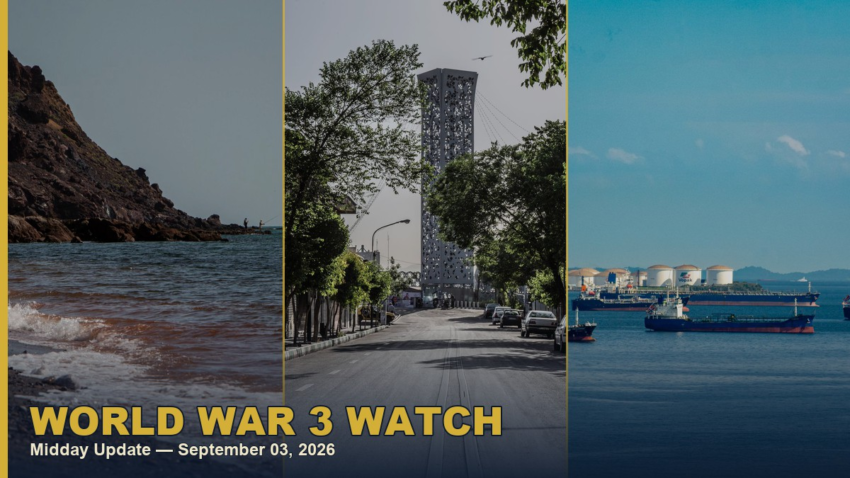
World War 3 Watch — Midday Update — September 03, 2026
- 40 ships, 18 million barrels: The U.S. military escorted 40 commercial vessels carrying 18 million barrels of oil through the Strait of Hormuz this week, a wartime high, while fending off drone waves and neutralizing anti-ship cruise missiles (Indian Express, 2026).
- Bases under fire: Iran struck U.S. positions at Kuwait’s Ahmad al-Jaber air base and the UAE’s Al Minhad air base on Thursday; Kuwait’s defense ministry called it a “blatant Iranian aggression” (The Guardian, 2026; Fox News, 2026).
- Civilian toll claim: Iran says a U.S. strike on a wedding in the southern city of Sirik killed 18 people on Tuesday night and has vowed to punish Washington (PennLive, 2026).
- Message war: President Trump called the latest U.S. strikes a “love tap” and assured Israel the fighting “won’t last long,” even as the exchange became the biggest since July (MSN, 2026a; MSN, 2026b).
- Financial front: Washington’s “economic D-day” sanctions campaign is now colliding with China, which vows to take necessary measures to protect its interests (The Guardian, 2026; NetEase, 2026, authors’ translation).
- Strait still strangled: Despite the wartime-high escort, Hormuz traffic remains far below prewar levels, and oil prices jumped again Thursday (The Guardian, 2026).
The Story So Far
Six months into a war that began just over six months ago, Thursday brought one of its most dangerous and contradictory days yet (Indian Express, 2026). The U.S. military ran an unprecedented 40-ship, 18-million-barrel convoy past Iranian fire, even as Iran’s missiles slammed into U.S. bases in Kuwait and the UAE (Indian Express, 2026; The Guardian, 2026).
The exchange now counts as the heaviest U.S.-Iran firefight since July (MSN, 2026a). Behind the explosions, a parallel economic war is tightening: Washington trumpeting an “economic D-day” sanctions push, Beijing publicly refusing to bend (The Guardian, 2026; NetEase, 2026, authors’ translation).
Oil prices jumped on Thursday because the two sides are trading strikes rather than deals (The Guardian, 2026). PennLive’s headline has already distilled the moment into two words: “We are stalled” (PennLive, 2026).
Video: OVERNIGHT: Iran UNLEASHES missile, drone attacks on Kuwait. Source: Fox News.
1. The Hormuz Gauntlet: 40 Ships, 18 Million Barrels, Under Fire
This week’s record transit began as a logistics problem with military stakes. Two U.S. officials told CNN that the military escorted 40 commercial vessels carrying 18 million barrels of oil through the Strait of Hormuz, a wartime high, while Iran and the United States exchanged a fresh round of strikes on Tuesday (Indian Express, 2026).
The convoy was not a peacetime cruise. U.S. forces drew on air, sea and space assets to keep hitting Iran’s ability to attack commercial shipping while simultaneously fending off waves of drone attacks (Indian Express, 2026). The escort also neutralized anti-ship cruise missiles along the way, one official said (Indian Express, 2026).
Context matters. Before the war began just over six months ago, roughly 20 million barrels a day moved through the strait — that was daily flow, not a single convoy’s cargo (Indian Express, 2026). The escorted ships carried 18 million barrels in total.
So despite President Trump’s repeated claims that he has opened the strait, The Guardian reports that traffic through the waterway remains far below prewar levels (The Guardian, 2026). A wartime-high escort is real military achievement; it is not yet a restored oil route.
Video: Oil Stabilizes As Trump Says Iran Strikes To Be Short | The Opening Trade 9/3/2026. Source: Bloomberg Television.
2. Iran’s Revenge Reaches Kuwait and the UAE
The week’s escalation has a clear trigger. On Sunday, U.S. forces hit Iranian rocket launchers on an island in the Strait of Hormuz, saying Tehran planned to use them to shoot mines into the waterway (The Guardian, 2026). By Thursday morning, Tehran answered at two of the most prominent U.S. air bases in the Gulf.
Iran’s military said it struck “the satellite communication systems, equipment depots and fighter aircraft hangars of the terrorist US army” at Ahmad al-Jaber air base in Kuwait, and attacked “the location of forces and radar systems of the child-killing US army” at Al Minhad air base in the UAE, using missiles and drones (The Guardian, 2026).
Those descriptions, carried by Iranian state television, were met on the receiving end by a cooler official tone. Kuwait’s defense ministry said on X that its air defenses intercepted the missile and drone attacks, calling it a “blatant Iranian aggression” (The Guardian, 2026). Fox News frames the same strikes as retaliation for U.S. hits on Iranian rocket launchers in the strait earlier in the week (Fox News, 2026).
The Gulf’s air-defense web is now being tested as a system. Bahrain and Jordan intercepted several Iranian air attacks on Wednesday, one day before Kuwait did the same (The Guardian, 2026). Iran is reaching these targets with a cheap, accurate weapon that can be launched within minutes and that The Guardian calls a “staple of Iranian strikes” — the Kheibar Shekan medium-range ballistic missile, with its solid-fuel motor (The Guardian, 2026).
Video: US-Iran War LIVE: US BOMBS Iran, Tehran STRIKES Back | Tehran Strikes U.S. Bases | Jordan | Bahrain. Source: WION.
3. ‘Love Tap’ vs. ‘Blatant Aggression’: The Message War
Washington and Tehran are narrating the same escalation in irreconcilable language. President Trump, in what MSN describes as a bizarre rant, labeled the new wave of U.S. bombings a “love tap” (MSN, 2026a). That same report notes the fighting now counts as the biggest exchange of fire with Iran since July (MSN, 2026a).
Trump separately assured Israel it need not worry about the latest escalation, predicting that the renewed fighting with Tehran “won’t last long” (MSN, 2026b).
Tehran’s framing could hardly differ more. Iran says U.S. attacks on Tuesday night killed 18 people, including a strike on a wedding ceremony in the southern city of Sirik, and has vowed to punish Washington (PennLive, 2026). The same coverage is headlined “‘We are stalled'” as energy prices spike (PennLive, 2026).
The gap between official claims and observable outcomes is widening. The Guardian reports “little evidence that the Trump administration is succeeding in advancing its nebulous war aims,” either on the battlefield or through mediation (The Guardian, 2026). Oil prices, already elevated ahead of U.S. midterm elections, jumped again Thursday after the Iranian strikes (The Guardian, 2026).
One country’s “love tap” is another’s “blatant aggression” — and, as Iran asserts, 18 dead at a wedding in Sirik (MSN, 2026a; The Guardian, 2026; PennLive, 2026). The gap in language is itself part of this war.
4. ‘Economic D-Day’ Meets China’s Wall
While missiles flew, Washington opened a second front. The Guardian notes that the Trump administration’s sanctions regime has been described as an “economic D-day” (The Guardian, 2026).
The English-language source set for this cycle supplies little beyond that label. The Chinese-language coverage of the same push, by contrast, is dense with operational detail.
A mainland self-media commentary hosted by NetEase describes the offensive as, in translation, “Operation Economic Outcast,” and lists its targets: Iranian oil buyers, shippers, financial intermediaries, and whole sectors including digital assets, technology, gold, aviation, and shipping (NetEase, 2026, authors’ translation).
Treasury Secretary Scott Bessent, the commentary reports, warned through CNBC that “no one is above U.S. sanctions,” adding: “If they assist transactions and become part of turning Iranian oil into funds, they will become targets” (NetEase, 2026, authors’ translation). In the Financial Times, the piece adds, Bessent called the campaign “an economic Normandy landing” and “the most significant financial offensive ever launched against an adversary” (NetEase, 2026, authors’ translation).
Trump, the commentary says, celebrated it as Iran’s “economic Normandy landing day” — the same D-Day metaphor The Guardian records in English (The Guardian, 2026; NetEase, 2026, authors’ translation).
The true target, in Beijing’s reading, is China. The commentary notes that China is Iran’s largest trading partner, takes the vast majority of Iran’s oil exports, and has already seen Hong Kong and mainland companies sanctioned under the label of “facilitating procurement for Iran” (NetEase, 2026, authors’ translation).
China’s Foreign Ministry spokesman, Lin Jian, responded that “sanctions and pressure do not help solve problems; they will only aggravate tensions and escalation, which is not in the interest of any party,” and that China will “take necessary measures to safeguard its legitimate rights and interests” (NetEase, 2026, authors’ translation).
The same commentary relays that Iran’s economy minister rejected Washington’s premise outright and pointed out that China and Russia have both refused to accept the measures (NetEase, 2026, authors’ translation). Lanzhou University scholar Zhu Yongbiao is quoted saying that with few other effective options, the U.S. is using secondary-sanction threats to “convert military strikes into extortion and blackmail” (NetEase, 2026, authors’ translation).
Even allied channels register that the squeeze could backfire. Israel’s defense chief warned that sanctions pressure could drive Tehran to more “extreme measures” (The Guardian, 2026).
5. Two Coverage Worlds: What Each Side’s Press Chooses
Read side by side, the English- and Chinese-language coverage of the same 48 hours describes two different wars. The English source set runs on combat reporting: the 40-ship escort, the Kuwait and UAE base strikes, the interceptions by three Gulf states, and the president’s “love tap” (Indian Express, 2026; The Guardian, 2026; MSN, 2026a).
The Chinese-language piece available for this cycle takes nearly the opposite route. The NetEase commentary does not mention the wartime-high convoy, Thursday’s base strikes, the Sirik wedding strike, or the 18 deaths Iran attributes to it (NetEase, 2026, authors’ translation). Its headline instead frames the story as a U.S. economic war, asking why China is the first to stand up against it (NetEase, 2026, authors’ translation).
Each side fills what the other omits. The NetEase commentary is the only source here carrying Bessent’s public threats, Lin Jian’s warning, the sanctioned Hong Kong and mainland companies, and Zhu Yongbiao’s analysis (NetEase, 2026, authors’ translation). The English sources are the only ones documenting where the missiles landed and how the oil is actually moving (The Guardian, 2026; Indian Express, 2026).
The two coverage worlds do converge on two points: oil prices and the U.S. midterm calendar. The Guardian notes prices have stayed “stubbornly elevated ahead of US midterm elections,” while the Chinese piece asks whether Washington is rushing to cover up its Iran failure before those same elections (The Guardian, 2026; NetEase, 2026, authors’ translation).
For a deeper look at how U.S., Israeli, Iranian, and BRICS outlets each narrate this conflict, see our narrative-comparison report on how each media ecosystem tells this war.
Is This Actually World War 3?
A real World War 3 would put the great powers’ armies against each other. What today’s sources show is a regional U.S.-Iran war in its sixth month, spreading geographically — Kuwait, the UAE, Bahrain, and Jordan are now intercepting or absorbing Iranian fire (The Guardian, 2026; Fox News, 2026).
The conflict still has a ceiling. China, Iran’s largest trade partner and oil buyer, is being pressured through sanctions and threats, not attacked militarily (NetEase, 2026, authors’ translation). The U.S. president is running wartime-high convoys while insisting the fighting “won’t last long” (Indian Express, 2026; MSN, 2026b).
The honest label for this phase is “regional war with global economic shockwaves.” It edges toward something bigger if Beijing’s sanctions clash hardens into retaliation, or if the Gulf’s air-defense net — tested in three countries in two days — fails somewhere catastrophic (The Guardian, 2026). Neither happened today. But the escort numbers and the missile salvos both say the distance to a wider war is narrowing, not growing.
What You Can Do Right Now
- Budget for energy volatility instead of just watching it: prices spiked Thursday and Hormuz traffic remains below prewar levels even after the wartime-high U.S. escort (The Guardian, 2026; Indian Express, 2026). For practical preparation advice, read our survival skills and preparedness guide.
- Read across languages and outlets before deciding what “happened” today. In this conflict, one country’s “love tap” is another’s “blatant aggression” — and each press ecosystem is selecting a different war to report (MSN, 2026a; The Guardian, 2026; NetEase, 2026, authors’ translation).
- Track primary statements from the Gulf defense ministries and the U.S. military rather than single headlines. The gap between official claims and observable outcomes is widening fastest on the oil question (The Guardian, 2026).
SUPPORT KEMETIC MINDS
Enjoying this coverage? Back the work and find every way to connect with us in one place.
Support the Page →Kemetic Minds Analysis
This roundup pulled directly from the day’s English- and Chinese-language wires side by side, because the gap between what each side chooses to report is often as informative as any single strike count. Treat the Key Takeaways above as the verified factual floor, and the framing differences noted in the sections above as the more interesting, harder-to-fake signal about where this war is actually headed next.
References
- Indianexpress. (2026, September 3). US escorts 40 oil ships through Hormuz as Iran attacks Gulf: Top updates. indianexpress.com
- Pennlive. (2026, September 3). ‘We are stalled’: Energy prices spike as Iran, U.S. trade strikes, not deals. pennlive.com
- MSN. (2026, September 3). Iran war live: Trump labels strikes a 'love tap' in bizarre rant. msn.com
- MSN. (2026, September 3). US Israel Iran war latest news: Will Trump protect Israel as Iran war escalates? US president says fighting with Tehran won't last long. msn.com
- Fox News. (2026, September 3). Iran retaliates against US by firing at Kuwait in 'blatant' aggression. foxnews.com
- The Guardian. (2026, September 3). Iran targets US bases as Israel warns sanctions could drive Tehran to ‘desperate steps’. theguardian.com
- 手机网易网. (2026, September 2). 美国又搞经济战!伊朗石油买家遭殃,中国为啥第一个站出来反对? [US Wages Economic War Again, Iran Oil Buyers Hit — Why Is China First to Oppose?]. 163.com
Investigative Methodology: This roundup is generated on a fixed schedule (noon and evening, America/Chicago) from live English- and Chinese-language wire sources. Every claim is grounded in fetched source text with an APA7 in-text citation; translated Chinese-language quotes are marked “authors’ translation.” Every video embed is verified to be a real, existing video via YouTube’s oEmbed endpoint before publication — none are written by the drafting model. No Wikipedia sources are used.
Stay Connected

Kemetic Minds Editorial Desk
Verified NewsroomPrimary-sourced investigative intelligence on civil rights, voting rights, federal policy, and consumer protection. Sourced from primary legal filings, government statistics, and direct field reporting.