
KEMETIC MINDS
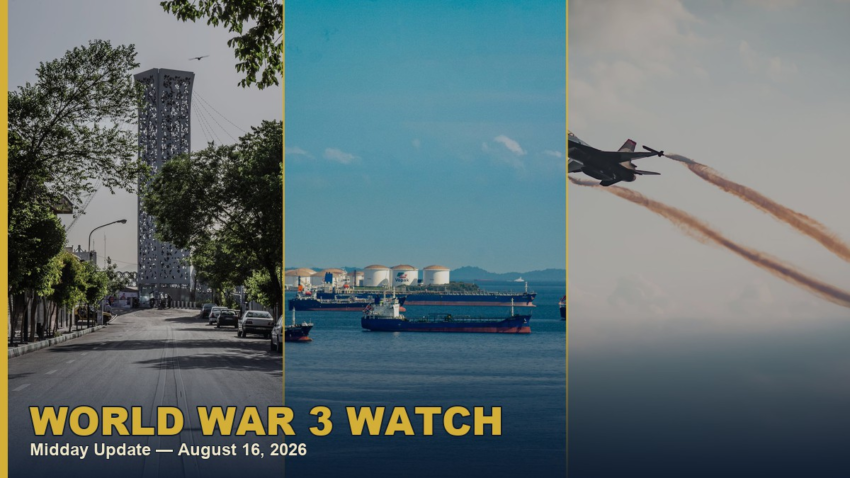
World War 3 Watch — Midday Update — August 16, 2026
- Israel’s Aug 15-16 strikes in southern Lebanon killed 11 people, including children — the deadliest day since the June ceasefire (The Straits Times, 2026).
- US Treasury Secretary Scott Bessent says Washington is preparing “unprecedented” economic measures against Iran, layered on an existing naval blockade (Firstpost, 2026).
- Iran and Oman are finalising a “shipping map” for the Strait of Hormuz in talks the US is not part of (The Straits Times, 2026).
- Turkish President Recep Tayyip Erdogan forced Israel and the United States to abandon a Mossad-CIA plan to send Kurdish fighters into Iran (AOL, 2026).
- Chinese media are framing Beijing’s mission to Iran around rare-earth potential, a strikingly different lens from the West’s sanctions-and-blockade coverage (NetEase, 2026, authors’ translation).
The Story So Far
The war is entering its most volatile 48 hours since the June ceasefire, with Israel killing 11 people in southern Lebanon on the eve of the Aug 17 expiration of the US-Iran truce (The Straits Times, 2026).
Negotiations between Washington and Tehran remain deadlocked, and control of the Strait of Hormuz sits at the center of the standoff (The Straits Times, 2026).
On the economic front, Treasury Secretary Scott Bessent is promising “unprecedented” measures to squeeze Tehran (Firstpost, 2026).
Turkish President Recep Tayyip Erdogan has quietly vetoed the war’s boldest covert plan — a Kurdish push into Iran (AOL, 2026).
For a side-by-side look at how each bloc frames these events, see our narrative-comparison report on how US, Israeli, Iranian, and BRICS media each tell this war.
Video: Bloomberg This Weekend | Meta on Trial, the Race To Replace Gov. DeSantis, and Pet Longevity. Source: Bloomberg Podcasts.
1. The Economic Front: Bessent’s ‘Unprecedented’ Squeeze
The Iran war is increasingly being fought beyond the battlefield; its new front is Iran’s economy (Firstpost, 2026).
Washington is betting that tougher sanctions, financial restrictions, and pressure on Iran’s oil trade can force Tehran to compromise (Firstpost, 2026).
Months into the conflict, the Trump administration is shifting greater weight onto oil restrictions, financial pressure, and a naval blockade of Iranian ports (Firstpost, 2026).
Treasury Secretary Scott Bessent told Reuters that Washington is preparing measures more severe than previous sanctions campaigns — what he described as unprecedented (Firstpost, 2026).
The strategy pairs financial isolation with pressure on the physical movement of Iran’s oil and other goods (Firstpost, 2026).
The US, the UN, and the EU have already applied sanctions, trade embargoes, and asset freezes for decades over Iran’s nuclear program and human rights violations (MSN, 2026a).
Analysts warn the squeeze could deepen pressure on Tehran while raising risks for oil markets and China ties (MSN, 2026b).
Video: WAR OF WORDS: Iran FIRES BACK at Trump’s Hormuz statement. Source: Fox News.
2. Hormuz: The Shipping Map and the Deadlocked Talks
Control of the Strait of Hormuz — through which a fifth of the world’s oil and gas transited before the war — is central to the stalled US-Iran negotiations (The Straits Times, 2026).
Iran and Oman appear to be finalising a “shipping map” as part of a broader agreement on how to govern traffic through the strait (The Straits Times, 2026).
The United States is not involved in those talks, and is unlikely to agree to any terms that do not restore free passage through the waterway (The Straits Times, 2026).
Sanctions, the reporting notes, have not stopped Iran’s nuclear ambitions or its control over the strait (The Straits Times, 2026).
All of this lands with the nominal end of the June ceasefire — Aug 17 — now less than 24 hours away (The Straits Times, 2026).
3. Lebanon: The Deadliest Day Since June
Israel said it killed Abu Hassan Alaa, a senior Hezbollah commander, in southern Lebanon on Aug 15 (The Straits Times, 2026).
The strike on the village of Deir al-Zahrani killed 11 people, including children — the deadliest toll since the sides agreed to a ceasefire at the beginning of June (The Straits Times, 2026).
Israeli Prime Minister Benjamin Netanyahu called the strikes retaliation for a Hezbollah attack that injured three soldiers early on Aug 15 (The Straits Times, 2026).
Israel said on Aug 16 it would strike the Iranian proxy group again should it feel threatened (The Straits Times, 2026).
Iran has long argued that Israeli attacks on Lebanon violate the ceasefire agreement, and the peripheral fighting may further complicate deadlocked US-Iran negotiations (The Straits Times, 2026).
4. The Kurdish Gambit Erdogan Killed
On Feb 11, Israeli Prime Minister Benjamin Netanyahu sat opposite Donald Trump in the White House Situation Room and laid out the conditions under which Iran’s regime could be toppled (AOL, 2026).
“He told Trump that if we are able to do certain things, we have a chance of creating conditions where the Iranian people could take their fate into their own hands,” a senior Israeli official in the room told The Telegraph (AOL, 2026).
Part of the pitch was a Mossad-developed mission, discussed with the CIA, to send thousands of Kurdish fighters under American air cover across the Iraqi Kurdistan border to fuel an uprising (AOL, 2026).
One man derailed it: Recep Tayyip Erdogan, unhappy with the prospect of armed Kurdish forces, intervened and forced Israel and the United States to pull the plug (AOL, 2026).
“Several of these conditions did not materialise because of reasons that I won’t get into — either operational failure or decisions that were made,” the official added (AOL, 2026).
Erdogan told the US president he would not tolerate Kurdish independence anywhere in the region, reflecting more than 40 years of Turkish fighting against the PKK at a cost of tens of thousands of lives (AOL, 2026).
5. The Chinese Lens: Rare Earth Beneath the Oil
While Western outlets concentrate on sanctions and blockades (Firstpost, 2026; MSN, 2026b), Chinese media are telling a different story about Iran.
NetEase’s lead report asks whether “China sending people to Iran definitely carries an important mission” — and whether the oil power’s underground could “also hide a large rare-earth mine” (NetEase, 2026, authors’ translation).
The framing shifts the center of gravity from bombs and blockades to resources and Beijing’s diplomatic leverage in Tehran.
A related-video rail on the same page highlights a clip described as “inhumane — the US military dropped phosphorus bombs on Iran; how great is the harm?” (NetEase, 2026, authors’ translation).
Chinese coverage is thus keeping its audience focused on the human cost of US strikes and the resource prizes under Iranian soil — a mirror image of the US economic-war narrative.
Is This Actually World War 3?
Today’s sources do not show a world war in the classic sense — no direct US-Iran or US-China combat is reported anywhere in them.
What they show is a regional conflict — Iran, Lebanon, and the Strait of Hormuz — fought with air strikes, blockades, sanctions, and covert operations that never launched (The Straits Times, 2026; Firstpost, 2026; AOL, 2026).
But the economic weapons are global in their reach: the squeeze on Tehran is already raising risks for oil markets and China ties (MSN, 2026b).
The immediate tripwire is the Aug 17 ceasefire expiration, while Iran and Oman’s parallel “shipping map” shows Tehran building an alternative order in the strait without the United States (The Straits Times, 2026).
The honest label is a regional war with global shockwaves — and a diplomatic clock that runs out tomorrow.
What You Can Do Right Now
- Watch the Aug 17 ceasefire deadline: if it lapses, expect Hormuz shipping disruptions to move oil markets quickly (The Straits Times, 2026).
- Before the next escalation cycle, review your household basics — water, food, medicine, and communications — with our survival skills and preparedness guide.
- Read across media blocs, not just one: compare Western sanctions coverage with China’s resource-focused framing in our narrative-comparison report on how US, Israeli, Iranian, and BRICS media each tell this war.
SUPPORT KEMETIC MINDS
Enjoying this coverage? Back the work and find every way to connect with us in one place.
Support the Page →Kemetic Minds Analysis
This roundup pulled directly from the day’s English- and Chinese-language wires side by side, because the gap between what each side chooses to report is often as informative as any single strike count. Treat the Key Takeaways above as the verified factual floor, and the framing differences noted in the sections above as the more interesting, harder-to-fake signal about where this war is actually headed next.
References
- Firstpost. (2026, August 16). Iran war shifts to the economic front as US and Tehran battle for the upper hand. firstpost.com
- Straitstimes. (2026, August 16). Israel strikes Lebanon as end of US-Iran ceasefire looms. straitstimes.com
- AOL. (2026, August 16). Erdogan blocked Kurdish forces from entering Iran war. aol.com
- MSN. (2026, August 16). What are Trump's options as he seeks to pile more economic pressure on Iran?. msn.com
- and at what cost?. (2026, August 16). What can Trump do to squeeze Iran even harder. msn.com
- 手机网易网. (2026, August 16). 中国派人去伊朗肯定有重任,石油大国地下还藏了稀土大矿? [China's envoy to Iran likely has a significant mission, as the oil-rich nation may also be hiding large rare earth deposits.]. 163.com
Investigative Methodology: This roundup is generated on a fixed schedule (noon and evening, America/Chicago) from live English- and Chinese-language wire sources. Every claim is grounded in fetched source text with an APA7 in-text citation; translated Chinese-language quotes are marked “authors’ translation.” Every video embed is verified to be a real, existing video via YouTube’s oEmbed endpoint before publication — none are written by the drafting model. No Wikipedia sources are used.
Stay Connected

Kemetic Minds Editorial Desk
Verified NewsroomPrimary-sourced investigative intelligence on civil rights, voting rights, federal policy, and consumer protection. Sourced from primary legal filings, government statistics, and direct field reporting.