
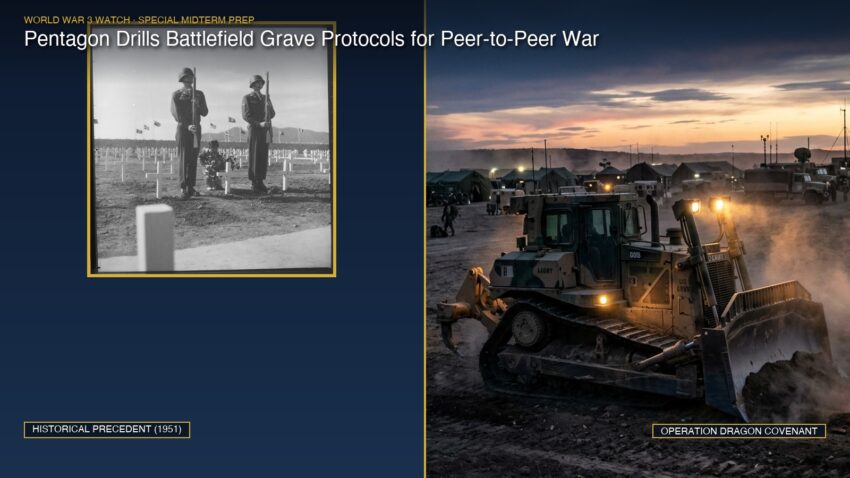
World War 3 Watch · Special Report · Midterm Defense Audit
Strategic Summary & Key FindingsAs the nation approaches the 2026 midterm elections amid escalating global conflicts in Eastern Europe, the Middle East, and the Western Pacific, the U.S. Army has quietly conducted its first large-scale battlefield temporary burial exercises since the Korean War. Dubbed Operation Dragon Covenant, the drills mark a sober doctrinal transition: moving away from two decades of low-intensity counterinsurgency and preparing for high-attrition, peer-to-peer warfare where total air supremacy and rapid casualty evacuation can no longer be guaranteed.
- The Exercise (Operation Dragon Covenant): Conducted at Fort Liberty, North Carolina, by the 3rd Corps Sustainment Command, the 20th Engineer Brigade, preventive medicine teams, and Unit Ministry Teams (chaplains) to validate mass temporary interment protocols under combat conditions.
- Engineering Metrics & Throughput: Utilizing armored D6 bulldozers and hydraulic excavators, engineers proved capable of digging trenches holding 20 remains in 1 hour and 15 minutes, establishing planning models for a single engineer company to process up to 2,400 fallen personnel every 24 hours.
- First Drill Since 1953: The United States military has not rehearsed or executed mass battlefield field burials since the Korean War; throughout the Global War on Terrorism, uncontested airspace allowed immediate rotary-wing evacuation directly to Dover Air Force Base.
- Temporary vs. Permanent Interment: Official military doctrine stresses that these procedures are strictly temporary, employing GPS coordinates, soil displacement physics, and airtight remains preservation to ensure complete forensic identification and eventual repatriation to American families.
- Midterm Defense Policy Stakes: The drills highlight the stark realities of Large-Scale Combat Operations (LSCO), providing critical empirical context for voters and lawmakers evaluating defense appropriations, industrial base resilience, and overseas war powers.
| Operational Dimension | Counterinsurgency Era (GWOT: 2001–2021) | Large-Scale Combat Operations (LSCO / Peer War) |
|---|---|---|
| Air Superiority & Evacuation | Uncontested airspace; guaranteed “Golden Hour” helicopter medical evacuation. | Highly contested anti-access/area-denial (A2/AD) airspace; flights severely constrained.[1] |
| Casualty Logistics Model | Immediate transfer from forward operating base to regional hospital, then Dover AFB. | Prolonged field care; forward temporary battlefield interment required during supply blockades.[2] |
| Fatality Throughput Demands | Low-to-moderate daily counts handled by specialized Mortuary Affairs collection points. | Engineered capacity for up to 2,400 remains per day per combat engineer company.[1] |
| Burial & Remains Protocols | Zero battlefield burials; 100% immediate individual return to next-of-kin. | Field interment in engineered trenches; GPS-logged, DNA-cataloged for post-war repatriation.[1] |
1. The Doctrinal Shift: Preparing for Uncontested Airspace Loss
For more than two decades following September 11, 2001, the American public grew accustomed to a specific model of warfare. In Iraq, Afghanistan, and counter-terror operations worldwide, the United States exercised absolute air supremacy. Wounded soldiers were retrieved by dedicated medical evacuation helicopters within the critical “Golden Hour,” and the remains of fallen service members were consistently returned to their families through Dover Air Force Base within days. Battlefield burials were considered a relic of the twentieth century.
However, comprehensive military reporting published by the Army Times and official releases from the Defense Visual Information Distribution Service (DVIDS) reveal that Pentagon planners are now preparing for a radically different reality.[1],[2] In a high-intensity conflict against a near-peer adversary equipped with modern integrated air defense systems, electronic warfare jamming, and long-range precision fires, air dominance cannot be presumed. Rotary-wing aircraft will face lethal surface-to-air missile threats, communications grids will experience blackouts, and forward logistics bases will be actively targeted.
Under these conditions, combat units will face severe isolation. When medical evacuation flights cannot fly and refrigerated transport is severed, the historical necessity of forward temporary field interment reemerges as an unavoidable operational requirement.[1]
2. Inside Operation Dragon Covenant: Heavy Machinery and Soil Physics
Phase II of Operation Dragon Covenant took place near the St. Mere Eglise Drop Zone at Fort Liberty, North Carolina.[1] The exercise brought together an interdisciplinary military cohort: combat engineers from the 20th Engineer Brigade, logistics commanders from the 3rd Corps Sustainment Command, preventive medicine officers, and military chaplains from Unit Ministry Teams.
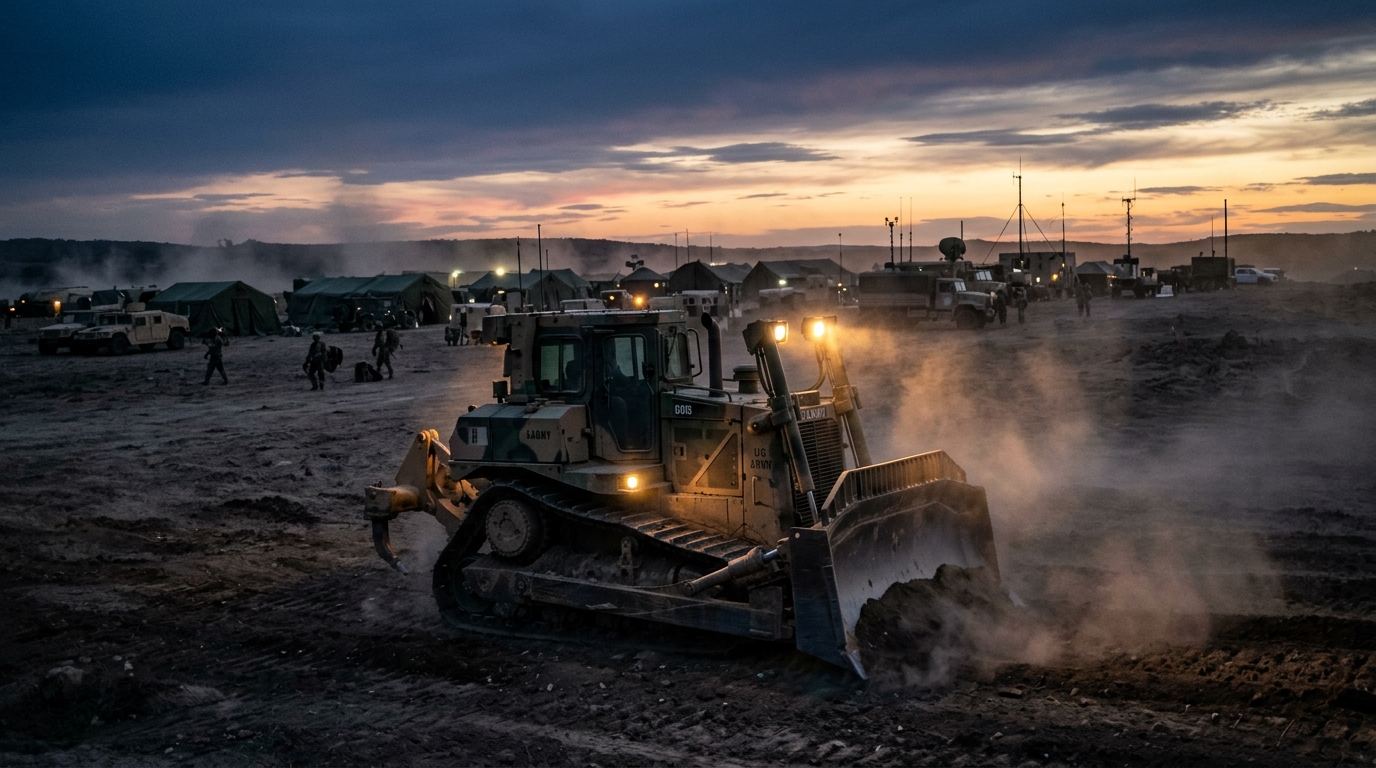
Rather than manual entrenchment, engineers deployed heavy earthmoving equipment, including armored D6 bulldozers and hydraulic excavators. The primary engineering challenge was evaluating soil displacement physics. Operators tested how displaced earth from heavy machinery behaves when backfilled into trenches holding simulated remains—constructed from weighted skeletal models and sealed water containers inside standard military burial bags. The objective was verifying that gravitational backfill would completely seal interments without crushing remains or disrupting forensic identifiers.[1]
The time-and-motion data compiled during the drill was stark: a single D6 bulldozer operator excavated a trench accommodating 20 remains in one hour and fifteen minutes. Military planners calculated that a single combat engineer company operating continuously over a 24-hour cycle could prepare and seal temporary interment plots for up to 2,400 casualties per day.[1],[2]
3. The Korean War Precedent: Why Mass Field Burials Ceased for 70 Years
To understand the gravity of Operation Dragon Covenant, one must examine military history. The United States military has not conducted large-scale temporary battlefield interments since the Korean War (1950–1953). During the brutal winter retreats from the Chosin Reservoir and the fluid frontlines along the 38th Parallel, American forces were forced to establish temporary cemetery plots across the Korean peninsula.
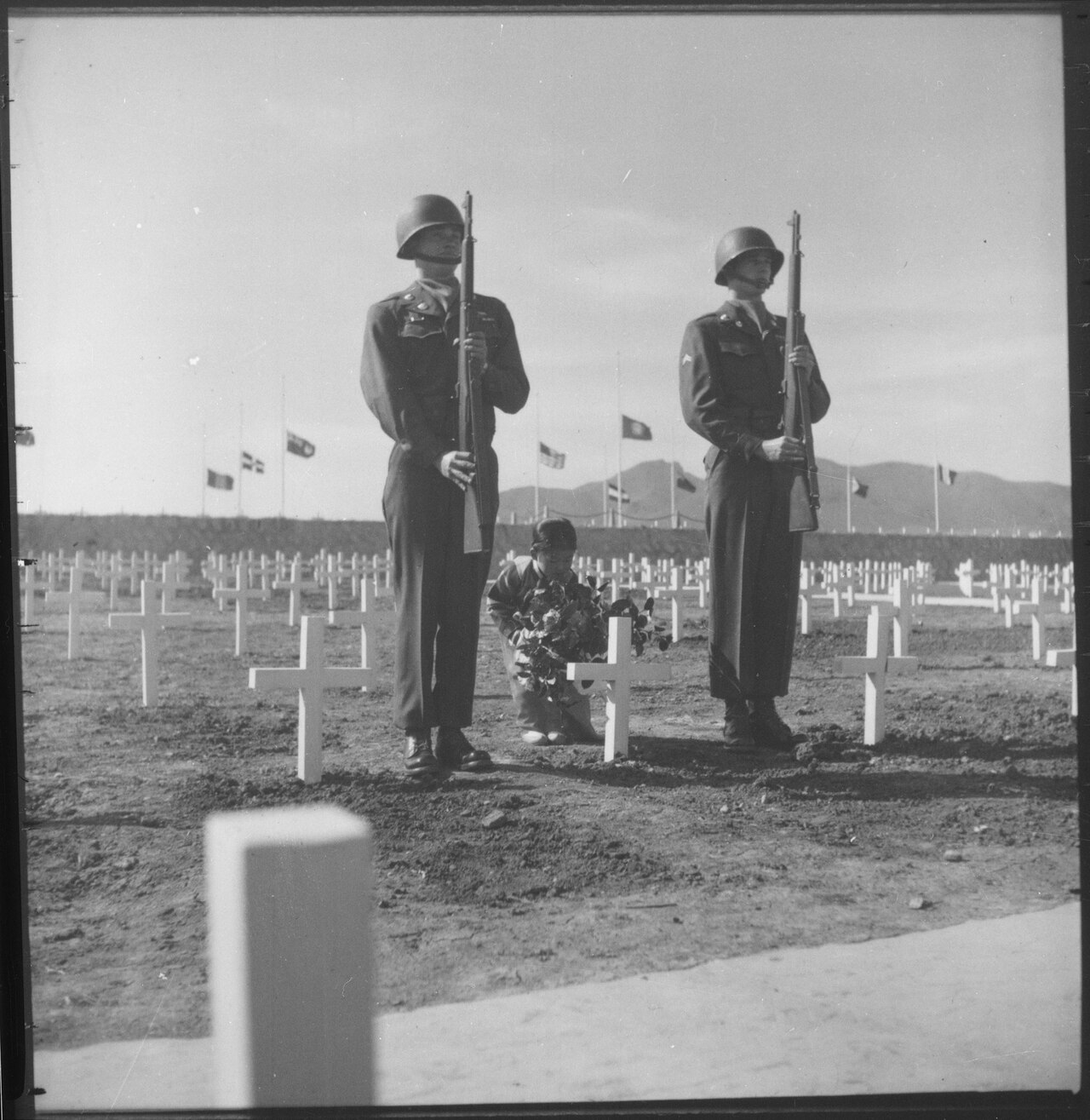
Following the 1953 Korean Armistice, the U.S. military executed Operation Glory, meticulously unearthing and identifying remains from temporary field plots for final burial in national cemeteries or return to loved ones. In subsequent conflicts—from the Vietnam War to Operation Desert Storm and the post-9/11 counterinsurgencies—improvements in transport aviation, battlefield refrigeration, and air dominance enabled the Pentagon to eliminate temporary field burials entirely. Operation Dragon Covenant confirms that military leaders recognize this 70-year luxury may vanish in a multi-front conflict.
4. Forensic Safeguards: DNA Tagging, GPS Mapping, and Repatriation Guarantees
A critical factual distinction must be drawn: Operation Dragon Covenant does not practice anonymous or permanent “mass graves.” Military doctrine explicitly defines these operations as temporary battlefield interments governed by strict scientific, legal, and spiritual protocols.[1]
The exercises tested multiple forensic safeguards:
- Sub-Meter GPS Geolocation: Every trench and individual placement within it is mapped using redundant digital surveying tools, ensuring precise coordinates are permanently recorded in central Defense Department databases.
- Forensic DNA and Biological Isolation: Preventive medicine specialists evaluated environmental barriers to prevent biological contamination, soil erosion, or wildlife disturbance, ensuring DNA viability remains intact for post-conflict laboratory identification.
- Religious Consecration: The inclusion of Unit Ministry Teams marked the first time in decades that military chaplains practiced rapid field consecration, ensuring that religious rites across faith traditions are observed even during relentless 24-hour combat operations.[1]
5. Midterm Geopolitical Implications & Domestic Defense Realities
The timing of these exercises carries profound implications as the United States navigates the 2026 midterm election season. While political campaigns frequently engage in surface-level rhetoric regarding foreign policy, the Pentagon's internal training schedules reflect unvarnished assessments of global flashpoints.
From the ongoing conflict in Ukraine and expanding tensions across the Persian Gulf to war games simulating contested straits in the Indo-Pacific, defense planners are budgeting for attrition levels unseen in three generations. In Congress, the upcoming debates over the National Defense Authorization Act (NDAA) will confront difficult questions regarding industrial manufacturing capacity, draft registration modernization, stockpiles of critical munitions, and domestic emergency preparedness.
6. Kemetic Minds Strategic Analysis & Emergency Readiness Baseline
STRATEGIC AUDIT
The reality that the U.S. military is actively testing 2,400-casualty-per-day earthmoving protocols should serve as a sobering baseline for the American public. Defense preparedness cannot be viewed as abstract posturing; it reflects hard operational planning for high-intensity crises. Kemetic Minds highlights three vital takeaways for domestic resilience:
Citizens must move beyond the misconception that future major conflicts will be bloodless cyber engagements. The military's own exercises acknowledge that contested peer warfare involves staggering physical casualties and logistical isolation.
During midterm debates, voters must scrutinize candidates on foreign policy realism, diplomatic de-escalation, and defense transparency rather than purely partisan soundbites.
Global supply interdictions and national security emergencies quickly reverberate domestically across energy, fuel, and food networks. Maintaining household emergency readiness and community communication networks remains essential.
References
- Defense Visual Information Distribution Service (DVIDS). Army tests battlefield temporary interment to validate remains preservation and future repatriation. Department of Defense. ↩
- Army Times. Army practices digging temporary battlefield graves for first time since Korean War. ↩
- National Archives and Records Administration (NARA). A Korean girl places a wreath of flowers on the grave of an American soldier at Tang-gok, Korea, 1951. Record ID 530634. ↩
- Defense One. Divisions, Corps Replace Brigades as Army’s Wartime Formations of Choice for Large-Scale Combat Operations. ↩
- War on the Rocks. Large-Scale Combat Operations Will Bring New Medical Ethics Challenges. ↩
Investigative telemetry note: Sourced directly from official Department of Defense records (DVIDS), verified reporting by Army Times, and National Archives historical documentation audited by Kemetic Minds.

Kemetic Minds Editorial Desk
Verified NewsroomPrimary-sourced investigative intelligence on civil rights, voting rights, federal policy, and consumer protection. Sourced from primary legal filings, government statistics, and direct field reporting.